

A perfect square is a whole number that comes from multiplying an integer by itself, and it always produces a square root that lands on another whole number with no decimal left behind. Numbers like 4, 9, 16 and 25 fall into this category simply because you can trace each one back to an integer squared. This single rule sits at the core of the perfect sDquare meaning, no matter how the question gets framed.
Yet students still stumble over this topic constantly, mixing it up with prime numbers, factor counts and square roots that never quite resolve cleanly. One wrong assumption here can cost valuable seconds on a timed GMAT question or a basic math test. This guide breaks the entire concept down step by step, so identifying a perfect square stops feeling like guesswork and starts feeling automatic.
What Is A Perfect Square
A perfect square is any whole number that you get by multiplying an integer by itself. In other words, if you take the square root of the number and land on a clean integer with no decimal, that number qualifies as a perfect square.
For example, 25 is a perfect square because 5 multiplied by 5 gives 25, and the square root of 25 is exactly 5. Similarly, 16, 9, 36 and 81 are all perfect squares since their square roots come out as whole numbers.
Read Also: 40% off $12.99 → $7.79 (save $5.20) | Percent-off Calculator
What Is Perfect Square Number
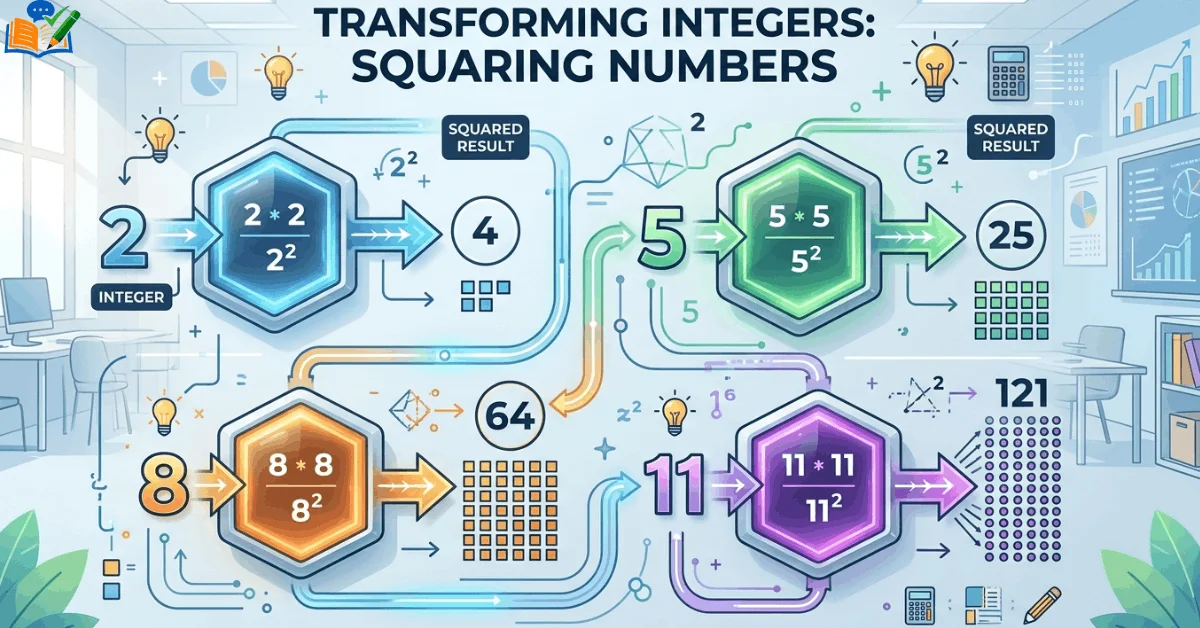
A perfect square number simply refers to the result you get after squaring an integer. Squaring a number means multiplying it by itself once. So when someone asks what a perfect square number is, they are really asking which numbers appear when you square 1, 2, 3, 4 and so on.
Here is a quick perfect square chart showing the first several results:
| Integer | Square of Number |
| 1 | 1 |
| 2 | 4 |
| 3 | 9 |
| 4 | 16 |
| 5 | 25 |
| 6 | 36 |
| 7 | 49 |
| 8 | 64 |
| 9 | 81 |
| 10 | 100 |
First 20 Perfect Squares
For quick reference during exam prep, here is the perfect square list from 1 to 20:
1, 4, 9, 16, 25, 36, 49, 64, 81, 100, 121, 144, 169, 196, 225, 256, 289, 324, 361, 400
Keeping this list of square numbers 1 to 100 memorized saves valuable time on quantitative aptitude sections, especially in GMAT quant and other number properties questions.
Perfect Square Formula
The perfect square formula answers what is the perfect square in the simplest mathematical form possible. It states that n² equals n multiplied by n, where n stands for any integer. This single line covers the entire perfect square meaning because it shows exactly how a starting number turns into its squared result.
This formula also extends into algebra through the perfect square trinomial pattern, written as a² + 2ab + b², which factors neatly into (a + b)². For instance, the expression x² + 2x + 1 follows this same rule and simplifies down to x + 1 once you take its square root. Recognizing this formula early makes solving a perfect square question far quicker during timed practice.
Perfect Squares 1 100
Perfect squares 1 100 refers to the complete set of squared values that fall between 1 and 100. This range gives learners a manageable starting point before tackling larger numbers, since it covers only ten total entries. Working through this shorter list first builds the confidence needed to spot a perfect square number instantly.
The ten values are 1, 4, 9, 16, 25, 36, 49, 64, 81 and 100. Each one comes from squaring the integers 1 through 10 in order, which makes the pattern easy to memorize. Once a student can recite this range without hesitation, identifying what is perfect square number becomes second nature during exam pressure.
Perfect Square Game

A perfect square game turns repetitive memorization into an interactive exercise that reinforces number recognition. These games usually present a mixed set of numbers and ask the player to sort out which ones qualify and which do not. Practicing this way keeps the perfect square meaning fresh without feeling like a dull drilling session.
Common formats include timed quizzes, flashcard matching and grid based puzzles where students click every square number hidden among decoys. Many GMAT prep platforms build similar drills into their number properties sections because speed matters as much as accuracy. Regular practice through this format sharpens the instinct needed to answer what is a perfect square within seconds.
Perfect Square Numbers
Perfect square numbers form a specific subset of integers that result from squaring another whole number. This subset follows a strict rule, meaning every entry must trace back to some integer multiplied by itself. Understanding this subset clears up most of the confusion around perfect square meaning that beginners run into.
Numbers like 4, 25, 64 and 121 all belong to this group since they come from squaring 2, 5, 8 and 11 respectively. Numbers such as 12 or 20 fall outside this group because no integer squared produces them exactly. This distinction is exactly what separates a genuine perfect square from an ordinary integer.
Perfect Square Roots
Perfect square roots describe the whole number you land on after taking the square root of a perfect square. Every perfect square carries this property, since its root always resolves cleanly without leaving a decimal behind. This clean resolution is the main test used to confirm whether a number truly is a perfect square.
For example, the square root of 144 is 12, and the square root of 225 is 15, both landing on exact integers. Compare this with a number like 50, whose square root sits between 7 and 8 and never settles into a whole value. That contrast makes perfect square roots one of the fastest checks available during quantitative reasoning problems.
Perfect Square Examples
Perfect square examples give learners a concrete way to internalize an otherwise abstract rule. Seeing actual numbers next to their squared origin makes the concept click faster than reading a definition alone. This approach also reinforces what is the perfect square through repetition rather than memorization.
A few reliable examples include 3 squared giving 9, 6 squared giving 36 and 9 squared giving 81. Larger examples like 15 squared giving 225 or 20 squared giving 400 show the same pattern holding steady at bigger scales. Working through examples like these regularly turns the perfect square meaning into an instinct rather than a memorized fact.
Perfect Squares 1 10000
Perfect squares 1 10000 covers every squared value up to the hundredth integer, since 100 squared equals exactly 10000. This wider range becomes useful once basic recognition skills are solid and a learner wants to test recall across a larger span. It also mirrors the type of number properties challenge that shows up in advanced quantitative sections.
Within this range, the perfect squares increase steadily, moving from 1 all the way up through values like 2500, 6400 and 9801 before reaching 10000 itself. Practicing recall across this full span helps confirm whether a student truly understands what is perfect square number or has only memorized the smaller, more common list. This extended range also builds stronger intuition for estimating square roots of unfamiliar numbers.
Perfect Square Numbers From 1 To 1000
Perfect square numbers from 1 to 1000 include every squared value that stays below the one thousand mark, ending with 31 squared at 961 since 32 squared already exceeds it. This range sits comfortably between the smaller 1 to 100 list and the much larger 1 to 10000 range, making it a solid middle step for practice. It also reflects the scale of numbers most commonly tested in GMAT quant and similar number properties questions.
The sequence moves through familiar values like 100, 225, 400 and 625 before closing out near 961. Reviewing this full range helps confirm a lasting grasp of the perfect square meaning across three digit numbers, not just the smaller single digit examples covered earlier. This middle range often becomes the practical ceiling most students need for real exam scenarios.
Is 1 A Perfect Square Or Not
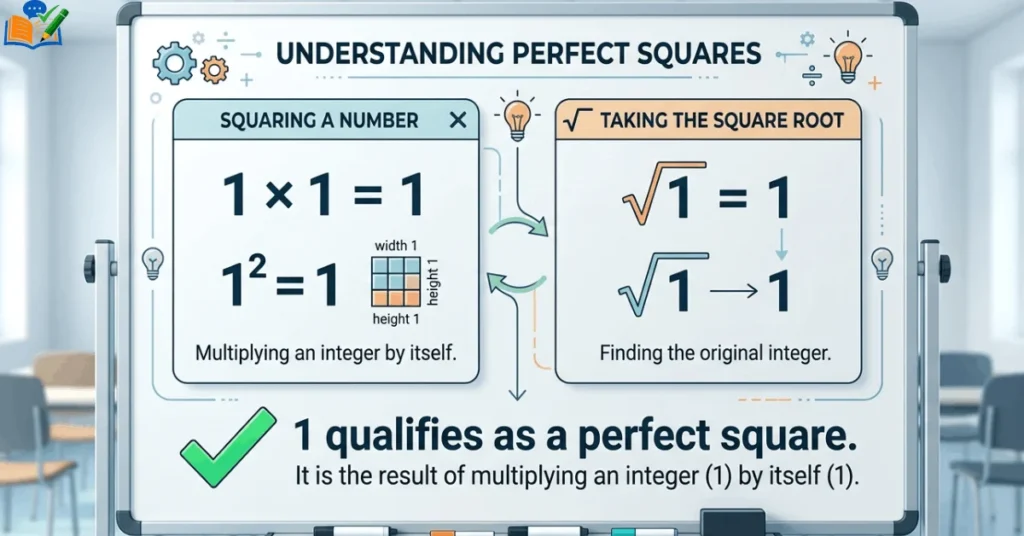
Yes, 1 counts as a perfect square. Since 1 × 1 equals 1, and the square root of 1 is exactly 1, it satisfies the definition completely. Many learners skip over this because it feels too simple, but 1 is technically the first entry in every perfect square list.
How To Check If A Number Is A Perfect Square
The fastest method uses a square root calculator or manual estimation. Take the square root of the number in question. If the result is a rational number with no decimal component, the original number is a perfect square. If the square root produces an irrational square root, meaning it never terminates or repeats, the number is a non perfect square.
Take 81 as an example. Its square root is 9, a clean whole number, so 81 qualifies. Now take 80. Its square root falls between 8 and 9 and never resolves into a whole number, so 80 is a non perfect square.
Is 49 A Perfect Square
Yes. The square root of 49 is 7, and 7 is an integer, which confirms 49 as a perfect square.
The Factor Connection: Why Some Numbers Behave Differently
This is where a lot of the confusion on forums begins. Students often notice that most numbers have an even number of distinct factors, while a small group of numbers behave differently.
Take the number 10. Its factor pairs are 1 with 10, and 2 with 5. That gives four total factors, an even count. This pairing pattern holds true for most integers because every factor naturally pairs with another factor to produce the original number.
Odd And Even Perfect Squares In Terms Of Factors
Perfect squares break the usual pairing pattern. Since a perfect square has a square root that pairs with itself, that particular factor does not get counted twice. This shrinks the total factor count down to an odd number.Look at 25. Its factors are 1, 5 and 25, a total of three, an odd count, because 5 multiplied by itself produces 25 and the 5 does not need a separate pairing partner.The same applies to 49.
Its factors are 1, 7 and 49, again three factors, again odd.This gives us a reliable rule in number theory: if a number has an odd number of distinct factors, that number must be a perfect square. And the reverse holds too. Every perfect square will always show an odd factor count.
Distinct Factors Versus Repeated Factors
A common mix up happens around prime factorization. When you break 49 down through factorization, you get 7 multiplied by 7. It may look like two separate sevens, but when listing distinct factors, you count 7 only once. The full factor list for 49 stays at three entries: 1, 7 and 49.
Understanding distinct factors this way avoids the trap of thinking a perfect square should have an even count just because its prime factorization repeats a value.
Why Exactly Three Factors Points To A Prime Square
Every integer greater than 1 automatically has at least two factors, namely 1 and itself. For a number to end up with exactly three factors total, it needs exactly one additional factor beyond those two. The only situation that produces this outcome is when the number is the square of a prime number.
Take 6 and 10 as counter examples. Neither is the square of a prime, so neither shows exactly three factors. The number 6 has four factors: 1, 2, 3 and 6. The number 10, as shown earlier, also has four. This confirms why squares of primes stand apart from other integers with similar looking factor patterns.
Perfect Square Versus Perfect Cube
While a perfect square comes from multiplying an integer by itself twice, a perfect square vs perfect cube comparison highlights a different power of 2 versus a power of 3. A perfect cube results from multiplying an integer by itself three times, such as 2 × 2 × 2 giving 8. Both concepts rely on the same exponent logic but differ in how many times the base number repeats in the multiplication.
Sum Of Squares And Difference Of Squares
Two additional identities show up often in algebra and quantitative aptitude:Sum of squares refers to adding two or more squared terms together, such as a² + b².
Difference of squares follows a factorable pattern: a² minus b² always breaks down into (a + b)(a − b). This algebraic identity appears frequently in GMAT quant problems because it simplifies expressions quickly without needing a full expansion.
Rational Versus Irrational Square Roots
Every perfect square produces a rational number square root, since the result is always a clean integer. Numbers that are not perfect squares produce an irrational square root instead, meaning the decimal value continues indefinitely without a repeating pattern. This distinction helps quickly separate perfect squares from ordinary integers during quantitative reasoning practice.
Quick Divisibility And Pattern Tricks
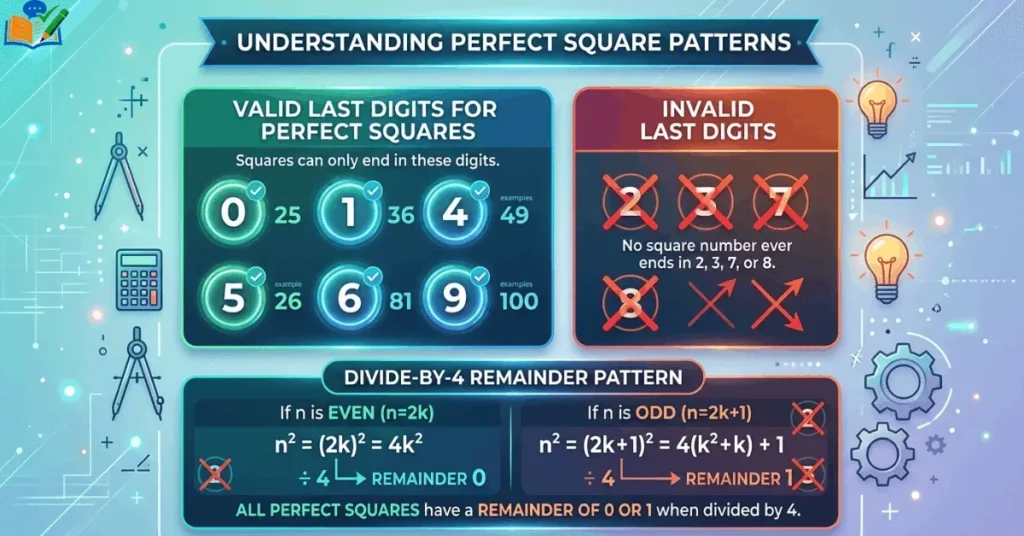
Recognizing a square number pattern speeds up mental math significantly. A few shortcuts worth remembering:
Perfect squares always end in 0, 1, 4, 5, 6 or 9. They never end in 2, 3, 7 or 8.Every perfect square is either divisible by 4 or leaves a remainder of 1 when divided by 4.These divisibility rules help eliminate wrong answer choices fast during timed exams.
Perfect Square Trick For GMAT And Competitive Exams
For GMAT number properties questions, the odd factor rule discussed above becomes a genuine shortcut. Whenever a data sufficiency or problem solving question mentions a number having an odd number of“ factors, you can immediately conclude the number is a perfect square, without manually listing its factors. This single trick saves time across multiple quantitative aptitude questions built around number theory and factorization.
Frequently Asked Questions
What is a perfect square and examples?
A perfect square is a number you get by multiplying an integer by itself, and common examples include 4, 9, 16 and 25.
How do you identify a perfect square?
Take the square root of the number, and if it lands on a whole number with no decimal, the number is a perfect square.
Is 7 a perfect square?
No, the square root of 7 falls between 2 and 3 and never resolves into a whole number.
Is √4 a perfect square?
Yes, since √4 equals 2, a clean whole number, which confirms that 4 is a perfect square.
What is √a + √b? √a + √b?
Simply adds two separate square root values together, and it does not simplify into √(a + b) unless one of the numbers is zero.
Conculsion:
A perfect square stops feeling confusing once you connect the square root test with the factor pattern behind it. Every example in this guide, from small numbers like 4 and 9 to larger ones like 400 and 961, follows the exact same logic without a single exception. That consistency is what makes a perfect square one of the most predictable concepts in basic number theory, whether you meet it in a classroom exercise or a timed GMAT question.
The real value shows up once you stop treating a perfect square as an isolated fact and start using it as a shortcut. Recognizing the odd factor rule, spotting the last digit pattern, and recalling the 1 to 100 range instantly all save time during actual problem solving. Revisit the examples, work through the FAQs above, and test yourself on numbers outside this list until identifying a perfect square becomes an instinct rather than a calculation.
