

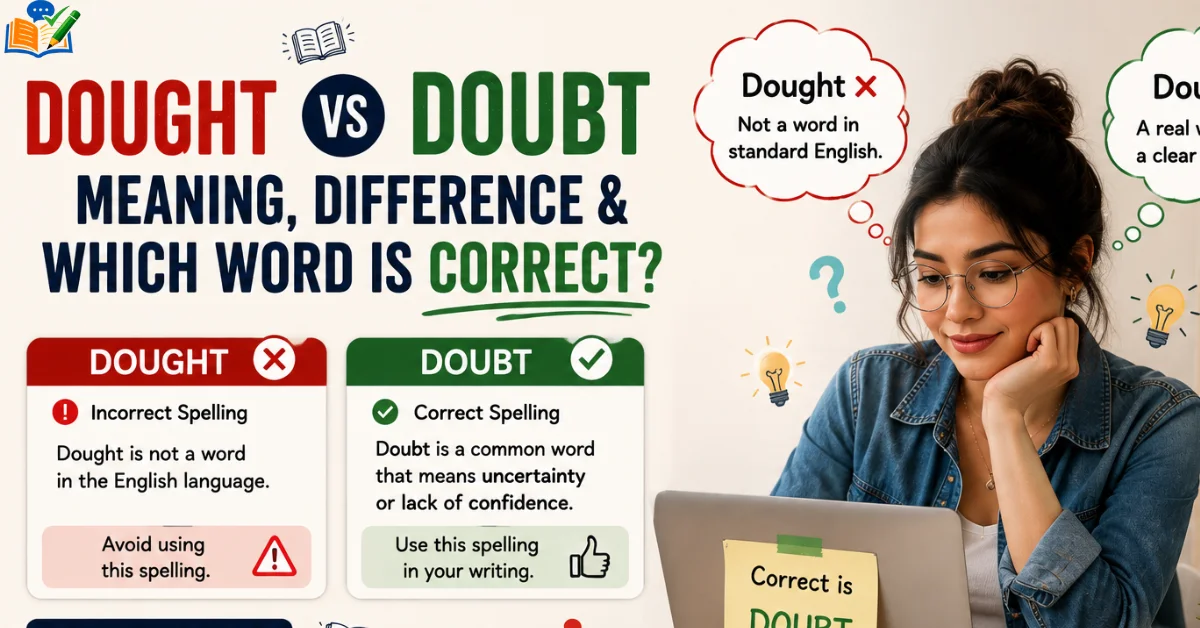
English spelling can sometimes be confusing, especially when two words look almost identical but have completely different meanings. Dought vs doubt is one of those confusing word pairs that makes many people stop and wonder which spelling is correct.
At first glance, “dought” and “doubt” seem like they could be related words. However, they belong to very different parts of English history. Doubt is a common modern English word used every day, while dought is an old-fashioned word that is rarely seen today.
If you are writing an email, article, essay, or professional document, the correct word you usually need is doubt. It expresses uncertainty, hesitation, or a lack of confidence in something. The word dought, on the other hand, has an outdated meaning connected with bravery and strength.
Dought meaning you will learn the exact difference between dought vs doubt, their meanings, examples, usage rules, and simple ways to remember which word to use.
Dought vs Doubt: Quick Answer
The simple answer is:
- Doubt = uncertainty, hesitation, or lack of belief in something.
- Dought = an archaic English word meaning brave, strong, or capable.
In modern English writing, doubt is the correct and commonly used word. The word dought is almost never used except in historical texts, old literature, or discussions about ancient English vocabulary.
Read Also: Tought vs Taught: What’s the Difference?
What Does “Doubt” Mean?

The word doubt is a modern English word that describes a feeling of uncertainty or a lack of confidence about something.
When you doubt something, you are not completely sure whether it is true, possible, or reliable. It can describe uncertainty about a person, situation, decision, information, or outcome.
For example:
- I doubt he will arrive on time.
- She has doubts about the project’s success.
- There is no doubt that practice improves skills.
The word doubt is commonly used in conversations, academic writing, workplace communication, and professional documents.
Dought Meaning
The word “dought” is an old and rarely used English word. It means brave, strong, capable, or powerful and was mainly used in historical texts and old literature to describe heroes or warriors. In modern English, “dought” is considered an archaic word and is not commonly used in everyday writing. Most people use it only when discussing old English language or historical stories.
Doubt as a Noun
As a noun, doubt refers to a feeling or state of uncertainty.
Examples:
- I have some doubt about the accuracy of this information.
- His decision created doubt among the team members.
- There is no doubt that she worked hard.
Common phrases with doubt include:
- No doubt
- Without a doubt
- Beyond doubt
- In doubt
- Benefit of the doubt
- Self-doubt
These phrases are widely used in everyday English.
Doubt as a Verb
The word doubt can also work as a verb. In this form, it means to question whether something is true or likely to happen.
Examples:
- I doubt his explanation.
- They doubt whether the plan will succeed.
- She never doubted her abilities.
When you use doubt as a verb, you are expressing uncertainty about something.
What Does “Dought” Mean?
Unlike doubt, the word dought is not commonly used in modern English. It is considered an archaic or historical word.
Historically, dought was used to describe someone who was brave, powerful, strong, or capable. It was often associated with warriors, heroes, and old English writing.
Example of old usage:
- The dought warrior defended his kingdom.
However, this type of usage is extremely rare today. Most modern readers will not recognize the word, and using it in normal writing may confuse your audience.
For everyday communication, essays, blogs, and professional writing, you should avoid using dought.
Dought vs Doubt: Main Differences
Understanding the difference between these words becomes easy when you compare their meanings and usage.
| Word | Meaning | Usage |
| Doubt | Feeling uncertain or unsure | Common modern English |
| Dought | Brave, strong, or capable | Old-fashioned and rarely used |
The biggest difference is that doubt describes uncertainty, while dought describes strength or bravery.
They may look similar, but they communicate completely different ideas.
Why Do People Confuse Dought and Doubt?
The confusion between dought vs doubt usually happens because of their similar spelling.
Some common reasons include:
Similar Appearance
Both words contain almost the same letters:
- Dought
- Doubt
The only difference is the position of the letters “gh” and “b”.
Because English has many unusual spelling patterns, people may assume both words are valid alternatives.
Silent Letters in English
English contains many words with silent letters, such as:
- Doubt
- Debt
- Subtle
- Knight
In the word doubt, the letter “b” is silent. This makes spelling more difficult because the pronunciation does not clearly show the written form.
Typing Mistakes
Many people type “dought” accidentally when they mean “doubt.” Autocorrect and fast typing can also create this mistake.
How to Pronounce Doubt Correctly

The correct pronunciation of doubt is:
/daʊt/
It sounds like:
“dout”
The letter b is silent.
You do not pronounce it as:
❌ dub-out
You pronounce it as:
✅ dout
Remembering the silent “b” can help you avoid spelling mistakes.
Examples of Doubt in Sentences
Here are some examples showing how to use doubt correctly:
Everyday Examples
- I doubt the store will be open late.
- She had doubts before making the decision.
- There is no doubt that he is talented.
Workplace Examples
- The manager expressed doubt about the deadline.
- We should not doubt the importance of customer feedback.
- The results removed all doubts about the strategy.
Academic Examples
- Researchers questioned the results because of some doubts.
- Students often doubt their abilities before exams.
- There is little doubt that education creates opportunities.
Common Phrases Using Doubt
Learning common expressions can help you use doubt naturally.
No Doubt
Meaning: Without uncertainty.
Example:
- She is no doubt one of the best players on the team.
Without a Doubt
Meaning: Completely certain.
Example:
- This was without a doubt the best experience of my life.
Beyond Doubt
Meaning: Completely proven or certain.
Example:
- The evidence proved his innocence beyond doubt.
In Doubt
Meaning: Uncertain or unclear.
Example:
- The final result is still in doubt.
Easy Ways to Remember Dought vs Doubt
If you often confuse these words, try these simple memory tricks.
Remember the Meaning
Think:
- Doubt = Question in your mind
- Dought = Old heroic word
Modern problems usually involve doubt, not dought.
Focus on Modern Writing
Whenever you are writing:
- Emails
- Blogs
- Essays
- Reports
- Social media posts
Use doubt unless you are specifically discussing historical English.
Practice With Examples
Writing sentences helps your brain remember the correct spelling.
Try creating examples like:
- I doubt the information is correct.
- There is no doubt about her success.
Is Dought a Correct English Word?

Yes, dought is technically a word, but it is considered outdated.
It appeared in older forms of English and was used to describe strength, courage, or ability. However, modern English speakers rarely use it.
If you see “dought” in everyday writing, it is most likely a spelling mistake for “doubt.”
Dought vs Doubt: Which One Should You Use?
For almost all modern situations, choose doubt.
Use doubt when you want to express:
- Uncertainty
- Hesitation
- Suspicion
- Lack of confidence
Examples:
- I doubt this information is accurate.
- She doubts his intentions.
Only use dought when discussing historical language, old literature, or specific meanings from the past.
Frequently Asked Questions
Is dought or doubt correct?
The correct word for expressing uncertainty is doubt. Dought is an old English word that is rarely used today.
What is the difference between dought and doubt?
Doubt means uncertainty or lack of belief, while dought historically meant brave, strong, or capable.
Is dought a misspelling of doubt?
In most modern situations, yes. Many people write “dought” accidentally when they mean “doubt.”
Why is the B silent in doubt?
The silent “b” comes from the word’s historical development and connection to older forms of English and Latin.
Can I use dought in modern writing?
It is not recommended unless you are writing about historical English or using the word intentionally for a specific literary purpose.
How do you remember the spelling of doubt?
Remember that doubt is connected with uncertainty. When your mind is unsure, you have a “doubt.”
Conclusion
The confusion between dought vs doubt happens because the words look very similar, but their meanings are completely different.
Doubt is the correct and commonly used modern English word. It describes uncertainty, hesitation, or a lack of belief. You will see it frequently in conversations, articles, professional writing, and academic work.
Dought, although a real historical word, is outdated and rarely appears in modern communication. It refers to bravery or strength and is mainly found in old texts.
So, when you are unsure which spelling to choose, remember this simple rule:
Use “doubt” for uncertainty. Use “dought” only when talking about old English history.
Understanding these small differences can improve your spelling, grammar, and confidence in English writing.
