


Have you ever stopped while writing a sentence and wondered whether you should use Todays or Today’s? You are not the only one confused by this small punctuation mark. The apostrophe in today’s may look simple, but it plays an important role in English grammar, especially when showing possession or a connection with the present day. Many students, professionals, and everyday writers often make this common spelling mistake while writing emails, articles, forms, or online content.
We explain everything about today’s vs todays, including today’s meaning, possessive form, apostrophe rules, correct spelling, sentence examples, and common grammar mistakes. You will learn when to use today’s, why today’s with apostrophe is usually correct, and how to improve your writing accuracy with simple English grammar rules.
Todays or Today’s – Quick Answer
Todays or Today’s is one of the most common apostrophe questions in English writing. The correct form in almost every normal situation is today’s with an apostrophe.
The apostrophe in today’s shows possession or connection with the present day. It means something belongs to, relates to, or is associated with today. For example, today’s meeting, today’s weather, and today’s news all refer to things connected with the current day. Whenever people type todays or today’s into a search bar, they are usually trying to settle exactly this apostrophe question.
The word todays without an apostrophe is extremely uncommon in standard English. It can technically appear as a plural form of “today” when someone is talking about multiple days called “todays,” but this usage is rare and mostly appears in creative or poetic writing. This is really the heart of the todays or today’s debate: one form is standard, the other is a rare exception.
What Is “Today”?
Before understanding today’s vs todays, it is important to understand the word “today” itself. Getting this foundation right makes the todays or today’s question much easier to answer later on.
The word today has different grammatical functions depending on how it appears in a sentence. It can work as:
A Noun
When “today” is used as a thing or concept:
Example: Today is a beautiful day.
Here, “today” refers to the current day itself. No apostrophe question arises here, so todays or today’s does not even come into play in this usage.
An Adverb
When “today” explains when something happens:
Example: I will complete my work today.
In this sentence, “today” describes the time of the action. No apostrophe is required. This is one of the simplest cases in the whole todays or today’s discussion.
A Noun Modifier
When “today” describes another noun, it usually takes the possessive form:
Example: Today’s schedule is busy. Today’s weather looks perfect. Today’s meeting starts at 3 PM.
This is where people often become confused about Todays or Today’s.
When “today” modifies another noun and shows a relationship with the present day, English grammar uses the possessive form today’s.
The apostrophe before “s” follows standard English apostrophe rules for singular possessive nouns.
Today’s Meaning
The today’s meaning is simple: something belonging to, happening on, or connected with the current day.
The today’s definition can be explained as:
“Today’s” is the possessive form of the word “today” and indicates something related to the present day.
Examples: Today’s news = news from the current day. Today’s task = a task assigned for the current day. Today’s lesson = the lesson happening today. Today’s events = events taking place on this day.
Many people search for todays meaning or todays definition because they are unsure whether the apostrophe changes the meaning. The answer is yes. The apostrophe changes the word into a possessive form. This small detail is exactly why todays or today’s trips up so many writers.Without the apostrophe, todays usually does not follow normal English grammar rules when placed before another noun.
The Origin of Today’s / Todays

The word “today” has existed in English for centuries. It developed from Old English expressions that referred to “this day” or “on this day.”
Over time, the phrase became shortened into the single word “today.” Looking at this history helps explain why the modern todays or today’s question even exists.
As English grammar developed, possessive forms began using apostrophes to show ownership or association. This created the modern form:
Today + apostrophe + s = today’s
This same historical pattern is why todays or today’s now has such a clear-cut grammatical answer. The same possessive pattern appears in many English words:
John’s book The teacher’s desk The company’s website Today’s schedule Today’s work
Today’s definition follows the same grammar pattern as other singular possessive nouns.
The apostrophe does not mean that “today owns something physically.” Instead, it shows a relationship between today and another noun.
For example: Today’s weather means the weather associated with today. Today’s news means news related to today. Today’s meeting means the meeting scheduled for today.
British English vs. American English Spelling
A common question is whether British English and American English use different rules for today’s vs todays.
The answer is no.
Both British English and American English follow the same apostrophe rule, so todays or today’s is not a matter of regional preference.
In both forms of standard English: ✅ Today’s is correct ❌ Todays is normally incorrect before a noun
Examples:
- American English: Today’s meeting is important.
- British English: Today’s meeting is important.
- Both varieties use the same spelling and punctuation.
The confusion does not come from regional differences. It comes from misunderstanding possessive nouns and apostrophe usage in English.
The rule remains consistent across formal writing, academic writing, business communication, and everyday English, which is why todays or today’s has one single correct answer worldwide.
Does Todays Have an Apostrophe?
A very common question is: does todays have an apostrophe?
The answer depends on the meaning.
If you mean something related to the current day, then yes: ✅ Today’s
Examples: Today’s date Today’s meeting Today’s weather Today’s news
If you are asking is todays a word, the answer is technically yes, but it is extremely uncommon. It can be used as a plural noun in unusual situations where someone refers to different “todays.”
Example: Our todays create our future tomorrows.
Today’s vs Todays: Main Difference
The difference between today’s vs todays comes down to apostrophe usage and meaning.
| Word | Meaning | Usage |
| Today’s | Belonging to or related to today | Correct possessive form |
| Todays | Multiple todays | Rare plural usage |
| Today | The current day or time expression | Used alone |
Examples: ✅ I checked today’s news. ❌ I checked todays news.
Why?
Because the news belongs to today, so the possessive form is required. Keeping this difference in mind is the fastest way to resolve todays or today’s for good.
Key Rule: When to Use Today’s vs Todays
Understanding Todays or Today’s becomes simple when you know the basic apostrophe rule. The main difference depends on whether you are showing possession, connection, or simply talking about the word “today.”
The word today’s uses an apostrophe because it works as a possessive form. In English grammar, a singular noun usually forms possession by adding an apostrophe followed by “s.”
For example: Today + ‘s = Today’s
- This creates a relationship between “today” and another noun.
Examples: Today’s meeting Today’s weather Today’s news Today’s schedule Today’s task
- All of these examples show something connected with the current day.
The correct use of today’s follows standard English grammar rules because the apostrophe shows association, not just ownership.
The One Rule You Need to Remember
When deciding between today’s or todays, ask yourself one simple question:
Is something related to or connected with the present day?
If the answer is yes, use: ✅ Today’s
Examples: Today’s homework is difficult. Today’s meeting starts at noon. Today’s weather is colder than yesterday. Today’s news is surprising.
If you are referring to several different days as separate “todays,” then the rare plural form may be used:
Example: Our todays influence our tomorrows.
However, this is not common in everyday English. Once you remember this one rule, todays or today’s stops being confusing altogether.
For professional writing, academic writing, emails, and online content, today’s with apostrophe is almost always the correct choice.
About your research……Unselect or Deselect: Which Term Truly Belongs in UX and Modern Writing?
Today’s vs Todays Comparison Table
The confusion between today’s vs todays usually happens because both words look similar. The apostrophe creates the difference in meaning, which is exactly what this todays or today’s table is meant to clarify.
| Word | Correct Usage | Meaning | Example |
| Today’s | Possessive form | Related to the current day | Today’s meeting is important |
| Todays | Rare plural form | Multiple “todays” | Our todays shape our future |
| Today | Noun or adverb | Current day or present time | I will finish it today |
The apostrophe in today’s changes the grammatical function of the word.
Without the apostrophe, “todays” does not normally work as a noun modifier. This table is a quick reference for anyone still unsure about todays or today’s.
Today’s Meeting vs Todays Meeting
Another common search phrase is:
Todays meeting or today’s meeting
The correct spelling is: ✅ Today’s meeting ❌ Todays meeting
Why?
Because the meeting is associated with today.
The word “today” acts as a noun modifier in this sentence, and the possessive form is required.
Correct examples: Today’s meeting will begin at 10 AM. I prepared notes for today’s meeting. Did you receive today’s meeting invitation?
Incorrect examples: Todays meeting will begin at 10 AM. I prepared notes for todays meeting.
The phrase today’s meeting grammar follows normal English possessive rules, and it is one of the clearest real-world tests of todays or today’s.
Today’s Weather vs Todays Weather
Many people search:
Todays weather or today’s weather
The correct form is: ✅ Today’s weather ❌ Todays weather
Examples: Today’s weather is perfect for a picnic. I checked today’s weather forecast. Today’s weather report predicts rain.
Here, “weather” is connected with the current day, so the possessive apostrophe is required.
The phrase today’s weather grammar is a simple example of a possessive noun used as a noun modifier, and it follows the same answer as every other todays or today’s example on this page.
Today’s News vs Todays News
The same rule applies to news.
Correct: ✅ Today’s news
Incorrect: ❌ Todays news
Examples: I read today’s news this morning. Today’s news covers several important events. The reporter shared today’s news online.
The word “today” does not own the news literally. The apostrophe simply shows that the news belongs to or relates to this particular day, which is the same logic behind every todays or today’s example on this page.
When to Use Today’s

You should use today’s when (in other words, this is exactly how to resolve todays or today’s in your own sentences):
1. Something belongs to the current day
Examples: Today’s schedule is full. Today’s task is important. Today’s work needs to be completed.
2. Something happens on the present day
Examples: Today’s events start at noon. Today’s lesson is about grammar. Today’s meeting has been moved.
3. You are writing formally
In formal writing, using the correct apostrophe placement improves clarity and professionalism, which matters a great deal whenever todays or today’s shows up in a business document.
Examples:
Business emails: Please review today’s report.
Academic writing: Today’s discussion focuses on language development.
Professional documents: Today’s agenda includes important updates.
When Not to Use Today’s
Do not use an apostrophe when “today” works as an adverb.
Examples: I will call you today. She completed the project today. We are leaving today.
Here, “today” simply explains time. It is not showing possession.
This is the difference between:
Today’s meeting
and
The meeting is today.
Both are correct, but they have different grammatical purposes, and understanding this distinction resolves most remaining todays or today’s confusion.
Why Does Today’s Need an Apostrophe?
Many learners ask:
Why does today’s need an apostrophe?
The answer is because it is a possessive form.
English uses apostrophes to show ownership, connection, or relationship between words.
Examples: Sarah’s phone The teacher’s desk Today’s news
The apostrophe tells the reader that the following noun is connected to the previous word.
So: Today’s news = news connected with today. Today’s date = date connected with today. Today’s meeting = meeting connected with today.
This connection is exactly why the answer to todays or today’s is almost always the apostrophe form.
What Is the Possessive Form of Today?
The possessive form of today is: ✅ Today’s
This is known as a singular possessive form.
Examples: Today’s events Today’s work Today’s lesson Today’s schedule
The possessive form does not mean that today physically owns something. It simply shows a relationship.
This type of grammatical usage is common with time expressions in English, and it is the deciding factor whenever todays or today’s needs to be settled.
Common Mistakes with Todays / Today’s
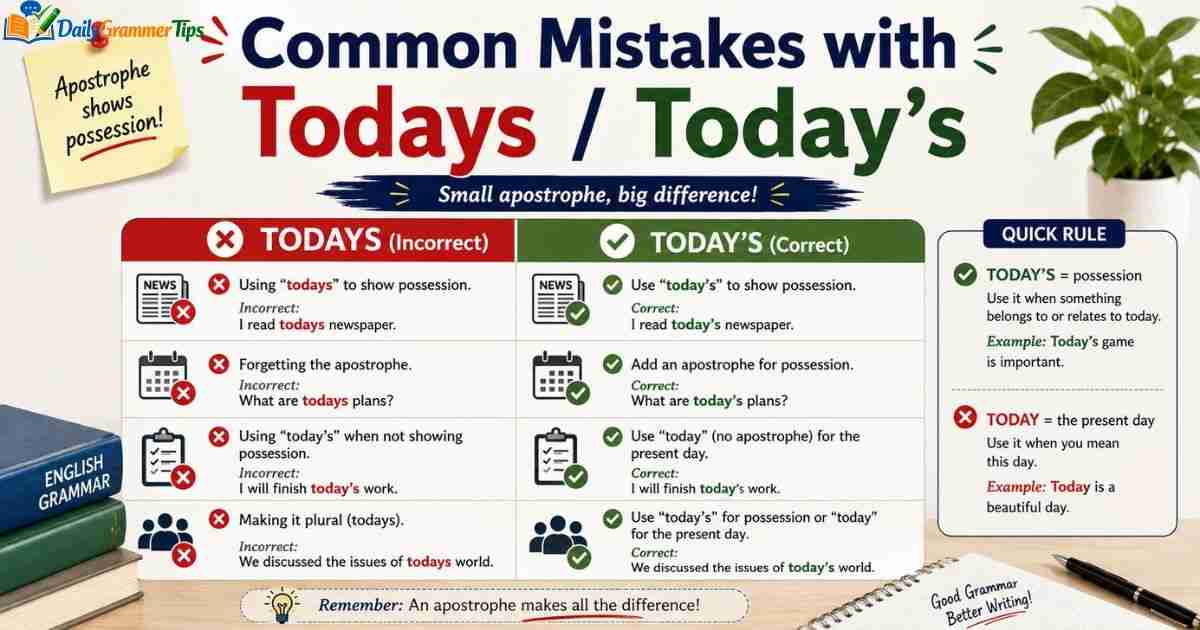
Many writers make small punctuation mistakes when using Todays or Today’s. Although the difference looks minor, the apostrophe changes the entire grammatical meaning.
The biggest confusion happens because people think “today” is already a time word, so adding an apostrophe feels unnecessary. However, when “today” becomes a possessive noun or noun modifier, the apostrophe is required. Apostrophes are commonly used in English to show possession or a relationship between nouns.
Understanding these mistakes helps you improve your writing correctly and follow standard English rules, and it puts an end to any lingering doubt about todays or today’s.
Mistake 1: Removing the Apostrophe Before a Noun
A very common mistake is writing todays without apostrophe before another noun.
Incorrect: ❌ Todays meeting is important. ❌ Todays weather looks beautiful. ❌ Todays news is interesting.
Correct: ✅ Today’s meeting is important. ✅ Today’s weather looks beautiful. ✅ Today’s news is interesting.
The reason is simple. The noun after “today” belongs to or relates to the current day. Therefore, the possessive form today’s is needed, which is the most common mistake people make with todays or today’s.
Mistake 2: Writing Todays’ With Apostrophe After S
Some writers incorrectly place the apostrophe after the letter “s.”
Incorrect: ❌ Todays’ meeting ❌ Todays’ schedule ❌ Todays’ events
This form suggests a plural possessive noun, but “today” is not normally made plural in everyday English.
Correct: ✅ Today’s meeting ✅ Today’s schedule ✅ Today’s events
The apostrophe placement matters because it changes the meaning. A singular possessive noun normally uses apostrophe before “s,” which is another detail worth remembering about todays or today’s.
Mistake 3: Using Today as an Adjective Without an Apostrophe
Another common grammar mistake is treating “today” like a normal adjective.
Incorrect: ❌ The today weather is cold. ❌ I checked the today news.
Correct: ✅ Today’s weather is cold. ✅ I checked today’s news.
The word “today” is not acting like a regular adjective here. It is a time expression being used in a possessive form, and mixing this up is another frequent source of todays or today’s errors.
Mistake 4: Confusing Today and Today’s
Many people confuse the difference between today vs today’s.Both forms are correct, but they have different uses.Today Used when talking about time.
Examples: I will finish the work today. She arrived today. We have a meeting today.Today’s Used when showing connection with the present day.
Examples: Today’s work is difficult. Today’s meeting starts at 5 PM. Today’s task is almost complete.A simple test: If you can replace “today’s” with “of today,” use the apostrophe.
Example: Today’s news = News of today. Today’s weather = Weather of today.
Todays Without Apostrophe: Is It Correct?
A common question is:
Is todays a word?
Technically, yes, but it is extremely uncommon.
The word todays may appear when someone intentionally uses “today” as a plural noun to describe multiple present moments or different days.
Example: Our todays become memories tomorrow.
However, this is a creative writing style and not normal grammatical usage. So in the everyday todays or today’s comparison, the plain plural form rarely wins.
In everyday English, formal writing, business communication, and academic content, todays without apostrophe is usually considered incorrect.
For normal sentence construction, choose: ✅ Today’s
Not: ❌ Todays
Is Today’s Grammatically Correct?
Another frequently searched question is:
Is today’s correct?
Yes, today’s is grammatically correct when it shows possession or a connection with the current day.
Examples: Today’s date is September 3. Today’s meeting has been canceled. Today’s lesson is about grammar. Today’s schedule includes several activities.
The apostrophe in today’s is called a possessive apostrophe because it shows a relationship between two words, and that relationship is the whole answer to todays or today’s.
Correct Use of Today’s in a Sentence
Learning through sentence examples is one of the easiest ways to understand today’s grammar, and it is a fast way to see todays or today’s used correctly in context.
Here are examples of correct grammatical usage:
Professional Writing Today’s report needs approval. Today’s meeting will include the marketing team. Please complete today’s task before the deadline.
Everyday English Today’s weather is perfect. I forgot today’s date. Did you watch today’s news?
Academic Writing Today’s lesson explains English apostrophe rules. Today’s discussion focuses on language development. Students completed today’s assignment.
Common Apostrophe Errors in Today’s
The apostrophe is one of the most misunderstood punctuation marks in English. Many writers make similar mistakes.
Common errors include: ❌ Todays date ✅ Today’s date
❌ Todays meeting ✅ Today’s meeting
❌ Todays weather ✅ Today’s weather
❌ Todays schedule ✅ Today’s schedule
These errors happen because people confuse plural nouns with possessive nouns.
Remember: Plural = more than one Possessive = belonging or connected to something
The apostrophe in today’s shows connection, not plurality, which is the single fact that answers todays or today’s every time.
Today’s in American English
In American English, today’s follows standard possessive grammar rules.
Examples: Today’s news is important. Today’s meeting starts soon. Today’s events are exciting.
American English writers use the apostrophe before “s” because “today” is treated as a singular noun, so todays or today’s is answered the same way across the country.
Today’s in British English
British English follows the same rule.
Examples: Today’s weather is warmer. Today’s lesson was interesting. Today’s schedule has changed.
There is no difference between British English and American English when deciding between Todays or Today’s.
Both use: ✅ Today’s with apostrophe ❌ Todays without apostrophe in normal situations
Today or Today’s in Everyday Examples

Seeing examples in real sentences makes the correct spelling easier to remember, and it settles todays or today’s once and for all in practical terms.Work and Business Today’s agenda includes important updates. Today’s meeting requires preparation. Today’s report is ready for review. Today’s deadline cannot be extended. Today’s work needs attention.
School and Learning Today’s lesson explains grammar rules. Today’s homework is challenging. Today’s class covers punctuation. Today’s assignment is due tomorrow.News and Media Today’s news covers global events. I read today’s newspaper. Today’s headlines are trending online.
Technology Today’s software update improves performance. Today’s app release includes new features. Today’s technology changes quickly.
How to Remember Today’s Correct Spelling
A simple trick can help you remember the difference:
Ask: Does something belong to today?
If yes, add an apostrophe.
Examples: Does the meeting belong to today? Yes → Today’s meeting.
- Does the weather relate to today? Yes → Today’s weather.
- Does the date belong to today? Yes → Today’s date.
This simple question helps you choose the correct form every time, and it is the fastest shortcut for anyone still weighing todays or today’s.
Todays or Today’s Google Usage & Search Understanding
Searches like: Todays or today’s today’s or todays todays date today’s meeting today’s weather
show that many people struggle with apostrophe placement.
The reason is that English uses apostrophes differently for possession and plural forms. Apostrophes are not normally added just to make words plural.
The standard usage across professional writing, educational content, and everyday English is: Today’s date Today’s meeting Today’s weather Today’s news Today’s schedule
Todays or today’s meaning
The Todays or today’s meaning depends on how the word is used in a sentence. The correct form is today’s when you want to describe something connected with the current day. The apostrophe shows the possessive form and creates a relationship between “today” and another noun. citeturn0search0
For example, today’s meaning refers to something belonging to or associated with today, such as today’s work, today’s schedule, or today’s events. Many people ask does todays have an apostrophe, but the answer is that the correct possessive spelling requires an apostrophe: today’s.
Todays or today’s examples
Looking at Todays or today’s examples makes the grammar rule easier to understand. The word today’s is commonly used before nouns to show that something relates to the present day. It follows standard English apostrophe rules for singular possessive nouns.
Examples:
- Today’s meeting starts at noon.
- Today’s weather is perfect for outdoor activities.
- Today’s news includes important updates.
- Today’s activity focuses on learning new skills.
These examples show why today’s vs todays is an important grammar difference. Writing “todays meeting” without the apostrophe is a common spelling mistake.
Todays or today’s grammar
Understanding Todays or today’s grammar becomes simple when you learn the role of the apostrophe. The apostrophe in today’s shows possession or association, similar to other singular possessive forms used in English grammar. citeturn0search4
In today’s grammar, the word works as a possessive noun modifier. It connects today with another word, such as today’s class, today’s task, or today’s schedule.
The main difference in today’s vs todays is that today’s follows correct punctuation rules, while todays without an apostrophe is not normally used in standard English writing.
Today or today’s activity
The difference between Today or today’s activity depends on whether you are talking about time or something connected with the present day. When “today” simply tells when something happens, no apostrophe is needed.
Example:
- I will complete the activity today.
When the activity belongs to the current day, use today’s.
Example:
- Today’s activity includes a group discussion.
The second sentence uses the possessive form because the activity is related to today.
Today’s or today’s meeting
The correct form is today’s meeting when referring to a meeting happening on the current day. The phrase today’s or todays often creates confusion because many writers forget the apostrophe before “s.”
Correct example:
- Today’s meeting starts after lunch.
Incorrect example:
- Todays meeting starts after lunch.
The apostrophe in today’s meeting shows a connection between the meeting and today. This is the same possessive pattern used in phrases like a company’s plan or a student’s book.
Today’s meaning
Today’s meaning refers to something related to the present day or something happening now. In English grammar, today’s can show a connection, relationship, or possession between today and another noun.
Examples:
- Today’s lesson means the lesson for today.
- Today’s task means the task assigned for today.
- Today’s news means news related to the current day.
The correct use of today’s improves grammatical accuracy and helps you follow standard English writing rules.
Today’s means today is

Many people wonder if today’s means today is. The answer is yes, but only in certain sentences. Sometimes today’s works as a contraction of “today is.”
Example:
- Today’s Friday.
This means:
- Today is Friday.
In phrases like today’s meeting or today’s weather, the apostrophe does not mean “today is.” It shows possession or association.
Understanding this difference helps you avoid confusion between the possessive form and contraction usage.
Today or today’s class
The difference between Today or today’s class depends on the sentence structure. Use today when you are talking about when something happens.
Example:
- The class is today.
Use today’s when the class is connected with the current day.
Example:
- Today’s class explains English grammar.
The phrase today’s class uses a possessive noun modifier because the class belongs to today. When choosing between today’s vs todays, remember that the apostrophe is required for the possessive form.
Frequently Asked Questions
What is today’s meaning?
Today’s means something related to the present day or something that belongs to the current day. It is the possessive form of “today” and uses an apostrophe to show a connection with another noun.
Is it correct to say “today morning”?
No, “today morning” is not natural in standard English. Use “this morning” or “today’s morning” depending on the meaning you want to express.
Is today’s proper grammar?
Yes, today’s is grammatically correct when it shows possession or a relationship with the present day, such as today’s weather, today’s news, or today’s schedule.
Is it correct to say “today’s meeting” or “todays meeting”?
The correct form is “today’s meeting” because the apostrophe shows that the meeting is connected with today. “Todays meeting” is a common spelling mistake.
Is today’s class grammatically correct?
Yes, “today’s class” is grammatically correct because the class relates to the current day. The apostrophe creates the possessive form and follows standard English grammar rules.
Conclusion
Understanding Todays or Today’s becomes much easier when you know the role of the apostrophe in English grammar. The correct form is usually today’s because it works as a possessive noun and shows a connection between the present day and another word. Whether you write today’s meeting, today’s weather, today’s news, or today’s activity, the apostrophe helps you follow proper punctuation and spelling rules.
The difference between today’s vs todays is a small but important grammar detail that improves your writing accuracy. By learning today’s meaning, today’s correct spelling, and the correct use of today’s in sentences, you can avoid common apostrophe mistakes and write more confidently in everyday English, formal writing, and professional communication.
