


Improvements are changes that make something better. You hear the word at school, at work, at the doctor, and at home. It can describe a higher grade, a faster process, a safer house, or a stronger skill.
This guide gives you clear answers in plain words. You will learn the meaning, plural form, pronunciation, and the Hindi and Urdu words. You will also see types, real examples, synonyms, antonyms, and the legal meaning used in leases and insurance.
What Are Improvements? Meaning and Definition
An improvement is a change that makes something better. It can also mean the act of making something better. The word fits people, places, products, systems, and ideas. You can use it for a tiny tweak or a major upgrade.
Dictionaries agree on the basic idea. Something moves from a weaker state to a stronger one. That move can be small or large. It can happen on purpose, or it can happen by luck.
The Core Meaning in Simple Words
Think of improvement as a before and after story. The before state has a problem or a gap. The after state is better in some clear way. If you cannot name the gain, you may be describing a simple change instead.
This test helps writers avoid empty claims. Instead of saying a plan brought improvement, name the gain. Say the plan cut wait time by half, or raised sales by ten percent. Clear details make your writing more useful and more believable.
Dictionary Senses You Should Know
Dictionaries list a few senses. The first is the act of improving. The second is a change for the better. The third is a condition better than an earlier one. Property law adds a fourth sense, which means work or buildings that raise the value of land.
British dictionaries add a building sense. It covers changes to structure, fittings, or decor that keep the building’s function the same. Business dictionaries add a numbers sense, such as a rise in annual profit. These extra senses explain why one word fits so many topics.
Improvements Meaning in Different Contexts
The meaning of improvements shifts a little with the setting. A teacher sees them in grades and effort. A doctor sees them in a patient’s condition. An economist sees them in jobs, sales, and prices.
The core idea stays the same in every setting. Something moves from a weaker state to a better state. The setting tells you what is getting better. It also tells you how to measure the gain.
Meaning at School and Work
At school, improvement means higher scores, better reading, and stronger study habits. At work, it means faster tasks, fewer errors, and happier customers. Managers often track these gains each month. Students often track them after each test.
Teachers also use the word for effort and attitude, not only scores. A student who asks better questions shows growth. In offices, leaders use it for team habits, such as clearer emails and shorter meetings. Both settings value steady and visible gains.
Meaning in Health, Economy, and Property
In health, the word describes a patient who feels or functions better than before. In the economy, it describes stronger sales or more jobs. In property talk, it describes new features that raise value. Each field uses the same word in its own way.
Doctors often write about improvement in symptoms or mobility after treatment. News reports use it for jobs, prices, and trade numbers. Real estate talk uses improvements for work that adds value, such as a new roof. Always check the field before you assume the meaning.
Improvement Plural: How to Form It
The plural of improvement is improvements. You add s to the end of the word. No letters change, and the stress stays on the middle syllable. This is a regular noun, so the rule is simple.
The singular and plural often carry different shades of meaning. The singular usually names the process or the general state. The plural names separate changes that you can count. Keep this idea in mind when you choose a form.
Spelling the Plural Correctly
Keep the e after the v and add only an s. Do not write improvments or improvemants. Spell checkers usually catch these slips, but fast typing can still hide them. Read your final draft once more before you publish.
Related Word Forms
Improvement belongs to a family of words. Improve is the verb. Improved and improving are common adjectives. Improver names a person or thing that improves. Some dictionaries also list nonimprovement and preimprovement, but writers rarely use them.
Each form has its own job. Improve works as an action. Improved describes a finished result, as in an improved recipe. Improving describes work in progress, as in an improving economy. Choosing the right form keeps your sentences clear and natural.
Improvements or Improvement: Which One Is Correct?
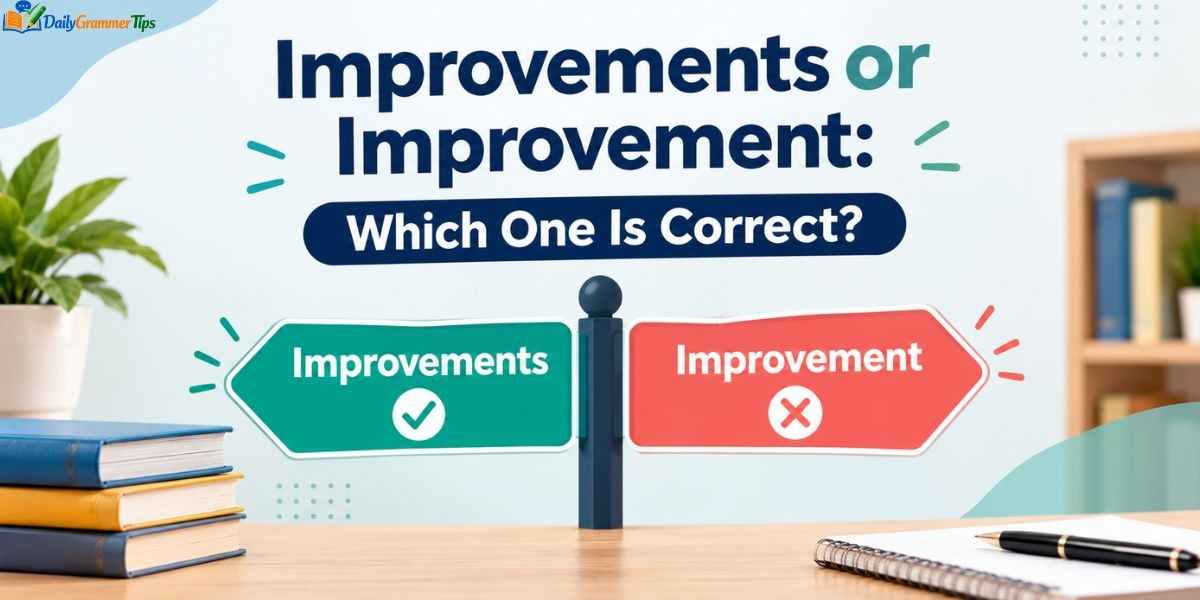
Both forms are correct. The right choice depends on what you mean. Use improvement for the process or the general state. Use improvements for separate changes. Readers notice the difference quickly.
A simple test helps. Ask yourself if you can count the changes. If you can, use the plural. If you cannot, use the singular. Grammar books call these the countable and uncountable uses.
The Countable and Uncountable Rule
When the word means the general process, it is uncountable. You say there is room for improvement, and you do not say rooms. When it means a single change or a set of changes, it is countable. You say one improvement or three improvements.
Many everyday nouns follow this pattern. Think of the words progress and advice, which usually stay singular. Improvement behaves in a similar way when it names a general state. It becomes countable only when you point to individual changes.
Quick Tests You Can Use
Try replacing the word with better results. If that fits, the singular usually works. Try adding a number before it. If that fits, use the plural. A list of changes, like new paint and new lights, also calls for the plural.
Another test is to ask how many or how much. How many changes did you make is a natural question, and it fits the plural. How much improvement did you see is also natural, and it fits the singular. Both forms are correct in their own settings.
How to Pronounce Improvement
Improvement has three syllables. Say it as im PROOV ment. The stress falls on the middle syllable. Say that part a little louder and longer than the others.
The IPA symbols are /ɪmˈpruːvmənt/. The first sound is short, like the i in sit. The middle sound matches the word prove. UK and US speakers say it almost the same way.
Breaking Down the Syllables
Start with im, a short and quiet beat. Move to PROOV, the strong beat with a long oo sound. End with ment, a light and quick beat. Say the three beats slowly, then join them without pauses.
Common Pronunciation Slips
Many learners stress the first syllable by mistake. Others say the middle sound like pro instead of prove. For the plural, add a clear s after the t. Listen to a dictionary audio clip once, then repeat the word out loud.
Improvement in Hindi and Urdu
People often search for the Hindi meaning of improvement. The most common Hindi word is सुधार, written as sudhaar in English letters. It covers improvement, reform, and correction. Urdu speakers usually say بہتری, written as behtari.
Choose the word by context. Sudhaar fits repairs, reforms, and fixes. Behtari fits a general move toward better health, grades, or results. Unnati and taraqqi fit growth in skill, status, or development.
Hindi Words for Improvement
Besides sudhaar, Hindi uses उन्नति (unnati) for progress and बेहतरी (behtari) for a better state. A useful phrase is स्वास्थ्य में सुधार (swasthya mein sudhaar), which means improvement in health. Another is सुधार की जरूरत (sudhaar ki zaroorat), the need for improvement.
Context matters in Hindi too. Use sudhaar for fixing faults, such as sudhaar in a system. Use unnati for rising in rank or skill. Use behtari for a general sense of better. Native speakers also mix these words in daily talk.
Urdu Words for Improvement
Urdu uses بہتری (behtari) for improvement and اصلاح (islah) for correction or reform. For growth, speakers say ترقی (taraqqi). A handy phrase is بہتری کی گنجائش (behtari ki gunjaish), which means room for improvement. In Roman Urdu, you might write “Sehat mein behtari aayi hai.”
Types of Improvements
Improvements fall into a few clear groups. Each group has its own goal, its own tools, and its own way to measure success. Knowing the group helps you pick the right words and the right plan.
A coach talks about progress, a landlord talks about betterments, and a city planner talks about capital plans. The same word can feel very different in each field. Always match your language to your reader.
Personal, Home, and Business Types
Personal improvement covers skills, habits, health, and learning. Home improvement covers repairs, upgrades, and remodeling that add comfort or value. Business improvement covers faster work, better service, and higher profit. These three types appear most often in daily life.
Each type also has a size. A personal habit may need only a few minutes a day. A home project may need weeks and a budget. A business change may need a team, a plan, and clear numbers.
Public, Product, and Legal Types
Public improvement covers roads, schools, parks, and services. Product improvement covers new features, fewer bugs, and better design. Legal and insurance improvement covers permanent changes a tenant makes to a rented building. Each type needs its own measures of success.
Product teams often release small changes every week. Public agencies plan bigger changes over several years. Legal improvements depend on a lease or contract and may involve insurers and lawyers. The type tells you who decides and who pays.
Improvements Examples in Daily Life

Improvements happen around you every day. Some are small, like a faster route to work. Others are large, like a new bridge that cuts travel time. Real examples make the idea easier to remember.
Good examples share one trait. They show a clear before and after. You can describe the old state and the new state in one short sentence. That clarity makes the gain easy to see.
Examples at Home and School
A family adds better lighting to a dark hallway. A cook adjusts a recipe until the dish tastes better. A student studies every evening and raises a test score. A learner uses flash cards and remembers more new words.
Notice the pattern in each case. Someone spots a problem, tries a fix, and checks the result. The cycle repeats until the result feels good enough. This simple loop drives most personal and household gains.
Examples at Work and in the Community
A team writes a shared checklist and misses fewer tasks. A cafe owner trains staff to greet guests quickly and sees more return visits. A neighbor plants trees and makes the street cooler and calmer. A commuter changes route and saves ten minutes a day.
Community gains often start small. One neighbor plants a tree, and others join in. Workplace gains often start with one honest question about what slows people down. Answering that question leads to simple fixes with strong results.
Home Improvements Examples
Home improvements make a house safer, more comfortable, or more valuable. Owners often start with small jobs and move to bigger ones. A clear goal for each job keeps the budget under control.
Some jobs add comfort now, and some add value when you sell. Think about how long you plan to stay. Compare quotes, set a budget, and keep a small reserve for surprises.
Small Home Jobs with Quick Results
Fresh paint refreshes a room at low cost. LED bulbs use less power and last longer than many older bulbs. Decluttering and deep cleaning make rooms feel larger. Working smoke alarms and secure locks help protect your family.
Quick jobs also build momentum. A cleaner and brighter room motivates owners to tackle bigger tasks. Start with jobs that cost little and take a weekend or less. Track what you spend so the budget stays clear.
Bigger Projects That Add Value
New flooring improves looks, comfort, and cleaning. Kitchen and bathroom updates can attract buyers. Better insulation and new windows cut drafts and noise. Plan the order of jobs, and fix safety and water problems first.
Large projects need more planning. Get several written quotes and check licenses where local rules require them. Ask about timelines and warranties. Set aside extra money for surprises, since old walls and pipes often hide problems.
Self Improvement Examples
Self improvement means growing your skills, habits, or character on purpose. It is a long game. Small steps repeated often beat big promises that fade after a week.
Pick one area at a time. Set a clear goal and track it each week. Ask people you trust for honest feedback. Review your plan every month and drop goals that no longer fit.
Learn more………..Hugging Face: Complete Guide to AI Models and Generative AI
Habits That Build Skills
Read a few pages every day to build knowledge. Practice a new language for ten minutes a day. Study a new skill through a course, a mentor, or a project. Practice clear speaking and active listening in daily talks.
Skills grow through repetition and feedback. Practice a little each day instead of cramming once a week. Ask a teacher or friend to review your work. Then adjust your method and try again.
Habits That Build Health and Money
Exercise on a regular schedule to build fitness. Use short walks, water, and good sleep to support energy and focus. Save a small amount each month to build good money habits. Write a short daily note about what went well.
Health habits work best when they feel easy. Start with a walk after a meal or a glass of water before coffee. Money habits work best when they run automatically. Set a small transfer on payday and increase it later.
Business Improvements Examples

Businesses look for gains in speed, quality, cost, and customer happiness. Every team has areas that can work better. Small changes often add up to large gains over time.
Many companies use continuous improvement. They test a small change, measure the result, and keep what works. A common cycle is plan, do, check, and act. Kaizen, a Japanese approach, follows the same idea.
Improving Processes and Service
Teams can simplify one step to speed up delivery. They can write clearer onboarding guides so new staff learn quickly. They can add quality checks to cut errors. They can use customer feedback forms to guide the next update.
Map the process before you change it. Write each step on a card and look for delays. Then remove one delay at a time. Measure the result so you know the change worked.
Building Habits of Continuous Improvement
Short daily meetings keep teams aligned and remove small blockers. Simple dashboards show delays, costs, and feedback in one place. Regular reviews help teams learn and plan the next change. Staff suggestions often reveal problems that managers miss.
Public and Community Improvements
Governments and communities also plan upgrades. They fix roads, build schools, clean parks, and upgrade water systems. These projects affect many people at once.
Many cities use a capital improvement plan. It lists projects, costs, and timing over several years. The plan helps leaders choose what to build first. It also helps residents see what is coming.
Roads, Schools, and Services
Road and bridge repairs make travel safer. New or renovated schools and libraries support learning. Better streetlights, sidewalks, and safer crossings protect walkers. Drainage and water upgrades keep neighborhoods healthier and dry.
Public services also need steady care. A pothole fixed early costs less than a road rebuilt later. Regular school maintenance protects students and staff. Reliable water and drainage prevent larger health and safety problems.
Planning and Paying for Public Projects
Leaders weigh cost, need, and timing before they pick projects. Public meetings let residents say which ones matter most. Clear progress reports show which projects are finished and which are still planned. Good communication builds trust.
Improvements and Betterments in Leases and Insurance
In leases and insurance, improvements and betterments are permanent changes a tenant makes to a rented building. The tenant usually pays for them. They often cannot be removed and may become the landlord’s property.
Trade fixtures are different. A tenant can often remove them when the lease ends. Coverage depends on the lease and the policy wording. This is general information, so ask your agent or lawyer about your case.
What Counts as an Improvement or Betterment
Built in shelves, new flooring, partitions, cabinets, and new ceilings are common examples. Counters, display units, and business equipment usually count as trade fixtures. Small jobs such as painting may not count. Larger changes such as a new floor often do.
The lease often decides the question. Some leases list trade fixtures and tenant property separately. When the lease is silent, local custom may guide the decision. Courts have reached different results, so clear lease language protects both sides.
How Insurance Treats Tenant Changes
The landlord’s building policy usually covers the structure. The tenant’s policy often covers the right to use the changes. If nobody repairs the work promptly, a payout may reflect only the unused part of the lease.
For example, a tenant spends 20,000 dollars at the start of a five year lease. A fire destroys the work after one year. Four years of use remain, so the payout may be about 16,000 dollars. Keep a written list of what you installed and what it cost.
Improvements vs Repairs vs Maintenance
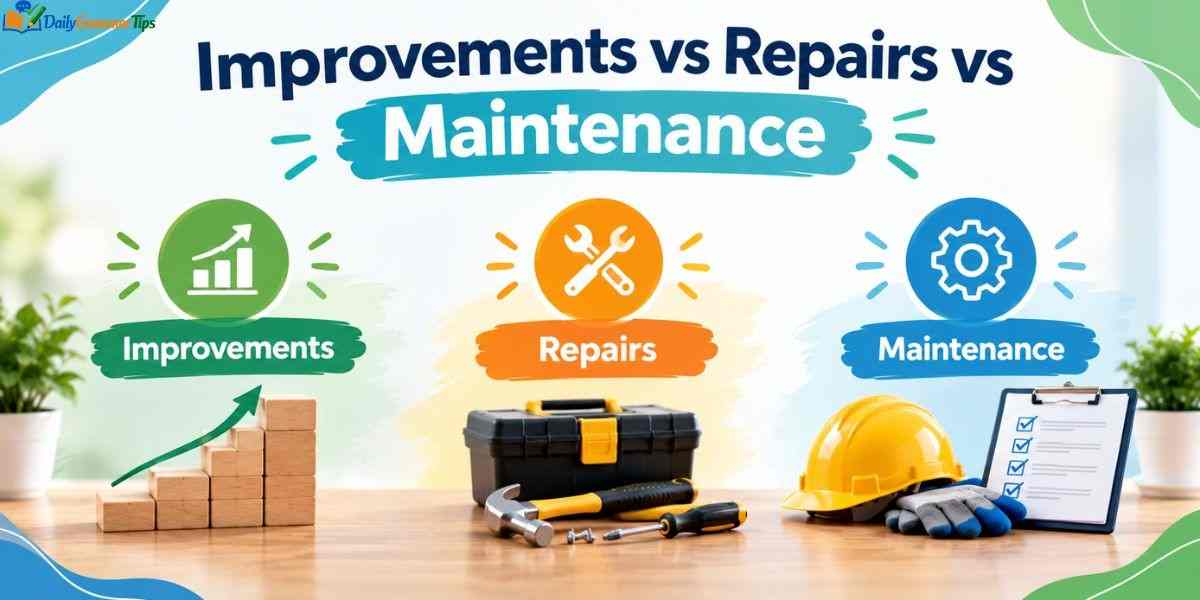
People mix up these three terms, but they mean different things. A repair fixes damage or wear. Maintenance keeps something in good shape with regular care. An improvement makes something better than it was before.
Small jobs sit in a gray area. Courts and insurers may judge them differently. Check your lease, contract, or policy for exact terms. Keep receipts and photos, because they help with insurance claims and lease talks.
Repairs and Maintenance Explained
Fixing a leaking faucet or a broken door lock is a repair. Cleaning gutters or servicing a heating unit each year is maintenance. Both jobs keep things working at their current level. Neither one makes the item better than new.
Maintenance is planned, and repairs are reactive. A yearly service visit prevents many breakdowns. Fixing a failure after it happens usually costs more. This gap explains why many owners schedule regular maintenance.
When a Job Counts as an Improvement
Ask one question. Did the job return the item to its old state, or did it make the item better? Replacing a whole floor or adding a new cooling system is likely an improvement. Replacing one broken tile is a repair.
Size matters too. Painting one wall is usually minor, while installing a new heating system is major. Some courts look for a substantial change. Others ask whether the tenant paid for the original item or only for its repair.
Improvements Synonym Options and When to Use Them
Many words can replace improvement. Each one has a slightly different feel. The best choice depends on the topic, the tone, and the reader. A formal report needs different words than a casual chat.
Avoid swapping words without thought. Some synonyms are stronger or narrower than the original. Match the word to the situation. Read your sentence out loud with the new word to check the tone.
Formal and Neutral Synonyms
These words work in most writing. Each one adds a small shade of meaning.
- Betterment: formal, often used in law and property.
- Advancement: steady forward movement in skill or status.
- Progress: gradual growth toward a goal.
- Enhancement: a change that makes something more pleasing or useful.
- Refinement: small polish that removes rough edges.
- Upgrade: a better version, often of a product or machine.
- Development: growth through expansion or fine tuning.
- Recovery: a return to a stronger state.
Casual and Special Case Words
Casual words like boost, fix, and tweak sound friendly in everyday talk. Gain, rise, and upturn fit money and sales. Amelioration and melioration sound academic and appear rarely. Avoid forcing a synonym where improvement already sounds clear.
Antonyms of Improvements
The most common opposite of improvement is decline. Other opposites include deterioration, worsening, setback, and downturn. Each word shows a different kind of fall. The right one depends on what went wrong.
Opposites help you write balanced reports. You can show both progress and decline in one paragraph. That balance builds trust with readers. It also keeps your writing honest.
Common Opposites
Decline is a gradual fall from a better state. Deterioration is loss of quality or condition over time. Setback is a short step backward on the way to a goal. Downturn is a drop in business or the economy.
Choosing the Right Opposite
Pick the antonym that fits your topic. Worsening suits health or weather. Slump suits sudden drops in results. Relapse suits a return to a worse state after recovery. For example, sales showed improvements in May, but a decline followed in June.
Improvement in a Sentence: Simple Examples
Seeing the word in a sentence is the fastest way to learn it. Short sentences make the meaning clear. The examples below show both the singular and the plural forms in real settings.
Notice the small words around improvement. Prepositions like in, on, over, and to often follow it. They connect the word to the thing that changed. Keep an eye on them as you read.
Sentences with the Singular Form
Her writing shows steady improvement. The new menu is a big improvement on the old one. The doctor noted an improvement in his condition. We saw a sharp improvement in sales this quarter. There is still room for improvement in our service.
Notice how each sentence names the area that changed. Speed, menu, condition, sales, and service all appear after a small word. This pattern makes your own sentences easier to write. Copy it with your own topics.
Sentences with the Plural Form
The city plans improvements to local roads. The update delivered many small improvements. The coach praised the team for several improvements to its drills. These changes saved the company time and money.
Common Phrases and Prepositions with Improvement
Improvement pairs with a few small words again and again. Use improvement in to name the area that got better. Use improvement on or over to compare a new version with an old one. Use improvements to to name the thing that was changed.
Adjectives also help you describe the size of the change. Common choices are slight, steady, marked, significant, and dramatic. Business English often adds constant, continued, and incremental.
Prepositions That Follow the Word
Say improvement in quality, improvement in sales, and improvement in health. Say improvement on last year and improvement over the old model. Say improvements to the design or improvements to the bus service. Choose the preposition that matches your sentence.
Avoid improvement of for a change that happened. It sounds odd in most settings. Prefer in, to, on, or over. When you feel unsure, rewrite the sentence with a clear verb, such as quality improved.
Phrases and Word Partners
Room for improvement means space to get better. Area for improvement names a weak spot to fix. Signs of improvement are early proof of progress. An improvement plan, an improvement initiative, and a capital improvement plan all point to organized work.
Business reports often use constant improvement and opportunities for improvement. Health notes use signs of improvement. News stories use steady improvement for the economy. Learning these partners helps you sound natural in each field.
Word Origin and History of Improvement
Improvement entered English in the 1400s. It comes from the Anglo Norman French word emprouement. That word meant profit, especially from the use of land. The root is the Old French word prou, which means profit.
The ending ment turns the verb improve into a noun. Early uses were about getting a good return from property. Over time, the meaning grew wider. Today it covers any change for the better in people, places, and things.
From Latin to Old French
The story starts with the Latin word prodest, which means is of advantage. Old French shaped it into prou, a word for profit. That link to profit explains the early focus on land that became more useful and valuable.
From Anglo Norman French to English Today
Anglo Norman French added emprower and emprouement for the profitable use of land. Late Middle English then recorded emprowement in the early 1400s. Modern English settled on improvement. Dictionaries now list senses for people, work, health, and law.
Common Mistakes with Improvements

Even strong writers slip with this word. Most errors involve the plural form, the wrong preposition, or a spelling slip. A quick check can fix all three.
Read your sentence out loud. Ask if you are counting changes or talking about a general state. Then check the small words around the noun. This simple routine catches most errors.
Grammar Mistakes to Avoid
Do not write an improvements or many improvement. Use an improvement or many improvements instead. Match the verb to the noun, so write the improvement was clear. Avoid improvement of for a change, and prefer improvement in or improvements to.
Check articles too. A, an, and one go before singular nouns only. Many, several, and few go before plural nouns. Some and any can go with either, depending on meaning.
Word Choice Mistakes to Avoid
Do not mix up improve, improved, and improvement. They are a verb, an adjective or verb form, and a noun. Do not confuse improvement with improvisation, which means making something up on the spot. Do not call a routine chore a big improvement.
Avoid vague claims like big improvement without proof. Add a number or a clear before and after. Also avoid repeating the same word in every sentence. Use synonyms such as progress or upgrade when they fit.
Frequently Asked Questions
What are the improvements?
Improvements are changes that make something better, such as repairs, upgrades, new habits, or better processes. The exact meaning depends on the context.
What is a better word for improvement?
Common choices are betterment, advancement, progress, enhancement, and upgrade. Pick the one that fits your topic and tone.
What is the meaning of improvement?
Improvement means a change that makes something better, or the act of making it better.
Is improvement plural?
No. Improvement is singular, and improvements is the plural form. Use the plural for separate changes you can count.
What is a good improvement?
A good improvement solves a real problem, adds more value than it costs, and lasts over time. Measure it with a clear before and after result.
Conclusion
Improvements are changes that make something better. The word can name a process or a set of separate changes. You now know its meaning, plural form, pronunciation, types, and common phrases.
Pick the right form for your sentence and the right synonym for your topic. Whether you plan a home project, a personal goal, or a business upgrade, clear goals lead to real gains. Use this guide whenever you need a quick and reliable answer.
