

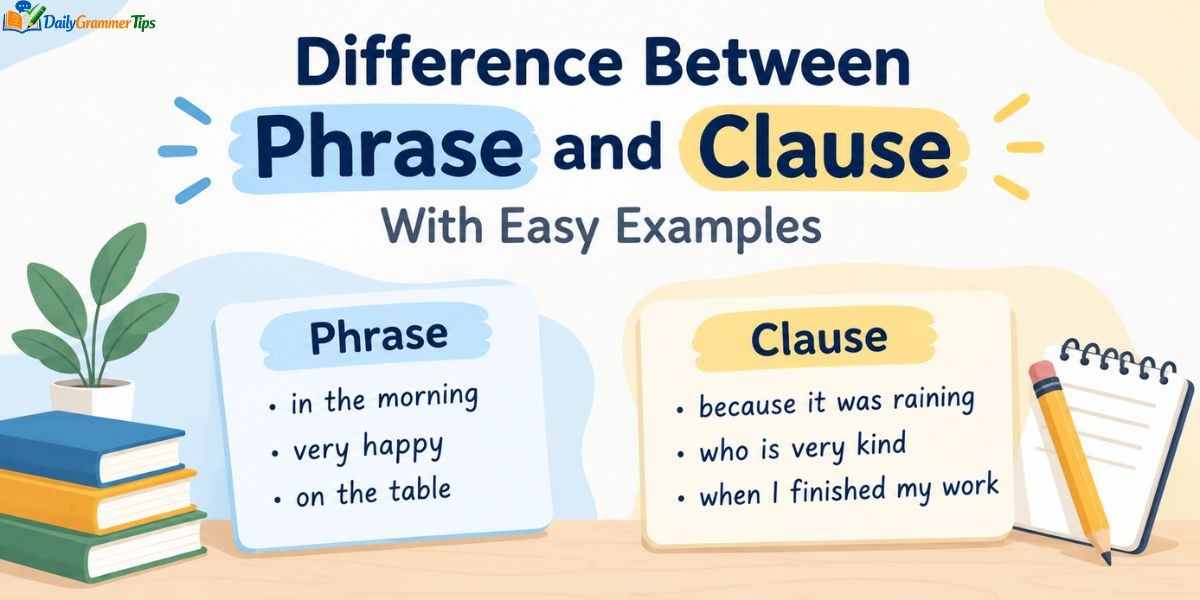
English sentences are made from different parts that work together to express complete ideas. Two important parts of English grammar are phrases and clauses.Many learners find it difficult to understand the difference between phrase and clause because both contain groups of words. However, they have different structures and purposes.
A phrase adds information to a sentence but does not contain a complete subject and verb combination. A clause contains a subject and a verb, and it may express a complete idea or need additional information.
What Is a Phrase?
A phrase is a group of words that works together but does not express a complete thought. It does not contain both a subject and a verb.Phrases usually provide extra details about a person, place, action, or idea. They make sentences more descriptive and meaningful.
For example:
“The student with a blue bag entered the classroom.”
In this sentence, “with a blue bag” is a phrase. It gives more information about the student, but it does not have its own subject and verb.
Another example:
“She completed the assignment in the evening.”
The phrase “in the evening” tells us when the action happened.
Phrases are common in everyday communication and professional writing because they help writers add details without creating unnecessary sentences.
What Is a Clause?
A clause is a group of words that contains a subject and a verb. It can express a complete idea or an incomplete idea depending on its type.
For example:
“The teacher explained the lesson.”
This is a clause because it contains:
- Subject: The teacher
- Verb: explained
It also expresses a complete thought, so it can work as a sentence.
Another example:
“Because the teacher explained the lesson”
This group of words also contains a subject and verb, but it does not give a complete idea. The reader expects more information.
A clause becomes clearer when it connects with another part of the sentence.
Example:
“Because the teacher explained the lesson, the students understood the topic.”
Here, the first part gives the reason, and the second part completes the meaning.
Difference Between Phrase and Clause
The main difference between phrase and clause is their structure.A phrase does not contain a complete subject and verb combination, while a clause contains a subject and a verb.Phrases usually work as parts of sentences. They describe, modify, or add extra information.
Clauses are stronger sentence elements because they express actions, events, or conditions.
Consider these examples:
Phrase: “After the meeting”
Clause: “After the meeting ended”
The first example is a phrase because it does not contain a verb. The second example is a clause because it includes the verb “ended.”
Another example:
Phrase: “The beautiful garden”
Clause: “The garden looks beautiful”
The phrase only describes something, while the clause gives complete information.
Why Understanding Phrase and Clause Is Important
A strong understanding of phrase and clause helps learners create better sentences. When writers know how these parts work, they can organize their ideas more effectively.Students use this knowledge when writing essays, assignments, and exam answers. English learners use it to improve grammar and sentence accuracy.
Professional writers also depend on correct sentence structure when creating articles, reports, emails, and other forms of communication.Good writing is not only about using advanced vocabulary. It is about arranging words correctly so readers can understand the message easily.
Types of Phrases in English Grammar

Phrases have different roles in sentences. Some describe nouns, some show actions, and others provide details about time, place, or manner.
Noun Phrase
A noun phrase works like a noun in a sentence. It usually includes a noun and words that describe it.
Example:
“The experienced teacher”
This phrase identifies a person and provides additional information.
Verb Phrase
A verb phrase includes the main verb and helping verbs. It shows an action or condition.
Example:
“has completed the project”
This phrase explains an action that has already happened.
Adjective Phrase
An adjective phrase describes a noun or pronoun.
Example:
“very useful”
This phrase adds information about something.
Adverb Phrase
An adverb phrase explains how, when, where, or why an action happens.
Example:
“with great confidence”
This phrase explains the manner of an action.
Prepositional Phrase
A prepositional phrase begins with a preposition and provides information about location, time, or relationship.
Example:
“under the table”
This phrase explains a place.
Types of Clauses in English Grammar
Clauses are mainly divided into two categories: independent clauses and dependent clauses. Both types contain a subject and a verb, but they work differently in sentences.Understanding these types makes the difference between phrase and clause easier to recognize.
Independent Clause
An independent clause expresses a complete thought and can stand alone as a sentence.
Examples:
“The company launched a new product.”
“The students completed their assignment.”
Both examples provide complete information. They contain a subject, a verb, and a clear meaning.Independent clauses are the foundation of simple sentences. They can also combine with dependent clauses to create more detailed sentences.
Dependent Clause
A dependent clause contains a subject and a verb but cannot express a complete thought by itself.
Examples:
“Although the weather was cold”
“Because she worked hard”
These examples leave the reader waiting for more information.
A dependent clause needs an independent clause to complete its meaning.
Example:
“Although the weather was cold, the players continued the match.”
The dependent clause adds extra information, while the independent clause provides the main message.
Noun Clause
A noun clause works as a noun in a sentence. It can act as the subject or object of a sentence.
Example:
“What he explained was helpful.”
In this sentence, “what he explained” works as the subject.
Another example:
“I understand what you mean.”
Here, the noun clause works as the object.
Adjective Clause
An adjective clause describes a noun or pronoun. It gives additional information about a person, place, or thing.
Example:
“The book that I purchased yesterday is interesting.”
The clause “that I purchased yesterday” describes the book.
Adjective clauses help writers add details without creating separate sentences.
Adverb Clause
An adverb clause explains the reason, time, condition, or purpose of an action.
Example:
“Because the student practiced regularly, her writing improved.”
The adverb clause explains the reason for improvement.These clauses are common in academic and professional writing because they help connect ideas logically.
How to Identify a Phrase or Clause
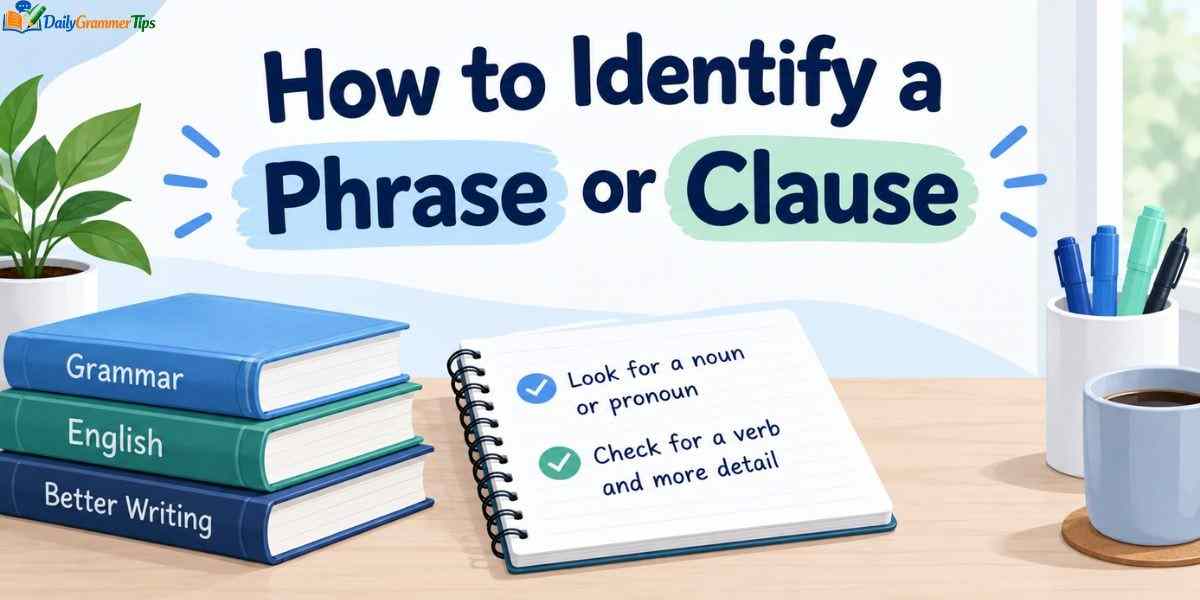
Many learners confuse phrases and clauses because both are groups of words. You can identify them by checking their structure and meaning.
Check for Subject and Verb
The easiest way to identify the difference between phrase and clause is to look for a subject and verb.
Example:
“After the class”
This is a phrase because it does not contain a verb.
“After the class ended”
This is a clause because it contains:
Subject: The class
Verb: ended
Learn more………Examples of Complex Sentences in Professional Writing: A Complete Guide
Check Whether It Gives a Complete Meaning
A complete thought can stand alone as a sentence.
Example:
“She finished her work.”
This is an independent clause because it gives complete information.
Example:
“Because she finished her work”
This is a dependent clause because it needs more information.
Look at Its Function
A phrase usually adds description or details.
Example:
“The man in the black coat entered the room.”
The phrase “in the black coat” describes the man.
A clause usually explains an action or situation.
Example:
“The man who wore a black coat entered the room.”
The clause “who wore a black coat” contains a subject and verb.
Phrase and Clause Examples in Professional Writing
Professional writing requires clear sentence structure. Writers use phrases and clauses to explain ideas, provide details, and make information easier to understand.
Consider this example:
“The manager approved the proposal after reviewing the details.”
The phrase “after reviewing the details” explains when the action happened.
Now consider:
“The manager approved the proposal because the details were accurate.”
The clause “because the details were accurate” explains the reason behind the decision.
Both structures improve writing by connecting information naturally.
In business communication, clauses help explain decisions and processes. Phrases help add descriptions and important details.
For example:
“The company with international clients expanded its services.”
The phrase “with international clients” provides additional information about the company.
Another example:
“Because customer needs changed, the company updated its strategy.”
The clause explains the reason for the change.
Common Mistakes When Using Phrases and Clauses
Understanding grammar rules helps learners avoid common mistakes.
Mistake 1: Using a Phrase as a Complete Sentence
Incorrect:
“After the meeting.”
This is only a phrase because it does not express a complete idea.
Correct:
“After the meeting, the team discussed the results.”
The complete sentence now includes an action.
Mistake 2: Confusing Dependent Clauses With Sentences
Incorrect:
“Although the project was successful.”
This is a dependent clause, but it does not complete the message.
Correct:
“Although the project was successful, the team continued improving the process.”
The independent clause completes the idea.
Mistake 3: Missing the Subject or Verb
Incorrect:
“Because was difficult.”
This group of words does not form a correct clause.
Correct:
“Because the task was difficult, the students needed more time.”
The subject and verb create a complete structure.
Mistake 4: Adding Too Many Clauses in One Sentence
Long sentences with many clauses can confuse readers.Good writing uses a balance between short and detailed sentences.A clear sentence structure helps readers understand information without difficulty.
How Phrase and Clause Improve Writing Skills
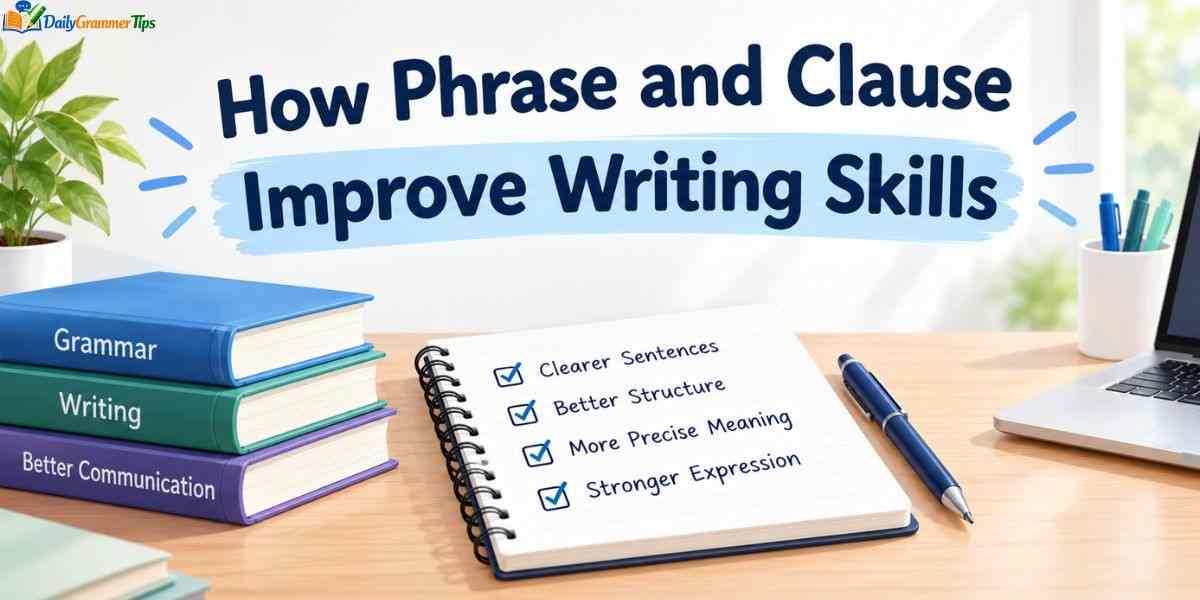
Learning phrase and clause structures improves both grammar and communication skills.When writers understand phrases, they can add useful details without making sentences repetitive.When writers understand clauses, they can connect ideas and explain relationships between different points.
For example, instead of writing:
“The company changed its plan. Customer needs were different.”
A writer can create a stronger sentence:
“The company changed its plan because customer needs were different.”
The second sentence creates a clear connection between the ideas.
Students preparing for exams such as IELTS and other English tests can also improve their writing by using different sentence structures correctly.
Practice: Understanding Phrase and Clause Through Examples
The best way to understand grammar is to observe how words work inside real sentences. Instead of memorizing definitions, learners should focus on how phrases and clauses add meaning.
Consider these examples:
The student with excellent writing skills won the competition.
The phrase “with excellent writing skills” gives extra information about the student. It does not contain a subject and verb, so it cannot work as a complete sentence.
The student who practiced every day won the competition.
The words “who practiced every day” form a clause because they contain a subject and a verb. This clause describes the student.
Another example:
The company introduced a new policy during the meeting.
The phrase “during the meeting” explains the time of the action.
The company introduced a new policy after employees shared their concerns.
The clause “after employees shared their concerns” explains when the action happened.
These examples show that phrases mainly add details, while clauses help explain actions and relationships between ideas.
Difference Between Phrase and Clause in Simple Words
The easiest way to remember the difference between phrase and clause is to focus on one question:
Does the group of words have a subject and a verb?
If the answer is no, it is usually a phrase.
Example:
“in the classroom”
This group of words does not contain a subject or verb.
If the answer is yes, it is a clause.
Example:
“students study in the classroom”
This group contains:
- Subject: students
- Verb: study
A phrase usually depends on another part of a sentence. A clause may work independently or may need support from another clause.
Phrase and Clause in Everyday Communication
People use phrases and clauses every day without thinking about grammar rules. These structures appear in conversations, emails, articles, and professional communication.
For example:
“I will call you after work.”
The phrase “after work” gives information about time.
“I will call you after I finish my work.”
The clause “after I finish my work” gives a complete action with a subject and verb.
Both sentences are correct, but the second one provides more information.
Phrase and Clause for English Learners
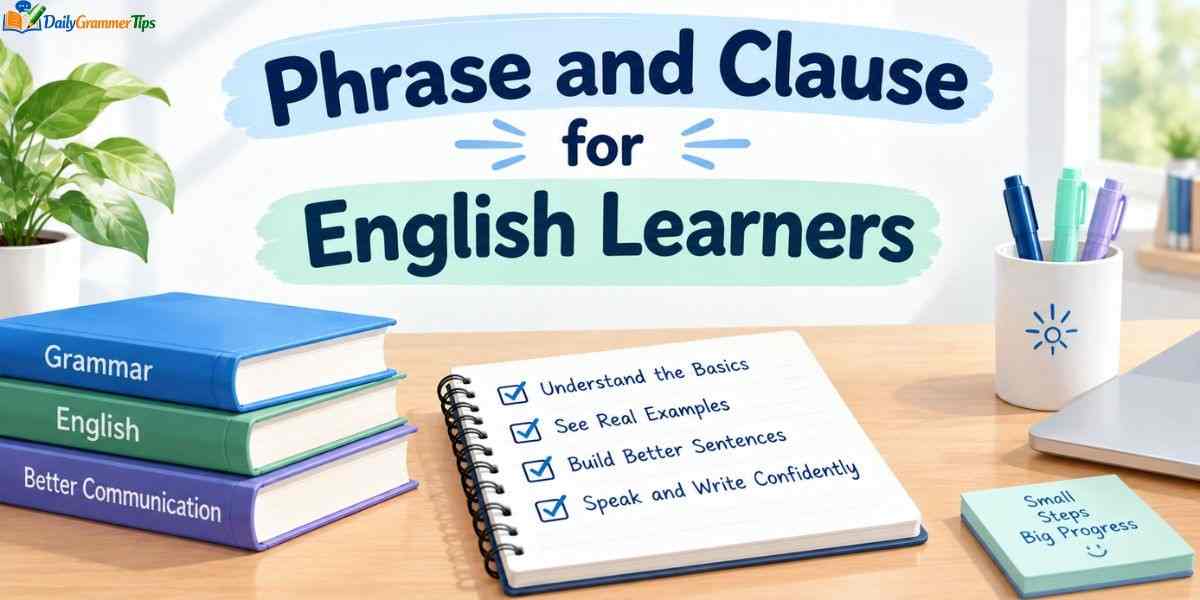
English learners often struggle with sentence formation because they try to translate ideas directly from their first language.Understanding phrase and clause structures helps learners create natural English sentences.
When learners know how clauses work, they can build longer and more organized sentences.When they understand phrases, they can add descriptions and details correctly.
This knowledge is especially useful for:
- academic writing
- professional emails
- essays
- IELTS and TOEFL writing tasks
A strong grammar foundation helps learners communicate with more confidence.
Frequently Asked Questions
What are 5 examples of clauses and phrases?
Examples of phrases include “in the garden,” “after lunch,” and “a beautiful house.” Examples of clauses include “she writes well,” “because he studied,” and “when the class ended.”
Is “I love you” a phrase or sentence?
“I love you” is a sentence because it contains a subject, verb, and complete meaning.
Can you give me 10 examples of phrases?
Examples include “in the morning,” “under the table,” “with great care,” “a talented writer,” “after the meeting,” “near the river,” “very quickly,” “during the holiday,” “by the window,” and “without hesitation.”
How to identify a phrase or clause?
Look for a subject and verb. A phrase does not contain a complete subject-verb structure, while a clause contains both.
What is the difference between a clause and a phrase?
A clause contains a subject and verb, while a phrase is a group of words without a complete subject and verb combination.
Why are phrases and clauses important in English?
Phrases and clauses help writers create clear sentences, organize ideas, and communicate information effectively.
Conclusion
Understanding the difference between phrase and clause makes English grammar easier and improves sentence-building skills. Phrases add useful details, while clauses express actions, ideas, and relationships between information.
When learners understand how these structures work, they can write clearer essays, professional messages, and accurate English sentences. Regular practice with real examples helps develop stronger grammar skills over time.
