

Subordinating conjunctions turn short sentences into smooth, connected ideas. They link a main idea to extra detail about time, reason, contrast, or condition. Without them, our writing would sound choppy and robotic.
This guide explains subordinating conjunctions in plain words. You will see the full lists, the rules, and the common mistakes. Clear examples and practice exercises will help each point stay in your mind.
What Are Subordinating Conjunctions?
Subordinating conjunctions are words that introduce a dependent clause. They connect that clause to a main clause. Common examples are because, although, if, when, and while.
Look at this sentence: “She stayed home because it rained.” The word “because” links “it rained” to the main idea.
Simple Definition of a Subordinating Conjunction
A subordinating conjunction joins a dependent clause to an independent clause. It shows how the two ideas relate to each other.
The dependent clause cannot stand alone. It needs the main clause to make full sense.
How Subordinating Conjunctions Work
Subordinating conjunctions sit at the start of the dependent clause. They make that clause depend on the main clause. This creates a complex sentence.
Take two simple sentences: “I was tired. I kept working.” Join them: “Although I was tired, I kept working.”
Subordinate Clauses Explained
To use these words well, you need to understand clauses. A clause is a group of words with a subject and a verb.
There are two kinds. One can stand alone, and the other cannot.
Independent Clause
An independent clause makes complete sense alone. Example: “The dog barked.” It has a subject, a verb, and a full idea.
It forms the backbone of a complex sentence.
Dependent Clause
A dependent clause cannot stand alone. Example: “because the dog barked.” It leaves the reader waiting for more.
People also call it a subordinate clause.
Complex Sentence
A complex sentence has one independent clause and at least one dependent clause. Example: “The neighbors complained because the dog barked.”
The subordinator is the bridge between the two clauses.
Types of Subordinating Conjunctions
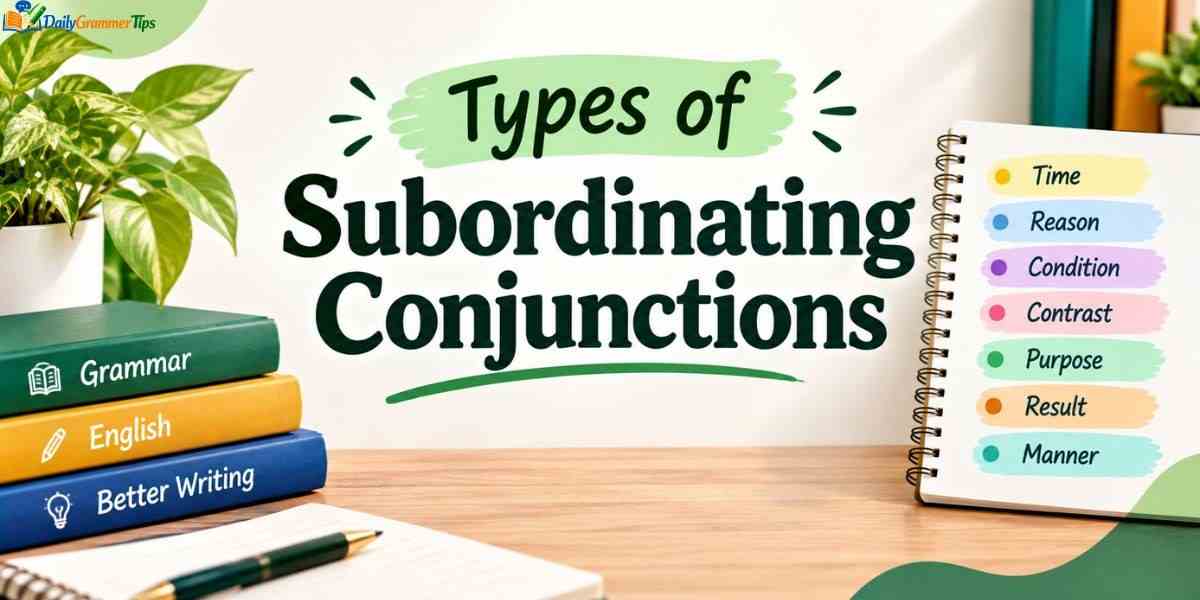
Subordinating conjunctions fall into groups based on the idea they show. The main groups are time, reason, contrast, condition, purpose, and place.
Each group answers a different question.
Time
Time conjunctions show when something happens. Common ones are after, before, when, while, until, since, and once.
Example: “We left before the rain started.”
Cause and Reason
These words show why something happens. Common ones are because, since, as, and now that.
Example: “He smiled because he passed.”
Contrast
Contrast conjunctions show a surprising or opposite idea. Common ones are although, though, even though, and whereas.
Example: “Although it was late, she kept reading.”
Condition
Condition conjunctions show what must happen first. Common ones are if, unless, even if, as long as, and provided that.
Example: “Unless you hurry, you will miss the train.”
Purpose and Result
These words show the goal of an action. Common ones are so that, in order that, and lest.
Example: “He saved money so that he could travel.”
Place
Place conjunctions show where something happens. Common ones are where and wherever.
Example: “Wherever she goes, she makes friends.”
List of 12 Subordinating Conjunctions
Here are twelve of the most common subordinating conjunctions. Each one comes with a short example.
- After: We ate after the guests arrived.
- Although: Although it was hot, we played outside.
- As: She smiled as she opened the gift.
- Because: He left early because he felt sick.
- Before: Wash your hands before you eat.
- If: If you try, you will succeed.
- Since: I have lived here since I was born.
- Though: Though he was tired, he helped us.
- Unless: You will fail unless you study.
- Until: Wait here until I return.
- When: Call me when you arrive.
- While: She read a book while he cooked.
List of 20 Subordinating Conjunctions
This longer list adds more useful subordinating conjunctions to your toolkit. Learn them in groups for faster recall.
Some of these are single words. Others, like “as soon as” and “even though,” are phrases.
- after
- although
- as
- as soon as
- because
- before
- even though
- if
- once
- since
- so that
- though
- unless
- until
- when
- whenever
- where
- whereas
- whether
- while
List of 50 Subordinating Conjunctions
This master list covers fifty subordinating conjunctions in seven groups. Some are phrases that work as one unit.
11 Conjunctions of Time
- after
- before
- as soon as
- once
- since
- until
- till
- when
- whenever
- while
- by the time
6 Conjunctions of Reason
- because
- as
- now that
- in that
- seeing that
- inasmuch as
6 Conjunctions of Contrast
- although
- though
- even though
- whereas
- much as
- whilst
11 Conjunctions of Condition
- if
- unless
- even if
- as long as
- so long as
- provided that
- providing that
- on condition that
- in case
- assuming that
- supposing that
7 Conjunctions of Purpose, Result, and Manner
- so that
- in order that
- lest
- such that
- as if
- as though
- just as
3 Conjunctions of Place
- where
- wherever
- everywhere
6 Conjunctions for Noun Clauses and Extent
- whether
- whether or not
- that
- how
- no matter how
- as far as
Subordinating Conjunctions Examples
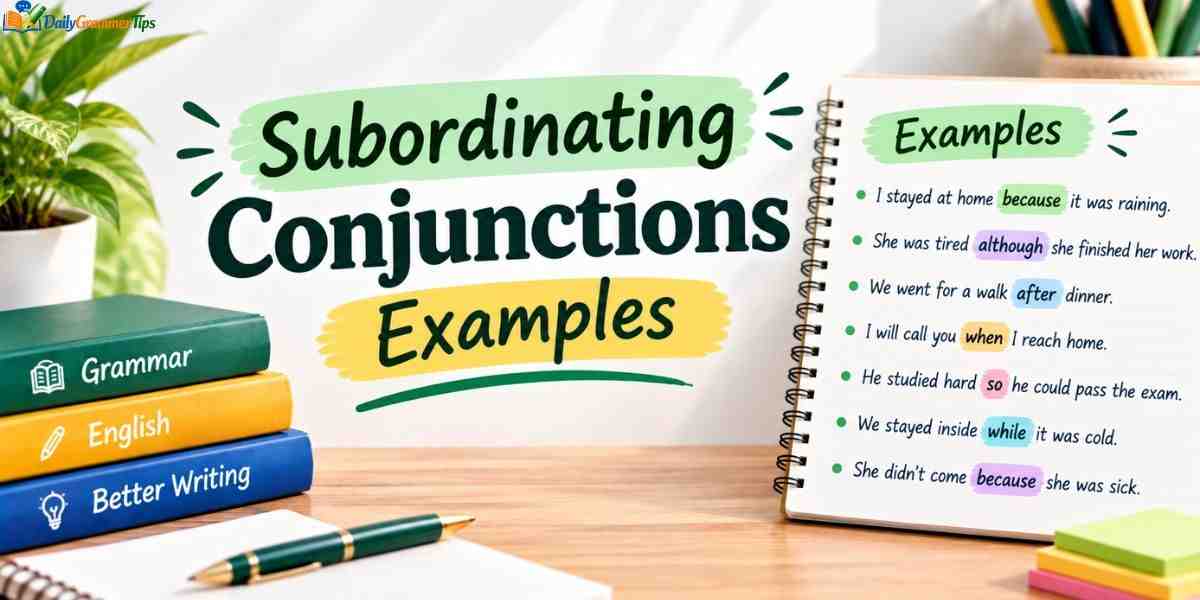
Examples show how subordinating conjunctions behave in real sentences. The lists below group them by meaning.
Examples of Time
- We will eat after the show ends.
- Lock the door before you leave.
- She called as soon as she landed.
- Wait here until the bus arrives.
- Whenever he travels, he writes a diary.
- Once the sun sets, the park closes.
Examples of Reason
- She passed because she studied daily.
- Since it was late, we went home.
- As he was tired, he slept early.
- Now that she knows the rules, she writes better.
Examples of Contrast
- Although he tried, he failed.
- Though it was cold, we walked.
- Even though she was sick, she came.
- He likes tea, whereas she likes coffee.
Examples of Condition
- If it rains, we will stay home.
- Unless you call, I will not come.
- You may go as long as you finish your work.
- Even if he apologizes, she will not forgive him.
Examples of Purpose and Place
- She saved money so that she could buy a car.
- He ran fast lest he miss the train.
- Sit where you like.
- Wherever we went, people smiled.
Learn more…………Proper Nouns: Definition, Rules, Types, and Examples
20 Examples of Subordinate Clauses
Here are twenty sentences with subordinate clauses. The clause appears after each sentence.
- Although it was cold, we went swimming. Clause: although it was cold
- She smiled because she won the prize. Clause: because she won the prize
- If you study hard, you will pass. Clause: if you study hard
- I will call you when I arrive. Clause: when I arrive
- He stayed home since he felt sick. Clause: since he felt sick
- We waited until the rain stopped. Clause: until the rain stopped
- Unless you hurry, you will miss the bus. Clause: unless you hurry
- Before she left, she locked the door. Clause: before she left
- They played football while the sun was shining. Clause: while the sun was shining
- After the movie ended, we went home. Clause: after the movie ended
- Though he was tired, he finished the work. Clause: though he was tired
- Once you learn the rules, grammar feels easy. Clause: once you learn the rules
- She sings as if nobody is listening. Clause: as if nobody is listening
- Wherever you go, I will follow. Clause: wherever you go
- He studied hard so that he could pass the exam. Clause: so that he could pass the exam
- Whenever it rains, the streets flood. Clause: whenever it rains
- As soon as the bell rang, the students left. Clause: as soon as the bell rang
- I do not know whether he will come. Clause: whether he will come
- Even though she was nervous, she spoke well. Clause: even though she was nervous
- We will stay inside provided that the storm continues. Clause: provided that the storm continues
Subordinating Conjunctions and Commas
Subordinating conjunctions follow a simple comma rule. When the dependent clause comes first, add a comma after it.
When the dependent clause comes second, skip the comma in most cases. Compare “Although it rained, we played” with “We played although it rained.”
Subordinating Conjunctions vs Coordinating Conjunctions
Subordinating conjunctions join unequal clauses, while coordinating conjunctions join equal ones. This is the key difference.
Coordinating conjunctions are for, and, nor, but, or, yet, and so. Example: “I was tired, but I kept working.” Compare it with “Although I was tired, I kept working.”
Subordinating Conjunctions vs Prepositions
Some subordinating conjunctions also work as prepositions. Examples are after, before, since, and until. The word that follows tells you which role they play.
A preposition takes a noun. A conjunction takes a full clause. Compare “after dinner” with “after we ate dinner.”
- Preposition: We left before noon.
- Conjunction: We left before the rain started.
Common Mistakes With Subordinating Conjunctions
Even strong writers slip with subordinating conjunctions. Most errors involve fragments, double connectors, and missing commas.
Learn the common ones below.
Writing a Sentence Fragment
A dependent clause alone is a fragment. Join it to a main clause.
- Wrong: Because I was late.
- Right: I apologized because I was late.
Using Two Connectors Together
Do not use a subordinating word and a coordinating word for the same link.
- Wrong: Although he was tired, but he worked.
- Right: Although he was tired, he worked.
Forgetting the Comma
Add a comma after an opening dependent clause.
- Wrong: When the bell rang the students left.
- Right: When the bell rang, the students left.
Using Because With So
One connector is enough for one link.
- Wrong: Because it rained, so we stayed home.
- Right: Because it rained, we stayed home.
Mixing Up If and Whether
Use “whether” for choices. Use “if” for conditions.
- Wrong: I wonder if or not he agrees.
- Right: I wonder whether or not he agrees.
Tips to Use Subordinating Conjunctions Correctly
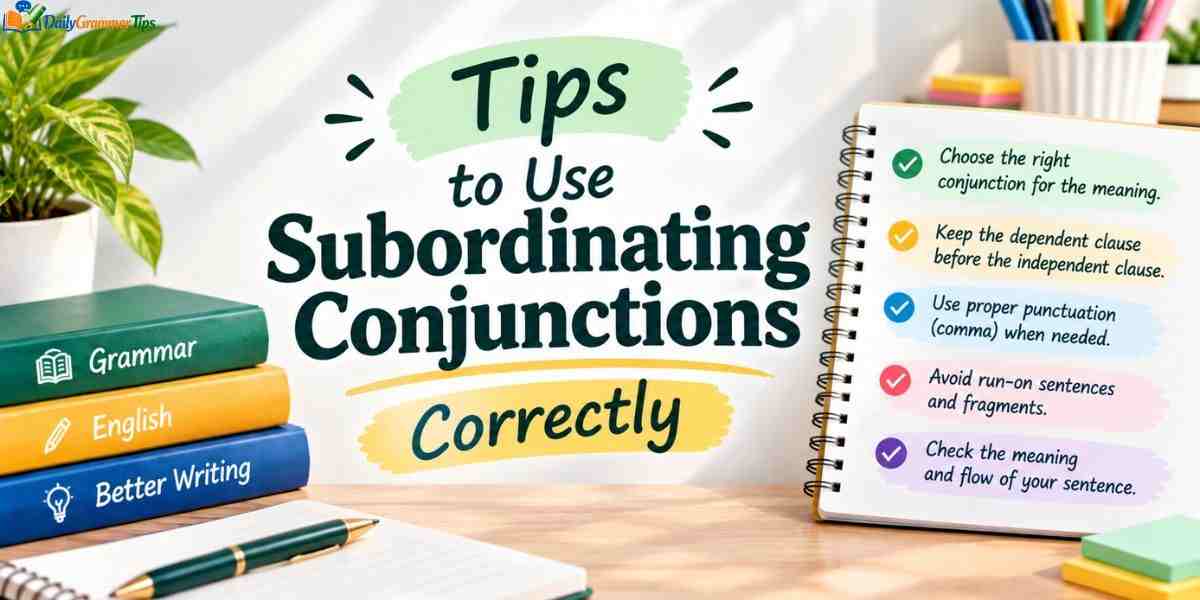
A few habits help you use subordinating conjunctions with ease. Each tip takes only a minute.
Pick the Right Meaning
Choose a word that matches your idea. Use “because” for reason and “although” for contrast.
Vary Your Sentence Openers
Start some sentences with a dependent clause. Example: “After the storm passed, we went out.”
Do not overuse this pattern. One or two per paragraph is enough.
Keep Clauses Short
Long clauses bury the main idea. Split a sentence when it grows heavy.
Check for Fragments
Read the clause alone. If it leaves you waiting for more, join it to a main clause.
Subordinating Conjunctions for English Learners
Learners often mix up subordinating conjunctions with other connectors. Regular practice makes the difference clear.
Small daily steps bring steady progress.
Start With the Basics
Master because, although, if, when, and while first. They cover most daily sentences.
Combine Short Sentences
Take two short sentences. Join them with a subordinator. Example: “It rained. We stayed home.” becomes “We stayed home because it rained.”
Read and Notice
Read stories and news. Mark each subordinator you see. Notice where the comma goes.
Keep a Personal List
Write new words in a notebook with one example each. Review the list every week.
Practice Exercises on Subordinating Conjunctions
These short exercises will test your skill with subordinating conjunctions. Try them before you read the answers.
Each exercise has five questions.
Exercise 1: Fill in the Blank
Choose from because, although, if, when, or until.
- (blank) it was raining, we played outside.
- I will wait (blank) you finish.
- She was happy (blank) she won.
- (blank) you study, you will pass.
- Call me (blank) you arrive.
Exercise 2: Join the Sentences
Join each pair with the word in brackets.
- He was tired. He kept working. (although)
- It rained. We stayed inside. (because)
- You hurry. You will miss the bus. (unless)
- The bell rang. The students left. (as soon as)
- She saved money. She wanted to travel. (so that)
Answers
Here are the correct answers.
- Exercise 1: Although, until, because, If, when.
- Exercise 2, one: Although he was tired, he kept working.
- Exercise 2, two: We stayed inside because it rained.
- Exercise 2, three: You will miss the bus unless you hurry.
- Exercise 2, four: The students left as soon as the bell rang.
- Exercise 2, five: She saved money so that she could travel.
Why Subordinating Conjunctions Matter
Subordinating conjunctions give your writing rhythm and depth. They let you show cause, contrast, time, and condition in one smooth sentence.
Strong writers use subordinating conjunctions to avoid choppy text. They keep readers engaged from the first line to the last.
They Add Depth
Compare “I stayed home” with “I stayed home because I was sick.” The second sentence gives a reason.
They Improve Flow
Joined ideas move naturally. Readers glide from one point to the next.
Frequently Asked Questions
What Are the 12 Subordinating Conjunctions?
Twelve common ones are after, although, as, because, before, if, since, though, unless, until, when, and while.
What Is a Subordinating Conjunction and Examples?
It is a word that links a dependent clause to a main clause. Examples include because, although, and if.
What Are the 20 Subordinating Conjunctions?
You can find twenty in the list above. Examples include after, because, even though, unless, and whenever.
What Are the 50 Subordinating Conjunctions?
You can find fifty in the grouped list above. They cover time, reason, contrast, condition, purpose, place, and more.
Can You Give Me 20 Examples of Subordinate Clauses?
Yes. The section above has twenty sentences with the clause named. One is “Although it was cold, we went swimming.”
Conclusion
Subordinating conjunctions are small words with a big job. They connect dependent clauses to main clauses and show how ideas relate. You now know the lists, the types, and the common mistakes.
Keep practicing subordinating conjunctions in your daily writing. Join short sentences, check each comma, and read your work aloud. Your style will feel smoother and more confident with every sentence.
