

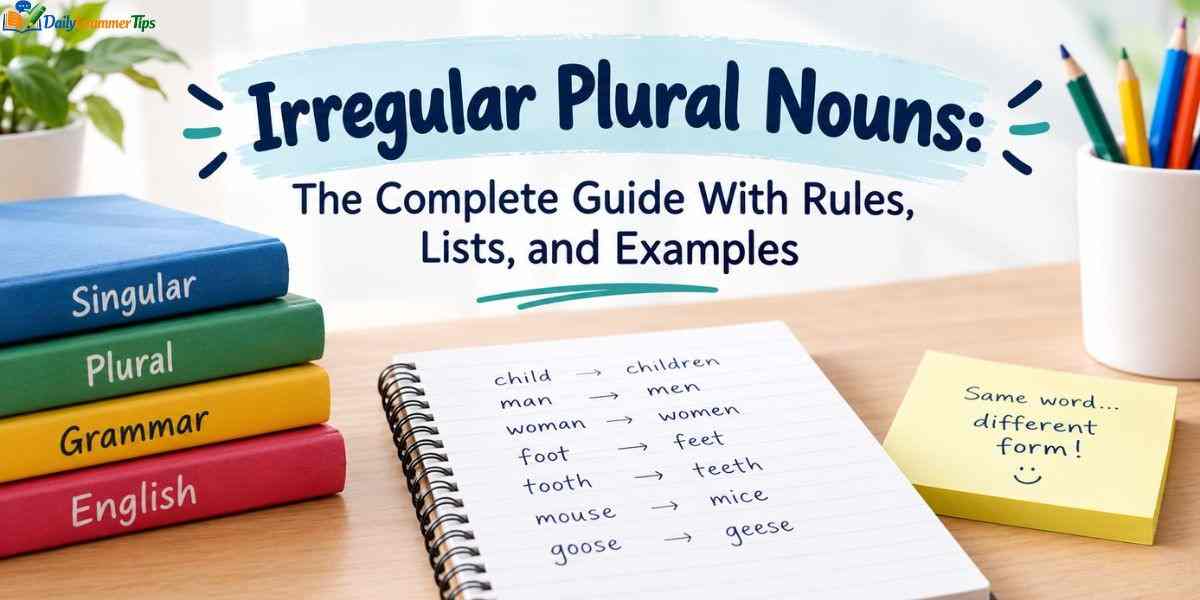
Add an -s, and one cat becomes two cats. Easy. Then you meet one mouse and two mice, and the rule falls apart. Irregular plural nouns do that to everyone, from second graders to college students.
This guide walks you through each pattern, one step at a time. You get clear rules, real examples, and tricks that make the forms stick.
What Are Irregular Plural Nouns?
A plural noun names more than one person, place, or thing. Most nouns add -s or -es to show that. A noun is irregular when it breaks the pattern.
Some irregular nouns change spelling, like leaf and leaves. Others change a vowel, like tooth and teeth. A few never change at all, like deer.
Regular Plurals: A Quick Refresher
Regular plurals follow rules you can predict. Most nouns take -s. Nouns that end in s, x, z, ch, or sh take -es.
Words that end in a consonant plus y change the y to i and add -es. Hundreds of words follow that rule, so it counts as regular.
| Ending | Rule | Example |
| Most nouns | Add -s | dog → dogs |
| s, x, z, ch, sh | Add -es | bus → buses, dish → dishes |
| Consonant + y | Change y to i, add -es | city → cities, baby → babies |
| Vowel + y | Add -s | toy → toys, day → days |
Why Do Irregular Plural Nouns Exist in English?
English borrowed words from many languages over more than a thousand years. Old English gave us forms like feet and men. Latin, Greek, and French added their own plural endings.
Everyday words kept their old plurals because people said them all the time. Newer words slid into the simple -s pattern. That is why foot becomes feet, but boot becomes boots.
Where You Meet Irregular Plural Nouns Every Day
You use these words when you talk about family, food, animals, and science. Teachers also test them, from early spelling lists to high school essays.
Family words change often. Child becomes children, man becomes men, and woman becomes women. Body words change too: one foot, two feet. Animals add more, like mice, geese, and sheep. The kitchen has knives, loaves, and shelves, and science class has bacteria and nuclei.
Three Quick Ways to Spot an Irregular Plural
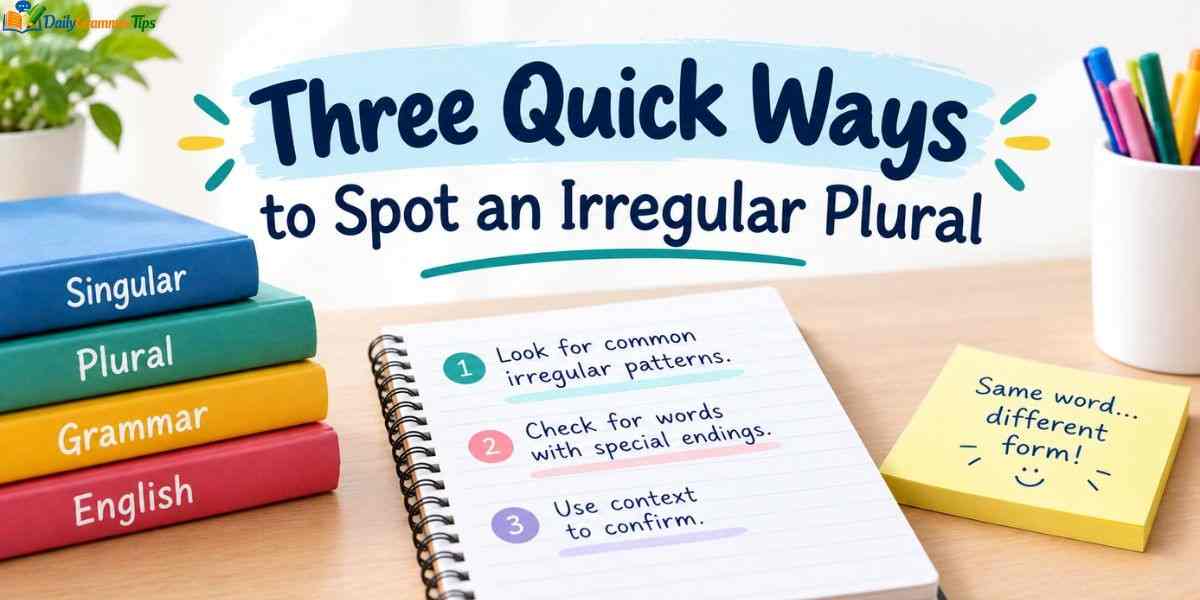
Look at the ending first. If a plural does not end in -s or -es, it is probably irregular. Then check the spelling for inner changes, like the oo in foot turning into ee in feet.
Also ask whether the word came from Latin or Greek, because science words often did. These checks are not perfect, so keep a dictionary close. Any good dictionary lists the plural form of tricky nouns.
The Main Types of Irregular Plural Nouns at a Glance
Nine patterns cover the words you will meet most often. The next sections explain each one in order.
Here is the map. Words that end in -f or -fe take -ves, and a few old words shift their vowels, like goose and geese. A few take -en, some never change, and some exist only in the plural. Latin and Greek words use -i, -es, and -a, while some -o words add -es.
Irregular Plural Nouns That End in -f or -fe
Many nouns that end in -f or -fe change to -ves in the plural. Switch the f to a v. Then add -es to words that end in -f, and -s to words that end in -fe.
Say the word out loud. The final sound changes from f to v. That sound shift is your clue.
Leaf, Wolf, Half, and Shelf
Leaf becomes leaves. The leaves turn red in October. Wolf becomes wolves, and wolves howl at night. Half becomes halves, so cut the sandwich into halves. Shelf becomes shelves, and the books fill three shelves.
Loaf, Thief, Calf, Life, Knife, and Elf
Loaf becomes loaves, and the bakery sells fresh loaves. Thief becomes thieves, and the police caught two thieves. Calf becomes calves. Life becomes lives, and nurses save lives every day. Knife becomes knives, so keep sharp knives out of reach. Elf becomes elves.
Words That Break the -f Rule
Not every word with -f follows this pattern. Roof, chief, cliff, belief, chef, and safe just add -s. You never hear a v sound in them, so write roofs, chiefs, cliffs, beliefs, chefs, and safes.
A few words work both ways. Scarf can be scarfs or scarves, and hoof can be hoofs or hooves. Most writers choose scarves and hooves. Dwarf also takes two forms: dwarfs and dwarves.
Irregular Plural Nouns That Change Their Vowels
Some of the oldest English words change a vowel inside the word. Nothing gets added at the end. Foot becomes feet, and goose becomes geese.
These irregular plural nouns are short and common, so you will use them every day. Linguists call the old pattern i-mutation. You do not need the term. You just need the list.
Man, Woman, Foot, and Tooth
Man becomes men, so two men fixed the roof. Woman becomes women, and many women run small businesses. Foot becomes feet, and my feet hurt after the hike. Tooth becomes teeth, so brush your teeth twice a day.
Goose, Mouse, and Louse
Goose becomes geese, and geese fly south in the fall. Mouse becomes mice, and mice hide in the walls. Louse becomes lice, so the nurse checked the kids for lice.
How Compound Words Handle Vowel Changes
Compound nouns follow their base word. Snowman becomes snowmen. Policewoman becomes policewomen. Many American writers now choose neutral terms, like police officers.
Say women out loud. It sounds like WIM-in, not WOH-men. That odd pronunciation trips up many English learners.
Foot or Feet? The Measurement Trap
Here is a tricky one. You say a six-foot fence, but you say the fence is six feet tall. A measurement stays singular when it works as an adjective before a noun.
She climbed a ten-foot ladder, but the ladder stands ten feet tall. He built a two-foot shelf, but the shelf measures two feet long.
Quick Practice: -ves and Vowel Changes
Try these irregular plural nouns on your own. Write the plural of wolf, foot, life, mouse, half, and woman, then check the answers below.
Answers: wolves, feet, lives, mice, halves, women.
Irregular Plural Nouns That Add -en
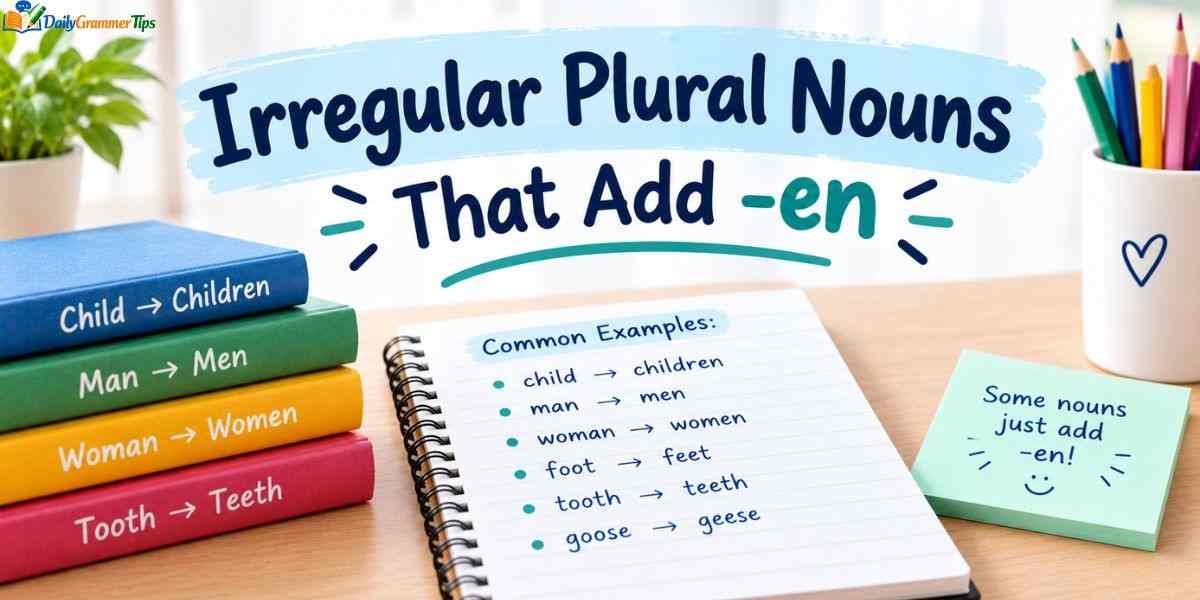
Only a few nouns still use an -en ending. Child becomes children, and ox becomes oxen. These are old forms that survived for centuries.
Brother has a rare plural, brethren, but you will mostly see it in religious writing. In daily life, just write brothers.
Person, People, and Peoples
People is the everyday plural of person. Three people waited in line. Persons shows up in legal and formal writing, like “persons of interest.”
Peoples means separate nations or ethnic groups. The peoples of the Pacific share many traditions. Use it only in that sense.
Irregular Plural Nouns That Never Change
Some nouns look the same in the singular and the plural. Context tells you how many. One sheep ate. Two sheep ate.
Many of these words name animals that people hunted or herded. A few name ideas, like series and species.
Sheep, Deer, and Moose
One sheep grazes, and ten sheep graze. A deer crossed the road, and six deer crossed the road. The moose waded in, and two moose waded in.
Salmon, Series, Species, and Aircraft
She caught a salmon, then she caught four salmon. The series ends tonight, and three series aired last year. This species is rare, and many species are rare. One aircraft landed, and five aircraft landed.
Fish or Fishes?
Use fish when you mean more than one fish. We caught five fish. Use fishes when you mean several kinds of fish. The reef holds many colorful fishes.
Scientists use fishes this way. Most other writers stick with fish.
Why Do Some Animal Nouns Stay the Same?
Many of these words come from Old English neuter nouns. Those nouns had no plural ending at all. Sheep, deer, and swine kept that habit.
Modern English never reset the pattern. So the old forms still sit beside newer, regular ones.
Irregular Plural Nouns With No Singular Form
Some nouns exist only in the plural. They usually name tools or clothes with two matching parts. You cannot say one scissor or one pant. Think of scissors, pants, jeans, shorts, glasses, binoculars, tweezers, and pliers.
Add a pair of when you mean a single item. A pair of scissors sits on the desk. Use a plural verb when you drop the phrase. The scissors are sharp.
Plural-Only Words for Groups and Ideas
Other plural-only nouns name groups, goods, or ideas. They also take plural verbs. My groceries are in the car. His earnings are growing.
More examples include clothes, thanks, congratulations, belongings, savings, groceries, earnings, and outskirts.
Singular Nouns That End in -s
Some words end in -s but act as singular nouns. They take singular verbs. The news is good. Mathematics is my favorite class.
Other examples include physics, economics, and measles. Treat each one as a single thing.
Quick Practice: Same Form, Plural-Only, and -en
This practice mixes the irregular plural nouns from this section. Pick the right word in each sentence, then check the answers.
The farmer feeds three (sheep / sheeps). Two (child / children) built a fort. I bought a new (pair of pants / pant). The (news / newses) airs at six. Answers: sheep, children, pair of pants, news.
Irregular Plural Nouns From Latin and Greek
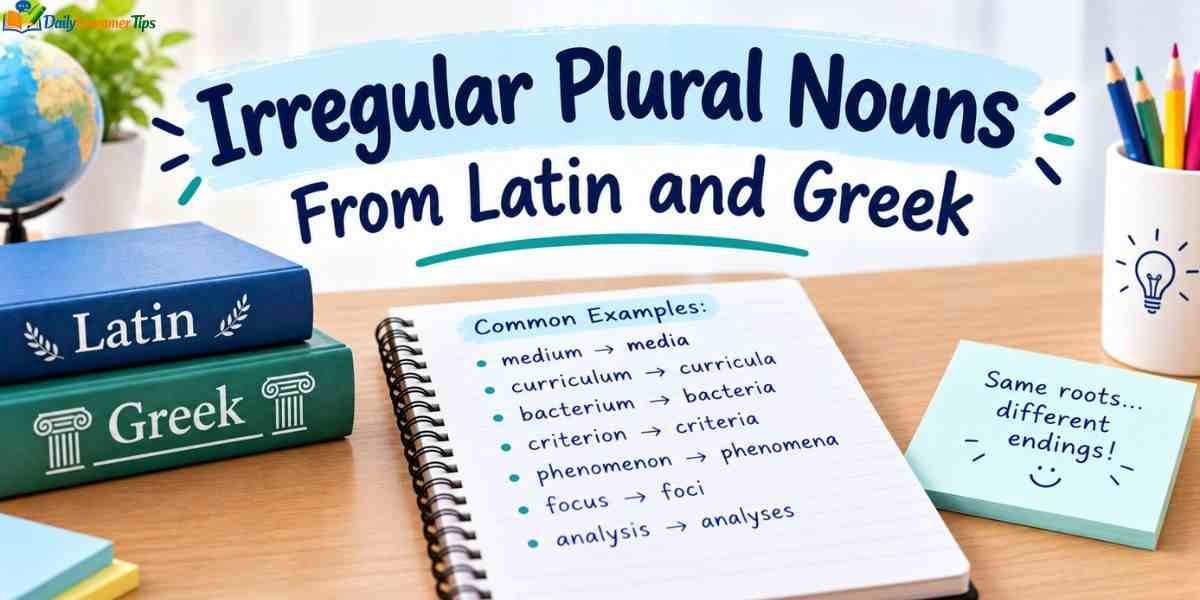
Science, medicine, and school subjects borrow heavily from Latin and Greek. Those languages brought their own plural endings along. Writers call these forms classical plurals.
Some borrowed words now take a regular -s plural too. Check the context, and pick the form your reader expects.
Words That End in -us
Drop the -us and add -i. One cactus becomes two cacti. Most speakers say that final -i like the word eye.
- cactus → cacti or cactuses: The garden has three cacti.
- nucleus → nuclei: Cells contain nuclei.
- fungus → fungi: Fungi grow in damp soil.
- alumnus → alumni: The alumni gather every June.
- stimulus → stimuli: The lab tested several stimuli.
- syllabus → syllabi or syllabuses: The professor posted two syllabi.
Exceptions: -us Words That Take -es
Not every -us word comes from Latin. Bus becomes buses. Campus becomes campuses. Virus becomes viruses. Do not write campi or viri.
Octopus is a famous trap. Octopuses is the safest choice. Octopi is common, but it comes from a mistaken Latin rule. The word actually comes from Greek.
Irregular Plural Nouns That End in -is
Change -is to -es. One crisis becomes two crises. Say the plural like KRY-seez, with a long e sound at the end.
- analysis → analyses: Two analyses reached the same result.
- crisis → crises: The city faced several crises.
- thesis → theses: Graduate students write long theses.
- diagnosis → diagnoses: Doctors made three diagnoses.
- hypothesis → hypotheses: Scientists test their hypotheses.
- basis → bases: We checked the bases of each claim.
- oasis → oases: The desert hides a few oases.
Irregular Plural Nouns That End in -on or -um
Change -on or -um to -a. One phenomenon becomes many phenomena. One bacterium becomes billions of bacteria.
- phenomenon → phenomena: Rare phenomena fill the night sky.
- criterion → criteria: The judges set three criteria.
- bacterium → bacteria: Soap removes most bacteria.
- curriculum → curricula or curriculums: Schools update their curricula often.
- medium → media or mediums: News media cover the story.
- stratum → strata: Rock strata tell a long story.
- millennium → millennia: Humans farmed for millennia.
Data, Media, and Criteria: Singular or Plural?
Datum is the formal singular of data, but few people use it. American writers often treat data as a mass noun, as in the data is clear. Others write the data are clear. Pick one style and stay consistent.
Criteria and phenomena are always plural. Write one criterion and one phenomenon. The criteria are clear is the correct form.
Words That End in -a
Some Latin words that end in -a take -ae. Larva becomes larvae, and alga becomes algae. Say them like LAR-vee and AL-jee.
Vertebra becomes vertebrae. Antenna becomes antennae for insects, but antennas for radios and TVs. Formula becomes formulas in everyday writing and formulae in science.
Words That End in -ix or -ex
Many words that end in -ix or -ex change to -ices. Appendix becomes appendices. Index becomes indices. Most of them also accept a plain -es plural.
Many writers use indexes for books and indices for math and finance. Both forms are correct.
- appendix → appendices (also appendixes)
- index → indices (also indexes)
- matrix → matrices (also matrixes)
- vertex → vertices (also vertexes)
- vortex → vortices (also vortexes)
Learn more…………..Demonstrative Pronouns: This, That, These, and Those Explained With Examples
Quick Practice: Latin and Greek Plurals
Test yourself on these classical irregular plural nouns. Write each plural, then check the answers.
The words are cactus, analysis, criterion, vertebra, matrix, and stimulus. Answers: cacti (or cactuses), analyses, criteria, vertebrae, matrices, and stimuli.
Irregular Plural Nouns That End in -o
Nouns that end in -o split into two camps. Some add -es, like potato and tomato. Others add -s, like photo and piano.
No single rule covers every case. Music words, shortened words, and words with a vowel before the -o usually take -s. Keep a dictionary close for the rest.
- Add -es: potato → potatoes, tomato → tomatoes, hero → heroes, echo → echoes, veto → vetoes, torpedo → torpedoes
- Add -s: photo → photos, piano → pianos, radio → radios, video → videos, zoo → zoos, solo → solos
A few words take either ending. Volcano can be volcanoes or volcanos. Mosquito can be mosquitoes or mosquitos. Zero can be zeros or zeroes.
Family Names and Proper Nouns
Proper nouns keep their spelling. Add -s to a name that ends in y. Say the Kennedys, not the Kennedies. Say two Marys, not two Maries.
Add -es to family names that end in s, x, z, ch, or sh. Say the Joneses and the Lopezes. Skip the apostrophe in both cases.
Compound Nouns: Which Part Takes the Plural?

Compound words form some of the trickiest irregular plural nouns. In most of them, the main word takes the plural. Mother-in-law becomes mothers-in-law.
Closed compounds that end in -ful add the -s at the very end. Write spoonfuls and cupfuls. Other examples include attorneys general, courts-martial, passersby, runners-up, and sisters-in-law.
French Words That End in -eau
French words that end in -eau often take -x or -s. Bureau becomes bureaus or bureaux. Plateau becomes plateaus or plateaux. Tableau becomes tableaux.
Both endings sound the same, because the x stays silent. American writers often choose the -s form. It is simpler and just as correct.
Letters, Numbers, and Abbreviations
Use an apostrophe only when it prevents confusion. Mind your p’s and q’s. She earned straight A’s. Those cases need the mark so the reader sees the letter.
Skip the apostrophe in most other cases. Write the 1990s, three CDs, and two PhDs. The plural is just an added -s.
Tricky Irregular Plural Nouns With Two Correct Forms
Many words have both a classic plural and a modern plural. Both can be right. Choose the one that fits your audience.
- cactus: cactuses (everyday) or cacti (formal)
- formula: formulas (everyday) or formulae (scientific)
- curriculum: curriculums (everyday) or curricula (formal)
- appendix: appendixes (everyday) or appendices (formal)
- fungus: funguses (everyday) or fungi (scientific)
- antenna: antennas (electronics) or antennae (biology)
Mouse or Mouses? The Computer Question
Most writers use mice for both the animal and the computer device. A few write mouses for the device, and some dictionaries accept it.
Mice is the safer choice. Readers rarely stop at it, and it never looks like a mistake.
Quick Practice: Tricky Cases
Here is a mixed set of irregular plural nouns and special cases. Write each plural, then check the answers.
The words are potato, photo, mother-in-law, bureau, and the Kennedy family. Answers: potatoes, photos, mothers-in-law, bureaus (or bureaux), and the Kennedys.
Common Mistakes With Irregular Plural Nouns
Most errors come from one habit. Writers treat an irregular word like a regular one and tack on an -s. The fix is simple once you spot the pattern.
| Wrong | Right | Why |
| childs | children | Child takes -ren |
| mans | men | The vowel changes |
| foots | feet | The vowel changes |
| womens | women | The vowel changes |
| mouses | mice | The vowel changes |
| sheeps | sheep | The form never changes |
| fishs | fish | The form never changes |
| leafs | leaves | The f becomes v |
| knifes | knives | The f becomes v |
| criterias | criteria | Criteria is already plural |
| a criteria | a criterion | Use the singular form |
| datas | data | Data is already plural |
Double Plurals: Why Childrens Is Wrong
Children already means more than one child. Adding an -s makes a double plural. Write the children play, not the childrens play.
The same goes for womens, mens, and peoples. Drop the extra -s unless you want a possessive. Then add an apostrophe, as the next section shows.
Showing Ownership With Irregular Plural Nouns
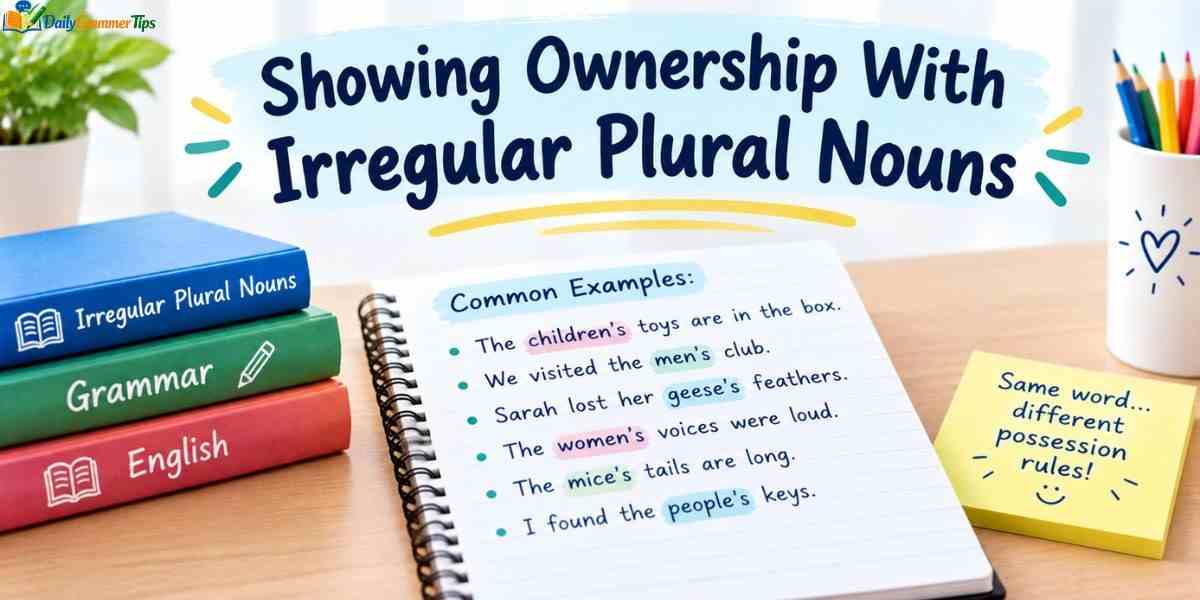
Regular plurals that end in -s take the apostrophe last. Write the dogs’ bowls. Irregular plurals that do not end in -s add ‘s. Write the children’s books.
- children → children’s: The children’s playground is new.
- men → men’s: The men’s team won.
- women → women’s: The women’s club meets Friday.
- people → people’s: The people’s choice is clear.
- sheep → sheep’s: The sheep’s wool feels soft.
Subject-Verb Agreement With Irregular Plural Nouns
Irregular plurals need plural verbs. Write the children are here, and the mice run away. An unfamiliar ending should not fool you.
Words like sheep and deer need a closer look. The verb tells the reader how many you mean. The deer is eating means one. The deer are eating means several.
More Examples of Plural Verbs
The criteria are strict. The phenomena were rare. The bacteria multiply fast. The people want change. The police are on their way. The cattle graze near the creek.
Look-Alike Words: When Plural Nouns Match Verbs
Several irregular plural nouns double as verbs. The leaves fall in autumn. She leaves at noon. Context tells you which one you have.
Lives works as a noun (Nurses save lives) and as a verb (She lives nearby). Loaves is a noun (Fresh loaves fill the shelf), but loafs is a verb (He loafs on Sundays). Wolves is a noun (Wolves hunt in packs), but wolfs is a verb (He wolfs down lunch).
Quick Practice: Fix the Mistakes
Each sentence below has one plural error. Rewrite it correctly, then check the answers.
The childs are playing outside. Both criterias are strict. Three mouses ran across the floor. The childrens’ toys are on the shelf. Answers: The children are playing outside. Both criteria are strict. Three mice ran across the floor. The children’s toys are on the shelf.
How to Catch Plural Errors in Your Own Writing
Proofread plurals in a separate pass. Read only the nouns that name more than one thing. Then stop at any word that ends in -s but feels odd.
Read each of your irregular plural nouns again, slowly. Spell checkers often miss real words like loafs, because they work as verbs. A dictionary settles the doubt in seconds.
Easy Ways to Remember Irregular Plural Nouns
You do not need to memorize hundreds of words one by one. Learn them in families instead. Each family shares a pattern, so one example helps you with many others.
Pick one trick below and use it for a week. Then add another.
Trick 1: Group Words by Pattern
Sort words into the nine patterns from the table earlier. Put wolf, leaf, and shelf together. Put goose, foot, and tooth together. Your brain loves groups.
Write each group on an index card. Add one example sentence for every word.
Trick 2: Say It Out Loud
Your ear catches what your eyes miss. Say two foots, then say two feet. The right one sounds smoother.
Reading aloud also fixes the f-to-v switch. You hear wolfs sound wrong and wolves sound right.
Trick 3: Build a Silly Sentence
Odd sentences stick in memory. Try this one: Two wolves and three geese stole my loaves. It packs three patterns into one line.
Write a short story with ten irregular forms. Read it to a friend and see who spots them all.
Trick 4: Link Words by Sound
Rhyming pairs act like memory hooks. Learn these small sets together.
Learn goose, foot, and tooth together, since oo becomes ee. Learn mouse and louse together, since ou becomes i. Learn man and woman together, since a becomes e.
Trick 5: Learn Latin and Greek Endings as Pairs
Memorize the endings, not each word. Think -us to -i, -is to -es, -on to -a, and -um to -a. Four pairs unlock dozens of science words.
When you meet a new word like alumnus or hypothesis, check its ending first. The pair gives you the plural.
Trick 6: Practice a Little Every Day
Review five words a day instead of fifty words once a week. Short, spaced practice helps memory last longer.
Wait a day, then test yourself again. Words you miss go back in the pile.
Teaching Irregular Plural Nouns to Kids
Start with words kids say every day, like feet, teeth, mice, and children. Use real objects and pictures. Ask them to show you one foot, then two feet.
Kids who say foots or mouses are not failing. They learned the -s rule and applied it, which is real progress. Praise the effort, then model the correct form.
Four Games Kids Love
Try card match, where kids pair each singular card with its plural card. Play plural bingo by calling the singular word while kids mark the plural picture. Add odd one out with three regular nouns and one irregular noun. Finish with story time, and hunt for plurals in a picture book.
Tips for English Learners Studying Irregular Plural Nouns
Plural rules in your first language may work differently. Do not worry. Native speakers still make plural mistakes, so you are in good company.
Start with the twenty most common irregular words. Add new ones as you meet them in books, videos, and daily conversations.
Four Study Habits That Work
Keep a notebook with the singular, the plural, and one sentence. Listen for plurals in podcasts and TV shows. Practice sound pairs like foot and feet. Choose a learner’s dictionary that lists plural forms.
Full Cheat Sheet of Irregular Plural Nouns
Save or print this table. It collects the most useful forms in one place, sorted by pattern.
| Singular | Plural | Pattern |
| child | children | -ren ending |
| ox | oxen | -en ending |
| man | men | Vowel change |
| woman | women | Vowel change |
| foot | feet | Vowel change |
| tooth | teeth | Vowel change |
| goose | geese | Vowel change |
| mouse | mice | Vowel change |
| louse | lice | Vowel change |
| person | people | Different word |
| leaf | leaves | -f to -ves |
| wolf | wolves | -f to -ves |
| half | halves | -f to -ves |
| shelf | shelves | -f to -ves |
| loaf | loaves | -f to -ves |
| thief | thieves | -f to -ves |
| calf | calves | -f to -ves |
| knife | knives | -fe to -ves |
| life | lives | -fe to -ves |
| wife | wives | -fe to -ves |
| sheep | sheep | No change |
| deer | deer | No change |
| moose | moose | No change |
| salmon | salmon | No change |
| series | series | No change |
| species | species | No change |
| aircraft | aircraft | No change |
| cactus | cacti | -us to -i |
| nucleus | nuclei | -us to -i |
| fungus | fungi | -us to -i |
| alumnus | alumni | -us to -i |
| stimulus | stimuli | -us to -i |
| analysis | analyses | -is to -es |
| crisis | crises | -is to -es |
| thesis | theses | -is to -es |
| diagnosis | diagnoses | -is to -es |
| hypothesis | hypotheses | -is to -es |
| phenomenon | phenomena | -on to -a |
| criterion | criteria | -on to -a |
| bacterium | bacteria | -um to -a |
| curriculum | curricula | -um to -a |
| medium | media | -um to -a |
| datum | data | -um to -a |
| larva | larvae | -a to -ae |
| alga | algae | -a to -ae |
| vertebra | vertebrae | -a to -ae |
| appendix | appendices | -ix to -ices |
| index | indices | -ex to -ices |
| matrix | matrices | -ix to -ices |
| potato | potatoes | -o to -oes |
| tomato | tomatoes | -o to -oes |
| hero | heroes | -o to -oes |
| bureau | bureaus or bureaux | French -eau |
Final Quiz: Test Your Irregular Plural Nouns
Ready for a challenge? Write the plural of each word, without peeking at the cheat sheet. The words are tooth, leaf, deer, crisis, ox, criterion, goose, life, cactus, woman, bacterium, loaf, mouse, appendix, and person.
Answers: teeth, leaves, deer, crises, oxen, criteria, geese, lives, cacti (or cactuses), women, bacteria, loaves, mice, appendices (or appendixes), people.
Score Yourself
Score 13 to 15, and you are a plural pro. Score 9 to 12, and you are almost there, so review the Latin and Greek endings. Score 8 or lower, and you should revisit the patterns and try again tomorrow.
Mixed Review: Fill in the Blank
Choose the right form in each pair: three (wolf / wolves), the (criterion / criteria), my (foot / feet), two (deer / deers), several (nucleus / nuclei), both (child / children), the (news / newses), and four (loaf / loaves).
Answers: wolves, criteria, feet, deer, nuclei, children, news, loaves.
A 7-Day Plan to Master Irregular Plural Nouns
Short daily practice works best. Follow this plan, and you will know the main patterns by next weekend.
| Day | Focus | Words to learn |
| Day 1 | Vowel changes | man, woman, foot, tooth, goose, mouse |
| Day 2 | -f and -fe to -ves | leaf, wolf, knife, life, half, shelf |
| Day 3 | Same form and plural-only | sheep, deer, fish, scissors, pants |
| Day 4 | -us and -is words | cactus, nucleus, crisis, analysis, thesis |
| Day 5 | -on and -um words | phenomenon, criterion, bacterium, curriculum |
| Day 6 | Tricky cases | potatoes, photos, mothers-in-law, bureaus |
| Day 7 | Review | Retake the final quiz and fix your misses |
Irregular Plurals in Real-Life Writing
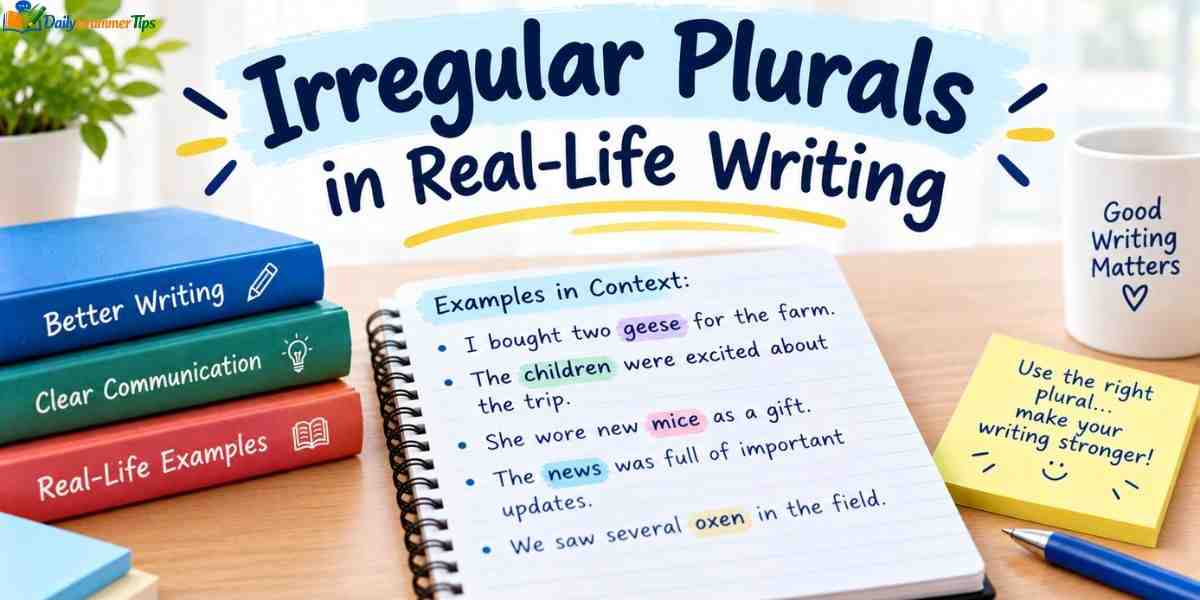
Plural mistakes show up in emails, resumes, and school essays. One wrong form can pull your reader away from a strong point.
Check plurals whenever you write about people, data, or science. Those are the places where slips happen most often. Lines like these sound right: Three people joined the call. The criteria for success are clear. The data show a steady trend. Geese lined the lake at sunrise.
Frequently Asked Questions
What is the plural noun of “person”?
The usual plural is people. Persons appears in formal or legal writing.
Can you give me 20 examples of irregular nouns?
Yes: children, men, women, feet, teeth, geese, mice, oxen, leaves, wolves, knives, lives, sheep, deer, fish, cacti, crises, criteria, bacteria, and appendices.
Is woman an irregular plural?
No, woman is singular. Its irregular plural is women.
What is a noun for a person?
Any noun that names a person works, like teacher, doctor, child, or person itself.
Can we say two persons?
Yes, it is grammatically correct, but it sounds formal. In everyday writing, say two people.
Conclusion
Irregular plurals feel tricky at first, but they follow clear patterns. Once you know the -ves words, the vowel changes, and the Latin and Greek endings, most of them start to make sense. Each pattern gives you a shortcut, so you do not need to memorize every word one by one.
Keep the cheat sheet close and practice a little every day. Say the words out loud, write your own example sentences, and check a dictionary when you feel unsure. With time, irregular plural nouns will feel natural, and you will write them with confidence.
