

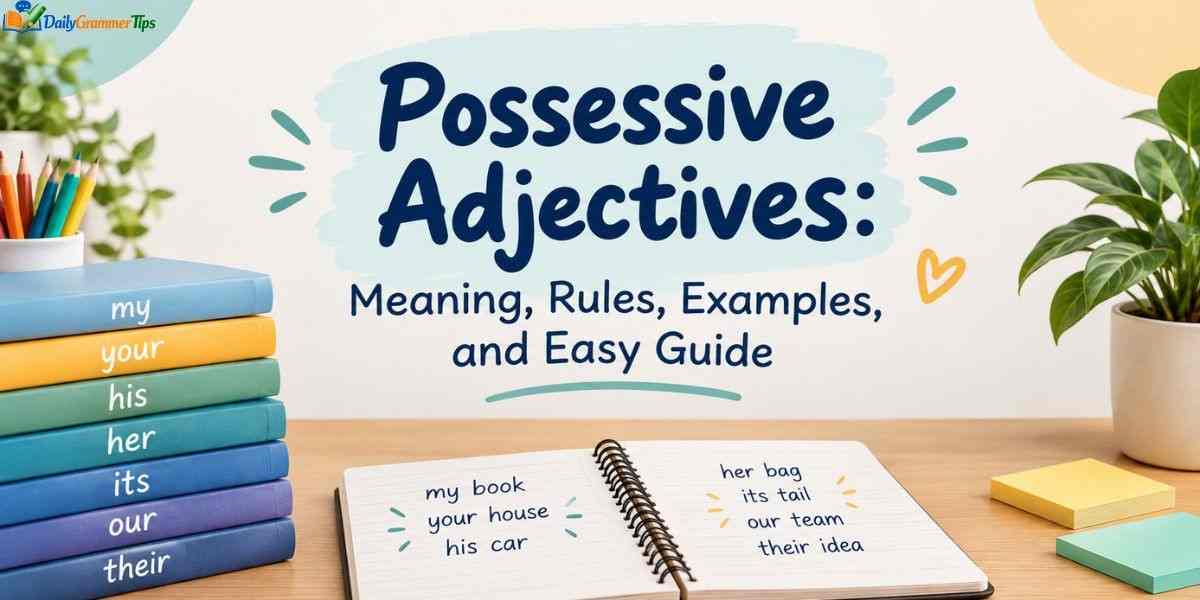
Possessive adjectives are an important part of English grammar because they help us show ownership, relationships, and connections in a clear way. Words like my, your, his, her, its, our, and their allow speakers to describe belongings and personal connections without repeating the same names or words again and again.
From everyday conversations to professional writing, we use possessive adjectives to make sentences smoother and easier to understand. Whether you are talking about your family, your work, your goals, or someone else’s experiences, learning these words helps you communicate more naturally and confidently.
What Are Possessive Adjectives?
Possessive adjectives are words that show who owns or has a relationship with something. They are placed before a noun to identify the person, group, animal, or thing connected to that noun.
In English, these words answer the question “Whose?” For example, in the sentence “This is my phone,” the word “my” tells us that the phone belongs to the speaker.
Unlike regular adjectives that describe appearance, size, color, or quality, possessive adjectives describe ownership or connection. They do not tell us what something looks like; instead, they explain who it belongs to.
Consider these examples:
“My car is new.”
“Her dress looks beautiful.”
“Their house is near the park.”
In each sentence, the possessive word comes before a noun and provides information about ownership.
Why Are Possessive Adjectives Important?
Correct use of possessive adjectives helps people communicate clearly without repeating the same words again and again. They make conversations sound more natural and writing more professional.
Imagine explaining a situation without using ownership words:
“John took John’s laptop because John needed John’s laptop for John’s presentation.”
This sentence feels repetitive and difficult to read. By using possessive adjectives, we can make it much clearer:
“John took his laptop because he needed it for his presentation.”
The word “his” replaces repeated information and improves sentence flow.
In American English, these grammar words are used constantly in daily life. People use them when talking about jobs, families, education, hobbies, technology, and personal experiences.
Understanding the Different Forms of Possessive Adjectives
English has seven main forms of possessive adjectives. Each one connects a noun with a specific person or group.
“My” is used when the speaker owns something. For example, “I finished my project” means the project belongs to the speaker.
“Your” is used when something belongs to the person or people being spoken to. For example, “Please bring your documents” shows that the documents belong to the listener.
“His” refers to something connected to a male person. For example, “Michael forgot his keys” means the keys belong to Michael.
“Her” shows ownership related to a female person. For example, “Sarah completed her assignment” means the assignment belongs to Sarah.
“Its” is used for animals, objects, companies, or organizations. For example, “The company changed its rules” explains that the rules belong to the company.
“Our” shows that something belongs to the speaker and other people together. For example, “We finished our work” means the work belongs to a group including the speaker.
“Their” shows ownership by more than one person or group. For example, “The students submitted their homework” means the homework belongs to the students.
How Possessive Adjectives Are Used in Sentences
The basic structure of using possessive adjectives is simple:
Possessive adjective + noun
The possessive word always comes before the thing that belongs to someone.
For example:
“My favorite book”
“Your new computer”
“Her family”
“Our neighborhood”
“Their business”
A common mistake among learners is placing the possessive word after the noun. English does not follow this structure.
Incorrect: “The phone my is expensive.”
Correct: “My phone is expensive.”
The position of these words is important because it affects sentence accuracy and meaning.
Possessive Adjectives in Everyday Conversations
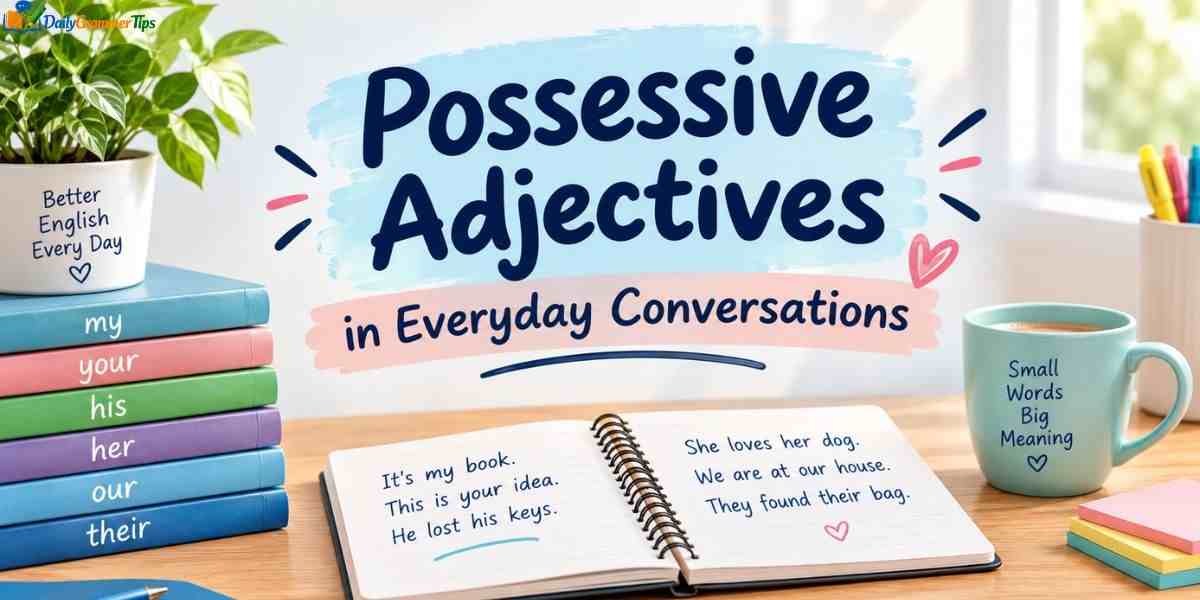
People use possessive adjectives naturally while speaking every day. They appear when discussing personal items, relationships, plans, and responsibilities.
Someone may say, “I forgot my wallet,” when talking about a missing item. A parent might say, “My children are at school,” while discussing family. A manager may say, “Our team completed the project,” during a workplace conversation.
These simple examples show how important ownership words are in normal communication.
Even when discussing entertainment and popular culture, people use these grammar structures. For instance, fans talking about SpongeBob often describe “his friends,” “his adventures,” and “his world.” These sentences use ownership language to explain connections between characters.
Brands and marketing content also use similar grammar patterns. A phrase like Burger King SpongeBob Meal can involve discussions about “its packaging,” “its theme,” or “its popularity,” where ownership words help describe relationships between the product and its features.
The Role of Possessive Adjectives in Learning English
For beginners, possessive adjectives are one of the first grammar topics that help build confidence in English. They allow learners to talk about themselves, their belongings, and people around them.
When students learn these words properly, they can create more detailed sentences. Instead of saying only “I have a book,” they can say “I have my favorite book.” Instead of saying “She has a friend,” they can say “She has her best friend.”These small improvements make communication more expressive and natural.
Rules of Using Possessive Adjectives Correctly
Learning the basic rules of possessive adjectives makes English sentences more accurate and easier to understand. Although these words are simple, many learners make mistakes because they confuse them with other grammar forms such as possessive pronouns or contractions.
The most important rule is that possessive adjectives always come before a noun. They cannot stand alone because they need a noun to complete their meaning.
For example:
“This is my book.”
“Their house is large.”
“Her idea was successful.”
In these sentences, “my,” “their,” and “her” describe the relationship between the person and the noun that follows.
If there is no noun after the word, it usually becomes incorrect. For example, saying “This book is my” is wrong because “my” needs a noun after it. The correct sentence would be “This is my book.”
Possessive Adjectives Always Match the Owner, Not the Object
One important rule of possessive adjectives is that they depend on the person who owns something, not the thing being owned.
Many English learners become confused because they think the possessive word should change according to the object. However, English focuses on the owner.
For example:
“John loves his car.”
The word “his” refers to John, not the car.
“Maria cleaned her room.”
The word “her” refers to Maria, not the room.
The object can be anything, but the possessive adjective changes depending on who has the connection with that object.
Possessive Adjectives Do Not Use Articles
Another important grammar point is that possessive adjectives are used instead of articles such as “a,” “an,” or “the.”
We do not say:
“This is the my phone.”
“This is a her bag.”
These sentences are incorrect because the possessive adjective already provides information about ownership.
The correct versions are:
“This is my phone.”
“This is her bag.”
The possessive word replaces the need for an article.
Possessive Adjectives With Singular and Plural Nouns
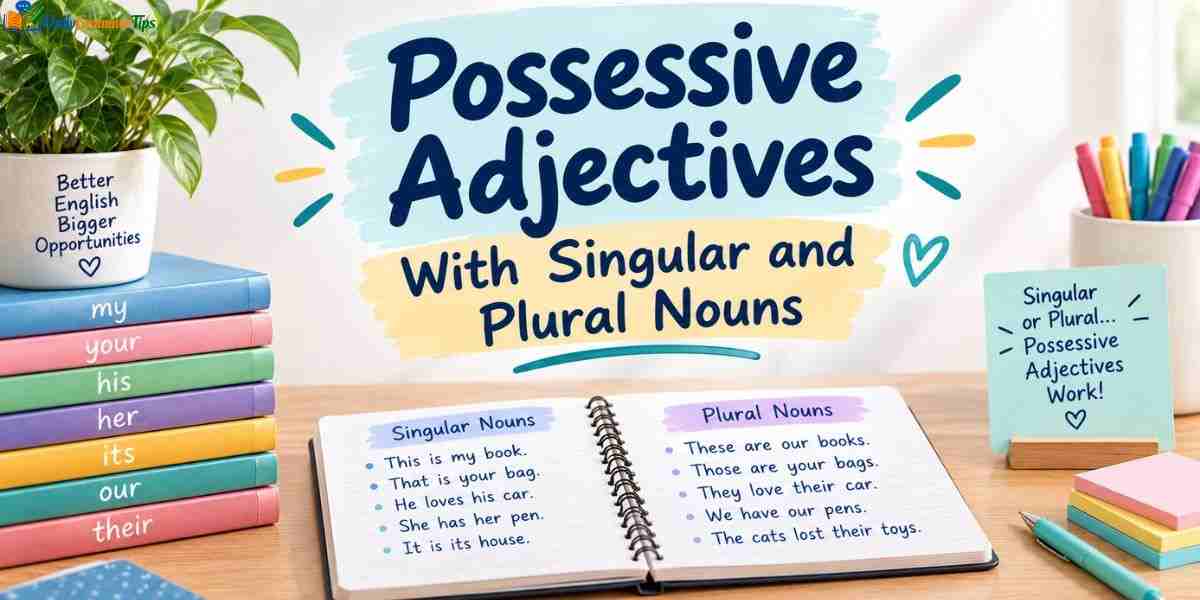
Possessive adjectives can be used with both singular and plural nouns. The form of the possessive word does not change.
For example:
“My friend is a doctor.”
“My friends are doctors.”
The word “my” remains the same even though the noun changes from singular to plural.
Another example:
“Our house is nearby.”
“Our houses are nearby.”
The possessive adjective stays unchanged because it depends on the owner, not the number of objects.
Difference Between Possessive Adjectives and Possessive Pronouns
Many learners confuse possessive adjectives with possessive pronouns because both show ownership. However, they have different functions in sentences.
A possessive adjective must be followed by a noun, while a possessive pronoun replaces the noun completely.
For example:
“This is my laptop.”
In this sentence, “my” is a possessive adjective because it comes before the noun “laptop.”
“This laptop is mine.”
Here, “mine” is a possessive pronoun because it replaces the noun.
The same pattern applies to other forms.
We say:
“This is her jacket.”
“This jacket is hers.”
We say:
“That is their car.”
“That car is theirs.”
Understanding this difference helps learners avoid common grammar errors.
Learn more…………Quantifiers in English: Meaning, Types, Rules, and Examples
Common Mistakes With Possessive Adjectives
Although possessive adjectives seem easy, some mistakes happen frequently among English learners. Knowing these errors can help improve writing and speaking skills.
One common mistake is confusing “your” and “you’re.”
“Your” shows ownership, while “you’re” is a short form of “you are.”
For example:
“Your phone is on the table.”
“You’re very helpful.”
These words sound similar but have completely different meanings.
Another common mistake is confusing “its” and “it’s.”
“Its” shows ownership.
“The dog found its toy.”
“It’s” means “it is” or “it has.”
“It’s raining today.”
Using the wrong form can change the meaning of a sentence.
Using Possessive Adjectives With Family Relationships
Family conversations often require possessive adjectives because people frequently talk about relationships and connections.
Examples include:
“My mother works in a hospital.”
“His brother lives in Texas.”
“Their children go to school.”
“Our family enjoys traveling.”
These sentences show how ownership words help explain relationships between people.
In American English, these expressions are commonly used in both casual and formal conversations. Whether someone is introducing their family or writing a personal story, these words make descriptions clearer.
Possessive Adjectives in Professional Communication
In workplaces, correct use of possessive adjectives helps create professional and understandable communication.
Employees often use these words when discussing responsibilities, projects, and teamwork.
Examples:
“I completed my report.”
“Our department achieved its goals.”
“The manager shared his instructions.”
“The company updated its policies.”
Using the correct grammar creates a stronger impression in emails, presentations, and business conversations.
Clear communication is especially important in professional environments because small grammar mistakes can affect how information is understood.
Possessive Adjectives in Academic Writing
Students use possessive adjectives regularly in essays, assignments, and research papers. They help explain ideas, sources, and relationships between different concepts.
For example:
“The researcher explained her findings.”
“The students presented their project.”
“Our study focuses on language development.”
Using these words correctly makes academic writing more organized and readable.
Teachers often encourage students to practice ownership structures because they appear frequently in written English.
Possessive Adjectives and Everyday Technology

Modern conversations often involve technology, making possessive adjectives even more common.
People regularly talk about their phones, computers, accounts, and online activities.
Examples:
“I updated my password.”
“She checked her email.”
“They protected their accounts.”
“We backed up our files.”
These sentences show how ownership words naturally appear when discussing digital life.
Whether someone is talking about personal devices or online services, these grammar structures help explain connections clearly.
How to Practice Possessive Adjectives Effectively
The best way to improve your understanding of possessive adjectives is through regular practice. Instead of memorizing rules only, learners should use these words in real sentences.
Start by describing things around you.
For example:
“My desk is clean.”
“My computer is new.”
“My favorite book is interesting.”
Then practice describing other people:
“Her car is blue.”
“His job is challenging.”
“Their house is beautiful.”
Daily practice helps these words become natural during conversations.
Reading English articles, watching videos, and listening to native speakers can also improve understanding because learners see how ownership words are used in real situations.
Advanced Uses of Possessive Adjectives in English
As learners become more comfortable with English grammar, understanding the deeper use of possessive adjectives helps them communicate with more confidence. These words are not only used for physical objects but also for ideas, emotions, responsibilities, relationships, and experiences.
Many people think ownership only means something they can touch, such as a phone, car, or book. However, English also uses ownership words for things that are personal, emotional, or connected to someone’s identity.
For example:
“I appreciate your support.”
“She shared her opinion.”
“We learned from our mistakes.”
In these sentences, the words “your,” “her,” and “our” do not describe physical ownership. Instead, they show a connection between a person and an idea or experience.
Possessive Adjectives With Abstract Ideas
Possessive adjectives are often used with feelings, thoughts, opinions, and personal qualities.
People commonly say:
“My dream is to become a doctor.”
“His confidence improved after practice.”
“Her creativity helps her solve problems.”
“Their experience was valuable.”
These examples show that ownership language can describe personal connections, not just objects.
This is one reason why learning possessive adjectives is important for advanced English communication. They allow speakers to express personal meaning in a natural way.
Possessive Adjectives in Questions
Questions also frequently use possessive adjectives. They help people ask about ownership or relationships.
Common examples include:
“What is your name?”
“Where is your house?”
“Is this your jacket?”
“What is their opinion?”
These questions are used every day in American English conversations.
When asking about someone’s belongings or information, the possessive form makes the question direct and easy to understand.
Possessive Adjectives With Names and People
Sometimes English speakers use names together with possessive adjectives to make sentences clearer.
For example:
“John forgot his wallet.”
“Lisa brought her laptop.”
“The students completed their assignment.”
The name identifies the owner, while the possessive adjective connects that person with the object.
This structure is common in storytelling because it avoids repeating names too often.
Instead of saying:
“Lisa opened Lisa’s computer and checked Lisa’s messages.”
A natural speaker would say:
“Lisa opened her computer and checked her messages.”
Possessive Adjectives in Storytelling
Writers use possessive adjectives to create smoother stories and descriptions. These words help readers understand relationships between characters and objects.
For example:
“Tom entered his room and found his old notebook. He opened its pages and remembered his childhood.”
This sentence becomes easier to follow because the ownership relationships are clear.
Even children’s stories and animated shows use these grammar structures frequently. When people describe characters like SpongeBob, they naturally use phrases such as “his friends,” “his home,” or “his adventures” to explain connections between the character and the story.
Possessive Adjectives in Marketing and Advertising
Advertising content often uses possessive adjectives because brands want customers to feel connected with products and services.
Companies use phrases that focus on personal experiences, such as:
“Your perfect choice.”
“Your everyday solution.”
“Our latest collection.”
These words create a sense of connection between the customer and the product.
For example, when people discuss special themed products like the Burger King SpongeBob Meal, they may talk about “its design,” “its packaging,” or “its popularity.” Ownership words help describe how a product connects with its audience.
Possessive Adjectives in Social Media Communication
Social media has made simple grammar structures even more important. People constantly share information about their lives, opinions, and activities.
Examples include:
“My new project is ready.”
“Our trip was amazing.”
“Their photos received many likes.”
These sentences are short, but they communicate personal connections clearly.
Correct use of possessive adjectives helps online writing appear more natural and professional.
How Native Speakers Use Possessive Adjectives Naturally
Native English speakers usually learn possessive adjectives at an early age, so they use them automatically during conversations.
They do not think about grammar rules every time they say:
“My friend called me.”
“Your order is ready.”
“Our meeting starts soon.”
“Their team won.”
For English learners, reaching this level requires regular exposure and practice.
Listening to conversations, reading English materials, and creating personal examples can help these words become easier to use.
Possessive Adjectives Practice Examples
Practicing sentences is one of the most effective ways to understand possessive adjectives. The goal is not only to remember the words but also to use them correctly in real communication.
Consider these examples:
I have a new phone. → This is my phone.
You have a beautiful garden. → This is your garden.
Michael has a bicycle. → This is his bicycle.
Emily has a painting. → This is her painting.
The company has a website. → This is its website.
We have a project. → This is our project.
The students have books. → These are their books.
These examples show how ownership changes depending on the person connected to the noun.
Fill-in-the-Blank Practice
Complete these sentences using the correct form of possessive adjectives.
I forgot _____ keys at home.
She loves _____ new apartment.
They finished _____ homework before dinner.
We invited friends to _____ party.
He cleaned _____ room yesterday.
The bird opened _____ wings.
The answers depend on who owns or connects with the object. Regular practice with these structures helps improve accuracy.
Tips to Remember Possessive Adjectives Easily
A useful way to remember possessive adjectives is to connect each word with a person.
When talking about yourself, think “my.”
When talking directly to someone, think “your.”
When talking about a male person, think “his.”
When talking about a female person, think “her.”
When talking about groups, think “our” or “their.”
When talking about animals or things, think “its.”
Creating these simple connections makes grammar easier to remember.
Why Possessive Adjectives Matter for English Learners

Many English learners focus mainly on vocabulary, but grammar structures are equally important. Knowing thousands of words is not enough if sentences are not organized correctly.
Possessive adjectives help learners create complete thoughts and express relationships clearly.
They are useful for beginners, students, professionals, and anyone who wants to communicate confidently in English.A strong understanding of these words improves speaking, writing, reading, and listening skills.
Frequently Asked Questions
What are possessive adjectives?
Possessive adjectives are words that show ownership or connection, such as my, your, his, her, its, our, and their.
Can you give examples of possessive adjectives?
Examples include: my book, your phone, his car, her bag, our house, and their team.
Where do possessive adjectives appear in a sentence?
They always come before a noun, such as “My friend is helpful” or “Their house is beautiful.”
What is the difference between possessive adjectives and possessive pronouns?
Possessive adjectives come before nouns, while possessive pronouns replace nouns, such as my book and the book is mine.
Can possessive adjectives be used with plural nouns?
Yes, they can be used with both singular and plural nouns, like my friend and my friends.
Conclusion
Possessive adjectives are an essential part of English grammar because they help show ownership, relationships, and connections clearly. Words like my, your, his, her, its, our, and their make sentences more natural by avoiding repetition and improving communication. Understanding their correct placement and usage allows learners to write and speak English with greater confidence.
Mastering possessive adjectives requires regular practice with real-life sentences and conversations. By using these words correctly in daily communication, students and English learners can improve their grammar skills, express ideas more clearly, and build stronger overall language abilities.
