

Adverbs of certainty show how sure you feel about an idea. Words like definitely, probably, and surely tell your listener whether you are certain, fairly sure, or just guessing.
This guide explains adverbs of certainty in a clear order. You will learn the definition, the list, the placement rules, the common mistakes, and the practice tasks, so you can speak and write with confidence.
Adverb of Certainty Definition and Examples
These words express the speaker’s level of confidence. They sit close to the verb and change the feel of a sentence. Let us begin with a clear definition.
Definition of Adverbs of Certainty
Adverbs of certainty are adverbs that show how certain a speaker is about an action or an event. They tell us whether something is sure, likely, or only possible. “She will definitely come” shows strong confidence.
Compare two sentences. “She will come” is a plain statement. “She will probably come” adds a level of doubt.
What They Show About the Speaker
These words reveal the speaker’s attitude. Certainly and undoubtedly show strong belief. Possibly and maybe show weak belief. The choice sends a clear signal to the listener.
Listeners use that signal to plan. If you say “He will definitely call,” they wait for the call. If you say “He might possibly call,” they stay flexible.
What They Modify
They modify verbs, adjectives, other adverbs, and whole sentences. In “He definitely knows,” the adverb modifies the verb. In “It is clearly wrong,” it modifies the adjective.
They can also stand over a full clause. “Obviously, the plan failed” comments on the whole sentence. This flexibility makes them very useful.
Adverbs of Certainty in Everyday Language
People use these words in every chat. “Are you coming?” “Definitely.” “Will it rain?” “Probably.” Short replies carry a clear level of belief.
You also hear them in news, ads, and films. Notice how speakers pick a strong or soft word to match the facts.
Why Learners Need Them
Daily talk depends on degrees of belief. You predict, promise, doubt, and agree all day. These words help you do each of these jobs in one short word.
Exams also reward them. They add range to speaking answers and essays. Accurate use shows a learner can express fine shades of meaning.
Adverbs of Certainty List
The list is long, so groups help. This section sorts the words by use and style. Learn one group at a time.
The Most Common Adverbs of Certainty
The most common adverbs of certainty are certainly, definitely, surely, probably, possibly, maybe, obviously, clearly, and undoubtedly. Many guides add unquestionably and doubtless to this core list.
Start with the first four. Certainly, definitely, surely, and probably cover most daily needs. Add the rest as your vocabulary grows.
Words for Complete Certainty
Some words leave no room for doubt. Certainly, definitely, undoubtedly, unquestionably, and undeniably belong here. Categorically, unequivocally, and indisputably also show total confidence.
“The results are undeniably strong.” “She categorically refused.” The more formal words fit reports and speeches better than casual chat.
Words for Probability and Possibility
Some words show less confidence. Probably means very likely. Possibly means it could happen. Maybe and perhaps mean the idea is open.
Order them by strength. Probably is stronger than possibly. Possibly is stronger than maybe in most settings. This scale helps you choose.
Everyday Words and Casual Phrases
Daily talk uses simple words. Definitely, really, sure, and for sure are common. “That is for sure.” “I sure hope so.” These forms sound relaxed.
Keep them for chat, texts, and friendly emails. Switch to certainly or undoubtedly in formal writing.
Words Based on Evidence
Some words say the evidence is clear. Obviously, clearly, evidently, patently, and demonstrably belong here. Conclusively shows that proof ends the debate.
“The error was patently obvious.” “The test conclusively proved the point.” These words suit academic and professional writing.
Inevitably and Unavoidably
Inevitably and unavoidably describe results that cannot be stopped. “Prices will inevitably rise.” “The delay was unavoidably long.” They show certainty about outcomes.
Use them when you describe cause and effect. They sound formal but clear.
Types of Adverbs of Certainty
Grammarians sort these words by strength. Each type sends a different message. Knowing the types prevents confusion.
The Certainty Scale
Adverbs of certainty form a scale from strong to weak. Undoubtedly, certainly, and definitely sit at the top. Probably and likely sit in the middle. Possibly, maybe, and perhaps sit near the bottom.
Use the scale to match your words to the facts. A strong word needs strong proof. A weak word fits a guess.
Strong Certainty
Strong certainty words show total belief. Certainly, definitely, undoubtedly, and surely work here. “The team will definitely win.”
Use them when you have solid facts or strong feelings. Do not use them for guesses.
High Probability
High probability words show strong but not total belief. Probably, likely, and presumably fit here. “They will probably arrive by noon.”
These words leave a small gap for surprise. They are the safest choice for predictions.
Low Probability
Low probability words show open doubt. Possibly, maybe, and perhaps fit here. “Perhaps we can meet later.”
These words invite discussion. They also soften requests and suggestions.
Certainty Based on Proof
Some words connect certainty to evidence. Obviously, clearly, evidently, and conclusively fit here. “The data clearly shows growth.”
They tell the reader that the facts speak for themselves. Use them only when the facts really are clear.
Adverbs of Certainty Examples
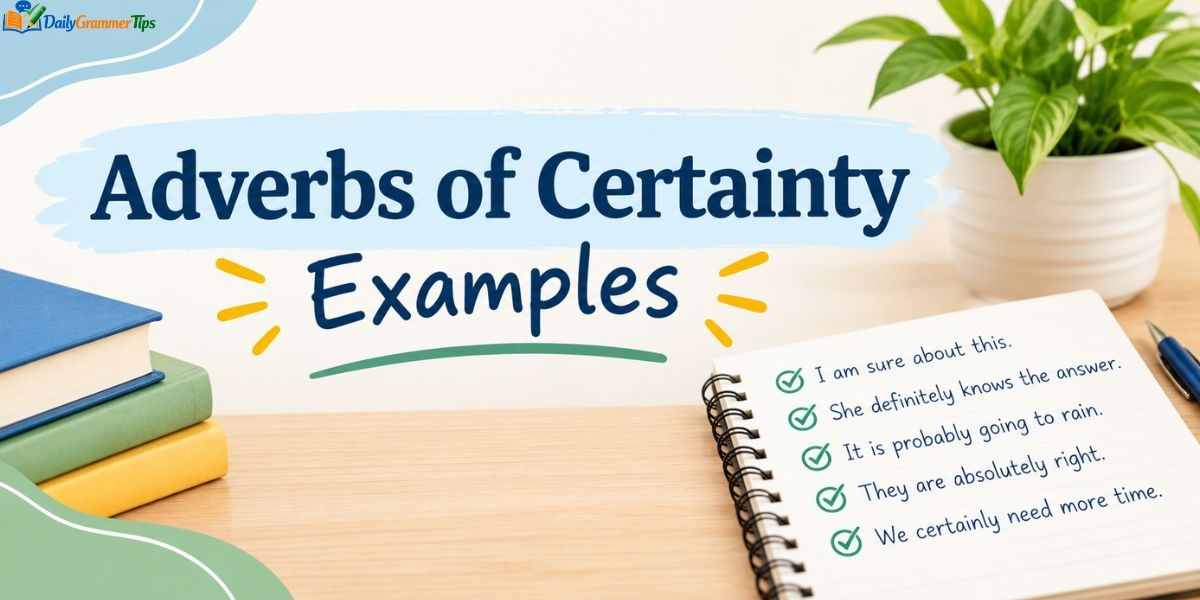
Examples show the pattern better than rules. Read each one aloud. Notice where the adverb sits.
Examples with Certainly
“You can certainly count on my support.” “She certainly knows the answer.” “They certainly deserve the prize.”
Certainly also works as a polite reply. “Can you help me?” “Certainly.” The word agrees with warmth.
Examples with Definitely
“I will definitely attend the meeting tomorrow.” “He is definitely the best candidate.” “We definitely need a break.”
Definitely often stands alone as an answer. “Are you coming?” “Definitely!” It sounds friendly and firm.
Examples with Surely
“She will surely appreciate your gesture.” “Surely you are joking.” “Surely they know the rules.”
Surely at the start of a sentence often asks for agreement. The speaker believes something is true but wants confirmation.
Examples with Probably
“She is probably late.” “We will probably meet tomorrow.” “He probably forgot.”
Probably fits predictions and guesses. It signals strong, not total, confidence.
Examples with Possibly and Maybe
“The weather might possibly improve.” “Maybe we can try again.” “Could you possibly help me?”
Possibly is polite in requests. Maybe is casual and often starts a sentence.
Examples with Undoubtedly and Unquestionably
“She is undoubtedly the best candidate.” “Her effort was unquestionably clear.” “He will no doubt succeed.”
These words suit formal settings. They add weight to praise and to claims.
Examples with Really and Sure
“I really saw a shooting star.” “I sure will be there.” Really stresses that a statement is true. Sure works as an adverb in casual American English.
Use them in friendly talk. Avoid them in formal reports.
Examples with Evidently and Presumably
“She was evidently upset.” “He is presumably at work.” Evidently points to visible signs. Presumably shows a sensible guess.
These words suit news reports and careful speech. They show that you base your view on clues.
Examples with Obviously and Clearly
“He was obviously tired.” “The plan clearly failed.” “Obviously, we need more time.”
These words point to visible evidence. Use them when the listener can see the facts too.
Adverbs of Certainty Sentences
Sentences show real usage. This section moves from simple to advanced. Practice reading each group aloud.
Short Sentences for Beginners
“He is definitely right.” “She certainly smiled.” “They probably left.” “It is clearly wrong.” Each sentence is short and clear.
Notice the order. The adverb sits next to the verb. This simple habit prevents most errors.
Everyday Sentences
“I will definitely call you tonight.” “He is probably at home.” “We will surely meet again.” These sentences sound natural in daily talk.
Add small details to practice. “I will definitely call you after dinner.” The pattern stays the same.
Sentences for School and Work
“The students will probably finish early.” “The manager will definitely approve the plan.” “The report clearly explains the cause.”
These sentences fit emails and meetings. They sound confident and professional.
Formal Sentences
“The findings are undeniably significant.” “The policy will inevitably affect small firms.” “The evidence conclusively supports the claim.”
Formal writing uses stronger, longer words. Keep the sentence clear and direct.
Sentences with Two Clauses
Longer sentences can carry two ideas. “She said she would definitely come, but she probably forgot.” “The plan clearly worked, so we will certainly repeat it.”
Each clause keeps its own adverb. Place each one next to its own verb.
Sentences in Short Dialogues
A: “Is he coming?” B: “Probably.” A: “Is the shop open?” B: “Definitely, until nine.”
A: “Can you help?” B: “Certainly.” A: “Is it true?” B: “Surely not!” Short answers sound natural and fast.
Where to Place Adverbs of Certainty in a Sentence
Position matters. A wrong place can sound odd or change the meaning. These rules cover the usual cases.
Before the Main Verb
Adverbs of certainty usually come before the main verb. “She certainly forgot about our date.” “He definitely knows the answer.”
This is the safest position. It works in present and past simple sentences.
After the Verb Be
After be, the adverb comes next. “She is clearly a keeper.” “He was obviously tired.” “They are definitely ready.”
The same pattern works in all forms of be. The adverb comes before the complement.
Between the Auxiliary and the Main Verb
With an auxiliary verb, place the adverb between the auxiliary and the main verb. “We will probably meet tomorrow.” “She has certainly improved.”
Use the first auxiliary as your guide. The adverb sits right after it.
With Long Verb Phrases
With two or more auxiliaries, place the adverb after the first one. “She will probably have finished by noon.” “He must certainly have known.”
This rule keeps the sentence smooth. The adverb does not split the main verb from its auxiliary chain.
Before Adjectives and Adverbs
Adverbs of certainty can modify adjectives and adverbs. “It is definitely worth the price.” “She is obviously talented.” “He is clearly very tired.”
Keep the adverb right before the word it modifies. Moving it away changes the focus.
Adverbs of Certainty at the End of a Sentence
Some adverbs can close a sentence for emphasis. “He will win, certainly.” “She knew, obviously.” A comma usually comes before the adverb.
This position sounds literary or dramatic. In daily English, most speakers place the adverb earlier.
Choosing the Best Position
Pick the position that fits your goal. Use the middle for a smooth comment. Use the start for emphasis. Use the end for a dramatic touch.
When in doubt, choose the middle. It works in almost every sentence type.
Adverbs of Certainty with Auxiliary and Modal Verbs
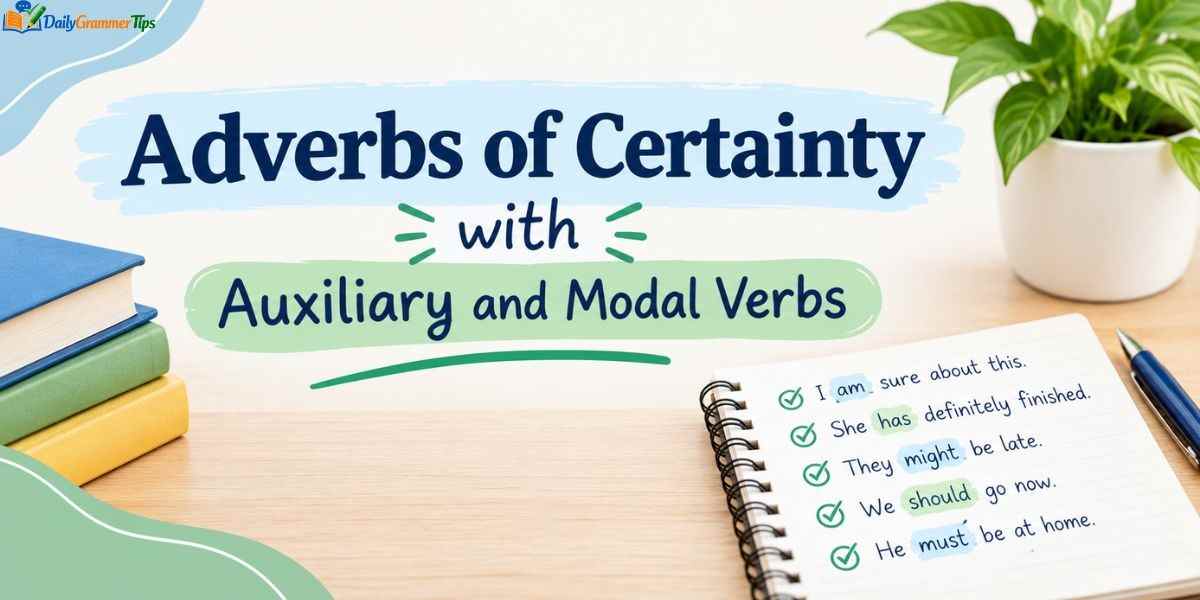
Modal verbs already express attitude. Adding an adverb can sharpen or soften the message. This section shows how to combine them.
With Will and Would
“She will definitely come.” “He would probably agree.” The adverb sits after will or would. It shows the strength of the prediction.
Will plus certainly sounds firm. Would plus probably sounds careful.
With Can and Could
“I cannot possibly accept.” “Could you possibly help me?” Possibly works well with can and could. It adds emphasis or politeness.
Certainly also fits. “You can certainly try.” The adverb stays after the modal.
With May and Might
“It may possibly rain.” “She might well agree.” These forms show open doubt. Possibly and well soften the modal.
Avoid stacking too many doubt words. “It might maybe possibly rain” sounds clumsy.
With Must and Should
“He must certainly know.” “You should definitely visit.” These forms express strong advice or strong logic.
Keep the pattern simple. The adverb comes after the modal and before the main verb.
Adverbs of Certainty at the Start of a Sentence
Some adverbs of certainty can open a sentence. This position adds emphasis. It also requires a comma in most cases.
Which Words Can Start a Sentence
Undoubtedly, certainly, clearly, obviously, and probably can open a sentence. “Undoubtedly, Mick Jagger is a great musician.” Maybe and perhaps also start sentences often.
Not every word fits this spot. Definitely at the start sounds less natural in formal writing.
The Comma Rule
Use a comma after most sentence opening adverbs of certainty. “Obviously, the plan failed.” “Clearly, we need a new method.”
The comma marks a pause. It also tells the reader that the adverb comments on the whole sentence.
Surely at the Start
Surely at the start of a sentence means something special. It shows the speaker thinks something is true but wants confirmation. “Surely you are not going out in this rain.”
Do not mix this meaning with strong certainty. The tone is closer to a polite challenge.
Maybe and Perhaps at the Start
Maybe and perhaps usually open the clause. “Maybe she forgot.” “Perhaps we should leave.” They signal an open idea.
Perhaps sounds more formal than maybe. Use perhaps in writing and maybe in talk.
Conditional and Passive Sentences
Certainty adverbs also work in conditionals and passives. “If we leave now, we will probably arrive on time.” “The report was clearly written.” “The goal would certainly be reached.”
In passive sentences, the adverb sits after the first auxiliary. The past participle follows.
Adverbs of Certainty and Adverbs of Degree
Learners often mix these two groups. They look alike, but their jobs differ. This section separates them clearly.
What Are Adverbs of Degree
Adverbs of degree show how much or to what extent. Very, quite, extremely, too, almost, fairly, and rather are typical. “The tea is very hot.”
They usually modify adjectives and other adverbs. They answer the question “how much.”
The Key Difference
Adverbs of certainty show confidence in a statement. Adverbs of degree show intensity of a quality. Compare “He is definitely tall” with “He is very tall.”
The first sentence says you are sure he is tall. The second sentence says how tall he is.
Learn more……….Interrogative Adverbs: Meaning, List, Examples, and Rules
Words That Overlap
Some words seem to serve both groups. Really, absolutely, and completely can show certainty or intensity. “I really saw it” stresses truth. “It is really cold” stresses degree.
Look at the job in the sentence. Ask whether the word shows belief or amount.
Modifying Certainty with Degree Words
Degree words can modify certainty words. “Very likely,” “almost certain,” “fairly sure,” and “quite possible” are common. “It is highly probable.”
These phrases fine tune confidence. Use them when plain words feel too strong or too weak.
Side by Side Examples
“She is definitely late” shows certainty. “She is extremely late” shows degree. “He will probably win” shows certainty. “He ran very fast” shows degree.
Practice with pairs. Change the adverb and watch the meaning change.
Adverbs of Certainty vs Other Adverbs
Adverbs come in many kinds. Each kind answers a different question. Seeing the difference sharpens your grammar.
Compared with Adverbs of Manner
Manner adverbs tell how an action happens. “She sings beautifully.” Certainty adverbs tell how sure you are. “She definitely sings.”
Both can sit near the verb. Their meanings stay different.
Compared with Adverbs of Frequency
Frequency adverbs tell how often. “He always arrives early.” Certainty adverbs tell how sure you are. “He probably arrives early.”
Frequency words answer “how often.” Certainty words answer “how sure.”
Compared with Adverbs of Time
Time adverbs tell when something happens. “He will arrive soon.” Certainty adverbs tell how sure you are. “He will probably arrive.”
You can use both together. “He will probably arrive soon.” Each word does its own job.
Compared with Adjectives of Certainty
Certain, sure, likely, and probable are adjectives. “I am sure.” “It is likely.” The matching adverbs are surely, certainly, and probably.
Likely works as an adverb only with words like very or most. “He will very likely win.”
Compared with Adverbs of Uncertainty
Some adverbs show doubt rather than belief. Apparently, supposedly, and allegedly fit this group. They show that you did not check the facts yourself.
Compare “He is clearly guilty” with “He is allegedly guilty.” The first shows confidence. The second shows distance.
Adverbs of Certainty with Verb Tenses
These words work in every tense. The adverb stays near the verb, and the tense appears in the verb. Study each group below.
Present Simple and Continuous
“She definitely knows the answer.” “He is clearly working hard.” The adverb sits before the main verb or after be.
These sentences describe facts and current actions. The certainty word adds your opinion.
Past Simple and Continuous
“He certainly forgot the keys.” “They were obviously waiting.” The adverb again sits near the verb.
Use the past forms to comment on finished events. “She probably left early.”
Present Perfect and Past Perfect
“They have probably left.” “She had definitely seen it.” The adverb comes after have, has, or had.
Perfect forms link past events to now or to another past event. The adverb adds your confidence level.
Future Forms
“It will undoubtedly rain.” “We are probably going to move.” “She will certainly agree.”
Future forms need strong adverbs only when facts support them. Otherwise, use probably or possibly.
Adverbs of Certainty in Negative Sentences and Questions
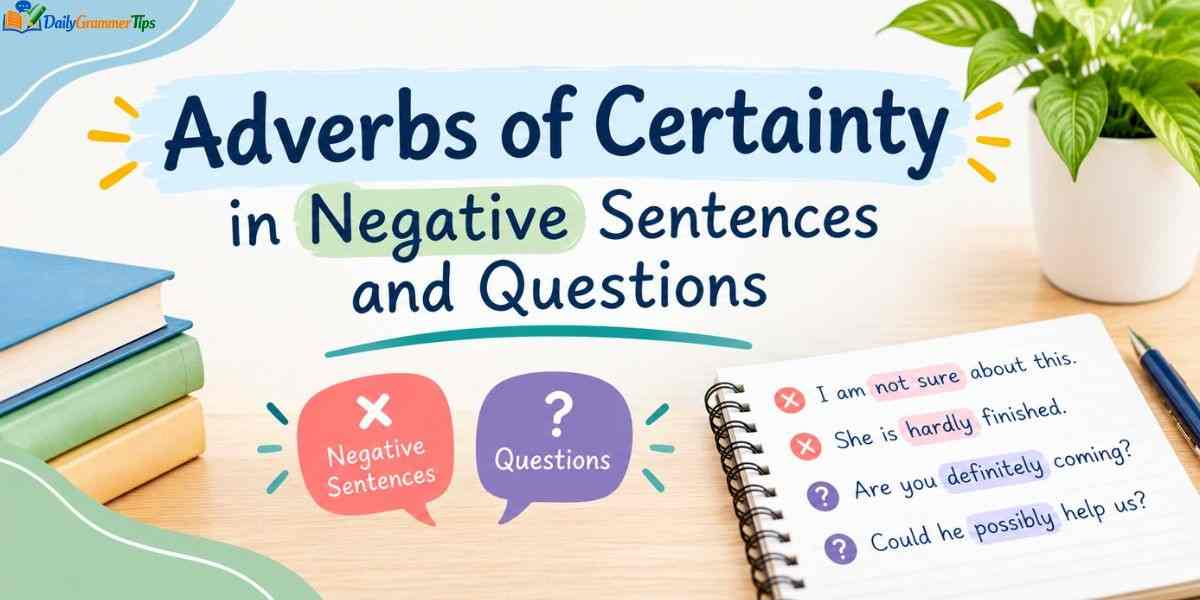
Negatives and questions change the usual order. A few simple rules keep them clear. Learn them as patterns.
Word Order in Negative Sentences
Place the adverb before the negative auxiliary. “She definitely doesn’t know.” “He probably won’t come.” “They certainly didn’t expect it.”
Do not say “He won’t probably come.” This pattern sounds unnatural in standard English.
Definitely Not and Certainly Not
Definitely not and certainly not give firm refusals. “Are you going?” “Definitely not.” “Is it safe?” “Certainly not.”
The adverb stays in front of not. These short answers sound strong.
Surely in Questions
Surely often appears in questions that expect a yes. “Surely you remember?” “Surely they will help?”
The speaker hopes for agreement. The tone is polite but pressing.
Possibly in Polite Requests
Possibly makes requests gentler. “Could you possibly open the window?” “Would you possibly have a minute?”
It also strengthens refusals. “I cannot possibly agree.”
Common Mistakes with Adverbs of Certainty
Even strong learners slip on these words. Knowing the common errors saves time. Each mistake below has a quick fix.
Wrong Position
A common error puts the adverb in the wrong place. “She forgot certainly” is wrong. Say “She certainly forgot.”
Place the adverb next to the verb. This habit fixes most errors.
Splitting the Verb and Object
Do not put the adverb between a verb and its object. “He likes definitely pizza” is wrong. Say “He definitely likes pizza.”
The verb and the object belong together. The adverb goes before the verb.
Using Likely Alone as an Adverb
“He will likely win” is common in speech. In careful writing, use probably or very likely. Say “He will probably win.”
Remember that likely is mostly an adjective. “He is likely to win” is correct.
Stacking Too Many Certainty Words
“He will surely definitely come” is clumsy. Choose one adverb. One clear word carries the message.
Stacking also weakens your tone. Readers may doubt a speaker who repeats certainty.
Probably with Negatives
“He won’t probably come” is wrong. Say “He probably won’t come.” Put the adverb before the negative.
The same rule works for definitely and certainly. They also come before the negative auxiliary.
Confusing Certain and Certainly
Certain is an adjective. Certainly is an adverb. “I am certain” is correct. “I am certainly” needs more words, such as “I am certainly ready.”
Use certain after be. Use certainly before a verb or after be with an adjective.
Mixing Sure and Surely
Sure is an adjective in most cases. “I am sure.” Surely is the adverb. “He will surely win.”
In casual American English, sure can work as an adverb. Avoid it in formal writing.
Misusing the Comma
Do not place a comma between the adverb and the verb it modifies. “She, definitely knows” is wrong. Say “She definitely knows.”
Use commas only for opening adverbs and for adverbs inserted in the middle. “He will, no doubt, succeed” is correct.
Overusing Definitely
Some writers use definitely in every sentence. The word loses force. Vary your choices with certainly, clearly, and undoubtedly.
A rich vocabulary keeps the reader interested. Save the strongest words for the strongest claims.
Adverbs of Certainty in Formal and Informal English
Tone matters. Some words fit chat better. Others fit reports better. Choose by situation.
Formal Choices
Formal writing prefers undoubtedly, unquestionably, undeniably, and inevitably. “The evidence is undeniably clear.” These words sound serious.
They fit essays, reports, and speeches. Use them with care and with proof.
Informal Choices
Chat prefers definitely, for sure, really, and sure. “I will definitely come.” “That is for sure.” These words sound warm and relaxed.
Friends and colleagues use them daily. They fit messages and casual talks.
Matching Tone to Audience
Pick the word for the reader. A friend gets definitely. A professor gets undoubtedly. Matching tone shows social skill.
Read your sentence aloud. If it sounds stiff or too casual, swap the adverb.
Politeness and Softening
Weak certainty words soften your tone. “Perhaps we could meet earlier.” “Could you possibly help?” These forms sound gentle and respectful.
Strong words can sound blunt in requests. Choose soft words when you ask for favors.
Hedging in Academic Writing
Academic writers often soften claims. Probably, possibly, and arguably show care. “This result probably reflects a wider trend.”
Strong certainty words need strong evidence. Hedging protects you from overclaiming.
Adverbs of Certainty in IELTS and Daily Speech
These words appear in tests and in daily talk. Strong control of them makes your English sound polished.
IELTS Speaking
Use them to give clear opinions. “I would definitely recommend that city.” “It is probably the best way to learn.” These answers sound confident.
Mix strong and soft words. Perhaps and possibly show balance. Definitely and certainly show firm views.
IELTS Writing
In essays, use measured words. “This policy will probably reduce costs.” “Technology has undoubtedly changed work.” These claims sound careful and clear.
Avoid absolute words without proof. Overclaiming costs marks.
Daily Conversation
Short answers keep chat moving. “Are you coming?” “Definitely.” “Is it far?” “Probably not.” These replies are quick and natural.
Match the strength to your real belief. Honest signals build trust.
Presentations and Emails
At work, these words add polish. “Certainly, I will send the file today.” “The numbers clearly show growth.” “We will probably finish by Friday.”
Choose words that match your real plans. Clear promises protect your reputation.
Tips for Using Them Well
Choose the word that fits your real confidence. Place it next to the verb. Check the comma at the start of a sentence.
Practice with five sentences each day. Say them aloud and notice the rhythm.
Adverbs of Certainty Phrases and Synonyms
Some phrases act like single adverbs. They add variety and rhythm. This section lists the most useful ones.
No Doubt and Without Doubt
No doubt and without doubt show strong confidence. “He will, no doubt, succeed.” “The view is, without doubt, breathtaking.”
They usually sit in the middle of a sentence with commas. They can also open it.
For Certain and For Sure
For certain and for sure mean with complete confidence. “I know for certain that she left.” “That is for sure.”
For sure sounds casual. For certain sounds a little more formal.
Of Course and By All Means
Of course shows that something is obvious. “Of course I will help.” By all means gives warm permission. “By all means, take a seat.”
Use them in polite replies. They sound friendly and open.
In All Likelihood and In All Probability
These phrases show high probability in formal style. “In all likelihood, the vote will pass.” “In all probability, she will agree.”
They sound careful and polished. Place them at the start of a sentence with a comma.
Beyond Doubt and Beyond Question
Beyond doubt and beyond question sound strong and formal. “The facts are beyond doubt.” “Her skill is beyond question.”
These phrases fit reports and speeches. Use them when the proof is solid.
Adverbs of Certainty Exercises
Practice fixes rules in memory. Try each task before you read the answers. Write your answers on paper first.
Exercise 1 Identify the Adverb
Underline the adverb of certainty. 1. He will definitely be at the party. 2. She is probably going to be late. 3. They are clearly the best team. 4. We will certainly help you. 5. He obviously knew the answer.
Exercise 2 Place the Adverb
Add the adverb in brackets. 1. She knows the answer. (definitely) 2. We will meet tomorrow. (probably) 3. He is the best player. (clearly) 4. They forgot the keys. (certainly) 5. It will rain tonight. (undoubtedly)
Exercise 3 Correct the Mistake
Fix the error. 1. She forgot certainly the keys. 2. He won’t probably come. 3. He likes definitely pizza. 4. She will surely definitely win. 5. They arrived late probably.
Exercise 4 Choose the Best Word
Choose the best word. 1. I (surely / sure) saw him there. 2. (Maybe / Definitely), I will go, but I am not sure. 3. The proof is (conclusively / possibly) clear. 4. He will (probably / possibly) win, since he trained hard.
Answer Key for Exercises 1 and 2
Exercise 1: 1. definitely. 2. probably. 3. clearly. 4. certainly. 5. obviously.
Exercise 2: 1. She definitely knows the answer. 2. We will probably meet tomorrow. 3. He is clearly the best player. 4. They certainly forgot the keys. 5. It will undoubtedly rain tonight.
Answer Key for Exercises 3 and 4
Exercise 3: 1. She certainly forgot the keys. 2. He probably won’t come. 3. He definitely likes pizza. 4. She will surely win. 5. They probably arrived late.
Exercise 4: 1. surely. 2. Maybe. 3. conclusively. 4. probably.
Adverbs of Certainty Worksheets PDF
Use these worksheets in class or at home. Each worksheet has short tasks and answers. You can copy them into a document and save them as a printable PDF.
Worksheet 1 Match the Meaning
Match each adverb with its meaning: certainly, probably, possibly, maybe. The meanings are: very likely, open idea, without doubt, could happen.
Write the pairs on paper. Then compare your answers with the key.
Worksheet 2 Rewrite the Sentence
Rewrite each sentence with a certainty adverb. 1. She is the winner. 2. They will arrive soon. 3. He forgot the meeting. 4. The plan worked.
Choose a different adverb for each sentence. Check the position of every adverb.
Worksheet 3 Write Your Own Sentences
Write six sentences about your day. Use certainly, definitely, probably, possibly, clearly, and obviously once each.
Then underline each adverb. Circle the verb it sits next to.
Worksheet Answers
Worksheet 1: certainly means without doubt. Probably means very likely. Possibly means could happen. Maybe means open idea.
Worksheet 2 sample answers: 1. She is clearly the winner. 2. They will probably arrive soon. 3. He certainly forgot the meeting. 4. The plan obviously worked.
How to Make a Printable PDF
Copy the tasks into a word processor. Add a title and space for answers. Then use the save as PDF option.
Print one copy for each learner. Keep the answer key on a separate page.
Frequently Asked Questions
What are adverbs of certainty?
Adverbs of certainty show how sure a speaker is about an action or event. Examples include definitely, probably, and surely.
What are examples of adverbs of certainty?
Common examples are certainly, definitely, surely, probably, possibly, maybe, obviously, clearly, and undoubtedly.
Where do adverbs of certainty go in a sentence?
They usually come before the main verb but after the verb be. With an auxiliary, they sit between the auxiliary and the main verb.
What is the difference between adverbs of certainty and adverbs of degree?
Adverbs of certainty show confidence in a statement. Adverbs of degree show how much or how strongly, as in very tall.
Is maybe an adverb of certainty?
Yes, many guides include maybe, but it shows low certainty. It signals an open idea rather than a firm belief.
Conclusion
Now you know how to show your level of confidence in English. Strong words like definitely and undoubtedly show firm belief, while probably and possibly leave room for doubt. Place each word near the verb, and your sentences will sound clear and natural.
Keep practicing with real examples. Write a few sentences each day, read them aloud, and pick the word that matches how sure you feel. Soon these small words will make your speaking and writing sound more confident and precise.
