

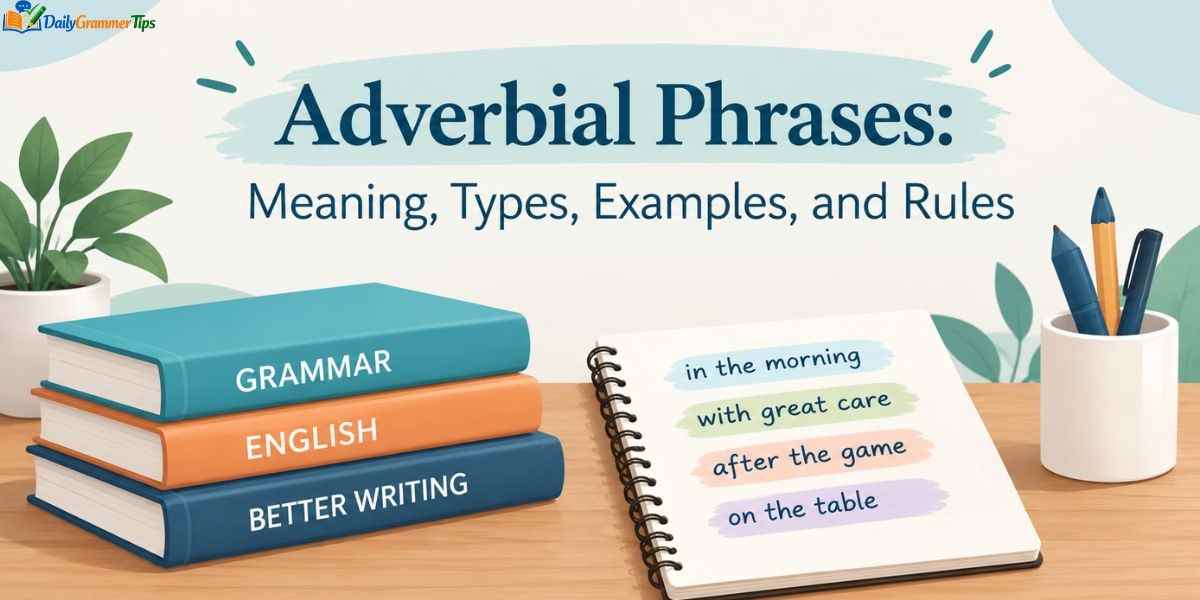
Adverbial phrases add the details that make a sentence useful. They tell us when, where, how, how often, and why something happens, and they do it with a group of words instead of a single adverb.
This guide explains adverbial phrases in a clear order. You will learn the definition, the types, the placement rules, the comma rules, and the common mistakes, so you can write and speak with more control.
What Are Adverbial Phrases?
An adverbial phrase is a group of words that works like an adverb. It has no subject and verb pair of its own. Let us start with a clear definition.
Definition of Adverbial Phrases
Adverbial phrases are groups of words that act as an adverb in a sentence. They modify a verb, an adjective, another adverb, or a whole clause. “She left in the morning” is a simple example.
The phrase in the morning tells us when she left. It works exactly like the single word early.
What Adverbial Phrases Tell Us
These phrases answer four main questions. When did it happen? Where did it happen? How did it happen? Why did it happen? They also answer how often and to what degree.
“He works with great care” answers how. “They met at the station” answers where. Each phrase adds one useful detail.
Adverbial Phrase or Adverb Phrase
Some books use the name adverb phrase. Others use adverbial phrase. Strictly, an adverb phrase is built around an adverb, as in very quickly. An adverbial phrase can use many forms.
Most learners can treat the two names as close relatives. The key idea is that the group of words acts like an adverb.
What Adverbial Phrases Modify
They modify verbs, adjectives, adverbs, and whole sentences. In “She sings very well,” the phrase very well modifies the verb sings. In “He is happy beyond words,” it modifies the adjective happy.
In “Frankly, I disagree,” the single word frankly comments on the whole sentence. Longer phrases can do the same job.
Adverbial Phrases and Sentence Meaning
Adverbial phrases change what a sentence means. “She called” is bare. “She called from the airport at midnight” tells a full story.
Each phrase adds a fact. Readers use those facts to picture the scene and judge the event.
Fronted Adverbials in School Grammar
Many schools teach the term fronted adverbial. It means a phrase at the start of a sentence. “Before sunrise, the farmer woke up.”
Pupils learn to add a comma after it. This habit builds clear and varied sentences.
Why Learners Need Adverbial Phrases
Writers use them to add time, place, manner, and reason. Without them, sentences feel bare and flat. With them, ideas become exact and vivid.
Teachers and examiners also look for them. Varied phrases show range and control. A learner who uses them well sounds more natural and more fluent.
Adverbial Phrases List
A short list gives you a head start. Groups make the words easier to remember. Learn a few from each group.
Common Adverbial Phrases
Some phrases appear everywhere. In the morning, at home, with care, every day, as soon as possible, and for a while are typical. Learn them as fixed chunks.
Native speakers use these chunks without thinking. Learning them in whole units saves time and builds fluency.
Formal and Informal Phrases
Some phrases fit formal writing. “In due course.” “At your earliest convenience.” “With immediate effect.” They sound polite and official.
Others fit chat. “Right away.” “In a sec.” “No problem at all.” Choose the tone that fits your reader.
Time Phrases
Time phrases include at noon, last night, next week, in the evening, and by Friday. Others include for two hours, since Monday, and all day long.
These phrases answer when and how long. They are among the most common in daily English.
Place Phrases
Place phrases include at home, in the garden, next to the bank, over there, and on the table. Others include around the corner and far from here.
They answer where. Many of them use prepositions such as in, on, at, and near.
Manner Phrases
Manner phrases include with great care, in a hurry, by hand, without a sound, and like a champion. Others include in no time and step by step.
They answer how. Some of them compare an action to something else, as in like a pro.
Frequency Phrases
Frequency phrases include every day, once a week, from time to time, now and then, and once in a while. Others include twice a month and day after day.
They answer how often. Pair them with the present simple tense for habits.
Types of Adverbial Phrases
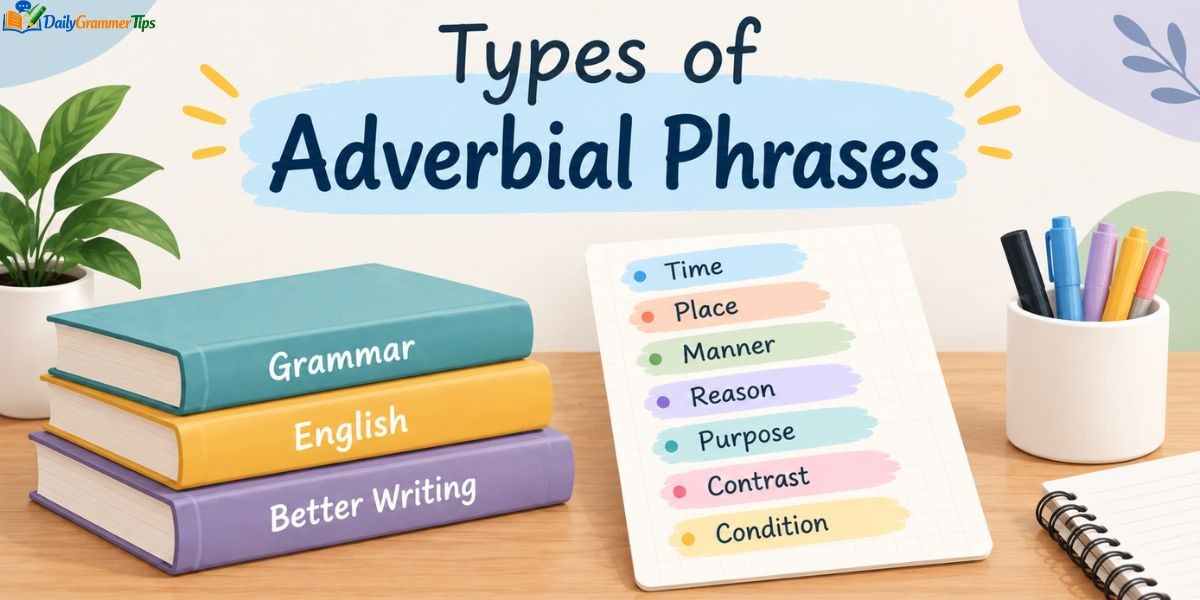
Grammarians sort these phrases in two ways. One way looks at meaning. The other way looks at form. Both help you understand how they work.
Sorting by Meaning
By meaning, adverbial phrases show time, place, manner, frequency, reason, purpose, degree, condition, and concession. Each group answers a different question.
Learning the meaning groups helps you pick the right phrase. It also helps you spot gaps in your writing.
Sorting by Form
By form, adverbial phrases can be prepositional phrases, adverb plus adverb phrases, noun phrases, and infinitive phrases. Each form builds the phrase differently.
“In the park” is a prepositional phrase. “Very slowly” is an adverb phrase. “Last week” is a noun phrase. “To win” is an infinitive phrase.
Fixed Expressions and Idioms
Some phrases are fixed idioms. “Once in a blue moon” means very rarely. “In the nick of time” means just in time. “By and large” means mostly.
Learn them as whole units. Changing a word usually breaks the meaning.
Modifying and Complement Phrases
Most adverbial phrases are modifiers. If you remove them, the sentence still works. “She ran in the park” still works as “She ran.”
A few are complements. Some verbs need them. “He lives in Paris” feels incomplete without in Paris.
Single Words and Longer Phrases
A single adverb can do the job of a phrase. Early and in the early morning mean the same. The longer form adds detail and rhythm.
Choose the single word for speed. Choose the phrase for emphasis and detail.
Adverbial Phrases Examples
Examples show the pattern better than rules. Read each one aloud and notice what the phrase adds.
Examples with Prepositions
“The children played in the garden.” “She waited at the station.” “He spoke with a smile.” Each phrase starts with a preposition and adds a detail.
Take the phrase away and the sentence still stands. The detail simply disappears.
Examples with Two Adverbs
“She cooks very well.” “He drives quite carefully.” “They arrived rather late.” Each phrase pairs an intensifier with an adverb.
The first word adjusts the strength of the second. Together they work as one unit.
Examples with Noun Phrases
“We met last week.” “He calls every day.” “They moved this year.” Each noun phrase acts as an adverb of time.
These phrases have no preposition. They still answer when or how often.
Examples with Infinitive Phrases
“She saved money to buy a car.” “He studied hard to pass the exam.” “They called to ask for help.” Each infinitive phrase shows purpose.
The phrase answers why. It usually comes at the end of the sentence.
Examples in Formal Writing
“The study was conducted over six months.” “The results improved to a large extent.” “The team worked under strict rules.” Each phrase adds exact detail.
These adverbial phrases suit reports and essays. They sound careful and precise.
Examples from Stories
“The old man walked slowly down the lane in the dim light of dusk.” “She spoke in a whisper, with tears in her eyes.”
Story writers stack phrases to build mood. Keep each phrase short so the scene stays clear.
Examples with Comparisons
“She ran like the wind.” “He slept like a baby.” “They worked as a team.” These phrases describe manner through comparison.
They add color to your writing. Use them with care, because stale comparisons sound tired.
Examples in Short Dialogues
A: “When does the class start?” B: “At nine in the morning.” A: “Where do you study?” B: “In the library near my house.”
A: “How do you cook rice?” B: “With a little oil and plenty of patience.” A: “Why did you leave?” B: “To catch the early bus.”
Adverbial Phrases of Time
Time phrases answer when, how long, and how soon. They help readers follow the order of events. This section shows the main forms.
Phrases for Points in Time
Points in time use at, on, and in. “At noon.” “On Monday.” “In July.” The preposition depends on the time word.
Use at for clock times, on for days and dates, and in for months, years, and seasons.
Phrases for Duration
Duration phrases tell how long. “For two hours.” “All day.” “Throughout the winter.” “During the meeting.”
For uses a length of time. Since uses a starting point. “For two hours” and “since nine” answer the same question in different ways.
Phrases with By and Until
By shows a deadline. “Finish the report by Friday.” Until shows how long an action lasts. “Wait until Friday.”
Compare the meanings. By Friday means on or before Friday. Until Friday means up to Friday.
Phrases for Sequence
Sequence phrases show order. “After lunch.” “Before the meeting.” “By the end of the day.” “At the same time.”
They connect events and keep stories clear. Writers use them to guide readers.
Phrases with Noun Phrases
Some time phrases have no preposition. “Last night.” “Next Monday.” “This morning.” “Every week.”
These phrases sound short and natural. They work well in speech and in emails.
Time Phrases in Different Tenses
Match the phrase to the tense. “Yesterday evening” fits the past. “Next week” fits the future. “Right now” fits the present.
A mismatch confuses readers. “I will see him yesterday” is wrong.
Adverbial Phrases of Place
Place phrases answer where and in which direction. They anchor an action in space. They are also easy to spot.
Phrases for Location
Location phrases use at, in, on, and near. “At the bus stop.” “In the kitchen.” “On the roof.” “Near the river.”
Each phrase gives a fixed location. The preposition shows how the objects relate.
Phrases for Direction
Direction phrases use to, toward, into, and across. “To the market.” “Toward the sea.” “Into the room.” “Across the bridge.”
They show movement. They often follow verbs like go, run, walk, and drive.
Phrases for Position
Position phrases show how things sit. “Above the door.” “Below the window.” “Between the two trees.” “Behind the school.”
They help readers picture a layout. Use them in descriptions and directions.
Phrases for Distance
Distance phrases tell how far. “Far from home.” “Close to the school.” “Ten miles away.” “Within walking distance.”
They help readers picture the scene. Numbers make them more exact.
Phrases with Here and There
Fixed phrases use here and there. “Over there.” “Right here.” “Up here.” “Down there.”
They are common in speech. Gestures often support them.
Place Phrases in Writing
In writing, choose exact place phrases. “On the second floor” beats “up there.” Exact phrases avoid confusion.
Add place phrases to scene setting. They help readers see where each action happens.
Adverbial Phrases of Manner
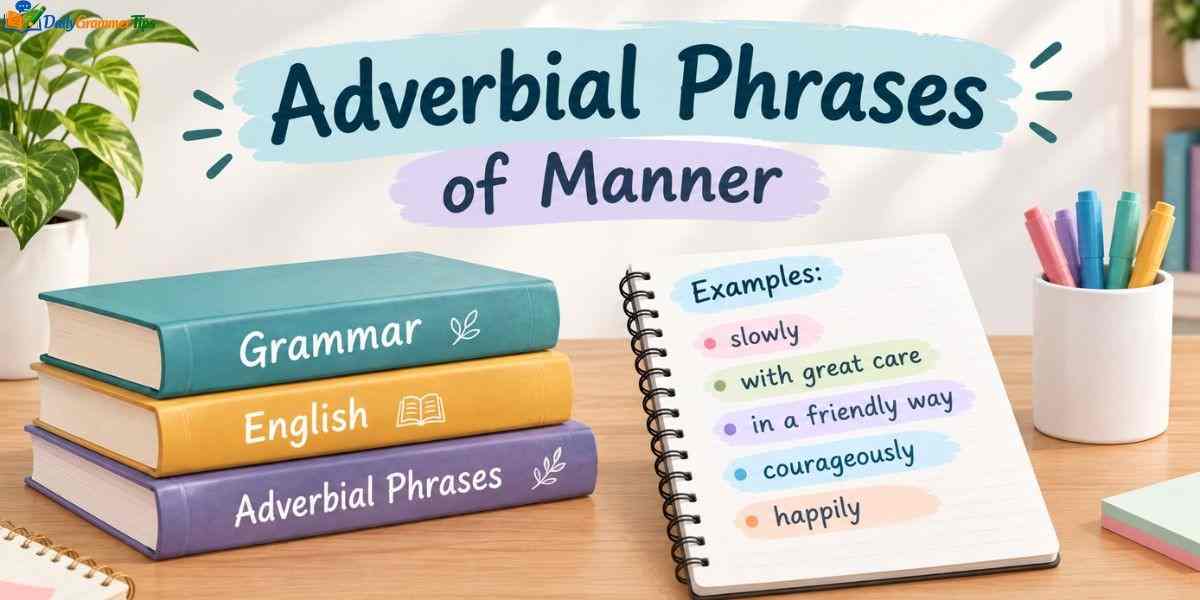
Manner phrases answer how. They describe the way an action happens. They give writing life and color.
Phrases with With and Without
With and without form many phrases. “With great care.” “With a smile.” “Without a sound.” “Without any help.”
They show attitude and style. “She answered with a smile” says more than “She answered.”
Phrases with In and By
In and by also form manner phrases. “In a hurry.” “In silence.” “By hand.” “By accident.”
They describe condition or method. “By hand” tells us the tool was a hand.
Phrases with Like and As
Like and as create comparisons. “Like a champion.” “As a team.” “As fast as possible.” “Like clockwork.”
Comparisons make images. Use fresh ones to keep your style sharp.
Phrases with Very and Quite
Intensifiers combine with adverbs. “Very quickly.” “Quite slowly.” “Rather badly.” “Extremely well.”
The intensifier controls the strength. These phrases are short and flexible.
Manner Phrases in Instructions
Instructions use manner phrases often. “Step by step.” “In small circles.” “From left to right.” “With a damp cloth.”
They tell the reader exactly how to act. Clear manner phrases prevent mistakes.
Choosing the Right Manner Phrase
Pick the phrase that fits the tone. “In a flash” is playful. “With great speed” is neutral. “At lightning pace” is dramatic.
Read your sentence aloud. If the phrase feels forced, choose a simpler one.
Adverbial Phrases of Frequency
Frequency phrases answer how often. They describe habits and routines. They also show patterns over time.
Phrases for Regular Habits
Regular habits use every, each, and per. “Every day.” “Each week.” “Once a month.” “Twice a year.”
They suit schedules and routines. “She jogs every morning” is clear and complete.
Phrases for Occasional Events
Occasional events use softer phrases. “From time to time.” “Now and then.” “Once in a while.” “Every so often.”
They suggest low frequency. They sound relaxed and informal.
Phrases for Repeated Events
Repeated events use phrases like “again and again,” “over and over,” and “day after day.” They stress repetition.
Use them to show effort or annoyance. “He knocked again and again.”
Frequency Phrases and Tenses
Frequency phrases fit the present simple for habits. “He visits his aunt every Sunday.” They fit the past simple for old habits. “We swam every summer.”
They rarely fit the present continuous. Exceptions show annoyance, as in “He is always complaining.”
Learn more……..Adverbs of Certainty: Meaning, List, Examples, and Rules
Placing Frequency Phrases
Most frequency phrases come at the end. “She calls her mother every day.” Some can start the sentence. “Every day, she calls her mother.”
The fronted form adds emphasis. Add a comma after it.
Adverbial Phrases of Reason and Purpose
These phrases answer why. They show cause, aim, and result. They help readers follow your logic.
Phrases of Reason
Reason phrases use because of, due to, and owing to. “Because of the rain, we stayed home.” “Due to illness, he missed class.”
They give the cause of an event. They work best when the cause is a noun phrase.
Phrases of Purpose
Purpose phrases use to, in order to, and so as to. “She studied to pass the exam.” “He left early in order to avoid traffic.”
They show the goal of an action. In order to sounds a little more formal than to.
Phrases of Condition
Condition phrases use in case of, in the event of, and without. “In case of fire, use the stairs.” “Without help, we would fail.”
They show what must happen first. They are common in rules and instructions.
Phrases of Concession
Concession phrases use despite and in spite of. “Despite the rain, we walked.” “In spite of his fear, he spoke.”
They show contrast. The main clause still happens against the odds.
Phrases of Degree
Degree phrases use to some extent, to a large degree, and by far. “She improved to a large degree.” “He is by far the best.”
They show how much. They suit analysis and opinion writing.
Structure of Adverbial Phrases
Every phrase has a core and some extra words. Knowing the structure helps you build and check phrases. This section shows the main forms.
Prepositional Phrases as Adverbials
A prepositional phrase starts with a preposition and ends with an object. “In the garden.” “With a friend.” “After dinner.” It becomes adverbial when it modifies a verb.
This is the most common form. Most examples in this guide belong here.
Adverb Plus Adverb
An adverb can take an intensifier. “Very slowly.” “Quite often.” “Too late.” “Almost always.”
The second word is the head. The first word adjusts its strength.
Noun Phrases as Adverbials
Some noun phrases work as adverbials. “Last year.” “Every morning.” “Next week.” “This time.”
They have no preposition. Their meaning shows their job.
Infinitive Phrases as Adverbials
An infinitive phrase starts with to plus a verb. “To save money.” “To get a better view.” “To pass the test.”
It usually shows purpose. It answers why.
Gerund Phrases After Prepositions
Adverbial phrases can also use gerunds. “He improved by practicing daily.” “She relaxed after finishing the task.” The gerund follows a preposition.
This form shows method or time. It is common in essays and reports.
Participle Phrases as Adverbials
A participle phrase uses an ing or ed verb form. “Walking home, she called a friend.” “Tired of waiting, he left.”
The phrase tells when, why, or how. Make sure its subject matches the main subject.
Adverbial Phrases vs Adverbial Clauses
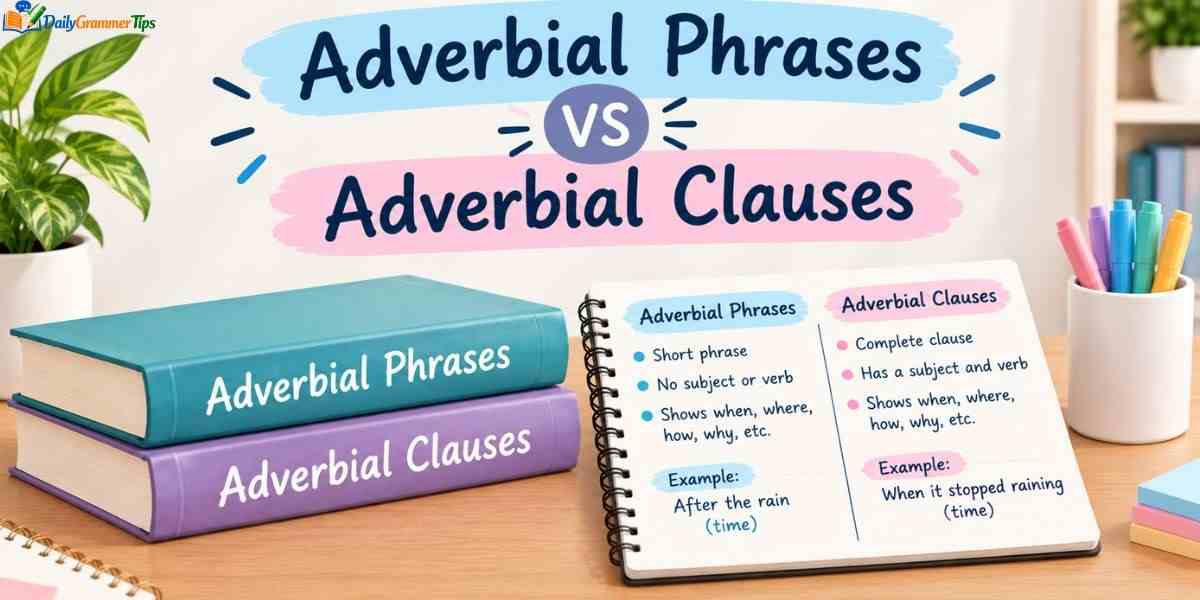
The two forms do the same job. The difference lies in structure. A clause has a subject and a verb.
Key Difference
An adverbial phrase has no subject and verb pair. An adverbial clause has both. “After lunch” is a phrase. “After we had lunch” is a clause.
The test is simple. Look for a subject and a verb. If both appear, you have a clause.
Turning Clauses into Phrases
You can shorten many clauses. “Because it rained” becomes “because of the rain.” “When we arrived” becomes “on arrival.”
Shorter forms make writing tight. Use them when the clause adds little.
Turning Phrases into Clauses
You can also expand a phrase. “Before the meeting” becomes “before the meeting started.” “With great care” becomes “as carefully as he could.”
Clauses add detail. Use them when the reader needs more information.
Examples Side by Side
Compare a phrase with a clause. “After dinner” and “after we ate dinner.” “Because of the storm” and “because a storm hit.”
The phrase is shorter. The clause carries a subject and verb. Both answer the same question.
Which Form to Choose
Choose a phrase for speed and rhythm. Choose a clause for detail and logic. Mix both to keep your style varied.
Too many clauses can feel heavy. Too many short phrases can feel choppy.
Adverbial Phrases vs Prepositional Phrases
These two terms overlap. One names a form. The other names a job. Knowing the difference clears up a lot of confusion.
Form and Function
A prepositional phrase is a form. It starts with a preposition. An adverbial phrase is a function. It acts as an adverb.
Many prepositional phrases act as adverbials. Others act as adjectives.
Adverbial Use
“She sat on the table” uses on the table as an adverbial. It tells where she sat. It modifies the verb sat.
Ask what the phrase modifies. If it modifies a verb, it is adverbial.
Adjectival Use
“The book on the table is mine” uses on the table as an adjective. It tells which book. It modifies the noun book.
The same words can do two jobs. Context decides.
A Quick Test
Ask what the phrase answers. If it answers when, where, how, or why, it is adverbial. If it answers which one, it is adjectival.
Use this test while you read. It works in most sentences.
Adverbial Phrases vs Adverbs
Single adverbs and phrases do similar jobs. They differ in size and style. Each has its place.
One Word or Many
An adverb is one word. An adverbial phrase is a group of words. “Quickly” and “with great speed” mean almost the same.
The phrase adds length and weight. The adverb stays light.
Different Strength
Phrases can add emphasis. “Without any doubt” feels stronger than “surely.” “At the top of his voice” feels stronger than “loudly.”
Choose by tone. Short words feel crisp. Long phrases feel rich.
Combined Use
You can use both in one sentence. “She quickly left the room in tears.” The adverb and the phrase add separate details.
Keep the balance. Too many modifiers can bury the main action.
Short Answers with Phrases
Phrases work well as short answers. “When did you leave?” “At six.” “Where is it?” “On the shelf.” “How did you fix it?” “With a screwdriver.”
These answers sound natural and quick. They also train you to match the phrase type to the question.
Replacing Adverbs with Phrases
Replace weak adverbs with strong phrases. “She walked slowly” becomes “She walked with heavy steps.” The second version shows, not tells.
Use this trick in stories and descriptions. It adds depth.
Where to Place Adverbial Phrases in a Sentence
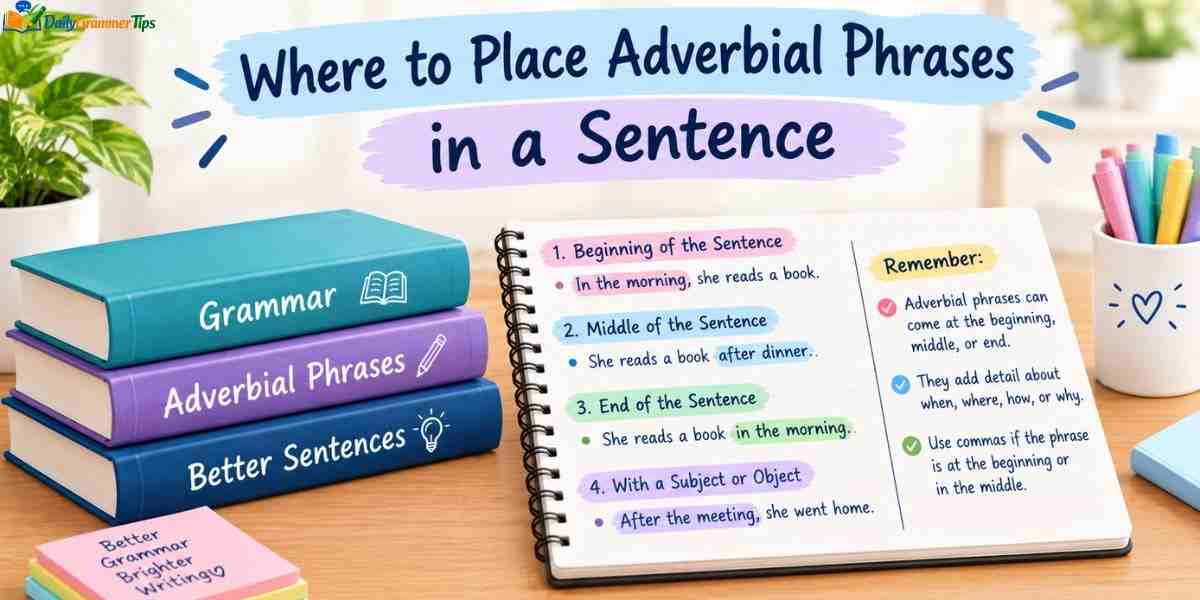
Position changes emphasis. It also changes clarity. These rules cover the usual cases.
At the End of a Sentence
The end is the most common spot. “She sings in the shower.” “We met at noon.” The phrase follows the verb and its object.
This position sounds natural. It rarely needs a comma.
At the Start of a Sentence
A phrase at the start is called a fronted adverbial. “In the morning, we left early.” It adds emphasis and sets the scene.
A comma usually follows. The comma marks where the main clause begins.
In the Middle of a Sentence
A phrase can sit between the subject and the verb. “She, with great care, opened the box.” Commas set it off.
This position sounds formal and slow. Use it rarely.
Order of Several Phrases
When phrases stack, follow a usual order. Manner comes first, then place, then time. “She sang beautifully at the party last night.”
This order sounds natural. Break it only for emphasis.
Moving Phrases for Emphasis
Moving adverbial phrases changes emphasis. “She sang at the party.” “At the party, she sang.” “She, at the party, sang.”
The first version feels neutral. The second adds focus. The third sounds formal and slow.
Never Between Verb and Object
Do not place a phrase between a verb and its direct object. “She ate quickly her lunch” is wrong. Say “She ate her lunch quickly.”
Keep the verb and object together. The phrase goes after them.
Commas with Adverbial Phrases
Commas guide readers through a sentence. A few simple rules cover most cases. Learn them as habits.
After Introductory Phrases
Use a comma after a long introductory phrase. “After the long meeting, we went home.” The comma shows the end of the phrase.
Short phrases may skip the comma. “Today we start.” Use a comma if the sentence could be misread.
Before Phrases at the End
Do not add a comma before a phrase at the end. “She left after dinner” needs none. The phrase is part of the main idea.
Add one only for a pause or contrast. “She left, after all.”
Around Phrases in the Middle
Set off middle phrases with two commas. “The team, at that moment, felt proud.” The commas mark the interruption.
Use one comma and the sentence breaks. Use two and it flows.
Commas in Lists of Phrases
Use commas between phrases in a list. “She worked with care, with speed, and with pride.” The pattern builds rhythm.
Add the final and for clarity. The serial comma avoids confusion.
Common Mistakes with Adverbial Phrases
Even strong learners slip on these phrases. Knowing the common errors saves time. Each mistake has a quick fix.
Misplaced Phrases
A misplaced phrase can change the meaning. “She nearly drove for two hours” differs from “She drove for nearly two hours.” Place the phrase next to the word it modifies.
Read the sentence aloud. If it sounds odd, move the phrase.
Dangling Participle Phrases
A dangling phrase has no clear subject. “Walking down the street, the trees looked tall” is wrong. The trees were not walking.
Say “Walking down the street, I saw tall trees.” The phrase now matches the subject.
Too Many Phrases
Too many phrases bury the main idea. “In the morning, at the office, with great care, she finished the report” is heavy.
Keep two or three phrases per sentence. Split long sentences into two.
Overusing Fronted Adverbial Phrases
Some writers start every sentence with a phrase. “In the morning, we left. At noon, we ate. In the evening, we slept.” The pattern sounds mechanical.
Vary your openings. Start some sentences with the subject. Keep fronted phrases for real emphasis.
Wrong Prepositions
Learners often choose the wrong preposition. “At the morning” is wrong. Say “in the morning.” “At Monday” is wrong. Say “on Monday.”
Learn time phrases as whole chunks. This habit prevents errors.
Confusing For and Since
For and since both show time. For uses a length. Since uses a starting point. “For two years.” “Since 2022.”
Do not mix them. “I have lived here since five years” is wrong.
Redundant Phrases
Do not repeat the same idea. “In the morning time” repeats itself. Say “in the morning.”
Cut extra words. Clear phrases read faster.
Adverbial Phrases in Writing and IELTS
These phrases help you build strong essays and fluent speech. Examiners notice variety. This section shows how to use them well.
Linking Phrases
Some phrases link ideas. “In addition.” “For example.” “As a result.” “On the other hand.” “In conclusion.”
They guide the reader through your argument. Use a comma after them at the start of a sentence.
IELTS Writing
In Task 2, use phrases to show time, reason, and contrast. “In recent years, cities have grown quickly.” “Because of this trend, housing costs have risen.”
Vary the openers. Do not start every sentence the same way.
IELTS Speaking
In speaking, use natural phrases. “From time to time.” “As soon as possible.” “In my free time.” They sound relaxed and fluent.
Link them to personal examples. Real details make answers memorable.
Academic Writing and Reports
Academic writers use precise phrases. “In this study.” “According to the data.” “To some extent.” “Over the past decade.”
These phrases show scope and caution. They also help readers follow the argument.
Style Tips
Use phrases to add detail, not to pad. Cut any phrase that adds nothing. Prefer exact phrases to vague ones.
Read your draft aloud. If a phrase slows the sentence, delete it.
Adverbial Phrases Exercises
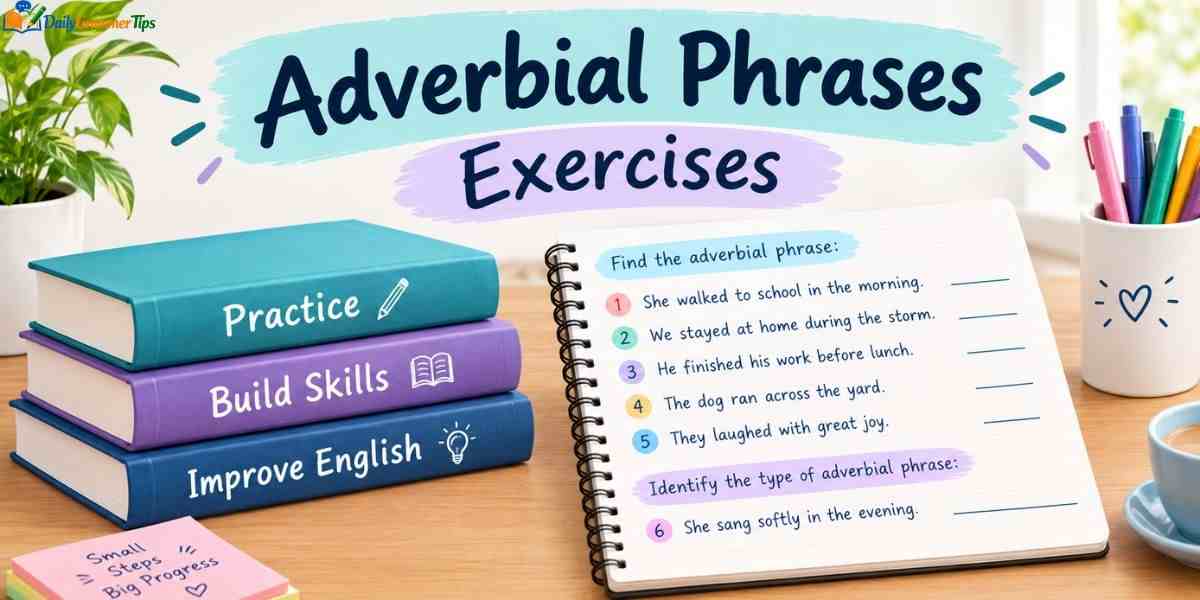
Practice fixes rules in memory. Try each task before you read the answers. Write your answers on paper first.
Exercise 1 Find the Phrase
Underline the adverbial phrase. 1. She arrived at noon. 2. He drives very carefully. 3. They met in the park. 4. We left to catch the train. 5. She calls every day.
Exercise 2 Name the Type
Name the type: time, place, manner, frequency, or purpose. 1. in the garden. 2. with great care. 3. once a week. 4. to win the race. 5. last night.
Exercise 3 Fix the Mistake
Fix the error. 1. She ate quickly her lunch. 2. I will meet you at Monday. 3. Walking home, the rain started. 4. He lives here since 2020. 5. We met in the morning time.
Exercise 4 Shorten the Clause
Turn each clause into a phrase. 1. Because it rained, we stayed home. 2. When we arrived, we ate. 3. Although he was tired, he worked. 4. If there is a fire, use the stairs.
Answer Key for Exercises 1 and 2
Exercise 1: 1. at noon. 2. very carefully. 3. in the park. 4. to catch the train. 5. every day.
Exercise 2: 1. place. 2. manner. 3. frequency. 4. purpose. 5. time.
Answer Key for Exercises 3 and 4
Exercise 3: 1. She ate her lunch quickly. 2. I will meet you on Monday. 3. Walking home, I felt the rain start. 4. He has lived here since 2020. 5. We met in the morning.
Exercise 4: 1. Because of the rain, we stayed home. 2. On arrival, we ate. 3. Despite his tiredness, he worked. 4. In case of fire, use the stairs.
Frequently Asked Questions
What is an adverbial phrase?
An adverbial phrase is a group of words that acts like an adverb. It tells when, where, how, or why something happens.
What are examples of adverbial phrases?
Examples include in the morning, with great care, every day, and to save money. Each one modifies a verb and adds a detail.
What are the types of adverbial phrases?
Common types show time, place, manner, frequency, and reason. By form, they can be prepositional, infinitive, noun, or adverb based phrases.
What is the difference between an adverbial phrase and an adverbial clause?
An adverbial phrase has no subject and verb pair. An adverbial clause has both, as in “after we had lunch.”
Is “in the morning” an adverbial phrase?
Yes, in the morning is an adverbial phrase of time. It works like the adverb early in “She left in the morning.”
Conclusion
Now you know how a group of words can do the work of one adverb. With the right phrase, you can tell your reader when, where, how, how often, and why something happens. Place each phrase near the word it modifies, and add a comma after a long opening phrase.
Keep practicing with real sentences. Write a few lines about your day, add one detail of time, place, and manner, and read them aloud. Soon these small details will make your writing clearer, richer, and more natural.
