

The past simple is the basic tense for finished events. It tells us what happened and when it ended. Learners also call it the simple past.
This guide explains the tense with clear rules and short examples. You will learn the uses, the forms, the irregular verbs, and the common mistakes. Practice exercises with answers close the lesson.
What Is the Past Simple?
The past simple is a verb tense that describes completed actions, states, and habits. The action has a clear end. The speaker treats it as finished.
We build it with the base verb plus ed for regular verbs. Irregular verbs change form. Negatives and questions use the helper did.
- She called me.
- We watched a film.
- He was tired.
- They lived in Rome for ten years.
When to Use the Past Simple
Use the past simple when a situation is over and no special tense is needed. If no present link, past continuous, or past perfect fits, this tense is the default choice.
There are five main uses:
- Finished actions with a finished time word
- Finished periods that everyone knows about
- Details of news
- Stories and lists of events
- Unreal situations in the present or future
Finished Actions With a Time Word
Add a finished time word, and this tense is almost always correct. The time word shows that the period has ended.
- I went to the cinema yesterday.
- We spent a lot of time in Japan in 2007.
- She called me at 2 o’clock.
- They moved house last week.
Finished Time From General Knowledge
Sometimes we skip the time word because everyone knows the period is over. This happens with history and with people who have died.
- Leonardo painted the Mona Lisa.
- The Vikings invaded Britain.
- Shakespeare wrote many plays.
Here the tense signals a closed chapter of history. No time word is needed.
Details of News
We often announce news with the present perfect. Then we give the details in the past simple. The details tell us when, where, and how.
- I’ve hurt my leg. I fell off a ladder when I was painting my bedroom.
- I’ve been on holiday. I went to Spain and Portugal.
- She has found a new job. She applied in March and started in May.
Stories and Lists of Events

Narratives use the past simple for the main actions in order. The past continuous describes the background scene around them.
He went to a café. People were chatting and music was playing. He sat down and ordered a coffee.
Each simple past verb moves the story forward. Each past continuous verb paints the setting.
Unreal Situations in the Present or Future
This tense also expresses imaginary situations. It appears in the second conditional and after the verb wish. The verb looks past, but the meaning is present or future.
- If I won the lottery, I would buy a house.
- I wish I had more time.
- If she lived closer, we would meet more often.
Past Simple Time Expressions
Certain words and phrases usually signal this tense. They mark a period that has ended.
- yesterday, last night, last week, last year
- two days ago, a month ago
- in 2010, in July, on Monday
- when I was a child, the other day, then
The word ago always pairs with this tense. Examples are: We met two years ago. She left last Friday.
Regular Verbs in the Past Simple
Regular verbs take the ending ed. Add it to the base form, and the verb is ready. The form stays the same for every subject.
- I walked to work.
- You walked to work.
- He walked to work.
- We walked to work.
- They walked to work.
One form serves all persons. That makes regular verbs easy to learn.
Spelling Rules for Regular Verbs
A few spelling rules change the ending. Follow them to avoid errors. Check the last letters first, then apply the matching rule.
| Rule | Base form | Past form |
| Most verbs add ed | walk | walked |
| Verbs ending in e add d | like | liked |
| Consonant plus y changes y to i | study | studied |
| Vowel plus y adds ed | play | played |
| One syllable, vowel plus consonant, doubles the consonant | stop | stopped |
| Stressed final syllable doubles the consonant | prefer | preferred |
Pronunciation of the ed Ending
The ed ending has three sounds. After voiceless sounds it sounds like t. After voiced sounds it sounds like d. After t or d it sounds like id.
- t sound: walked, helped, laughed
- d sound: played, called, cleaned
- id sound: wanted, needed, decided
Clear pronunciation helps listeners tell past from present. Practice each group aloud.
Irregular Verbs in the Past Simple
Irregular verbs do not take ed. Their past forms must be learned. Many of the most common verbs belong to this group.
| Base form | Past form | Base form | Past form |
| go | went | think | thought |
| see | saw | give | gave |
| eat | ate | find | found |
| buy | bought | have | had |
| take | took | know | knew |
| come | came | run | ran |
| make | made | speak | spoke |
| write | wrote | drink | drank |
| bring | brought | begin | began |
| leave | left | say | said |
| sit | sat | stand | stood |
| tell | told | read | read |
| sleep | slept | wear | wore |
| drive | drove | forget | forgot |
Group verbs by pattern, like buy and bought or think and thought. Patterns make memory easier.
Past Simple of the Verb To Be
The verb be has two past forms. Use was with I, he, she, and it. Use were with you, we, and they.
- I was at home.
- They were late.
- She wasn’t ready.
- We weren’t there.
- Was he angry?
- Were you in Paris?
The verb be needs no helper. It forms negatives with not and questions by inversion.
Positive Past Simple Sentences
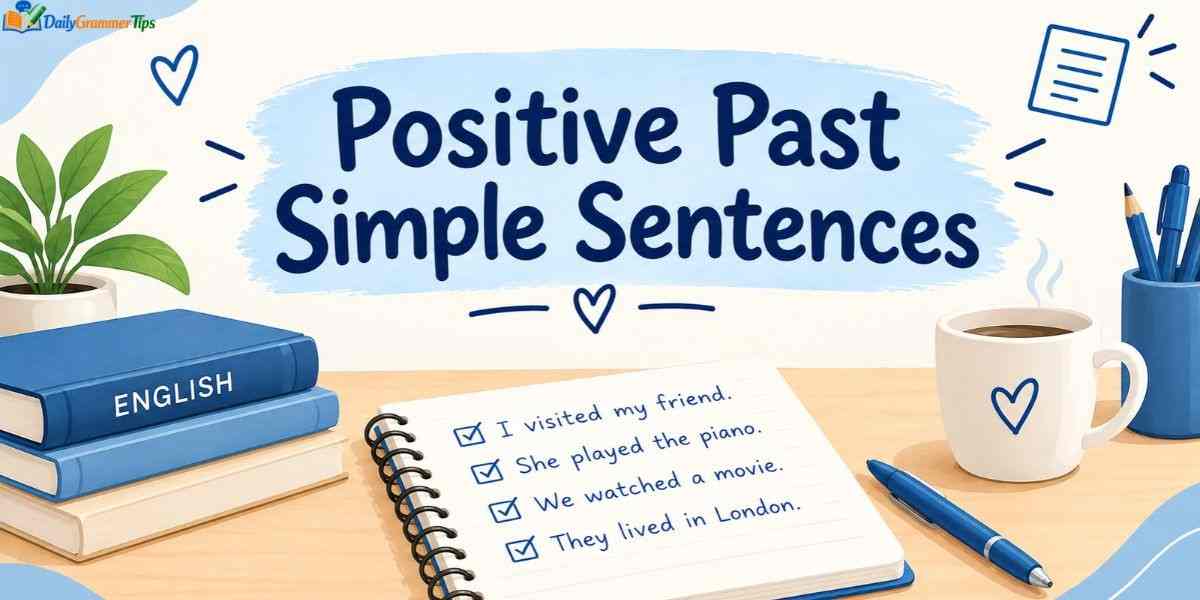
The positive pattern is simple: subject plus past form. Regular verbs end in ed. Irregular verbs use their special form.
Subject + past verb + object
- I finished my homework.
- She drove to the airport.
- They sold their old car.
- We ate dinner at eight.
Add a time word at the start or end for clarity. Both positions work.
Negative Past Simple Sentences
Make negatives with did not or didn’t plus the base verb. The main verb returns to its base form. The helper carries the past.
Subject + did not + base verb
- I didn’t go to school.
- She didn’t call.
- They didn’t see the film.
- We did not finish on time.
A common error is didn’t went. Remember that did already shows the past.
Past Simple Questions
Form questions with did plus the subject plus the base verb. The helper comes first. The main verb stays in its base form.
Did + subject + base verb?
- Did you finish the report?
- Did they travel by train?
- Did she like the gift?
- Did he pass the exam?
Questions in the past simple follow one rule for all verbs except be.
Yes or No Questions and Short Answers
Short answers repeat the helper. Use did or didn’t, not the main verb.
| Question | Positive answer | Negative answer |
| Did you call her? | Yes, I did. | No, I didn’t. |
| Did he win? | Yes, he did. | No, he didn’t. |
| Did they leave? | Yes, they did. | No, they didn’t. |
| Were you late? | Yes, I was. | No, I wasn’t. |
Short answers sound natural and polite. They also show that you know the pattern.
Wh Questions in the Past Simple
Put the question word first. Then add did, the subject, and the base verb. The word order stays steady.
- What did you eat?
- Where did she go?
- Why did they leave?
- When did he arrive?
- How did you learn English?
When the question word is the subject, skip did. For example: Who called you? Who broke the window?
Past Simple vs Present Perfect
Use the present perfect for experiences or news with a link to now. Use the past simple for finished time. A finished time word forces the past simple.
- I have lost my keys. (news, still a problem)
- I lost my keys yesterday. (finished time)
- Have you ever been to Rome?
- Did you go to Rome last year?
Ask yourself: is the time finished or still open? That question solves most choices.
Read also………Reported Speech: A Complete Guide to Indirect Speech in English
Past Simple vs Past Continuous
The past continuous shows an action in progress. The past simple shows a completed action that interrupts it. Use both in one sentence for contrast.
- I was cooking when she called.
- While we were walking, it started to rain.
- He was sleeping when the alarm rang.
A long background action takes the continuous. A short event takes the simple form.
Past Simple vs Past Perfect
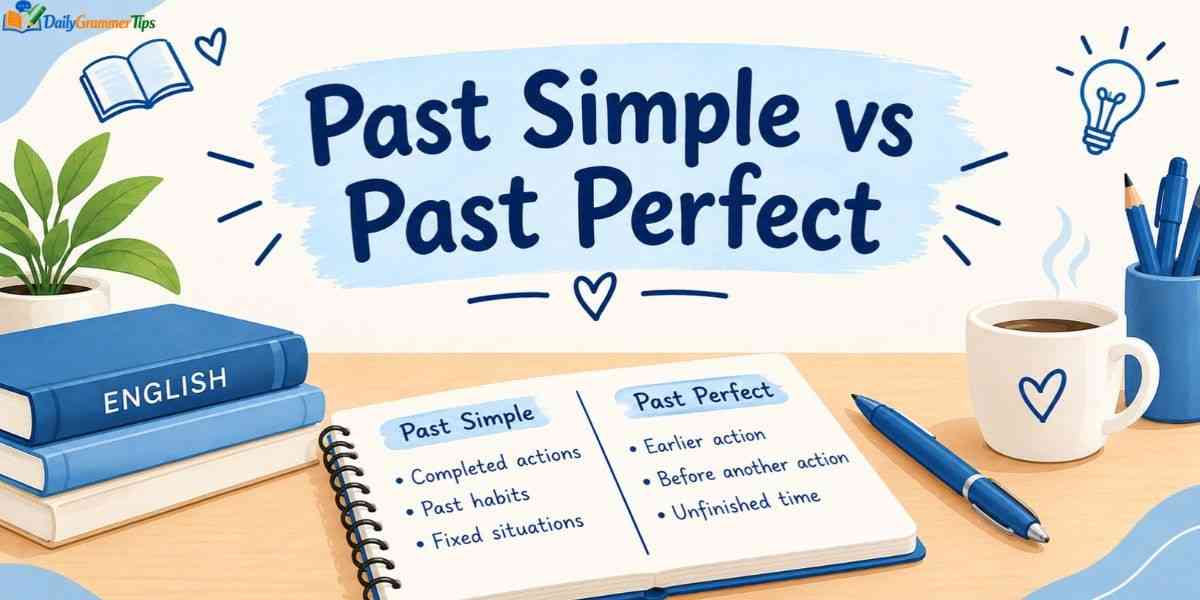
Use the past perfect for an earlier past action. Use the past simple for the later one. Together they show the order of events.
- When I arrived, the film had started.
- She had eaten before we came.
- They had left when I called.
Without the past perfect, both actions look simultaneous. Choose the tense that shows your intended order.
Common Mistakes With the Past Simple
Learners repeat a few errors again and again. Spot them early, and fix them quickly.
| Wrong | Correct |
| She didn’t went. | She didn’t go. |
| Did you saw him? | Did you see him? |
| I have seen him yesterday. | I saw him yesterday. |
| He studyed hard. | He studied hard. |
| They was late. | They were late. |
| I buyed a bag. | I bought a bag. |
Most mistakes come from mixing the helper did with a past form. Use one past marker only.
Past Simple Practice Exercises
Complete each sentence with the correct form of the verb. Write your answers before checking.
- She (visit) her aunt last Sunday.
- We (not watch) the match.
- (you finish) the report?
- He (buy) a new phone in May.
- They (be) in Paris in 2019.
- I (not see) him yesterday.
- What time (the train leave)?
- The children (play) in the garden.
- She (write) a long email.
- (it rain) last night?
Answers to the Exercises
Count your correct answers. Review any mistakes by checking the rules above.
- visited
- didn’t watch
- Did you finish
- bought
- were
- didn’t see
- did the train leave
- played
- wrote
- Did it rain
Positive, Negative, and Question Forms Together
This table shows the whole system at a glance. Review it before any test.
| Positive | Negative | Question |
| I worked. | I didn’t work. | Did I work? |
| You went. | You didn’t go. | Did you go? |
| He ate. | He didn’t eat. | Did he eat? |
| She played. | She didn’t play. | Did she play? |
| We finished. | We didn’t finish. | Did we finish? |
| They were. | They weren’t. | Were they? |
Adverbs of Frequency in Finished Time
Adverbs like always, never, often, and sometimes describe past habits. They sit before the main verb but after was or were.
- She always walked to school.
- We never ate meat.
- He was often late.
- They sometimes visited us.
Time adverbs such as suddenly, soon, and finally help sequence events. For example: Suddenly, the lights went out. Finally, we found the hotel.
Stative Verbs and States in the Past
Stative verbs describe states, not actions. Examples are know, like, love, want, believe, and own. They usually take the simple form, not the continuous.
- I knew the answer.
- She loved that song.
- We wanted a bigger house.
- He owned two cars.
Use this group to describe feelings, opinions, and possession in finished time.
Used to and Would for Past Habits
Used to describes habits and states that no longer exist. Would describes repeated actions, but not states. Both link closely with finished time.
- I used to play football every weekend.
- She used to be shy.
- We would visit our grandparents every summer.
Questions and negatives use did plus use to. For example: Did you use to live here? I didn’t use to like coffee.
Time Clauses With When, After, and Before
Clauses with when, after, before, and as soon as often take the simple form. The order of the verbs shows the order of events.
- When I got home, I made dinner.
- After she left, the room felt empty.
- Before we ate, we washed our hands.
- As soon as the bell rang, the students ran out.
Move the clause to the end for a smoother rhythm. Then drop the comma: I made dinner when I got home.
Contractions and Short Forms
Spoken English prefers short forms in negatives. Did not becomes didn’t. Was not becomes wasn’t. Were not becomes weren’t.
| Full form | Short form |
| did not | didn’t |
| was not | wasn’t |
| were not | weren’t |
Positive verbs take no contraction in finished time. Write walked, not walk’d.
Reported Speech and Backshift
Reported speech often shifts a present tense to a past form. This change is called backshift. It helps us report what someone said earlier.
- Direct: I like tea. Reported: She said she liked tea.
- Direct: We live in Leeds. Reported: They said they lived in Leeds.
Say and tell both take backshift when the reporting verb is past. Time words often change too.
Common Verbs for Daily Routines
Describe yesterday’s routine to practice many irregular verbs in one text.
- I woke up at six.
- I had breakfast and left home at seven.
- I took the bus to work.
- I started my first meeting at nine.
- I had lunch with a colleague.
- I came home at six.
- I cooked dinner and watched TV.
- I went to bed at eleven.
Irregular Verbs With No Change
Some verbs keep the same form in both tenses. Context shows the time. Watch for words like yesterday to avoid confusion.
| Base form | Past form |
| cut | cut |
| put | put |
| hit | hit |
| set | set |
| let | let |
| hurt | hurt |
| shut | shut |
| cost | cost |
| quit | quit |
The verb read changes only in sound. It is pronounced like red in the past.
Irregular Verbs With a Vowel Change
Many verbs change the vowel inside the word. These patterns repeat, so grouping helps.
| Base form | Past form | Base form | Past form |
| sing | sang | break | broke |
| ring | rang | steal | stole |
| swim | swam | choose | chose |
| ride | rode | rise | rose |
| fly | flew | grow | grew |
| throw | threw | draw | drew |
Say each pair aloud three times. Sound patterns stick better than lists.
Irregular Verbs Ending in ght
A group of verbs ends in ought or aught. They share one spelling in the past. Learn them as a set.
- buy, bought
- bring, brought
- think, thought
- seek, sought
- fight, fought
- catch, caught
- teach, taught
These verbs look hard but follow a clear sound pattern.
Everyday Conversation Examples
Short dialogues show how the tense sounds in real life. Read them aloud to build rhythm and confidence.
- A: Where did you go last weekend?
- B: I went to the beach with my cousins.
- A: Did you swim?
- B: No, I didn’t. The water was too cold.
- A: What did you do instead?
- B: We played volleyball and ate ice cream.
Notice the pattern. Questions use did and the base verb. Answers use the past form.
A Short Story Example
A mini story shows several patterns together. Read it once for meaning and once for grammar.
Last summer, my family travelled to Lisbon. We arrived on a sunny morning and checked into a small hotel. The streets were busy, and musicians were playing near the harbour. We walked for hours, tasted fresh bread, and bought postcards. I didn’t want to leave.
Underline each verb. Most are regular, while bought is irregular.
Mixed Exercise: Choose the Correct Form
Pick the correct option for each sentence. Then check your answers below.
- She (goed / went) to school by bus.
- They (didn’t watched / didn’t watch) the news.
- (Did you eat / Did you ate) breakfast?
- We (were / was) very tired.
- He (taked / took) my umbrella.
- I (didn’t see / didn’t saw) your message.
- (Did she call / Did she called) you?
- The film (begin / began) at nine.
Answers: went, didn’t watch, Did you eat, were, took, didn’t see, Did she call, began.
Transformation Exercise
Change each sentence as shown. Turn positives into negatives and questions.
- She cleaned the kitchen. (negative)
- They went to the park. (question)
- He didn’t finish the book. (positive)
- You saw the match. (question)
- We were angry. (negative)
Answers: She didn’t clean the kitchen. Did they go to the park? He finished the book. Did you see the match? We weren’t angry.
Error Correction Exercise
Find and fix the mistake in each sentence. Each line has one error.
- He didn’t came to class.
- Did they arrived late?
- I buyed some milk.
- She wasn’t knew the answer.
- We have visited Paris last year.
Answers: He didn’t come to class. Did they arrive late? I bought some milk. She didn’t know the answer. We visited Paris last year.
Tips to Remember the Past Simple
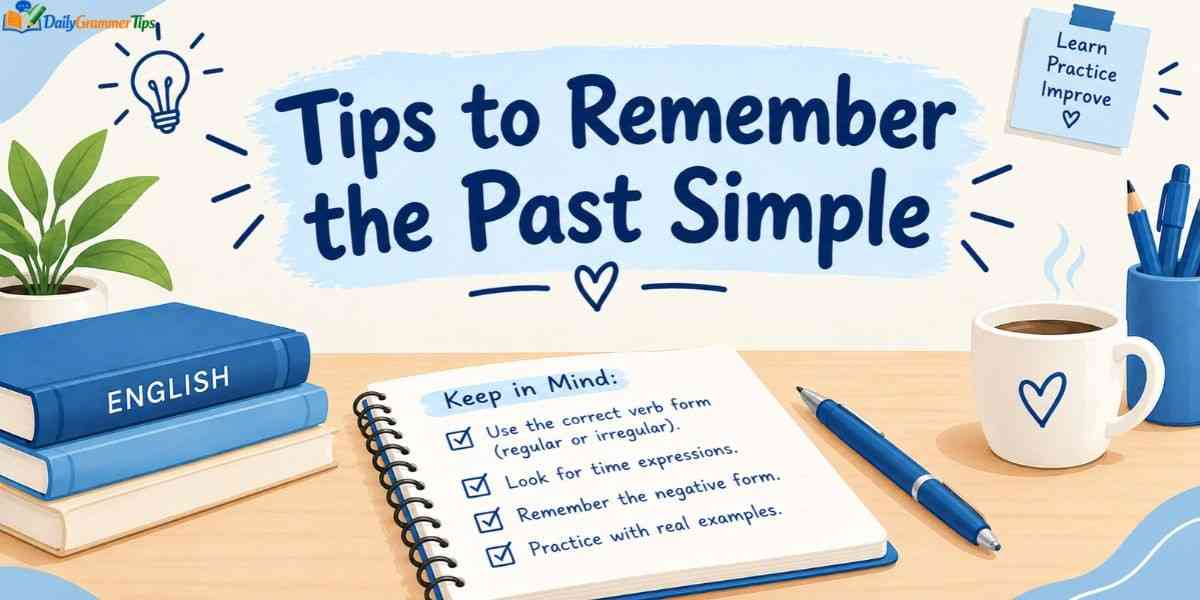
Link each verb to a short phrase. Say it out loud. Write five sentences each day about yesterday.
- Keep a list of irregular verbs
- Read short stories and underline past forms
- Describe your day in the past
- Record voice notes about last weekend
- Test yourself once a week
Frequently Asked Questions
What Is Past Simple With an Example?
The past simple describes a finished action. For example, I visited my grandmother yesterday. The verb visited is the past form, and yesterday marks finished time.
What Is the Simple Past of Explain?
The simple past of explain is explained. Add ed to the base form. For example: The teacher explained the rule twice.
When to Use the Past Simple?
Use it for finished actions, known historical events, details of news, story events, and unreal present situations. A finished time word is the clearest signal.
Is Past Simple V2 or V3?
The past simple uses V2, the second verb form. V3 is the past participle, used in perfect tenses. For regular verbs both forms look the same, as in walked.
What Is This Past Simple?
This question asks what the tense means. It is the basic English tense for finished actions. It uses ed or an irregular form, and did for negatives and questions.
Conclusion
The past simple helps you tell stories, share news, and describe finished events. Add ed to regular verbs, learn the common irregular forms, and use did for negatives and questions. These three habits cover most of what you need.
Mistakes like “didn’t went” fade with practice. Write a few sentences about your day, read them aloud, and check them against the rules. Soon you will talk about the past with ease.
