

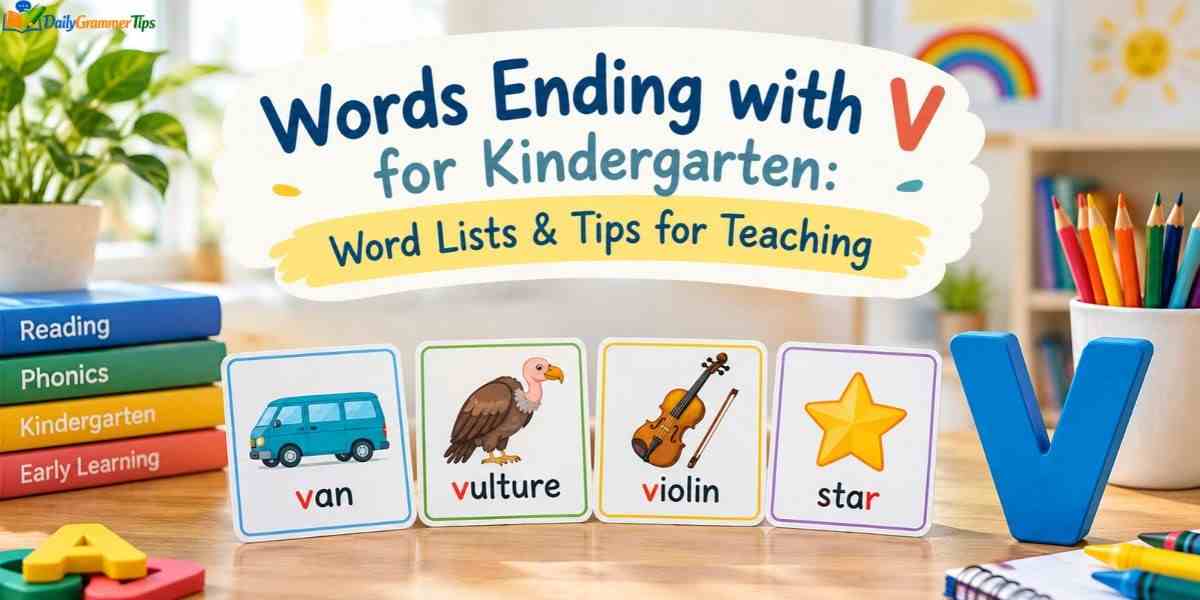
Words Ending with V Teaching words ending with V for kindergarten helps children connect speech sounds with letters and learn common English spelling patterns. Many words that end with the /v/ sound, such as have, give, and love, use a silent E after V.
This guide covers easy word lists, the final V spelling rule, fun phonics activities, and practical teaching tips for parents and kindergarten teachers.
Understanding Words Ending with V in Kindergarten
The letter V makes a buzzing consonant sound. Children hear it in words such as van, seven, and love. However, common English words rarely end with the letter V alone.
Instead, words that end with the /v/ sound usually have -ve at the end. Teaching this spelling pattern helps children improve their phonics, reading, and spelling skills.
Words Ending with the /v/ Sound for Kindergarten
The following words are useful for early literacy lessons. Start with familiar words, then introduce new vocabulary as children become more confident.
Easy Four-Letter Words Ending in -VE
- Have — I have a red ball.
- Give — Give me a hug.
- Love — I love my family.
- Live — I live in a house.
- Five — I have five crayons.
- Dive — The duck can dive.
- Hive — Bees live in a hive.
- Cave — A bear may live in a cave.
- Wave — I wave to my friend.
- Save — We save our drawings.
- Move — I can move my arms.
- Dove — A dove is a type of bird.
Five-Letter Words Ending in -VE
These words can help children build vocabulary and recognize the same spelling pattern in longer words.
- Above — The bird flies above the tree.
- Alive — The plant is alive.
- Brave — The brave child tried something new.
- Drive — We drive to school.
- Drove — Dad drove the car yesterday.
- Glove — I wear a glove in winter.
- Prove — Show me how you can prove it.
- Serve — We serve food at dinner.
- Shave — Some adults shave their beards.
- Shove — Do not shove your friends.
- Stove — Mom cooks on the stove.
Longer Words Ending in -VE

For children ready for more challenging vocabulary, introduce these examples:
- Believe — I believe you.
- Behave — We behave kindly at school.
- Arrive — We arrive at school in the morning.
- Improve — I want to improve my reading.
- Receive — I receive a letter.
These words are best taught as an extension activity. Kindergarten students do not need to master every word at once.
Why Do Words Ending with V Usually Have a Silent E?
In English, a common spelling pattern is to add a silent E after a final V. This is why we write have instead of hav and give instead of giv.
The final E is not pronounced. However, it does not always make the earlier vowel long. Compare give with five to show children that English spelling has patterns and exceptions.
Words Where Silent E Does Not Make the Vowel Long
Examples include have, give, love, and live (meaning to reside somewhere). Children should practice these words because their vowel sounds do not follow the usual long-vowel silent E pattern.
Words Where Silent E Helps Show a Long Vowel
Examples include cave, five, hive, save, and wave. In these words, the vowel has a long sound, and the final E remains silent.
Tips for Teaching Words Ending with V to Kindergarten
Effective kindergarten phonics instruction combines listening, speaking, reading, and writing. Teach a few words at a time and give children opportunities to practice them in different ways.
Teach the /v/ Sound First
Ask children to say a word such as van. Help them notice that their upper teeth gently touch their lower lip while their voice creates a buzzing sound.
Compare /v/ with /f/ using van and fan. Both sounds use a similar mouth position, but /v/ uses voice vibration.
Practice the -VE Spelling Pattern
Write have, give, and save on a board. Say each word aloud and point to the final V-E letters.
Explain that the E is silent and that common English words usually use -ve when they end with the /v/ sound.
Use Pictures and Everyday Examples
Pictures of a glove, hive, wave, and cave help children connect spelling with meaning. Ask children to name each picture, say the word, and identify its final sound.
You can also use simple sentences during shared reading. For example, ask children to find love or have in a familiar story.
Learn more………..Descarada | Spanish to English Translation
Encourage Reading and Writing Practice
Let children read a word, trace its letters, write it, and check their spelling. Letter tiles are useful because children can move letters around and see how the word is built.
Keep practice sessions short. Repeat familiar words over several days instead of introducing a long list in one lesson.
Fun Phonics Activities for Words Ending in -VE
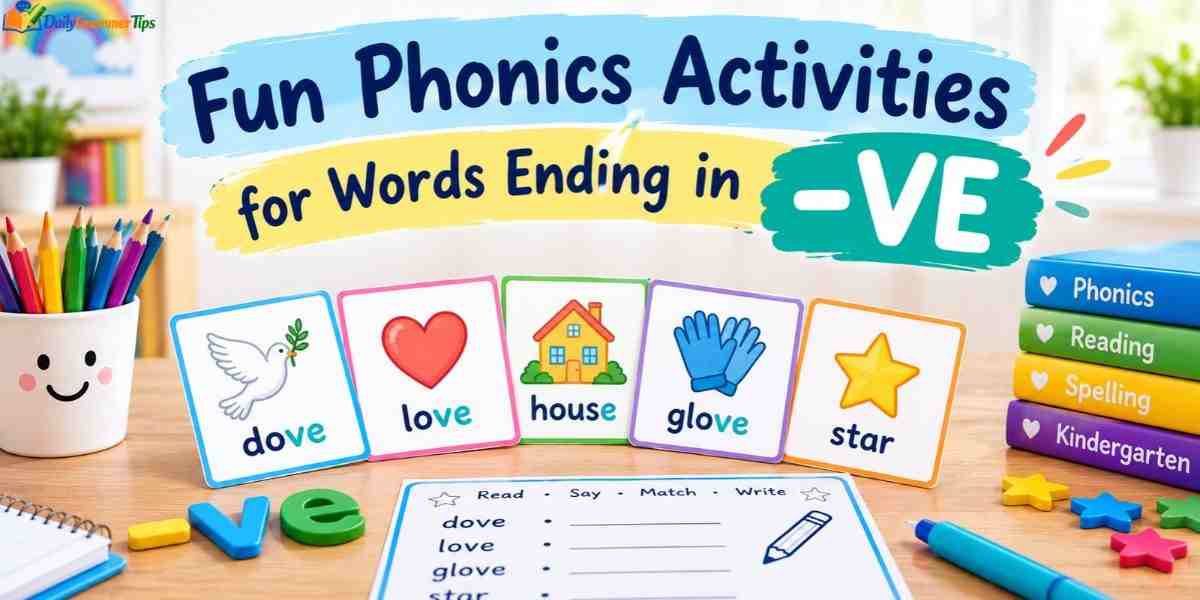
Interactive games make words ending with V for kids easier to remember. Choose activities that allow children to hear sounds, recognize spelling patterns, and use new words.
Picture and Word Matching
Prepare picture cards for five, hive, glove, and wave. Ask children to match each picture with its written word and say the word aloud.
Missing Silent E Game
Write hav, giv, and sav on cards. Ask children to add the missing E to complete the conventional spellings have, give, and save.
Explain that this is a spelling exercise, not a rule that every English word must end in E.
Word Sorting Game
Create two groups of words: those ending with the /v/ sound and those ending with other sounds. Children can listen to each word and sort the cards.
For an extra challenge, ask them to find the final -ve letters in the written words.
Read, Trace, Write, and Check
Choose three words, such as have, love, and five. Children read each word, trace it, write it from memory, and compare their work with the correct spelling.
This activity supports letter recognition, phonemic awareness, and early spelling development.
Common Teaching Challenges and Solutions
Children Leave Out the Final E
If a child writes hav instead of have, model the correct spelling and point out the final V-E pattern. Give the child another chance to read and write the word.
Children Think Silent E Always Makes a Long Vowel
Compare give and five. Explain that the E is silent in both words, but the vowel sounds are different.
Children Confuse V and F
Practice pairs such as van and fan. Ask children to notice the vibration in their throat when they say /v/.
Children Need More Support
Use fewer words, clear pictures, repeated oral practice, and letter tiles. Children who are ready for more can write short sentences using words such as brave, drive, and believe.
A Simple Kindergarten Lesson Plan for Words Ending with V
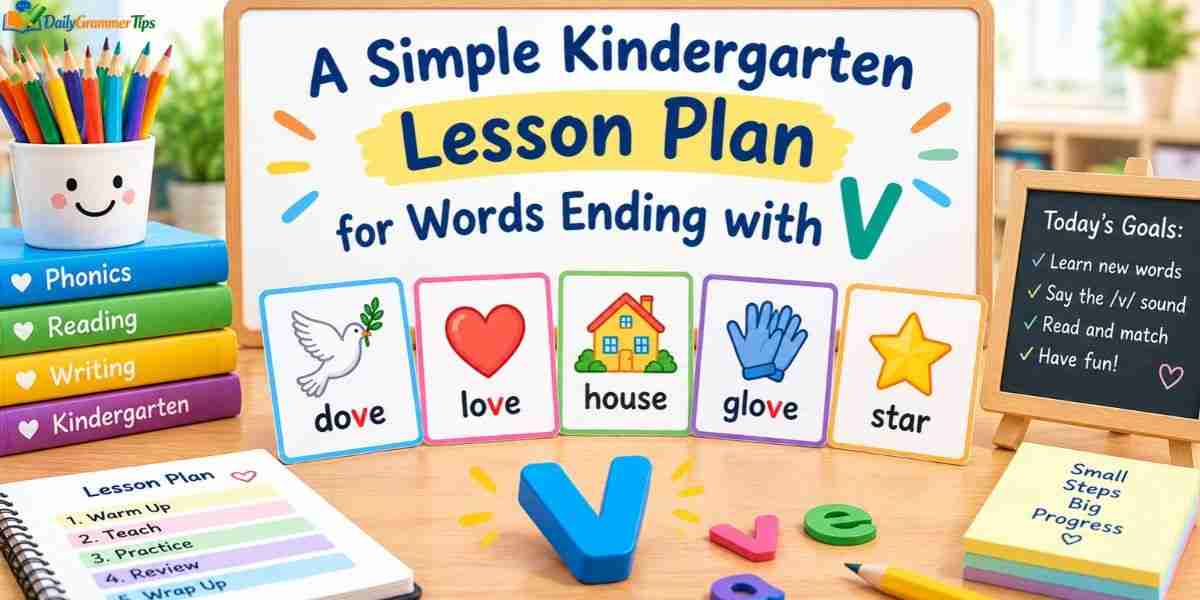
Learning objective: Children will identify the final /v/ sound and recognize the common -ve spelling pattern.
Materials: Picture cards, letter tiles, a whiteboard, and a short word list.
Lesson steps:
- Warm-up: Listen for /v/ in familiar spoken words.
- Model: Introduce have, give, and save.
- Practice: Build the words with letter tiles and identify the final E.
- Independent activity: Read and spell two or three words.
- Review: Ask children why E appears after V in these words.
To check understanding, ask each child to spell a familiar word and explain what they notice about its ending. Adjust the next lesson according to the child’s progress.
Frequently Asked Questions
Are There Any English Words That End with the Letter V?
Most common English words do not end with a bare V. Words such as have, give, and love end with the letters -ve. Some abbreviations, informal forms, borrowed words, and names may be exceptions.
What Are Some Easy Words Ending with the /v/ Sound?
Easy examples include have, give, love, five, save, wave, cave, and hive. These words are useful for practicing the final /v/ sound and the -ve spelling pattern.
Why Do Words Like Have, Give, and Love Have a Silent E?
English commonly uses a final E after V. The E is not pronounced, and in words such as have, give, and love, it does not make the preceding vowel long.
Does Silent E Always Make a Vowel Say Its Name?
No. Compare five, which has a long I sound, with give, which has a short I sound. Children should learn common spelling patterns along with words that do not follow the expected vowel pattern.
How Can Parents Teach -VE Words at Home?
Parents can use picture cards, simple reading books, letter tiles, and short spelling games. Practicing a few words regularly is more manageable than asking children to memorize a long list.
What Is the Difference Between the Letter V and the /v/ Sound?
V is a letter of the alphabet, while /v/ is the speech sound it represents. Children hear /v/ in words such as van and love, even though those words have different written endings.
Conclusion
Teaching words ending with V for kindergarten starts with helping children hear the /v/ sound and recognize the common -ve spelling pattern. Familiar words, picture games, letter tiles, and short writing activities can make the lesson easier to understand.
Begin with a few useful words, explain silent E clearly, and provide regular practice. Over time, children can become more confident in recognizing, reading, and spelling these words.
