

Arabic and Turkish have a long history of cultural exchange, but they are different languages. They share some words because of historical contact, yet their grammar, pronunciation, and writing systems are not the same.
Understanding Arabic vs Turkish helps you learn how these languages differ, why they share vocabulary, and which language may be easier for English speakers to learn.
Are Arabic and Turkish Similar?
Arabic and Turkish share historical connections and many borrowed words. However, Turkish belongs to the Turkic language family, while Arabic belongs to the Semitic branch of the Afroasiatic language family.
Their main differences include grammar, sentence structure, pronunciation, and writing systems. Knowing one language does not automatically allow you to understand the other.
Arabic vs Turkish: Key Differences at a Glance
| Feature | Arabic | Turkish |
| Language family | Semitic | Turkic |
| Writing system | Arabic script | Latin-based alphabet |
| Writing direction | Right to left | Left to right |
| Word formation | Root-and-pattern system | Suffix-based system |
| Typical word order | VSO or SVO | Usually SOV |
| Grammatical gender | Masculine and feminine | No grammatical gender |
| Vowel harmony | No Turkish-style vowel harmony | Yes |
| Third-person pronoun | Separate masculine and feminine forms | O means he, she, or it |
| Borrowed vocabulary | Includes Turkish loanwords | Includes many Arabic loanwords |
| Mutual intelligibility | Not generally mutually intelligible with Turkish | Not generally mutually intelligible with Arabic |
Arabic vs Turkish Language Families and Origins
Arabic and Turkish developed from different linguistic backgrounds. Turkish belongs to the Turkic language family, which includes Azerbaijani and Uzbek, while Arabic belongs to the Semitic branch of the Afroasiatic language family.
What Language Family Does Turkish Belong To?
Turkish belongs to the Turkic language family, which includes Azerbaijani, Uzbek, Turkmen, and Kazakh. These languages share historical and linguistic connections, although their vocabulary and grammar differ.
Modern Turkish developed from earlier Turkic varieties spoken in Anatolia. It is not a dialect of Arabic and does not belong to the Semitic language family.
What Language Family Does Arabic Belong To?
Arabic belongs to the Semitic language family, part of the larger Afroasiatic language family. Hebrew and Aramaic are other well-known Semitic languages.
Arabic uses a distinctive system of word formation based on consonant roots and patterns. This differs from Turkish, which commonly forms words by adding suffixes to a root or stem.
Arabic Script vs Turkish Alphabet
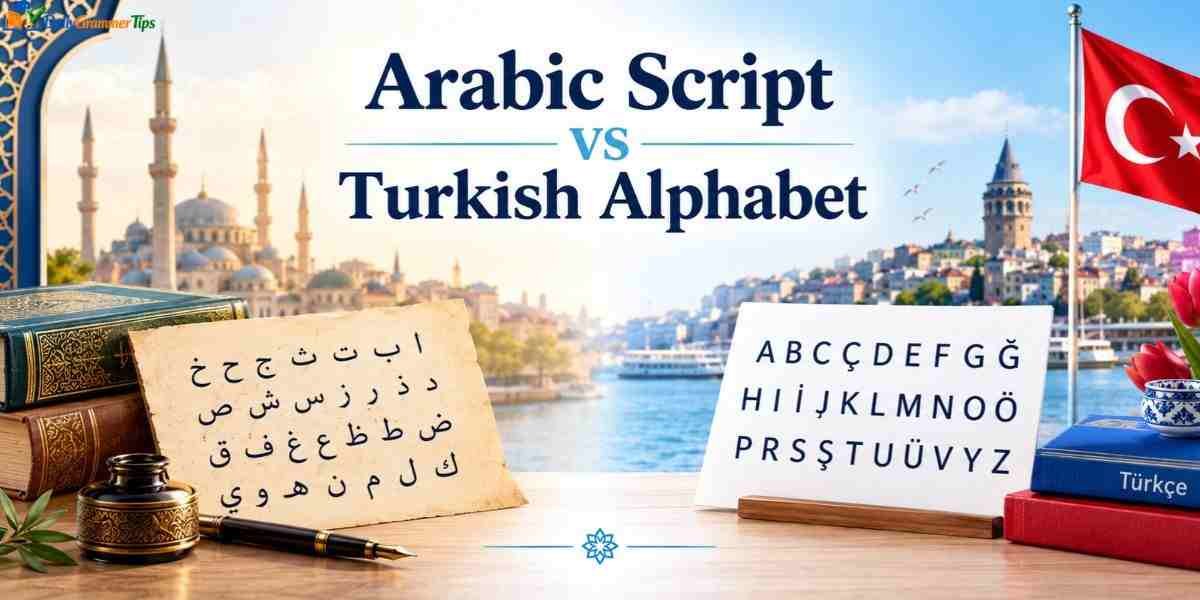
One major difference between Arabic and Turkish is their writing system. Modern Turkish uses a Latin-based alphabet and is written from left to right, while Arabic uses a connected script written from right to left.
What Alphabet Does Turkish Use?
Modern Turkish uses a 29-letter Latin-based alphabet. It includes special letters such as ç, ğ, ı, ö, ş, and ü to represent Turkish sounds.
Turkish is written from left to right. Its spelling is generally predictable, which helps learners pronounce unfamiliar words after they understand the alphabet.
What Writing System Does Arabic Use?
Arabic uses an Arabic abjad, a writing system in which letters mainly represent consonants. Short vowels are often omitted from everyday writing but can be shown with special marks in learning materials and religious texts.
Arabic is written from right to left. Its letters also change shape depending on their position in a word, and many letters connect to neighboring letters.
Did Turkish Ever Use the Arabic Alphabet?
Yes. Ottoman Turkish was historically written using a modified Arabic-based script. It also contained many Arabic and Persian loanwords because of centuries of cultural, religious, and political contact.
In 1928, Türkiye adopted a Latin-based alphabet under Mustafa Kemal Atatürk. This reform changed Turkish writing, but Turkish remained a Turkic language.
Arabic vs Turkish Grammar: Main Differences
Arabic and Turkish grammar follow different systems for building words and sentences. Turkish commonly adds suffixes to word stems, while Arabic uses consonant roots and patterns to form many related words.
How Does Turkish Grammar Work?
Turkish is an agglutinative language, meaning it often adds suffixes to a word stem to express different meanings. These suffixes can indicate plurality, possession, location, and direction.
For example, ev means “house,” evler means “houses,” and evlerimden means “from my houses.” Several grammatical meanings can appear in one Turkish word.
How Does Arabic Grammar Work?
Arabic forms many words through a root-and-pattern system. A common example is the root k-t-b, which is associated with writing.
Words such as kitāb (book), kātib (writer), and maktaba (library or bookshop) show how different words can develop from the same root. Patterns help communicate different meanings and grammatical functions.
Arabic vs Turkish Sentence Structure
Turkish usually follows Subject–Object–Verb (SOV) word order. In a simple sentence meaning “I read the book,” the verb generally appears at the end.
Arabic can use Verb–Subject–Object (VSO) or Subject–Verb–Object (SVO) order, depending on the sentence and context. This difference means English speakers must learn new sentence patterns when studying Turkish or Arabic.
Grammatical Gender in Arabic vs Turkish
Arabic has grammatical gender, with masculine and feminine forms affecting pronouns and agreement with nouns, adjectives, and verbs.
Turkish does not have grammatical gender. Its pronoun o can mean “he,” “she,” or “it,” depending on the context. This makes Turkish gender rules simpler in this area than Arabic gender agreement.
Vowel Harmony in Turkish vs Arabic
Turkish uses vowel harmony, which means suffix vowels often change according to the vowels in the word stem. This helps Turkish words follow regular sound patterns.
Arabic does not use Turkish-style vowel harmony. Instead, Arabic word formation follows its own sound patterns and morphological rules.
Articles and Grammatical Cases in Arabic vs Turkish
Arabic uses the definite article al- to express “the.” For example, al-kitāb means “the book.”
Turkish does not have a direct equivalent of the Arabic definite article. It often expresses definiteness through context and sentence structure, while case suffixes help show relationships such as location and direction.
Arabic vs Turkish Vocabulary: Similarities and Differences
Arabic and Turkish share many words because of centuries of contact, particularly during the Ottoman period. Turkish borrowed Arabic vocabulary related to religion, education, literature, government, and everyday life.
Common Turkish Words That Come From Arabic
Turkish borrowed many words from Arabic through religious, educational, literary, and political contact. Some remain common in everyday Turkish.
| Turkish word | Related Arabic word | English meaning |
| Kitap | kitāb | Book |
| Kalem | qalam | Pen |
| İnsan | insān | Human or person |
| Dünya | dunyā | World |
| Saat | sāʿa | Clock or hour |
| Hayat | ḥayāt | Life |
| Sabah | ṣabāḥ | Morning |
| Cevap | jawāb | Answer |
| Selam | salām | Greeting or peace |
| Fikir | fikr | Idea or thought |
These examples show the influence of Arabic on Turkish vocabulary. However, borrowed words can change in spelling, pronunciation, and meaning over time.
Why Does Turkish Have Arabic Loanwords?
Arabic influenced Turkish through religion, education, literature, scholarship, and government. During the Ottoman period, Arabic and Persian contributed many words to Ottoman Turkish.
Later, Turkish language reforms encouraged the use of Turkish alternatives for some borrowed words. Many Arabic-derived words remained in everyday use, while others became less common.
Are Arabic and Turkish Words Pronounced the Same Way?
Not always. Turkish often adapts borrowed words to fit its own sound system, so a word may sound different in Turkish than it does in Arabic.
Arabic also has sounds that are unfamiliar to many English speakers, including ʿayn and emphatic consonants. Recognizing a shared word can help with vocabulary, but pronunciation still requires practice.
Arabic vs Turkish Pronunciation
Arabic and Turkish have different sound systems, so learners must develop different pronunciation skills for each language. Arabic includes several consonants that may be unfamiliar to English speakers, while Turkish has distinctive vowels such as ı, ö, and ü.
Which Language Is Harder to Pronounce?
Arabic pronunciation can be challenging for English speakers because it includes sounds that do not exist in English. Learners may need to practice unfamiliar throat sounds and distinguish between similar consonants.
Turkish has its own pronunciation challenges, especially the vowels ı, ö, and ü. However, its spelling is generally more consistent than English spelling, which can make reading aloud easier after learning the alphabet.
Why Does Turkish Sound Different From Arabic?
Turkish and Arabic developed within different language families and have different sound systems. Turkish uses vowel harmony and adapts many borrowed words to Turkish pronunciation patterns.
Arabic preserves consonant distinctions that Turkish does not use in the same way. Therefore, even words with shared origins may sound different when spoken in each language.
Are Arabic and Turkish Mutually Intelligible?
Arabic and Turkish are not generally mutually intelligible. A person who speaks one language cannot usually understand the other without studying it or gaining substantial exposure.
Can Arabic Speakers Understand Turkish?
Arabic speakers who have not studied Turkish generally cannot understand ordinary Turkish conversations. Some borrowed words may sound familiar, but Turkish grammar, suffixes, and sentence structure are different.
Can Turkish Speakers Understand Arabic?
Turkish speakers who have not learned Arabic generally cannot understand Arabic conversations either. Knowing Turkish words that originated in Arabic does not provide enough knowledge of Arabic grammar, pronunciation, or script.
Shared vocabulary does not mean mutual intelligibility. Understanding a language requires recognizing words and knowing how they work together in sentences.
Arabic vs Turkish: Which Language Is Harder to Learn?
The difficulty of Arabic and Turkish depends on a learner’s first language, study goals, and previous experience. For English speakers, Turkish offers a familiar Latin-based alphabet, but its suffixes, vowel harmony, and sentence structure may require practice.
Is Turkish Hard for English Speakers?
Turkish can be challenging because of its suffixes, vowel harmony, case endings, and subject-object-verb sentence structure. English speakers must learn to build sentences differently instead of translating each word directly.
However, Turkish uses a Latin-based alphabet and generally predictable spelling. These features can make the early reading process more approachable for people familiar with English letters.
Is Arabic Hard for English Speakers?
Arabic can be challenging because learners must master a new writing system, unfamiliar sounds, grammatical gender, and root-and-pattern word formation.
Learners may also need to study Modern Standard Arabic and a spoken dialect, depending on their goals. Modern Standard Arabic is widely used in formal writing and media, while everyday conversations often use regional varieties.
How Long Does It Take to Learn Arabic or Turkish?
Learning time depends on your goals, study habits, and previous language experience. The U.S. Foreign Service Institute has historically estimated approximately 1,100 classroom hours for Turkish and approximately 2,200 for Arabic for its professional language-training benchmarks.
These figures relate to specific proficiency goals for diplomats, not guaranteed timelines for every learner. Basic conversation, reading, and advanced professional proficiency require different amounts of practice.
Arabic vs Turkish: Which Language Should You Learn?
The right language depends on why you want to learn it. Arabic may be useful for communicating across Arabic-speaking communities, studying Arabic literature, or understanding religious and historical texts.
Learn Arabic If You Want To…
- Communicate with people across Arabic-speaking communities.
- Study Arabic literature, history, or Islamic texts.
- Explore career opportunities involving Arabic-speaking regions.
- Understand Modern Standard Arabic and a regional dialect.
Learn Turkish If You Want To…
- Travel in Türkiye and communicate with local people.
- Understand Turkish television dramas, music, and literature.
- Study the Ottoman Empire and Turkish history.
- Build a foundation for learning related Turkic languages.
Can Learning Arabic Help You Learn Turkish?
Learning Arabic may help you recognize some Turkish words borrowed from Arabic. This can be useful when learning vocabulary related to religion, culture, literature, and history.
However, Arabic knowledge does not automatically teach Turkish grammar or pronunciation. You must still learn Turkish suffixes, vowel harmony, sentence structure, and everyday expressions.
Can Learning Turkish Help You Learn Arabic?
Turkish may help you recognize certain Arabic-derived words and cultural concepts. This familiarity can provide a small advantage when studying Arabic vocabulary.
However, you will still need to learn Arabic script, pronunciation, grammar, and word formation. Turkish and Arabic require separate study because they belong to different language families.
Arabic and Turkish in Culture, Religion, and History
Arabic and Turkish have influenced each other through centuries of contact involving religion, education, trade, literature, and government. The Ottoman Empire played an important role in bringing Turkish-speaking and Arabic-speaking communities together.
How Did the Ottoman Empire Connect Turkish and Arabic?
The Ottoman Empire brought Turkish-speaking and Arabic-speaking communities into contact through government, trade, education, and religion. This contact helped Arabic and Persian vocabulary become part of Ottoman Turkish.
Turkish words also entered some Arabic varieties through historical contact, particularly in areas that experienced long periods of Ottoman rule. These exchanges show how languages can influence one another without becoming closely related.
What Is the Role of Arabic in Turkish Religious Vocabulary?
Arabic has influenced Turkish religious vocabulary because of its importance in Islamic texts and scholarship. Many Arabic-derived words remain familiar in Turkish religious and cultural settings.
However, a shared religious vocabulary does not mean that Turkish and Arabic have the same grammar. Their linguistic structures remain different.
Common Myths About Arabic vs Turkish
Many people assume Arabic and Turkish are closely related because they share words and historical connections. In reality, they belong to different language families and use different grammatical systems.
Myth: Turkish Is a Dialect of Arabic
This is incorrect. Turkish and Arabic are separate languages from different language families, with different grammar and sound systems.
Myth: Modern Turkish Uses the Arabic Alphabet
Modern Turkish uses a Latin-based alphabet. Arabic script was used historically for Ottoman Turkish, but the writing system changed in 1928.
Myth: Turkish and Arabic Have the Same Grammar
Turkish relies heavily on suffixes and vowel harmony. Arabic uses a root-and-pattern system and grammatical gender, so their grammar differs in important ways.
Myth: Knowing Arabic Means You Can Speak Turkish
Arabic knowledge may help you recognize some Turkish loanwords, but it does not replace learning Turkish vocabulary, grammar, and pronunciation.
Myth: All Arabic Speakers Speak Exactly the Same Arabic
Arabic has several regional spoken varieties. Modern Standard Arabic is used in formal writing, education, and many media settings, while everyday speech varies across regions.
Questions
Is Turkish Similar to Arabic?
Turkish and Arabic share historical connections and borrowed vocabulary, but they belong to different language families. Their grammar, pronunciation, and writing systems are distinct.
Are Arabic and Turkish Related Languages?
No. Turkish belongs to the Turkic language family, while Arabic belongs to the Semitic branch of the Afroasiatic language family. Their similarities largely reflect historical contact and borrowing.
Can Turkish Speakers Understand Arabic?
Not usually, unless they have studied Arabic or gained significant exposure to it. Recognizing a few Arabic-derived words is not enough to understand full conversations.
Can Arabic Speakers Understand Turkish?
Not usually, unless they have learned Turkish. The languages use different grammatical structures, pronunciation patterns, and writing systems.
Did Turkish Use the Arabic Alphabet?
Yes. Ottoman Turkish historically used a modified Arabic-based script. Türkiye adopted a Latin-based Turkish alphabet in 1928.
Is Arabic or Turkish Easier for English Speakers?
Turkish may be easier to start reading because it uses Latin letters and generally predictable spelling. Arabic requires learning a new script and presents different pronunciation and grammar challenges. Overall difficulty depends on your goals and learning experience.
Does Turkish Have Arabic Words?
Yes. Turkish includes many Arabic-derived words, such as kitap (book), kalem (pen), dünya (world), and saat (clock or hour). Their modern meanings and pronunciations may differ slightly from the Arabic forms.
Why Does Turkish Sound Different From Arabic?
Turkish and Arabic have different sound systems. Turkish uses vowel harmony and adapts many borrowed words to its own pronunciation patterns, while Arabic has consonant distinctions that Turkish does not use in the same way.
How Many Arabic Words Are Used in Turkish?
There is no single number that applies to every dictionary or definition of a loanword. Estimates depend on whether historical terms, rare vocabulary, and words with disputed origins are included. Modern Turkish also contains words borrowed from Persian and other languages.
Conclusion: Arabic vs Turkish
The main differences between Arabic and Turkish are their language families, writing systems, grammar, and pronunciation. Turkish belongs to the Turkic language family and uses a Latin-based alphabet, while Arabic belongs to the Semitic language family and uses Arabic script.
Their shared vocabulary reflects centuries of historical and cultural contact, especially during the Ottoman period. Understanding these connections helps explain their similarities while recognizing that Arabic and Turkish are distinct languages that must be learned separately.
