

Bvostfus Python is a term that can create confusion for developers because there is limited verified information about the software behind the name. Before treating it as a normal Python package, users should check its source, documentation, package metadata, developer activity, and compatibility. A careful approach is especially important when an unfamiliar name appears in a tutorial, error message, software repository, or online discussion.
For people searching for a Bestofus Python tutorial or trying to install bvosfus python, safety should come before convenience. A reliable Python setup depends on the Python interpreter, package manager, Python dependencies, virtual environment, and compatible package versions. If the software cannot be verified through trusted package sources, installing it directly can introduce unnecessary software security risks .
What Is Bvostfus Python?
Bvostfus Python is best treated as an unverified Python related term unless a trustworthy developer, package repository, or official documentation confirms exactly what it represents. The name may refer to a private Python project, a newly created application, an internal development tool, a spelling variation, or an incorrectly reported software name. That uncertainty means users should not assume that every search result describing Bvostfus Python represents an established Python package.
When researching Bvostfus Python, start by identifying its purpose. A legitimate project should explain what problem it solves, which Python version it supports, what dependencies it needs, and how developers can test it. Good package documentation should also describe the installation process and provide enough package metadata to distinguish the project from similarly named software.
Why People Search for Bestofus Python
People may encounter Bobsttus Python while reading a programming tutorial, searching for a Python library, reviewing Python scripts, or investigating an installation error. Someone may also discover the term through a GitHub repository, a software repository, a discussion forum, or a command copied from another project.
Another possibility is that the name belongs to New Software Bobstfus Python, a private experiment, or a project that has not gained broad recognition. A new software project can exist without having a large community, but limited visibility means package verification becomes even more important.
- Who created the software?
- What does the Python application actually do?
- Is there clear package documentation?
- Does the project have active package maintenance?
- Is the package listed in a recognized package repository?
- Does the source code match the stated purpose?
- Are the installation requirements clearly explained?
Is Bvostfus Python a Real Python Package?
The safest answer is that users should not assume Bvostfus Python is an official or widely recognized Python package simply because the name appears online. Python has a large ecosystem containing official tools, independent libraries, business applications, private packages, research projects, and experimental software. Recognition depends on evidence rather than the name itself.
A genuine Python package normally provides identifiable package metadata, a defined package version, installation instructions, dependencies, and information about its maintainer. A PyPI package may be available through the Python Package Index, while another legitimate project may use a private package repository or a GitHub repository.
The important point is that Bvostfus Python does not automatically become trustworthy because someone provides a pip command. The pip command only tells the package manager what someone wants to install. It does not prove package authenticity or guarantee that the downloaded source is safe.
Bvostfus Python Tutorial: What Should You Learn First?
A useful Bvostfus Python tutorial should begin with verification instead of immediately providing an installation command. First learn how Python software is packaged, how dependencies work, how virtual environments isolate projects, and how package repositories identify software.
If you are following a Bobstfus Python tutorial from an unknown source, compare its instructions with established Python development practices. Pay attention to unusual commands, requests for administrator permissions, external downloads, encoded scripts, or instructions that disable security protections.
A responsible tutorial should explain why a command is needed, where the software comes from, which package version it installs, and how to remove it later. If those details are missing, pause before continuing.
How to Verify Bestofus Python Before Installation
Verification is the most important stage before using Bvostfus Python. Software installation should begin only after you have enough evidence to understand the package and its source.
Check the Software Source
Start with the source. A trusted project should provide identifiable developer information, useful documentation, version history, and a clear explanation of its purpose. If you find the project inside a package repository, inspect the package metadata rather than relying only on its title.
A package repository should provide information about releases, dependencies, package version history, and often links to project information. When a GitHub repository is mentioned, review its source code, activity, issues, release history, and ownership before considering installation.
The phrase verify software source should become a normal part of your Python workflow. It is especially important when unfamiliar packages appear in search results.
Review Package Documentation
Package documentation can reveal whether a project is maintained seriously. Useful documentation normally explains installation requirements, supported Python releases, dependencies, configuration steps, usage examples, and troubleshooting.
Poor package documentation does not automatically prove that software is malicious. However, vague documentation increases uncertainty. When Bvostfus Python lacks a clear explanation, treat the absence of information as a reason for additional investigation.
Examine Package Metadata
Package metadata can reveal the package version, dependencies, project description, author information, license details, and other useful clues. Comparing metadata with the stated software purpose can expose inconsistencies.
Package authenticity becomes easier to evaluate when the project name, maintainer, repository, release history, and source code all tell the same story. If these details conflict, do not rush into software installation.
Understanding How Python Packages Work
Understanding Python packages makes unfamiliar software much easier to evaluate. A Python application usually relies on several components rather than one isolated file.
| Component | Main purpose |
| Python interpreter | Executes Python code |
| Python package manager | Installs and manages packages |
| Python library | Provides reusable functionality |
| Python modules | Organize reusable code |
| Dependencies | Supply supporting features |
| Virtual environment | Isolates project software |
| Configuration files | Define project settings |
A Python package may depend on several other packages. Those relationships are handled through dependency management, which helps developers keep compatible components together.
The Python ecosystem is broad, so developers commonly use Python developer tools, Python development tools, package managers, frameworks, testing utilities, and Python libraries to build applications.
Python Packages Explained Simply

A Python package is reusable software that developers can add to a Python project instead of writing every feature from scratch. Packages may provide web functionality, database access, data analysis, automation, machine learning, testing, networking, or other capabilities.
A Python library can contain multiple Python modules, functions, classes, and supporting resources. Developers import those components into Python scripts or larger applications.
For example, a Python project for data analysis might use a data processing library, while a web application may rely on a Python framework. The exact structure depends on the project’s purpose.
Understanding this structure helps explain why Bvostfus Python could produce installation errors if its dependencies or supported package versions are unclear.
The Role of Python Package Management
A Python package manager makes software installation and dependency management easier. Developers can use package managers to install Python packages, inspect versions, manage dependencies, and reproduce a development environment.
The pip command is widely associated with Python package installation. However, knowing how to run a pip command is different from knowing whether the package is trustworthy.
Good package management includes:
- Checking the package source
- Reviewing package metadata
- Confirming Python version compatibility
- Installing inside a virtual environment
- Recording dependencies
- Testing after installation
- Updating packages carefully
Pip installation should therefore be part of a larger verification process rather than an automatic first step.
Why Virtual Environments Matter for Beautiful Python Setup
A virtual environment creates an isolated space for a Python project. This separation is useful because different projects can require different package versions.
For example, one Python project may depend on an older Python library while another requires a newer release. Installing both globally can create dependency conflicts. A virtual environment keeps each project’s Python dependencies separate.
When testing Bvostfus Python, an isolated Python environment provides a safer place to investigate behavior. If the software does not work, you can remove the environment without disturbing unrelated projects.
Before Installing Bvostfus Python: System Requirements
Before attempting Bvostfus Python installation, review your computer’s system compatibility. The exact installation requirements depend on the software, but common checks include the Python release, operating system, available storage, permissions, and required dependencies.
| Requirement | Why it matters |
| Python version | Determines compatibility |
| Operating system | Determines platform support |
| Storage | Prevents incomplete installation |
| Dependencies | Provides required functionality |
| Permissions | Controls where software can be installed |
| Development environment | Provides a controlled workspace |
Python version compatibility deserves particular attention. A package designed for one Python release may not behave correctly with another. Checking the package version and supported interpreter version before installation can prevent many problems.
Common Warning Signs Before Installing Unknown Python Software
Unknown Python software deserves extra attention when it has one or more warning signs. These may include missing developer information, vague documentation, suspicious download instructions, unexplained permissions, inactive maintenance, or commands that execute downloaded scripts immediately.
Be especially careful with malicious Python packages that imitate legitimate package names. Attackers can use similar names to trick users into installing unwanted software.
Other software security risks include packages that collect unexpected data, modify system settings, access sensitive files, or download additional components without a clear reason.
Trusted package sources reduce risk, but they do not remove the need for package verification.
How to Install Bestofus Python Safely
If you want to install Bvostfus Python, begin with verification rather than copying an installation command. Confirm the package name, source, documentation, supported Python release, dependencies, and package authenticity.
A safe workflow is:
- Verify the project identity.
- Review the package repository.
- Check package metadata.
- Confirm Python version compatibility.
- Create a virtual environment.
- Review installation requirements.
- Install only from a trusted source.
- Test the package.
- Record the working configuration.
- Remove the software if its behavior does not match its documentation.
Do not use a random command simply because it appears in a Bvostfus Python tutorial. Command-line installation can be efficient, but an incorrect command can install the wrong package or modify the wrong environment.
Step One: Confirm Your Python Version
Your Python interpreter determines which packages can run correctly. Before installing Bvostfus Python, identify the Python release currently active in your development environment.
Python version compatibility affects package installation, dependency resolution, and application behavior. Older software may depend on libraries that do not support newer Python releases, while newer packages may require a recent interpreter.
If the package documentation does not state a supported version, consider that a warning sign and investigate further.
Step Two: Prepare a Clean Environment
A clean Python environment makes troubleshooting easier. Create a dedicated virtual environment for unfamiliar software instead of adding it directly to a production project.
This approach supports safer software configuration because you can change settings, test dependencies, and remove the project without affecting unrelated applications.
A clean development environment also makes debugging Python easier. When only the required packages are installed, error messages are easier to interpret.
Bvostfus Python may depend on Python modules, external libraries, frameworks, or utility Step Three: Install Dependencies Carefully
packages. Installing dependencies without checking their source can introduce unnecessary risk.
Review the project’s dependency list before installation. If requirements.txt is provided, inspect its contents and check whether the specified packages are appropriate for the project.
Dependency management becomes especially important when several packages depend on different versions of the same library. Controlled package installation helps prevent dependency conflicts.
Common Bvostfus Python Installation Issues and How to Fix Them
Common issues include package not found errors, ModuleNotFoundError, permission problems, incompatible versions, dependency conflicts, and environment activation mistakes.
Python error handling begins with reading the full message. The error often identifies the missing module, unsupported version, or location where the failure occurred.
Software troubleshooting becomes much easier when the problem is reproduced in a clean environment.
Package Not Found Error
A package not found error usually means the package manager cannot locate the requested package. The cause may be a spelling mistake, unavailable package, private package repository, or incorrect installation source.
If a user searches for Bvostfus Python and expects an immediate installation command, the first step should still be package verification. If the package cannot be confirmed through trusted package sources, forcing installation is not a solution.
Possible Causes
| Cause | Explanation |
| Incorrect package name | The name may be misspelled |
| Unavailable package | The package may not be publicly released |
| Private project | Access may require authentication |
| Wrong repository | The package may exist elsewhere |
| Unsupported release | The package may not support your Python version |
ModuleNotFoundError in Python

ModuleNotFoundError means Python cannot locate a required module. This can happen when installation occurred in another environment or when a dependency was not installed.
Common solutions include checking the active environment, reviewing installed packages, inspecting requirements.txt, and confirming that the correct Python interpreter is being used.
The same approach applies when troubleshooting Bvostfus Python. Do not assume the missing module is always caused by the main package.
Common Fixes
- Confirm the active virtual environment.
- Check the installed package version.
- Review dependency requirements.
- Confirm the Python interpreter.
- Reinstall only verified dependencies.
- Test the application again.
Python Version Compatibility Problems
Python version compatibility can affect almost every part of software installation. A package may work correctly on one interpreter and fail on another.
Before installing Bvostfus Python, compare the required package version with the Python version used by your project. Avoid upgrading Python simply to solve one error unless you have confirmed that the project supports the newer release.
Compatibility should also be checked after software updates because package dependencies can change over time.
Dependency Conflicts
Dependency conflicts happen when different components require incompatible versions of a Python library.
For example, one application may require package version 2 while another expects version 3. Installing both requirements into the same global environment can cause one application to fail.
A virtual environment is one of the simplest solutions. It allows each Python project to maintain its own dependency management rules.
Permission Errors During Installation
Operating systems sometimes prevent software from writing to protected directories. Permission errors may occur when users attempt global installation without the required access.
Instead of immediately granting broad permissions, review the installation path and use a dedicated development environment. Installing software with excessive privileges can increase software security risks.
A controlled software installation is usually safer than forcing the operating system to allow every requested change.
Environment Activation Problems
Creating a virtual environment is not enough. You must ensure that the correct environment is active before installing or running packages.
If the wrong environment is active, Python may use unexpected package versions or fail to find installed modules.
When troubleshooting Bvostfus Python, check the interpreter path, active environment, package list, and project configuration before reinstalling anything.
How to Update Bvostfus Python Safely
Software updates can improve compatibility, fix bugs, and address security problems. However, updating everything at once can introduce new dependency conflicts.
Before updating Bvostfus Python, record the current package version and working configuration. Then review available release information and test the update inside a controlled environment.
Check the Current Version Before Updating
Knowing the current package version gives you a reference point. It helps with Python troubleshooting when behavior changes after an update.
Package version records are useful for comparing releases, reproducing old environments, and identifying which update introduced a problem.
Update Dependencies Carefully
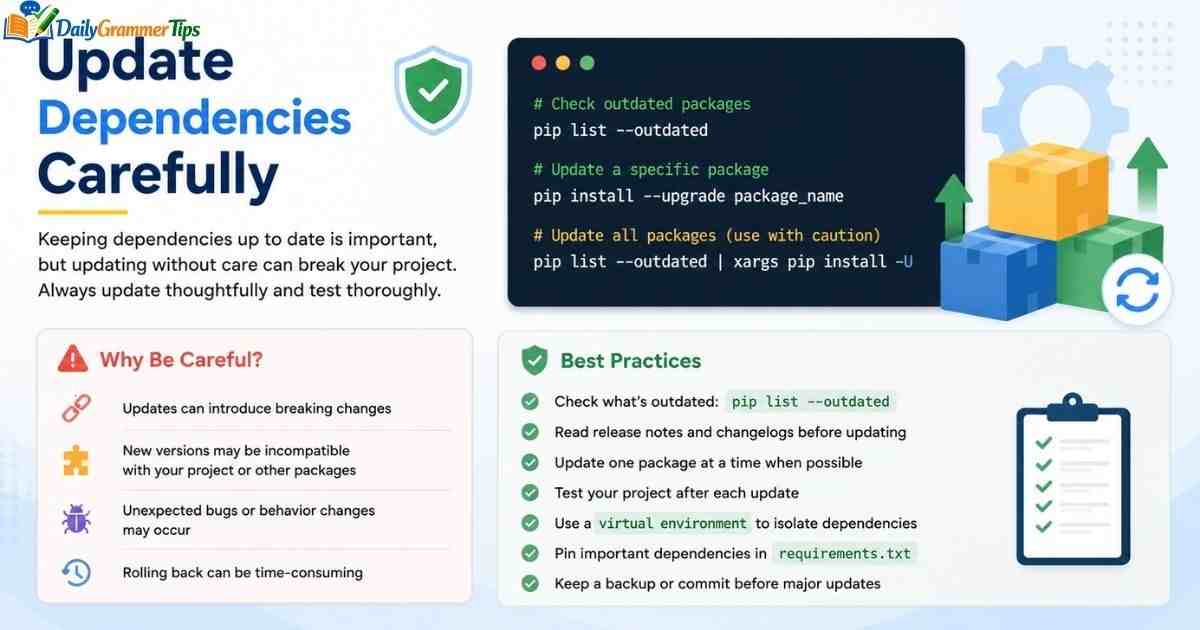
Do not automatically update every Python package in a large project. Review important dependencies individually and check whether newer versions remain compatible.
The goal is controlled maintenance rather than constant change. Update Python packages when there is a clear reason, especially when a release addresses security, compatibility, or important bugs.
Recommended Update Practices
- Review the package version first.
- Read relevant release information.
- Update inside a test environment.
- Run project tests afterward.
- Keep a record of changes.
- Retain a working version when possible.
Test After Every Update
After updating Bvostfus Python or related dependencies, test the application before using it in an important environment.
Check whether the application starts, required modules load, core features work, and no unexpected errors appear.
Testing is part of good Python development because package updates can affect seemingly unrelated components.
Roll Back When Updates Create Problems
If an update breaks a project, return to the previous working package version when possible. Version records and dependency files make rollback much easier.
Rollback is especially useful when a package version introduces compatibility problems or conflicts with another dependency.
Best Practices for Managing Python Software
Good Python software management includes organization, documentation, testing, package maintenance, and security. These practices apply to Bvostfus Python as well as established Python software.
A reliable Python project should have a clear development environment, controlled dependencies, documented configuration, and a repeatable installation process.
Keep Projects Organized With Separate Environments
Each Python project should ideally have its own virtual environment. This prevents accidental changes from one project affecting another.
Separate environments also simplify debugging Python because the number of active packages remains limited.
Document Your Software Setup
Documentation helps developers recreate a project later. Record the Python version, package versions, configuration settings, and important dependencies.
A requirements.txt file can provide a simple record of project dependencies. More advanced projects may use other dependency management tools, but the principle remains the same: make the software configuration reproducible.
Test Software Before Production Use
Never move unfamiliar Python software directly into a critical production environment. First test it in an isolated development environment.
Testing can reveal installation errors, unexpected behavior, compatibility problems, performance limitations, and security concerns.
Maintain Regular Security Checks
Python security requires ongoing attention. Review dependencies regularly, remove packages that are no longer needed, and investigate unusual behavior.
Avoid unknown downloads and do not disable security tools merely to make installation easier. Software security risks often increase when users bypass normal verification.
Security Maintenance Checklist
- Verify software source.
- Review package metadata.
- Use trusted package sources.
- Monitor package maintenance.
- Update trusted dependencies.
- Remove unnecessary packages.
- Test unfamiliar software separately.
- Watch for suspicious behavior.
Real World Applications of Python Based Software

Python programming is used across many areas, including web development, automation, data science, artificial intelligence, cloud computing, testing, and cybersecurity.
Understanding these applications helps explain why Python software has such a large ecosystem. Developers can choose Python frameworks, Python libraries, Python developer tools, and specialized packages according to the requirements of a project.
Python in Web Development
Python web development commonly uses frameworks and libraries to build websites, APIs, dashboards, and online services.
A Python framework can provide routing, request handling, database integration, authentication, and other reusable features. This allows developers to focus on application logic rather than rebuilding common functionality.
Python for Automation
Python scripts can automate repetitive tasks such as file management, reporting, data processing, system administration, and workflow operations.
Python development tools make it easier to create, test, and maintain these scripts. Automation is one reason Python remains popular among developers and technical teams.
Python in Data Science and Analytics
Python is widely used for data analysis because its libraries support data cleaning, numerical calculations, visualization, and statistical work.
A Python project can combine several libraries to process information, identify patterns, generate reports, and support business decisions.
Python and Artificial Intelligence
Python programming is strongly associated with artificial intelligence and machine learning. Developers use specialized Python libraries and frameworks for model development, data preparation, natural language processing, and computer vision.
The Python ecosystem makes it possible to combine different tools into a single development environment.
Python in Cloud Computing and DevOps
Python applications can support deployment automation, infrastructure management, monitoring, testing, and cloud workflows.
Python scripts can also connect different development tools, allowing technical teams to automate repetitive operational tasks.
Python in Cybersecurity
Python is used for defensive security analysis, monitoring, testing, log processing, and automation.
However, security related Python scripts should always be tested responsibly. Unknown packages should never be trusted merely because they claim to provide security functionality.
Bvostfus Python vs Traditional Python Setup
A traditional Python setup gives developers direct control over the interpreter, packages, virtual environments, configuration, and project structure. A specialized tool may simplify some of these tasks, but convenience depends on the software’s quality and maintenance.
| Area | Traditional Python setup | Unverified specialized software |
| Control | High | Depends on the tool |
| Documentation | Usually established | May be limited |
| Package verification | Easier to research | Requires extra checking |
| Maintenance | Developer controlled | Depends on maintainer |
| Compatibility | Well documented for common tools | May be uncertain |
| Security evaluation | Established practices | Requires additional caution |
This comparison does not mean every specialized Python project is unsafe. It means developers should evaluate an unfamiliar tool based on evidence rather than its name.
How to Decide If a Python Project Is Trustworthy
A trustworthy Python project should have a clear purpose, identifiable ownership, useful documentation, version history, and evidence of package maintenance.
When evaluating Bvostfus Python, ask whether the available information answers basic questions about the software. If important details remain unexplained, postpone installation until the source can be verified.
Learn More……Outing or Outting: Which Spelling Is Correct?
Check Developer Activity
Active development can provide useful evidence about a project’s condition. Look for recent releases, issue discussions, maintenance activity, and meaningful source code changes.
A project that has been abandoned for years may still work, but it requires additional compatibility and security review.
Review User Feedback
User feedback can reveal installation difficulties, compatibility problems, performance concerns, and unexpected behavior.
Do not rely on a single comment. Compare multiple sources and determine whether reports are consistent with the project’s documentation.
Avoid Random Installation Commands
One of the most important lessons from any Bvostfus Python tutorial is to understand commands before running them.
Before using a command-line installation command, ask:
- What package will it install?
- Which repository provides it?
- Which version will be installed?
- What dependencies will change?
- Does the command require elevated permissions?
- Can the software be removed safely?
These checks are simple but valuable.
Bvostfus Python GitHub: What Should You Check?
If you encounter a Bvostfus Python GitHub project, do not judge it only by the repository title. Examine the repository owner, source code, release activity, documentation, issue history, dependencies, and project structure.
A GitHub repository can be useful evidence, but the presence of source code alone does not guarantee that software is safe. Review whether the repository matches the package name and whether its installation instructions are consistent with the actual files.
Check the README, release history, package metadata, dependency files, and recent activity. If the project requests unusual downloads or unexplained permissions, investigate before installation.
Alternatives If Bvostfus Python Is Not Available
If Bvostfus Python cannot be verified, choose a Python alternative based on your actual development goal.
| Goal | Common solution type |
| Web development | Python framework |
| Automation | Python scripts and libraries |
| Data analysis | Data science libraries |
| Artificial intelligence | Machine learning frameworks |
| Testing | Python testing tools |
| General development | Established Python development tools |
Python alternatives are often easier to evaluate because established projects have stronger documentation, broader communities, and clearer maintenance histories.
Choosing a known solution is usually better than forcing an unknown package into a project simply because its name appeared in a search result.
Is Bvostfus Python Safe to Install?
The safest approach is to treat Bvostfus Python as unverified until its package authenticity and source can be established. Avoid installing software simply because a tutorial or forum post provides a command.
Use a virtual environment, inspect package metadata, verify software source, review dependencies, and test the application separately. These practices reduce exposure to software security risks without making normal Python development unnecessarily difficult.
Can You Install Bvostfus Python With Pip?
You should not assume that a pip command exists for Bvostfus Python. Pip installation only makes sense when the package name, repository, source, and release are verified.
If a package is genuinely published through a recognized package repository, its official documentation should identify the correct installation process. If no trustworthy package listing exists, do not substitute a random package name.
What Should You Do If Bvostfus Python Does Not Work?
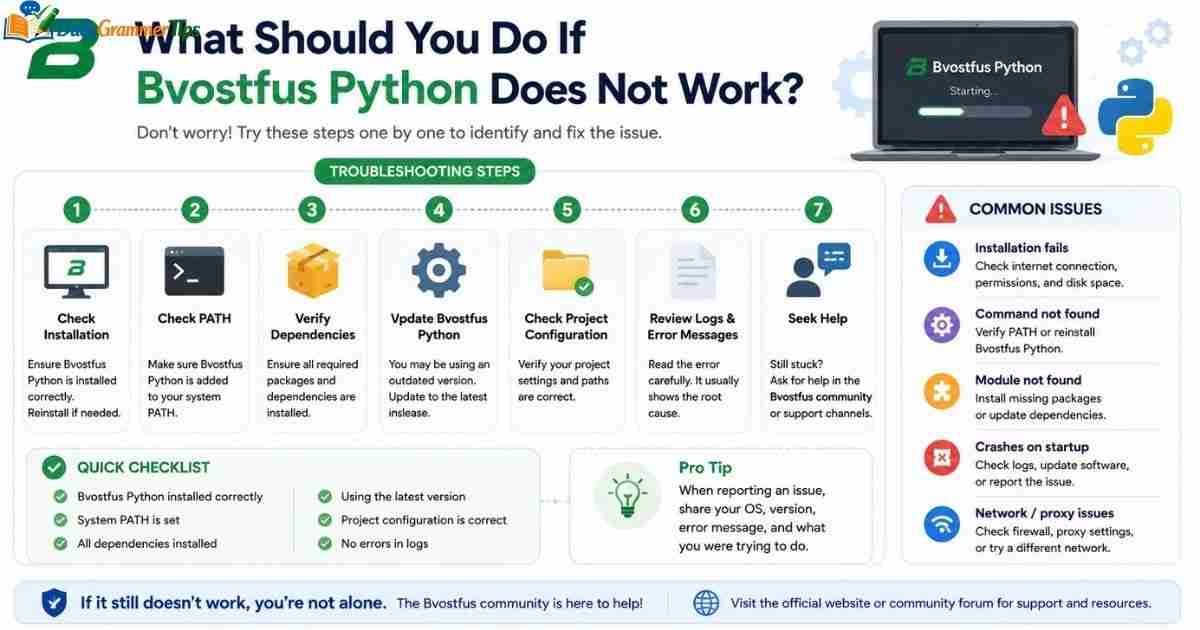
Start with the error message rather than reinstalling repeatedly. Check the active Python environment, interpreter version, package version, dependency list, and installation source.
Python troubleshooting becomes more effective when you isolate one variable at a time. If the package cannot be verified at all, the best solution may be to stop troubleshooting the installation and choose a trusted Python alternative.
Frequently Asked Questions
Does NASA use Python?
Yes. NASA has used Python in various scientific, engineering, data analysis, automation, and research contexts. Python is valuable because its libraries support scientific computing and rapid development.
Does NASA use C or C++?
Yes. NASA uses C and C++ in areas where performance, hardware interaction, embedded systems, and precise control are important. The language choice depends on the mission and software requirements.
What’s harder, C++ or Python?
C++ is generally considered harder for beginners because it exposes more complex concepts involving memory, types, compilation, and language features. Python has simpler syntax, making Python programming easier to start.
What is called Python?
Python is a high level, general purpose programming language and also refers to the Python software ecosystem built around its interpreter, libraries, packages, and development tools.
What are the key features of Python?
Key features include readable syntax, dynamic typing, extensive libraries, cross platform support, object oriented programming, automation capabilities, and a large developer community.
Conclusion
The biggest lesson from Bvostfus Python is that unfamiliar software deserves verification before installation. A package name alone cannot prove authenticity, safety, compatibility, or usefulness. Developers should inspect the source, documentation, package metadata, dependencies, maintenance history, and supported Python versions before making changes to a development environment.
If you are trying to install bvostfus python, begin with a clean virtual environment and confirm the software source before running commands. If reliable evidence remains unavailable, choosing established Python alternatives is a safer path. Good Python development is not about installing every new package quickly; it is about selecting appropriate tools, managing dependencies carefully, testing changes, and protecting the development environment.
