


Spelling in English rarely follows a single clean rule, and that is exactly why so many people pause over Outing or Outting before hitting send on an email or finishing a school assignment. The two forms look almost interchangeable at first glance, and English does love doubling consonants in plenty of other words, so the hesitation makes sense. Still, only one spelling belongs in a dictionary, and the other one simply does not exist in standard usage no matter how natural it might feel to type.
The short version is this: outing is correct, and outting is not a recognized spelling anywhere in standard English. Whether the word is describing a fun day trip, a group excursion, or the less common sense involving public disclosure, the accepted form always keeps a single “t.” This guide breaks the Outing or Outting question down piece by piece, covers the grammar reasoning behind it, and shows exactly how to use the word with confidence.
Outing or Outting: Which One Is Correct?
Anyone typing Outing or Outting into a search bar usually wants a fast, clear answer, so here it is upfront.
The correct spelling is:
- Outing
The spelling to avoid is:
- Outting
Every major English dictionary and every widely accepted grammar reference agrees on this point without exception.
Correct Example
- “The class went on an outing to the science museum.”
Incorrect Example
- “The class went on an outting to the science museum.”
That second version is simply wrong, no matter how common the typo might be in casual writing, and it is a mistake worth avoiding once you understand the Outing or Outting rule.
Read Also: Filing vs Filling: Meaning, Differences, and Usage
Why Is “Outing” Correct and Not “Outting”?

Confusion around spell outing or outting usually traces back to a well known English pattern involving doubled letters before an ending like -ing.
Many learners notice patterns such as:
- Run becomes Running
- Sit becomes Sitting
- Hit becomes Hitting
From there, it feels logical to assume:
- Out should become Outting
But that assumption does not hold up once you look closer at how the word actually formed.
The Grammar Rule
Outing is not built by taking the short word “out” and simply doubling its final consonant the way certain one syllable verbs do. Instead, outing exists as its own established noun, and in some situations a verb form, that has always carried a single “t” in standard English.
That distinction settles the Outing or Outting debate immediately:
- Correct: outing
- Incorrect: outting
English is full of quirks like this one, but once the underlying reason clicks, the correct spelling becomes second nature in any Outing or Outting comparison.
What Does “Outing” Mean?
Knowing both meanings of the word makes the Outing or Outting spelling far easier to remember and use correctly.
1. A Social Trip or Excursion
This is by far the most familiar sense of the word in everyday Outing or Outting conversations.
Example:
- “Our neighborhood organized an outing to the botanical garden.”
In short, this meaning describes:
- A short trip, group excursion, or planned activity meant purely for enjoyment.
You will regularly hear it in phrases like:
- Family outings
- Office outings
- School outings
- Weekend outings
2. Publicly Revealing Something About Someone
The second, less common meaning involves publicly disclosing private information about a person, often tied to personal identity or private details they had not chosen to share.
Example:
- “The story sparked backlash after outing the individual without their permission.”
While this sense appears far less often in casual writing, it remains a fully legitimate and grammatically correct use of the same spelling within the wider Outing or Outting picture.
Spell Outing or Outting: Why the Confusion Happens
A lot of people search spell Outing or Outting precisely because English spelling conventions can feel inconsistent from one word to the next.
Here is where the mix up tends to start.
Similar Words Double the Consonant
Consider familiar examples such as:
- Hit turns into Hitting
- Stop turns into Stopping
- Run turns into Running
Seeing this pattern repeatedly makes it tempting to assume “out” should follow suit and become “outting.”
But “Outing” Breaks the Pattern
Outing does not follow that doubling rule, because it functions as an already established word rather than a freshly modified verb form. Standard spelling has always kept it at a single “t.”
Once you view outing as a complete word in its own right, rather than “out” plus an ending, the correct spelling stops feeling like an exception and starts feeling obvious.
Is It Outing or Outting in British and American English?
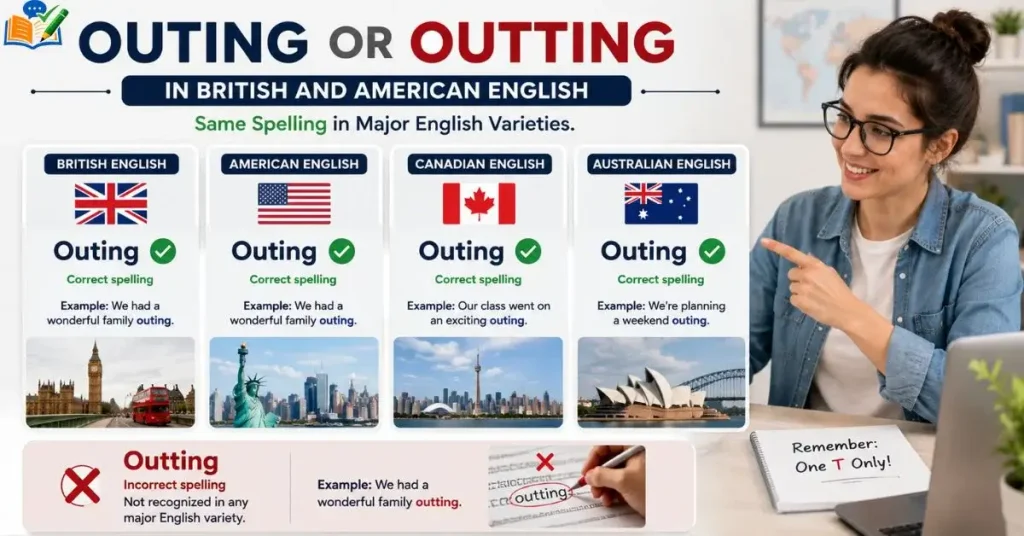
People frequently wonder whether regional spelling differences change the answer to this Outing or Outting question, especially since British and American English disagree on plenty of other words.
Here is the answer across major English speaking regions:
- British English uses: Outing
- American English uses: Outing
- Canadian English uses: Outing
- Australian English uses: Outing
No major English speaking region recognizes outting as an accepted alternative spelling.
This is one of the rare cases where every dialect lines up perfectly on the Outing or Outting question, so there is no need to adjust the spelling based on audience or location.
How to Use “Outing” in a Sentence
Seeing the word inside full, natural sentences helps lock in both the Outing or Outting spelling and the meaning.
Social Trip Meaning
- “We are planning a weekend outing to the coast.”
- “The team’s summer outing included a picnic and a hike.”
- “Their annual outing to the lake has become a family tradition.”
Public Disclosure Meaning
- “The unexpected outing put the entire situation under public scrutiny.”
- “Concerns over privacy followed the outing almost immediately.”
Context always signals which meaning applies, so pay attention to the surrounding sentence rather than the word in isolation.
Common Mistakes With Outing
A short list covers most of the recurring Outing or Outting errors writers make with this word.
Incorrect Spelling
Wrong version:
- Outting
Correct version:
- Outing
Confusing the Meaning
Some writers assume outing only ever refers to a trip, forgetting the second meaning entirely within the broader Outing or Outting picture. Reading the full sentence, rather than the word alone, usually clears up any doubt about which sense is intended. Some people even type outting or outing in the reverse order out of habit, but the correct answer stays the same either way.
Easy Trick to Remember the Correct Spelling
Here is a simple mental shortcut worth keeping in mind for the Outing or Outting choice.
Think of it this way:
- Trip equals Outing
Not this way:
- Out plus a doubled T
Another helpful comparison involves other everyday words that keep a clean, simple spelling:
- Morning
- Evening
- Outing
All three follow the same straightforward pattern without any extra doubled letters, which makes outing far easier to remember once it is grouped alongside familiar words like these, settling the Outing or Outting question for good.
Similar Words People Misspell

Outing is hardly alone in causing this kind of Outing or Outting style hesitation. Several other word pairs create nearly identical confusion for writers.
- Traveling or travelling
- Canceling or cancelling
- Benefited or benefitted
- Aging or ageing
- Outing or outting
These spelling patterns generally trace back to word history and regional convention rather than any single universal rule, which is exactly why memorizing individual cases like the Outing or Outting pair still matters.
Outing Plural Form
The plural of outing follows the standard English rule for nouns ending in a single consonant, simply adding an “s” to form outings. There is no doubling, no apostrophe, and no irregular spelling involved, which makes this one of the easier plural forms to remember once the singular spelling is locked in. You will see it used naturally in phrases like “several school outings” or “our weekend outings always end at the same diner.”
Because outing is a regular noun, it behaves exactly the way you would expect a word like “meeting” or “gathering” to behave in its plural form. There is no special exception here, so writers who already know the singular spelling rarely stumble when adding the “s” for multiple trips or excursions.
Outing vs Outting Grammar Explained
From a grammar standpoint, outing is a standard noun formed from the verb “out,” but it does not follow the doubling rule that governs short vowel verbs like “run” or “sit.” That rule applies specifically to one syllable words where a single vowel sits between two consonants, and “out” does not fit that pattern because its vowel sound is a diphthong rather than a short vowel. This is the technical reason outting never became an accepted form, even though it might look logical at first glance.
Understanding this distinction also clears up why words like “outing,” “renting,” or “resting” keep a single consonant while words like “running” or “stopping” double theirs. The rule depends on syllable stress and vowel length, not just on whether a word ends in a consonant, which is exactly the kind of detail that makes English spelling feel inconsistent until you see the pattern behind it.
Is Outing One Word or Two Words
Outing is always written as a single word, with no space and no hyphen separating any part of it. Writers sometimes second guess this because the word visually resembles “out” plus “ing,” but standard English treats outing as one complete, unified term rather than two separate pieces joined together.
This matters most in formal writing, where an accidental space could turn a correctly spelled word into an obvious typo. Whether you are writing “family outing,” “team outing,” or “weekend outing,” the word itself always stays intact as a single unit, regardless of what noun or adjective comes before it.
Outing Synonyms and Alternatives
When outing refers to a trip or excursion, several close synonyms can work well depending on tone and context, including excursion, trip, expedition, and jaunt. Each carries a slightly different feel: excursion sounds a bit more formal, while jaunt feels more casual and lighthearted, giving writers flexibility depending on the setting.
For the less common meaning tied to publicly revealing private information, appropriate alternatives include disclosure, exposure, or revelation. These words carry a more serious tone that matches the sensitivity of that particular context, so choosing the right synonym often comes down to matching the emotional weight of the situation being described.
Pronunciation of Outing

Outing is pronounced with two syllables, stressed on the first syllable, so it sounds like “OW-ting” rather than “oo-TING” or any variation that shifts the emphasis elsewhere. The “ou” combination produces the same diphthong sound heard in words like “out,” “shout,” and “about,” which is part of why the spelling does not follow the short vowel doubling rule.
Getting the pronunciation right can also reinforce the correct spelling, since hearing the natural break between “out” and “ing” makes it clear there is no reason to insert an extra consonant. Many language learners find that saying the word slowly, syllable by syllable, helps the correct spelling stick far more effectively than memorization alone.
Past Tense of Outing
As a noun, outing does not have a past tense in the traditional sense, since nouns do not conjugate the way verbs do. However, when outing is used in its less common verb form, referring to publicly revealing information about someone, the past tense becomes “outed,” as in “the reporter outed the source without permission.”
This is worth noting because writers sometimes mistakenly search for a past tense of the noun form, expecting something like “outinged” or “outted,” neither of which exists in standard English. The only correct past tense construction applies exclusively to the verb sense of the word, keeping the noun form completely unaffected by tense at all.
FAQs
Which is correct, outing or outting?
Outing is the correct spelling in every standard form of English. Outting is never accepted, no matter the context or region.
What is the meaning of outing?
It usually means a short trip or social excursion, like a family outing or school outing. It can also mean publicly revealing private information about someone.
How do you spell outting?
You don’t, since “outting” isn’t a real word in standard English. The correct spelling is always “outing” with a single “t.”
Is it correct to say “a outing” or “an outing”?
An outing” is correct because the word starts with a vowel sound. “A outing” is grammatically wrong in standard English.
What is outting?
Outting” isn’t a real word, so it has no accepted meaning or definition. It’s simply a common misspelling of “outing.”
Conclusion
If the Outing or Outting question has been nagging at you, the resolution is refreshingly simple: outing is the correct spelling in every standard form of English, and outting has no legitimate place in formal or casual writing. That holds true whether you are describing a relaxing day trip, a planned group excursion, or the less common sense tied to publicly revealing private information about someone.
English spelling rules can feel unpredictable at times, but this particular Outing or Outting case leaves no real ambiguity once you understand the reasoning behind it. The next time you catch yourself wondering is it outing or outting, you can move forward with full confidence, knowing outing is always the spelling that belongs in your writing.
