

Have you ever typed a sentence and suddenly stopped because you were unsure whether to write Useing or Using? You are not the only person who faces this confusion. Many language learners, students, and even native English speakers pause at this Useing or Using spelling question because the incorrect version looks almost right at first glance.
You will learn how do you spell using, why the wrong spelling appears, how the final e rule works, examples of using in sentences, British and American English differences, memory techniques, and answers to common Useing or Using grammar questions.
Useing
“Useing” is not an accepted word in standard English. It does not appear as a correct dictionary spelling and has no official meaning in written English. When people write “useing,” they usually make a spelling mistake because they apply the wrong spelling pattern while adding the suffix “ing” to a verb. This is exactly why the Useing or Using debate keeps coming up in grammar forums.
This mistake is common among language learners because English word formation is not always based on simply joining letters together. Many verbs change their spelling when they receive endings like -ing or -ed, and this is the root of most Useing or Using confusion.
For example, the Useing or Using pattern breaks down here:
Use + ing = Useing ❌
This looks logical, but it ignores an important English spelling convention. The final silent letter must be removed before adding the suffix.
Correct:
Use + ing = Using ✅
Understanding these spelling rules helps improve language accuracy and makes written communication more professional, which is the main reason the Useing or Using question matters so much to writers, and why it keeps coming back to Useing or Using in everyday writing.
Using
“Using” is the correct spelling and is widely accepted in the English language. It is the present participle form of the base verb “use.” It can also work as a gerund form when the action itself becomes the subject or object of a sentence. Whenever the Useing or Using question comes up, the dictionary always confirms the same answer.
The word “using” is created by following the final e rule:
Base verb: Use Remove silent e: Us Add suffix “ing”: Using
This spelling pattern appears in many other verbs:
Make → making Write → writing Take → taking Give → giving Love → loving Move → moving
Each of these follows the same Useing or Using logic. The correct form appears in everyday English, academic writing, professional communication, and everyday conversation. Whether you are writing an email, article, report, or social media post, “using” is the only correct choice, and the Useing or Using debate should never affect your final decision.
Useing or Using Quick Answer
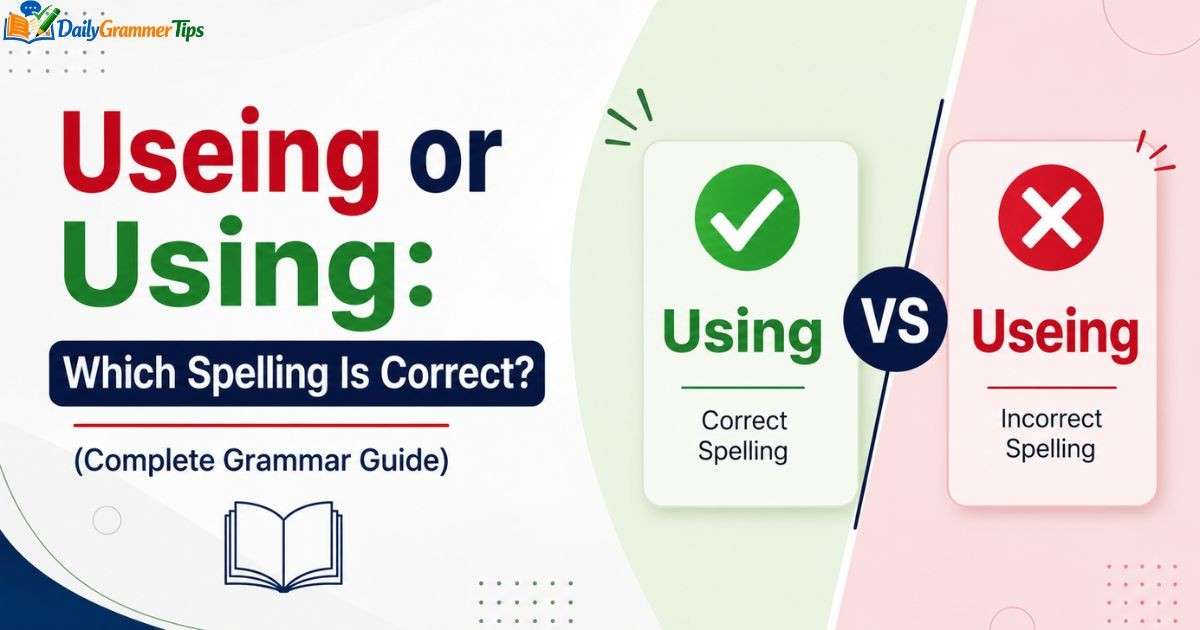
If you are searching useing or using which spelling is correct, the answer is clear: Using is correct and useing is wrong. This Useing or Using quick answer settles the confusion instantly for most readers.
The spelling mistake happens because people forget the silent e rule. When a verb ends with a silent e and receives a suffix beginning with a vowel, English usually removes that final letter.
So:
Use + ing = Using ✅
Not:
Use + ing = Useing ❌
There is no difference between British English and American English in this case. Both writing systems use the same spelling, so the Useing or Using answer stays consistent worldwide. The correct word form remains “using” in all standard forms of English.
Using or Useing? Why Does This Confusion Happen?
The reason people search Useing or Using is because the incorrect version follows a pattern that appears reasonable. Many people learn that adding “ing” means attaching the suffix directly to the original word.
For example:
Walk + ing = Walking Play + ing = Playing Talk + ing = Talking
None of these examples involve a silent e, which is part of why the Useing or Using mix-up happens so often. Because of this pattern, writers often assume:
Use + ing = Useing
However, English spelling rules include many exceptions and adjustments, and this is exactly where the Useing or Using mix-up begins. Verbs ending with a silent e usually require a spelling change before adding suffixes.
The final e rule helps maintain correct pronunciation and spelling patterns. The word “use” contains a silent e, meaning the last letter is not pronounced separately. When “-ing” is added, that unnecessary letter disappears.
This creates:
Using ✅
Instead of:
Useing ❌
The confusion also happens because some verbs keep their e when adding “-ing,” which adds another layer to the Useing or Using puzzle.
Examples:
See → seeing Agree → agreeing Free → freeing
These exceptions are often raised whenever the Useing or Using topic comes up in classrooms. These irregular spelling patterns make learners question the rule. However, most common verbs ending with silent e follow the dropping the e pattern, which is why the Useing or Using rule still applies to “use.”
Understanding pronunciation and spelling together makes it easier to remember the correct form and avoid the Useing or Using mistake in the future. Practicing this daily is the fastest way to master Useing or Using for good.
How Do You Spell Using Correctly?
Many people ask, how do you spell using? The answer is simple:
U S I N G
The correct spelling does not contain the second “e,” and remembering this ends the Useing or Using debate for good.
A useful way to remember it is:
Use → Remove the silent e → Add ing → Using
Think of the word as:
Root word: use Final word: using
Keeping this simple two-step process in mind makes the Useing or Using choice effortless. This method helps language learners recognize spelling patterns instead of memorizing individual words, so the Useing or Using rule becomes automatic over time.
Whenever you feel unsure, pause and run through the Useing or Using check before you continue typing. When writing in English, always check whether the verb ends with a silent letter before adding suffixes. This small step can prevent many grammar mistakes and keep the Useing or Using confusion away from your writing.
Examples of Using in Sentences
Seeing real sentence examples makes the correct word usage easier to understand and clears up any remaining Useing or Using doubts.
Incorrect: She is useing my computer for her project.
Correct: She is using my computer for her project.
Incorrect: They are useing a new method to solve the problem.
Correct: They are using a new method to solve the problem.
Incorrect: The company is useing advanced technology.
Correct: The company is using advanced technology.
Incorrect: He improved his skills by useing online resources.
Correct: He improved his skills by using online resources.
More examples:
Once you internalize the Useing or Using rule, sentences like these become second nature:
She is using a grammar checker to improve her writing skills. Students are using digital tools for vocabulary development. The team succeeded by using better planning strategies. I am using this opportunity to improve my English vocabulary. They have been using this software for several years. Using clear words improves professional communication. Using proper sentence structure makes written English easier to understand.
The Origin of Using
The history of the word “using” goes back hundreds of years. The verb use came into English through Old French from the Latin word usus, which carried the meaning of employing, applying, or making something useful. Long before anyone typed the phrase Useing or Using into a search bar, this spelling rule already existed in classical grammar.
As the English language developed, many words adopted spelling patterns influenced by French and Latin. The final silent letter became common in many English words, even when that letter was not pronounced. Over time, English grammar rules developed to explain how these words should change when suffixes were added, and modern learners still rely on those rules to settle the Useing or Using question.
When forming the present participle of verbs ending in a silent e, English usually follows the rule of dropping the e before adding “-ing.”
This is why:
Use → Using ✅
Not:
Use → Useing ❌
The same spelling convention appears in many other verbs:
Make → Making Write → Writing Take → Taking Come → Coming Have → Having
Every one of these reinforces the same Useing or Using principle. These examples show how English verbs change during word formation. Learning these patterns helps improve writing skills and makes the Useing or Using decision easier every time.
Why Is Using Spelled Without an E?
A common grammar question is: Why is using spelled without an e? This is really just another way of asking the Useing or Using question.
The answer comes from the silent letter rule in English grammar. When a verb ends with a silent e and we add a suffix beginning with a vowel, the final e is usually removed.
The suffix “ing” begins with a vowel, so the silent e in “use” disappears.The process looks like this:
Base verb: Use Remove silent e: Us Add suffix: Ing Final word: Using
This spelling pattern keeps words easier to read and follows traditional English language rules, reinforcing the same Useing or Using answer discussed earlier.
English does have exceptions. Some verbs keep the final e because removing it would affect pronunciation or make the word confusing.
Examples:
See → Seeing Agree → Agreeing Guarantee → Guaranteeing
Comparing these to the Useing or Using rule shows why context matters. These examples are why understanding spelling patterns is more useful than memorizing only one word, even though the Useing or Using case is one of the simplest to remember.
Learn more………Input vs Imput: The Real Difference Explained Clearly and Completely
English Verbs Ending With Silent E
Many English verbs follow the same spelling rule as “use.” When adding “-ing,” the final silent e disappears, just like in the Useing or Using example above.
Examples:
Make → Making — She is making a cake. Write → Writing — He is writing an email. Take → Taking — They are taking notes. Love → Loving — She is loving her new course. Move → Moving — The company is moving forward. Give → Giving — He is giving helpful advice.
Notice how each pair mirrors the Useing or Using pattern discussed earlier.
These examples show the connection between spelling rules, pronunciation and spelling, and correct word formation, all of which relate back to the Useing or Using rule.
British English vs American English Spelling

People often search Useing or Using because they know that British English and American English sometimes have different spelling variations.
For example:
British English: Colour — American English: Color British English: Organise — American English: Organize
Neither of these examples affects the Useing or Using rule in any way.
Using vs useing is not a spelling variation between countries, so the Useing or Using answer does not change based on region.
Both British English and American English use:
Using ✅
Both forms follow the same English spelling rules and dictionary spelling standards.
Whether you are writing for a university assignment, business communication, a blog post, or everyday conversation, “using” is always the correct choice, and the Useing or Using rule applies equally everywhere.
Which Spelling Should You Use?
The correct answer is simple: always write using. This final word on Useing or Using should remove any lingering doubt.If you are wondering Should I write useing or using?, choose using every time.
The incorrect spelling may appear in online comments, informal messages, or quick typing situations, but it is still considered a grammar mistake, and the Useing or Using rule still applies even in casual writing.Using the correct word form shows language accuracy and improves the quality of your written English.
Professional writers, students, teachers, and editors follow the same spelling convention because accurate language creates stronger communication, and getting the Useing or Using rule right is part of that standard. Editors in particular flag the Useing or Using mistake quickly during proofreading.
Using correct spelling is especially important in:
Academic writing Professional communication Business emails Online content Educational materials Formal documents
In every one of these contexts, the Useing or Using rule stays exactly the same.
A small spelling mistake can change how readers view your writing skills. Using the correct form helps your message appear clear and reliable, and knowing the Useing or Using rule is a simple way to protect your credibility.
Common Mistakes With Useing and Using
Many spelling mistakes happen because writers apply general rules without checking specific English grammar rules, and this is where most Useing or Using errors start.
Here are common examples:
Wrong: I am useing this software for my work.
Correct: I am using this software for my work.
Wrong: Useing new technology can save time.
Correct: Using new technology can save time.
Wrong: The application is useing too much storage.
Correct: The application is using too much storage.
Wrong: She is useing a different approach.
Correct: She is using a different approach.
Each corrected sentence above demonstrates the Useing or Using rule in action.
The mistake usually happens because people forget the silent e rule or do not recognize the relationship between the base verb and the suffix, which keeps the Useing or Using confusion alive online.
Using in Different Sentence Structures
Understanding sentence structure makes it easier to recognize how “using” works in different situations, no matter how the Useing or Using topic first came up.
Present Continuous Tense Using can describe an action happening now. Example: She is using her phone to complete the assignment.
Present Participle Using can work with helping verbs. Example: They are using new methods to improve results.
This is another everyday instance of the Useing or Using rule at work.
Gerund Form Using can act as a noun. Example: Using technology in education has many benefits.
With Prepositions Using can follow words like “by” or “without.” Examples: He solved the issue by using a simple technique. She improved her writing without using complicated words.
Understanding these forms helps both native English speakers and language learners use the word correctly, well beyond the basic Useing or Using question, since the Useing or Using rule applies across every one of these structures.
Using in Everyday English Examples
The word “using” appears constantly in everyday English. You can find it in conversations, articles, reports, and online communication, long after readers have moved past the Useing or Using debate.
These everyday instances make the Useing or Using rule easy to spot in real writing.
Email Example:
“I am using this information to prepare the final report.”
Academic Writing
Example: “Researchers are using new methods to study climate changes.” Professional Communication Example: “The company is using advanced software to improve productivity.” Social Media Example: “Currently using this recipe and loving the results.” Everyday Conversation Example: “Are you still using that old laptop?”
These examples show how common the correct spelling is in real communication, and how rarely the Useing or Using error appears once you know the rule.
Is it correct to say “by using”?
Yes, “by using” is correct. It shows the method or way someone does something, such as “She improved her skills by using online resources,” and it has nothing to do with the Useing or Using spelling error.
Useing or Using Meaning
The meaning behind Useing or Using becomes clear once you separate the two forms. “Useing” carries no meaning at all because it does not exist as a recognized word in any English dictionary. Grammar checkers treat it as a typo rather than a real variant.
“Using” means applying, operating, or putting something to work for a purpose. Someone using a tool, a method, or an idea is actively employing that thing to reach a result. This meaning holds steady whether the word acts as a present participle or as a gerund.
Useing or Using Examples
Looking at real examples makes the Useing or Using contrast easy to spot. A sentence like “She is useing her laptop” signals an error right away, because the extra letter breaks the expected spelling pattern for verbs ending in a silent vowel.
Compare that with “She is using her laptop to finish the report,” which reads naturally and follows standard grammar. Other solid examples include “The team is using fresh data” and “He learned a lot by using flashcards every morning.” Each one reinforces the same spelling logic.
Using Meaning
At its core, using describes the act of employing something, whether that something is an object, a skill, or a resource. The word functions as the present participle of “use,” so it naturally pairs with helping verbs like “is,” “are,” and “was.”
Using also works as a gerund, meaning it can stand in for a noun and act as the subject of a sentence. A phrase like “Using a checklist saves time” treats the word as an activity in its own right. This flexibility explains why it appears so often in everyday writing.
Useing or Using Exercises
Practicing with exercises helps cement the Useing or Using rule better than reading examples alone. Try filling in the blank in sentences such as “She is a new app to track her goals.” The correct answer always follows the silent e removal pattern.
A useful drill involves writing five original sentences with the word and checking each against the rule. Learners can also convert other silent e verbs, such as “write,” “make,” and “love,” into their ing forms as extra practice. Repeating this weekly builds lasting confidence.
Using in a Sentence
Seeing the word placed within full sentences shows how flexible it is. In a workplace context, someone might write, “Our team is using a new project management tool this quarter.” A student might say, “I improved my essay by using clearer transitions.”
The word also fits casual conversation, such as “Are you still using that old phone?” Across reports, emails, and everyday chats, it keeps its spelling and meaning steady. That makes it one of the more reliable verbs for learners to master early.
Using Spelling
The spelling of using follows a predictable rule tied to how English handles verbs ending in a silent letter. Removing that letter before attaching a vowel suffix keeps the word easy to read, which is why “use” becomes “using.”
This convention is not unique to one word. Verbs like “write,” “make,” “hope,” and “care” all drop their final letter the same way before taking on “ing.” Once a learner spots this shared pattern, the correct spelling becomes almost automatic.
Frequently Asked Questions
What is the difference between useing and using?
“Using” is the correct spelling, while “useing” is a common spelling mistake. The word “using” follows the silent e rule by removing the final e before adding “-ing.” This is the core of the Useing or Using distinction.
How do you spell “useing”?
“Useing” is not the correct spelling in English. The correct form is “using,” which comes from the verb “use” with the suffix “-ing” added, settling the Useing or Using question once again.
What is the meaning of using?
Using means applying, employing, or making use of something for a specific purpose, such as using a tool, method, or idea.
What is a better word for “using”?
Depending on the sentence, alternatives for “using” include applying, utilizing, employing, operating, or taking advantage of something. None of these synonyms change the underlying Useing or Using spelling rule.
What is the rule when using?
The rule: when a verb ends in a silent e, drop that e before adding “-ing” — so use becomes using, not useing.
Conclusion
Understanding Useing or Using becomes much easier when you learn the basic English spelling rules behind verb formation. The correct spelling is using because the silent e in the base verb “use” disappears before adding the suffix “-ing.” This simple final e rule helps language learners improve their spelling patterns, understand word formation, and write with better language accuracy in everyday English, academic writing, and professional communication.
When you know how do you spell using correctly, you can avoid a common grammar mistake and feel more confident in your written English. Remember that using follows standard English grammar rules, while “useing” is only an incorrect spelling. By practicing correct word usage, improving proofreading habits, and understanding sentence structure, you can strengthen your writing skills and put the entire Useing or Using debate to rest for good.
