

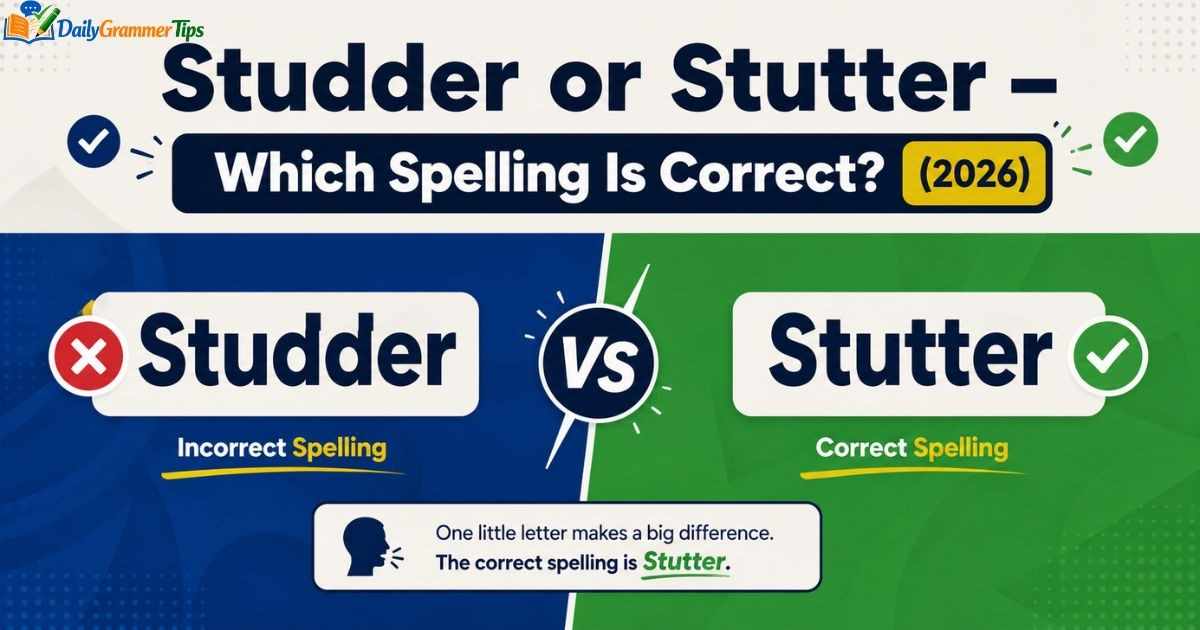
Have you ever paused while typing and questioned whether the correct spelling is studder or stutter? Many people face this same confusion because English pronunciation does not always match written words perfectly. This small spelling difference often creates uncertainty, even among experienced English speakers.
You are preparing an article, writing an important email, completing an assignment, or simply searching for the right answer online, understanding the correct word matters. This guide explains the difference clearly and helps you confidently choose the right spelling every time.
Studder
When people search for studder definition or ask is studder a word, they are usually looking for information about a speech condition. However, “studder” is not recognized as the correct spelling for a speech problem in standard English dictionaries.
The confusion around studder or stutter happens mainly because people write words according to how they sound. When someone quickly says “stutter,” the repeated sound can sometimes be misunderstood, making people believe that the middle sound contains a “d” instead of a “t.”
For normal writing, medical discussions, educational content, and professional communication, “studder” is considered a misspelled word. It is one of the many commonly misspelled words created because spoken language and written language do not always match perfectly.
Many people search how to spell studder because they want to confirm whether this spelling is acceptable. The answer is simple: when talking about interrupted speech, the correct word is always stutter.
Stutter
Stutter is the correct and dictionary approved spelling. It is the recognized word used in English to describe a speech pattern where a person experiences interruptions while speaking.
The word can be used as both a noun and a verb.
As a verb:
She may stutter when she feels uncomfortable during conversations.
As a noun:
He has a mild stutter that improved after speech therapy.
So, what does stutter mean? The stutter definition refers to a speech fluency disorder where a person may repeat sounds, repeat syllables, stretch sounds, or experience moments of blocked speech.
A person who stutters may experience:
- Repeated sounds or words
- Difficulty maintaining normal speech flow
- Hesitation while speaking
- Unexpected pauses during conversation
- Problems producing smooth speech
Stuttering is considered a fluency disorder because it affects the natural rhythm and flow of verbal communication. It is often noticed during childhood language development, especially between the ages of two and six, but it can continue into adulthood.
A stutter does not indicate a lack of intelligence or poor communication skills. Many people who experience this speech difficulty become successful speakers, professionals, and leaders with proper support and practice.The word “stutter” also has uses beyond human speech. It can describe repeated interruptions in technology, machines, or movement.
For example:
- The internet connection started to stutter during the video call.
- The engine stuttered before stopping completely.
These examples show that stutter word usage is not limited only to speech. However, when discussing a person’s speech condition, “stutter” is the correct word.
Understanding the difference between studder and stutter becomes easier when you remember that only one spelling appears in major English dictionaries.
Studder or Stutter Quick Answer
If you need a quick answer about stutter or studder, here is the simple explanation:
| Word | Correct | Meaning |
| Stutter | Yes | A speech disorder involving repetition, hesitation, or blocked sounds |
| Studder | No | An incorrect spelling commonly confused with stutter |
The correct word is stutter.
Whenever you are writing about a speech condition, use stutter. Whether you are creating educational content, writing professionally, or improving your English vocabulary, the correct spelling will always be “stutter.”
The confusion between studder or stutter exists because pronunciation can sometimes influence spelling. However, dictionary spelling should always be preferred over writing words based only on sound.
Examples of Studder and Stutter
The easiest way to understand studder vs stutter is to see both spellings used in sentences. Many people make this spelling mistake because both words sound similar when spoken. However, only one form follows English spelling rules.
Incorrect Examples Using Studder
❌ She has a studder when she speaks in front of large groups.
❌ The child’s studder became better after receiving professional help.
❌ His studder becomes noticeable when he feels nervous.
These sentences use an incorrect spelling. The word “studder” is not the correct term for a speech condition.
Correct Examples Using Stutter
✅ She has a stutter when she speaks in front of large groups.
✅ The child’s stutter became better after receiving professional help.
✅ His stutter becomes noticeable when he feels nervous.
The correct word “stutter” explains a speech pattern involving repeated sounds, speech interruption, or difficulty speaking fluently.
Using the correct spelling improves written communication and prevents common spelling mistakes. Whenever you are unsure about how to spell stutter, remember that the word contains double “t” in the middle.
The Origin of Stutter
Learning the history of a word can help you remember its spelling correctly. The word stutter has a long history in the English language and has remained consistent for centuries.
The word comes from Germanic language roots and is connected with older English terms that described interrupted speech or difficulty producing words smoothly. The Old English word “stotorian” carried a similar meaning related to speaking with hesitation.
As English developed, the word changed through different forms before becoming the modern spelling “stutter.” This development explains why the word has a fixed spelling that appears in major dictionaries today.
The spelling of stutter also connects with the way the condition sounds. People who experience stuttering may repeat sounds or syllables, creating a repeated speech pattern.
Some language experts believe the word has sound based qualities because its pronunciation reflects the interruption it describes. This makes it easier to remember the correct spelling.
Unlike studder, the word stutter has a documented history and established use in English vocabulary. There is no accepted linguistic background that supports “studder” as an alternative spelling for a speech disorder.
This is why sources such as the Oxford dictionary and Merriam Webster definition recognize “stutter” and not “studder” when explaining the condition.
Understanding the word origin also helps English learners avoid writing mistakes and improves their overall vocabulary knowledge.
British English vs American English Spelling
A common reason people search for studder or stutter is because they wonder if British English and American English use different spellings.
The answer is no. Both English varieties use stutter as the correct spelling. However, there is a difference in the preferred word used in everyday conversations.
| Region | Common Term |
| American English | Stutter |
| British English | Stammer |
| Medical Field | Stutter or Stuttering |
In American English, people usually say “stutter” when talking about speech difficulties. In British English, “stammer” is often used more commonly in casual conversation.
For example:
American English:
He has a stutter.
British English:
He has a stammer.
Both terms describe similar speech problems involving repeated sounds, hesitation, or interrupted speech flow.
In professional and medical writing, “stutter” and “stuttering” are widely recognized terms. Speech language professionals use these words when discussing fluency disorders, speech therapy, and communication difficulties.
Learn more……….Signalling or Signaling: Complete Guide, Uses, Examples
Which Spelling Should You Use?
The answer to studder or stutter is straightforward: always use stutter.
If you are confused about how to spell stutter, remember the double “tt” in the middle. This spelling pattern separates the correct word from the incorrect variation.
A simple memory technique is to connect stutter with similar words:
- Butter
- Clutter
- Gutter
All of these words contain double “t,” which can help you remember the correct spelling.
Another useful trick is to remember that stuttering involves repeated sounds. The double “t” in the word itself can remind you of repetition.
Here are some important reminders:
- Use stutter in academic and professional writing.
- Avoid studder because it is an incorrect spelling.
- Check an English dictionary when you are unsure about spelling.
- Practice proofreading to reduce spelling errors.
For students, writers, and English learners, understanding small spelling differences improves language accuracy. Knowing the correct word also helps people find reliable information about speech therapy, communication skills, and speech disorders.
The correct word is always stutter, whether you are discussing a speech condition, writing an article, or improving your English grammar.
Studder or Stutter in Adults
Many people search for studder or stutter in adults because they are not only confused about the spelling but also want information about the condition itself. The spelling does not change with age. Whether someone is a child, teenager, or adult, the correct word remains stutter.
Adult stuttering is a speech fluency issue that can affect the natural rhythm of speaking. Some adults experience repeated sounds, repeated syllables, difficulty starting words, or moments of blocked speech during conversations.
While stuttering often begins during early childhood, it can continue into adulthood for some people. Others may develop speech difficulties later due to different life circumstances, medical conditions, or neurological changes.
Adults who stutter may find support through different approaches, including:Speech therapy with a qualified speech language professionalBreathing techniques to reduce speaking tensionSlow speech exercises to improve fluencyCommunication strategies for stressful situations
Confidence building methods for public speakingA speech disorder does not represent a person’s intelligence, knowledge, or communication ability. Many successful professionals, performers, and public speakers have experienced stuttering and developed effective ways to communicate.
People often connect stuttering with nervousness, but anxiety does not cause every case of stuttering. However, stressful situations may increase speech interruptions for some individuals.
Understanding the condition helps remove misconceptions and encourages better communication skills. Whether someone searches stutter meaning, stutter definition, or information about adult speech problems, the important point remains the same: the correct spelling is “stutter,” not “studder.”
Stutter Synonyms and Related Words
The word “stutter” has several related terms depending on the situation. These words can help writers describe speech patterns, communication challenges, and language differences more accurately.
Common Synonyms for Stutter
- Stammer
- Hesitate
- Falter
- Stumble over words
- Pause while speaking
- Struggle with speech flow
“Stammer” is especially common in British English and is often used as an alternative word for stutter.
Metaphorical Uses of Stutter
The word “stutter” can also describe repeated interruptions outside human speech.
Examples:
- The video started to stutter because of connection problems.
- The machine began to stutter before shutting down.
- The athlete’s movement had a stutter step during the game.
These examples show that stutter has different meanings depending on the context. All uses follow the same spelling. The word “studder” does not replace it in any situation.
Common Mistakes with Studder and Stutter
The confusion between studder or stutter is one of the many English spelling mistakes caused by pronunciation differences.
Here are some common incorrect examples and their corrections.
Incorrect:
❌ He has a studder when he talks.
❌ She was studdering during her presentation.
❌ My child started studdering at age four.
❌ Is studder a real speech condition?
Correct:
✅ He has a stutter when he talks.
✅ She was stuttering during her presentation.
✅ My child started stuttering at age four.
✅ Is stuttering a real speech condition?
The rule is simple: replace every form of “studder” with the correct form of “stutter.”
Avoiding this spelling mistake improves writing quality and helps maintain correct English usage.
Stutter in Everyday Examples

The word “stutter” appears in many types of communication. Understanding proper usage helps writers use the word naturally.
Email Example
“I sometimes experience a stutter during presentations, but I am working with a speech coach to improve my confidence.”
News Example
“The speaker discussed his experience with stuttering and explained how support helped him communicate more effectively.”
Social Media Example
“My stutter is part of my journey. It does not stop me from sharing my ideas and connecting with others.”
Formal Writing Example
“Research shows that individuals who stutter may experience challenges related to speech fluency, especially in high pressure communication environments.”
These examples show that “stutter” works in casual, professional, and educational writing.
Using the correct word also helps search engines and readers understand the topic accurately. When creating online content about speech conditions, always use the recognized dictionary spelling instead of the incorrect form.
Studder or Stutter Google Trends and Usage Data
Search behavior shows that studder or stutter remains a popular spelling question. Many people type the incorrect version because they are unsure which spelling follows English language rules.
The high interest in this search shows that “studder” is a commonly misspelled word rather than a completely unknown term.
People searching this topic often continue looking for information about:
- The meaning of stuttering
- Speech therapy options
- Causes of speech difficulties
- Ways to improve speaking fluently
- Famous people who stutter
This shows that a simple spelling question can lead people toward deeper information about communication, language development, and speech health.
Understanding the correct spelling helps users find accurate resources and avoid incorrect information.
When searching online, using the correct term “stutter” provides better results because it matches the recognized vocabulary used by dictionaries, professionals, and speech specialists.
Comparison Table Studder vs Stutter
| Feature | Studder | Stutter |
| Correct spelling | ❌ Incorrect | ✅ Correct |
| Dictionary recognition | ❌ Not accepted for speech condition | ✅ Recognized |
| Medical usage | ❌ Not used | ✅ Commonly used |
| Speech disorder term | ❌ No | ✅ Yes |
| Formal writing | ❌ Avoid | ✅ Recommended |
| Word history | No established history | Has historical English roots |
| British English connection | Not used | Related to stammer |
| Meaning | Common spelling error | Speech interruption or hesitation |
Studder or Stutter in English
Studder or Stutter is one of the most common English spelling confusion topics because many people write words according to how they sound. When people search stutter or studder, they usually want to know the correct word for a speech condition. The correct spelling is stutter, while “studder” is a commonly misspelled word.
Studder or Stutter creates confusion among English learners and native speakers because pronunciation can sometimes make the double “t” sound unclear. If you are checking the studder definition or wondering how to spell studder, remember that standard English dictionaries recognize “stutter” as the correct word for speech difficulty and fluency problems.
Studder or Stutter Examples
Studder or Stutter examples clearly show why spelling accuracy matters in English writing. Many people mistakenly use “studder” when they actually mean a speech interruption or fluency disorder. The correct word usage is always “stutter” in formal and everyday communication.
Studder or Stutter examples help explain the difference between an incorrect spelling and the correct word. For example, “She has a stutter during presentations” is correct, while “She has a studder during presentations” is a spelling mistake. Understanding these examples improves correct English usage.
Stutter in French
Studder or Stutter has different translations in other languages, but the meaning remains connected with speech difficulties. In French, the word used for stuttering is “bégaiement,” which describes repeated sounds, blocked speech, and challenges with normal speech flow.
Studder or Stutter understanding becomes easier when comparing languages because vocabulary changes but the communication problem remains similar. Learning translations improves language development and helps English learners understand speech related terms more effectively.
Stutter Pronunciation
Studder or Stutter pronunciation confusion is one of the main reasons people search for the wrong spelling. The correct pronunciation of “stutter” contains a clear “t” sound, which matches its dictionary spelling.
Studder or Stutter pronunciation differences often lead people to search how to spell studder because they write what they hear. Learning the correct pronunciation guide helps reduce pronunciation errors and improves vocabulary improvement.
Stutter Synonym
Studder or Stutter synonyms include words like stammer, hesitate, falter, and stumble over words. These related terms describe similar communication challenges, although “stutter” remains the most common term in American English.
Studder or Stutter related vocabulary also includes fluency disorder, speech impediment, speech difficulty, and dysfluency. These LSI terms are commonly used in discussions about speech therapy, verbal communication, and speaking fluently.
Stutter in a Sentence
Studder or Stutter in a sentence helps readers understand correct word usage. The correct word “stutter” can work as both a noun and a verb when describing speech interruption or repeated sounds.
Studder or Stutter examples in sentences include “He has a stutter when he feels nervous” and “She started to stutter during the interview.” These examples show the correct English grammar pattern and avoid common spelling mistakes.
Stuttering Symptoms
Studder or Stutter symptoms are connected with speech patterns and fluency challenges. Common signs include repeated sounds, repeated syllables, blocked speech, hesitation while speaking, and difficulty maintaining smooth speech.
Studder or Stutter is often searched by people looking for information about speech disorders. Stuttering symptoms can appear during childhood language development and may continue into adulthood, but speech therapy can help improve communication skills.
Stutter Verb
Studder or Stutter as a verb explains the action of speaking with interruptions or repeated sounds. For example, “He began to stutter when answering the question” shows how the verb form works.
Studder or Stutter should always be written with the correct spelling “stutter” when used as a verb. Whether describing human speech, technology issues, or repeated movement, the correct word follows English spelling rules.
Frequently Asked Questions
What does stutter mean?
Stutter means a speech difficulty where a person repeats sounds, syllables, or words or experiences pauses while speaking.
What does “studder” mean?
“Studder” is usually a misspelling of stutter and is not the correct word for describing a speech condition.
Is stammering a serious problem?
Stammering is not a sign of low ability, but it can affect communication confidence and may benefit from speech therapy.
Does stammer mean stutter?
Yes, stammer and stutter describe the same speech fluency issue, although “stammer” is more common in British English.
Is a stammer anxiety?
A stammer is not caused only by anxiety, but stress and nervousness can sometimes make speech difficulties more noticeable.
Conclusion
Understanding Studder or Stutter becomes easier when you know the correct spelling and meaning behind the word. The correct term is “stutter,” which describes a speech difficulty involving repeated sounds, blocked speech, or interruptions in speech flow. While “studder” is a common spelling mistake, using the right word helps maintain language accuracy and correct English usage.
Whether you are improving your vocabulary, learning English grammar, or researching speech disorders, knowing the difference between Studder or Stutter helps you communicate more clearly. Remember that stutter is the recognized dictionary spelling, while stuttering and stammering are related terms connected with fluency, speech patterns, and verbal communication.
