

Most people type signalling or signaling without stopping to think about it, and honestly, that’s fine most of the time. But the moment you’re writing for a client in London and another in New York, that small spelling choice starts to matter. I’ve edited enough student papers and business emails to know that signalling or signaling trips up more writers than you’d expect not because the concept is hard, but because nobody ever explained the rule clearly.
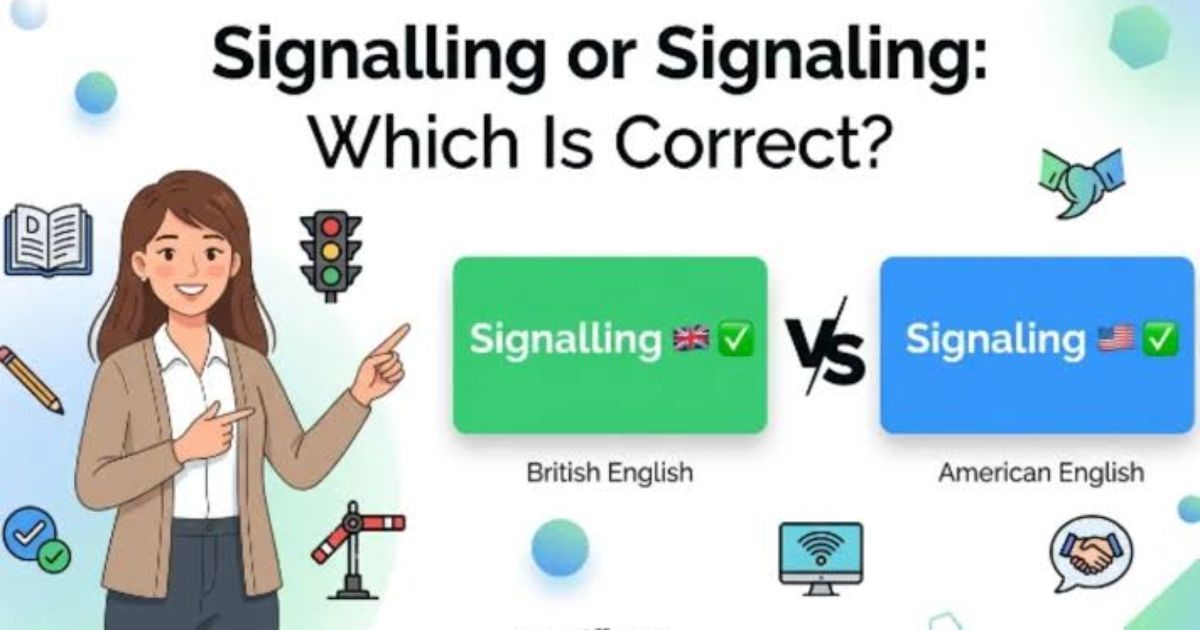
Here’s the short version: signalling or signaling refers to the exact same word. The only thing that changes is which side of the Atlantic you’re writing for. British English doubles the “l” and writes signalling, while American English keeps it single and writes signaling. Neither one is a typo, and neither one is “more correct” than the other they’re just two conventions doing the same job.
This guide walks through what the word actually means, why the spelling splits the way it does, how signals work step by step, and where you’ll run into signalling or signaling in real writing academic papers, business reports, and everyday online content.
What Is Signalling or Signaling?
At the most basic level, signalling or signaling describes the act of sending information from one point to another in a way that carries meaning. It’s not just data moving from A to B it’s a sender putting meaning into a message and a receiver pulling that meaning back out.
Simple Definition
Think of it this way: a source encodes an idea, pushes it through some channel, and a receiver on the other end decodes it. You do this constantly without noticing:
- A raised eyebrow signals doubt
- A ringing phone signals an incoming call
- A stop sign signals danger ahead
- A rising fever signals the body fighting infection
Same underlying process, completely different settings.
Meaning in Different Contexts
The word bends depending on the field you’re standing in.
Human Communication A pause in conversation can signal hesitation. Crossed arms often signal defensiveness. A warm tone signals reassurance.
Technology Systems Servers exchange handshake signals before opening a connection. Routers signal network status through blinking lights. Apps ping servers with status signals in the background.
Biology Neurons fire electrical signals across synapses. Hormones act as chemical signals between organs. Immune cells signal each other to coordinate a response.
Economics A sudden price drop signals falling demand. Rising bond yields often signal investor caution. Job growth numbers signal the health of an economy.
A Real-Life Example
Picture a lifeguard’s whistle. One short blast signals a minor warning. Three sharp blasts signal an emergency. No sentence gets spoken, yet everyone on the beach understands exactly what to do. That’s signalling or signaling stripped down to its purest form shared meaning, agreed in advance, delivered instantly.
Who Relies on This Concept?
You’ll find the idea baked into almost every profession:
- Network engineers troubleshooting dropped connections
- Neurologists studying how the brain transmits information
- Traders reading market movement for early warnings
- UX designers building visual cues into an interface
- Linguists tracking how tone and gesture carry meaning
Wherever information travels with intent behind it, signalling or signaling is happening.
Read Also: Unselect or Deselect: Which Term Truly Belongs in UX and Modern Writing?
Why Signalling or Signaling Matters in 2026
Communication in 2026 moves faster than ever, and almost none of it happens through plain conversation anymore. Behind every notification, recommendation, and automated reply sits some form of signal.
Modern Relevance
Every tap, scroll, and click you make online creates a data point that a system reads as a signal. Watching a video past the ten-second mark signals interest. Skipping it instantly signals the opposite. Platforms have built entire recommendation engines around interpreting these micro-signals correctly.
What’s Driving the Growth
A handful of real shifts explain why understanding signalling or signaling carries more weight now than a decade ago:
- Wider 5G rollout pushing near-instant data transmission
- Early 6G trials promising even faster exchange rates
- AI models processing enormous volumes of behavioral signals daily
- Billions of connected IoT devices constantly exchanging status updates
Digital and Social Platforms
Social apps run entirely on interpreting user signals. A like signals mild approval. A save signals stronger intent. A share signals enough conviction to pass something along to someone else. Algorithms weigh these signals to decide what spreads and what quietly disappears.
Why This Affects You Directly
Getting comfortable with signalling or signaling both the concept and the correct spelling sharpens how you read situations, write clearly, and avoid embarrassing mix-ups in professional documents. It’s a small skill with a surprisingly wide payoff.
How Signalling or Signaling Works Step by Step
Strip away the jargon, and the process behind signalling or signaling follows a simple, repeatable pattern.
Step 1: A Source Generates the Signal
Every signal starts somewhere concrete a person speaking, a sensor detecting motion, a neuron firing, a server logging an event. The source holds information that needs to travel.
Step 2: The Signal Gets Encoded
Next, that raw information turns into a transmittable format.
| Original Information | Encoded Signal |
| Spoken word | Sound waves |
| Written text | Digital binary data |
| A thought | Electrical impulse in a neuron |
| Recorded video | Compressed data stream |
Without encoding, nothing could travel anywhere.
Step 3: The Signal Transmits
The encoded signal now moves through a channel air, fiber-optic cable, a wireless frequency, or a nerve pathway. Whatever channel it takes shapes how fast and how clearly it arrives.
Step 4: A Receiver Decodes It
On the other end, a receiver interprets what came through. Get the decoding right, and communication succeeds. Get it wrong, and you end up with a misunderstanding which is exactly why precise signalling or signaling matters so much in high-stakes fields like aviation or medicine.
A Familiar Example
Send a text message and you’ve just run through the entire cycle: you type the words, your phone encodes them into data, the network transmits that data, and the recipient’s phone decodes it back into readable text on their screen. That whole chain is signalling or signaling in action, happening in under a second.
Benefits of Signalling or Signaling Systems
Reliable signals make almost everything run smoother.
Faster communication A single alert reaches thousands of people instantly, something a printed letter could never manage.
Less miscommunication Standardized signals, like traffic lights, remove ambiguity entirely. Nobody debates what red means.
Automation at scale Smart devices, self-driving vehicles, and automated assembly lines all depend on constant signal exchange to function without a human stepping in.
Sharper decision-making Investors, meteorologists, and engineers all lean on incoming signals to make faster, better-informed calls.
Real-time interaction Video calls, live streams, and online gaming only work because signals travel and get interpreted almost instantly.
Common Mistakes People Make About Signalling or Signaling
Even with a concept this straightforward, a few mix-ups show up again and again.
Mixing up British and American spelling. “Signalling” belongs to British English; “signaling” belongs to American English. Both spellings are fully correct they’re just regional.
Assuming the spelling changes the meaning. It doesn’t. Swap one for the other and the sentence means exactly the same thing.
Overcomplicating a simple idea. People sometimes treat signaling as some advanced technical field. In reality, a shrug, a text message, and a hormone all count.
Awkward sentence construction. Writing “He was signaling happiness everywhere” reads clumsily. “His expression signaled happiness” reads naturally and says the same thing.
Ignoring context entirely. A green light means nothing useful if you don’t already know it belongs to a traffic system. Context gives a signal its meaning.
Expert Tips to Understand Signalling or Signaling Better
Skip the memorization and focus on structure instead. Ask yourself:
- Who is the sender, and who is the receiver?
- What channel is carrying the message?
- How was the information encoded?
- Did the receiver interpret it the way the sender intended?
Once you start asking these questions automatically, you’ll notice signalling or signaling happening everywhere in meetings, in apps, in traffic, in casual conversation.
Is Signalling or Signaling Still Relevant in 2026?
Yes, and arguably more than ever.
Social Media’s Influence
Every interaction on a platform doubles as a signal. Likes signal approval, comments signal engagement, and watch time signals genuine interest. Algorithms rely on these signals to decide what content millions of people see next.
Adoption Across Industries
| Industry | How Signals Get Used |
| Healthcare | Monitoring vital signs and biological signals |
| Finance | Reading market movement and investor sentiment |
| Telecom | Managing data transmission across networks |
| Automotive | Processing sensor feedback in real time |
| Entertainment | Tracking audience behavior and content performance |
Where This Is Headed
Expect faster transmission speeds, sharper AI-driven interpretation, and a growing share of signals passing between machines rather than people. Signalling or signaling isn’t going anywhere if anything, it’s becoming the backbone of how modern systems talk to each other.
Signalling or Signaling Meaning
At its heart, the meaning stays fixed no matter which spelling you pick: it’s the act of sending a piece of information from a sender to a receiver so that it carries some intent. A driver flicking on an indicator, a doctor reading a patient’s vitals, and a company issuing a press release are all doing the same basic thing putting meaning into a form the other side can pick up and understand.
What changes is only the packaging, not the substance. British writers see “signalling” and read it as a normal verb form; American readers do the same with “signaling.” Neither version adds or removes anything from the underlying idea, which is why dictionaries on both sides of the Atlantic list identical definitions under each spelling.
Signalling or Signaling Examples
Real examples make the concept click faster than any definition. A driver switching on a turn signal before changing lanes is signaling intent to other drivers. A teacher raising a hand for silence is signaling a request for attention without saying a word. A stock chart showing a sudden volume spike is signaling that something significant just happened in the market.
Outside of daily life, examples show up constantly in professional writing too. A company lowering prices might be signaling a shift in strategy to competitors. A patient’s rising temperature is signaling that the body is fighting an infection. Each example follows the same pattern: information moves from a source to a receiver, and that movement itself is the signal.
Signalling Meaning
Used on its own, “signalling” carries the exact meaning described above it’s simply the British spelling of the word. You’ll spot it in UK newspapers, British academic journals, and any writing that follows Oxford or Cambridge style guidelines.
Readers sometimes assume “signalling” must mean something slightly different from its American counterpart, maybe something more formal or technical. That assumption doesn’t hold up. Open a British biology textbook and an American one side by side, and both will describe cell signalling and cell signaling as identical processes the spelling shift never touches the science.
Signalling or Signaling Synonym
When you want to avoid repeating the word too often in a paragraph, a handful of synonyms work well depending on context. “Indicating,” “conveying,” “cueing,” and “communicating” all capture the general sense of passing along information. “Flagging” and “signposting” work nicely in more casual or editorial writing.
Context still decides the best fit. In a biology paper, “transmitting” or “relaying” often reads more naturally than “signaling.” In everyday writing, “hinting at” or “pointing to” can replace the word without losing meaning. Picking the right synonym keeps writing varied while staying accurate to what’s actually happening.
Signalling Pathway
In biology, a signalling pathway describes the chain of molecular events that carries a message from outside a cell to a specific response inside it. A hormone or chemical messenger binds to a receptor on the cell surface, and that single event triggers a cascade of internal reactions until the cell finally does something divides, changes shape, or releases another chemical.
These pathways matter far beyond textbooks. Researchers studying cancer, diabetes, and immune disorders spend entire careers mapping how a single broken step in a signalling pathway throws off an entire system. Understanding the pathway means understanding not just that a signal was sent, but exactly how the body carried it from one point to another.
Signalling Pronunciation
Both spellings sound identical when spoken aloud the doubled “l” in the British version is a written convention only, not a pronunciation difference. You’ll hear it pronounced as SIG-nuh-ling, with stress landing on the first syllable, regardless of which side of the Atlantic the speaker grew up on.
This is exactly why the confusion tends to happen more in writing than in conversation. Nobody mishears “signalling” as a different word from “signaling” on a phone call, but plenty of writers second-guess themselves the moment they need to type it out, especially when switching between British and American style guides in the same week.
What Is Signalling in Economics
In economics, signalling describes a situation where one party shares information to influence how another party behaves, often to overcome a gap in what each side knows. A classic example is education: earning a degree doesn’t just teach skills, it also signals to employers that a candidate is capable and disciplined enough to complete a demanding, multi-year commitment.
The same logic shows up across markets. A company offering a long warranty is signaling confidence in its own product quality. A CEO buying company shares personally is often read by investors as a signal of confidence in future performance. Economists study these signals closely because they shape decisions even when no direct guarantee backs them up.
Signalling Theory
Signalling theory, first developed to explain why certain costly or unusual actions can convey trustworthy information, argues that a signal only works if it’s hard enough to fake. A peacock’s elaborate tail feathers only mean something as a fitness signal because producing and carrying them is genuinely costly a weak peacock couldn’t manage it.
The same reasoning applies well beyond biology. Job seekers invest in expensive degrees partly because the cost itself makes the signal credible to employers. Companies take on visible, costly commitments to reassure investors their promises aren’t empty. Signalling theory essentially explains why some messages carry weight simply because of what it took to send them.
FAQS
How do you spell “signaling” in the UK?
In the UK, the word is spelled “signalling,” with two Ls. This follows standard British English convention for adding “-ing” to short verbs like “signal.”
Does signalling have one L or two?
It depends on the region. British English uses two Ls (“signalling”), while American English uses just one (“signaling”). Both spellings are correct in their own context.
What are the types of signalling?
Common types include verbal signalling (spoken words), non-verbal signalling (body language, tone), digital signalling (data transmission), and biological signalling (hormones, neurons). Each type carries meaning through a different channel.
How do you say signalling?
It’s pronounced SIG-nuh-ling, with the stress on the first syllable. The pronunciation stays the same regardless of whether you spell it with one L or two.
What is a word for “signalling”?
Common alternatives include “indicating,” “conveying,” “communicating,” and “cueing.” The best choice depends on the context you’re writing in.
Conclusion
Signalling or signaling comes down to one simple fact: it’s the same word, just wearing two different regional outfits. British writers reach for “signalling,” American writers reach for “signaling,” and both are fully correct depending on where your audience sits. The spelling never changes what the word means it always describes the same process of a sender putting meaning into a message and a receiver pulling that meaning back out, whether that happens through a traffic light, a heartbeat, or a text message.
What actually matters is consistency, not which version you pick. Once you choose British or American spelling for a piece of writing, stick with it from the first line to the last. Understanding this distinction, alongside how signals travel, get encoded, and get interpreted, gives you more confidence writing across academic papers, business reports, and everyday digital content where signalling or signaling shows up constantly.
