

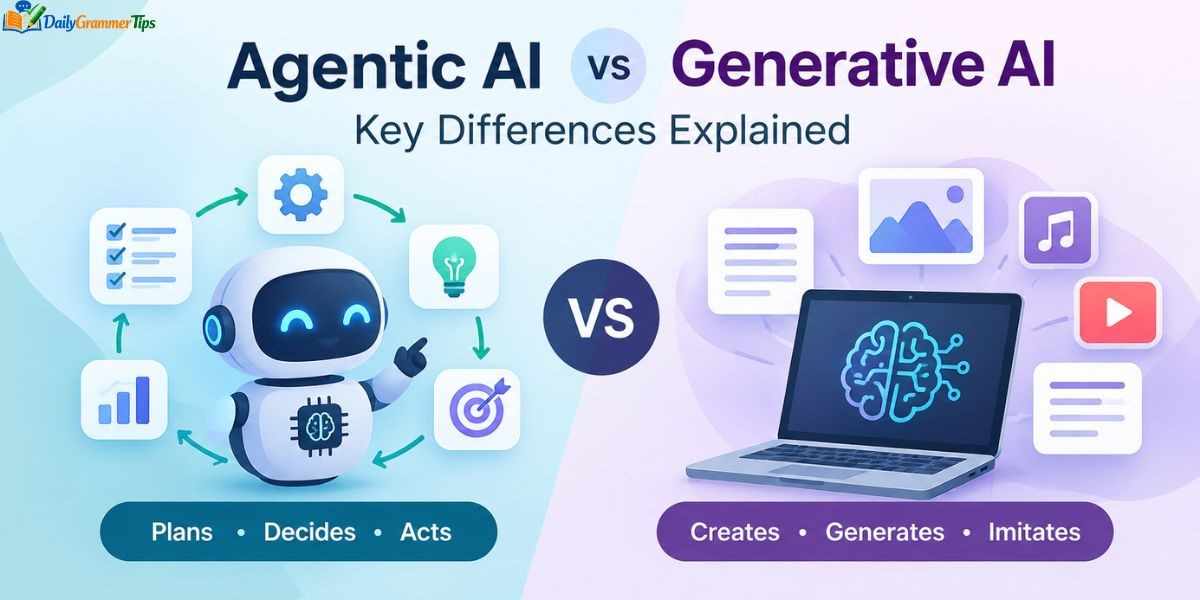
Artificial intelligence is moving fast. Every few months, a new term takes over the conversation. Right now, that term is agentic AI, and it sits right next to another familiar term, generative AI.
This guide breaks down agentic AI vs generative AI in plain language. You will learn what each one does, how they work, where they overlap, and which one fits your goals.
What Is Generative AI?
Generative AI is a type of artificial intelligence that creates new content. It can write text, generate images, produce code, or compose audio. It learns patterns from huge amounts of training data and uses those patterns to produce something new.
Generative AI is reactive. It waits for a prompt before it does anything. Once you give it an instruction, it produces a single output and stops.
Core Capabilities of Generative AI
Generative AI models are built on large language models and deep learning. They predict the next word, pixel, or sound based on patterns they learned during training. This is why they can write a blog post, draft an email, or generate an image from a short description.
These models do not plan ahead. They do not remember your last conversation unless you provide that context again. Every request is treated as a fresh task.
What Is Agentic AI?
Agentic AI is a system that can act on its own to reach a goal. Instead of waiting for a single prompt, it breaks a goal into steps and carries out those steps with little human input.
Agentic AI is proactive. It can use tools, call APIs, check its own progress, and adjust its plan if something changes. This is the core difference in any discussion of agentic AI vs generative AI.
Core Capabilities of Agentic AI
An agentic AI system usually has three parts. It has a planning module that breaks a goal into smaller tasks. It has memory that stores past actions and outcomes. It has tool access that lets it call external systems like a CRM, a calendar, or an email service.
These parts work together in a loop. The system perceives the situation, plans a response, takes action, and then checks the result before moving to the next step.
How Generative AI Works
Generative AI works by predicting what comes next in a sequence. A language model predicts the next word in a sentence. An image model predicts the next pixel pattern that fits a description.
This prediction is based on statistical patterns the model learned from training data. The model does not understand meaning the way a person does. It recognizes patterns and produces output that matches those patterns closely.
The Generation Process
The process is short and simple. You give the model a prompt. The model processes that prompt using its trained parameters. It returns one output.
There is no ongoing loop. If you want a revision, you send a new prompt. Each request stands on its own unless you add conversation history manually.
How Agentic AI Works
Agentic AI works through a repeating cycle. It perceives its environment, plans its next move, acts on that plan, and learns from the result. This cycle can repeat many times before the task is complete.
A common setup uses a main agent, sometimes called an orchestrator, that breaks a big goal into smaller jobs. It may hand off some of those jobs to smaller, specialized agents.
The Agentic Workflow
Picture a sales team that wants a follow up email sent automatically. An agent checks the CRM for a lead marked as ready. It pulls context about that lead. It drafts a message using a generative model. It sends the message and updates the record.
Each of these steps happens without a person typing a new prompt each time. This is the practical heart of agentic AI vs generative AI discussions in business settings.
Agentic AI vs Generative AI vs Predictive AI
Predictive AI is often left out of the agentic AI vs generative AI conversation, but it matters. Predictive AI looks at historical data and forecasts what is likely to happen next. It does not create new content and it does not take independent action.
| Type | Main Job | Human Input Needed |
| Predictive AI | Forecasts outcomes from data | Reviews the forecast |
| Generative AI | Creates new content | Provides the prompt |
| Agentic AI | Executes multi step goals | Sets the goal, reviews results |
Predictive AI answers the question of what will happen. Generative AI answers what should be created. Agentic AI answers what should be done about it. Many enterprise systems combine all three.
Agentic AI vs Generative AI vs Machine Learning
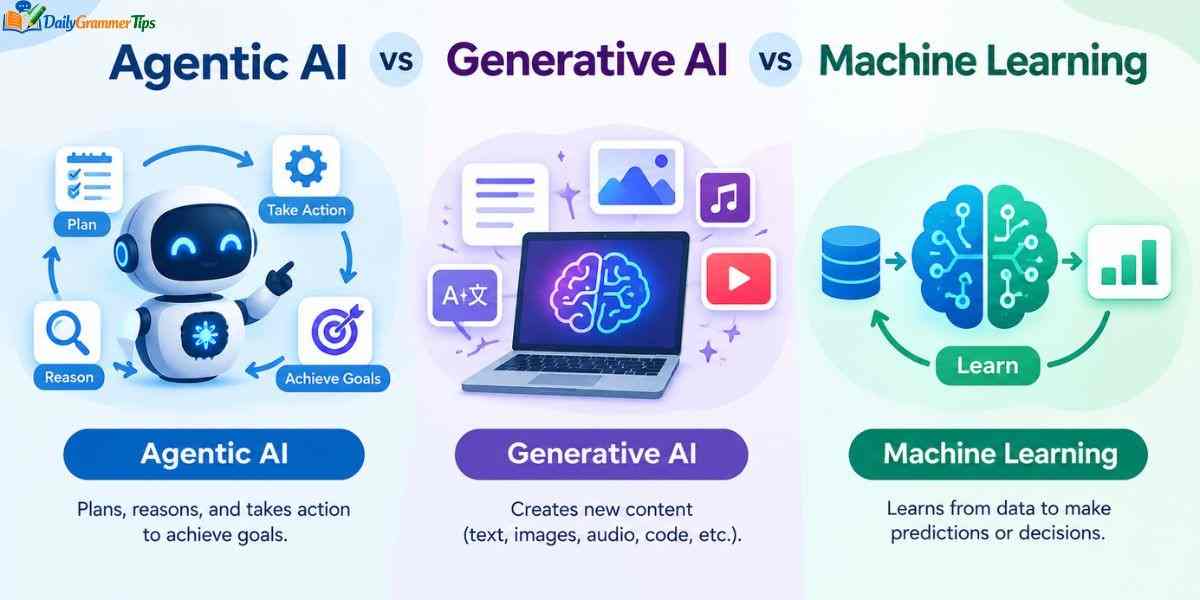
Machine learning is the broader field that both generative AI and agentic AI sit inside. Machine learning is any system that learns patterns from data instead of following fixed rules.
Generative AI and agentic AI are both built using machine learning techniques, especially deep learning and neural networks. The difference is in purpose, not in the underlying math.
| Concept | Scope |
| Machine learning | Broad field covering any pattern based learning system |
| Generative AI | A specific machine learning application focused on content creation |
| Agentic AI | A system built on machine learning models plus planning and tools |
Thinking of it as layers helps. Machine learning is the foundation. Generative AI is one application built on that foundation. Agentic AI adds planning, memory, and tool use on top of a generative core.
Learn more………..What Is AI Automation? A Complete Guide
Agentic AI vs Generative AI vs AI Agents
People often use the terms AI agent and agentic AI as if they mean the same thing, but there is a small difference. An AI agent is one component. Agentic AI describes the whole framework that coordinates many agents toward a shared goal.
| Term | What It Means |
| AI agent | A single unit that perceives, decides, and acts |
| Agentic AI | The full system where agents work together toward a goal |
| Generative AI | The content engine an agent may call on during its work |
An agentic AI system might include several AI agents working in parallel. One agent might research data. Another might draft a report using a generative model. A supervisor agent coordinates the two and checks the final result.
Is ChatGPT Generative AI or Agentic AI?
ChatGPT started as a pure generative AI tool. It took a prompt and returned text. It had no memory between sessions and no ability to take independent action.
That has changed over time. Modern versions of ChatGPT can browse the web, run code, and complete some multi step tasks. This blurs the line in the agentic AI vs generative AI debate.
Even so, most experts still classify ChatGPT primarily as generative AI with some agentic features layered on top. Its core job is still to respond to a prompt rather than to pursue a standing goal without one.
Agentic AI vs Generative AI: Comparison Table
Here is a fuller side by side view for anyone comparing agentic AI vs generative AI across common business criteria.
| Criteria | Generative AI | Agentic AI |
| Core purpose | Content creation | Goal completion |
| Autonomy | Low | High |
| Planning | None | Multi step planning |
| Tool and API use | Limited | Central to function |
| Best for | Drafts, summaries, images, code | Workflows, coordination, monitoring |
| Risk type | Informational errors | Operational errors |
| Oversight needed | Review each output | Set guardrails, audit trail |
This table shows why the two are not competitors. They solve different problems and often work best when paired together inside one workflow.
Agentic AI vs Generative AI: Which Is Better?
There is no single winner in the agentic AI vs generative AI debate. The right choice depends on the task in front of you.
Choose generative AI when you need a draft, a summary, an image, or a piece of code, and a person will review it before it goes out. Choose agentic AI when you need a multi step process completed with minimal manual work, such as updating a system across several tools.
Most businesses end up using both. Generative AI handles the writing and creating. Agentic AI handles the coordination and execution around that content.
How Agentic AI and Generative AI Work Together
The two technologies are strongest as a team. A generative model often acts as the reasoning engine inside an agentic system, producing text or analysis at each step of a larger task.
Consider a customer support example. An agent notices a delayed shipment. It checks the tracking system. It asks a generative model to draft an empathetic message to the customer. It sends that message and closes the ticket.
In this setup, the agent plans and acts. The generative model writes. Neither one could complete the full task alone, which is why so many products now blend agentic AI vs generative AI capabilities into one experience.
Use Cases of Generative AI
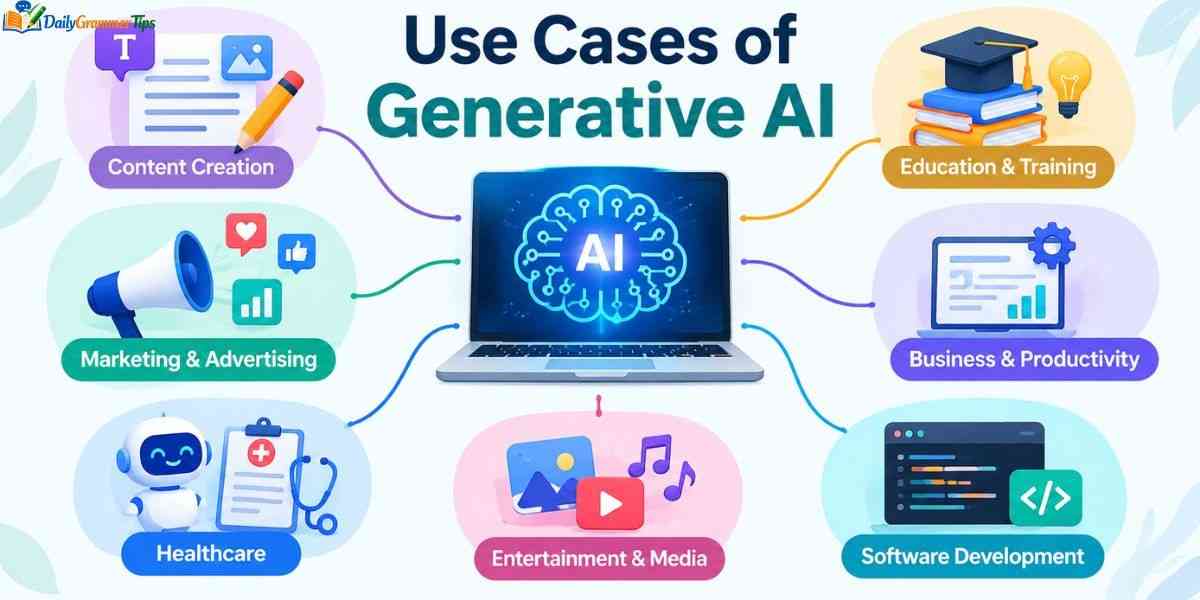
Generative AI fits any task where the output is a single piece of content that a person can review before use.
Writing and Content
Teams use generative AI to draft blog posts, marketing copy, product descriptions, and internal documents. It speeds up first drafts so writers can focus on editing and strategy.
Visual and Audio Creation
Generative AI can create images, short videos, and voice recordings from a text prompt. This is useful for marketing assets, product mockups, and training material.
Code and Data
Developers use generative AI to write code snippets, explain functions, and generate sample data for testing. It also helps summarize long reports into short, readable notes.
Use Cases of Agentic AI
Agentic AI fits tasks that require several steps, several systems, and ongoing decisions.
Sales and Customer Service
An agent can track a lead, gather account details, draft a follow up, and send it without a person triggering each step. In support, an agent can diagnose a ticket, check policy, and resolve it end to end.
Operations and Supply Chain
Agentic AI can watch stock levels, place reorders, and reroute shipments when a delay happens. It reacts to changing conditions faster than a manual review process.
IT and Security
Agentic systems can monitor logs, spot unusual activity, and isolate an affected system before a human even sees the alert. This cuts response time from hours to minutes.
Agentic AI vs Generative AI: Real World Examples
Real examples make the agentic AI vs generative AI difference easier to picture.
A marketing team uses generative AI to draft ten headline options for a campaign. A person picks the best one. That is generative AI in action.
A logistics company uses agentic AI to watch a shipment, notice a delay, contact the carrier, and update the customer automatically. Nobody had to start each step by hand. That is agentic AI in action.
Agentic AI vs Generative AI: Key Differences
The clearest way to understand agentic AI vs generative AI is to look at behavior. Generative AI reacts to a prompt. Agentic AI works toward a goal without constant prompting.
| Aspect | Generative AI | Agentic AI |
| Behavior | Reactive | Proactive |
| Output | Single piece of content | Series of actions |
| Human input | Needed for every task | Needed only to set the goal |
| Memory | Limited or none | Persistent across steps |
| Tool use | Rare, unless connected to an agent | Core part of how it works |
Generative AI is a tool for creation. Agentic AI is a system for execution. Many real products actually use both together, with generative AI handling content and agentic AI handling the workflow around it.
Agentic AI Examples
Here are more specific examples of agentic AI at work across industries.
A finance team uses an agent to monitor market data and flag unusual account activity before a human reviews it. A healthcare provider uses an agent to track patient vitals continuously and alert a nurse only when a reading crosses a set threshold.
A retail business uses an agent to rebalance inventory across warehouses based on live demand signals. A software team uses an agent to review pull requests, run tests, and flag issues before a developer even opens the file.
Industry Examples of Agentic AI vs Generative AI
Different industries apply agentic AI vs generative AI in different ways, based on their own risks and priorities.
Healthcare
Generative AI drafts shift handover notes and summarizes policy updates for staff. Agentic AI tracks patient vitals and medication schedules, alerting a care team only when something needs attention.
Manufacturing
Generative AI writes quality reports and supplier notices. Agentic AI watches production lines, flags defects, and reorders parts automatically when stock runs low.
Financial Services
Generative AI drafts client communications and compliance summaries. Agentic AI monitors transactions in real time and flags patterns that suggest fraud before a human reviews the case.
Agentic AI vs Generative AI: Tools and Frameworks
Developers exploring agentic AI vs generative AI in code often look at open source frameworks. These tools help build agents that can plan, use tools, and remember context across steps.
Popular categories include orchestration frameworks that manage multi agent workflows, memory libraries that store context between steps, and tool calling standards that let an agent connect to outside systems safely. Many of these projects are actively maintained and updated on public code repositories.
Generative AI tools, by contrast, are usually simpler to set up. A single API call to a language model is often enough to get useful output. Agentic frameworks require more planning around permissions, memory, and monitoring before they go live.
Governance, Risks, and Human Oversight
Agentic AI vs generative AI also differ sharply in risk profile. Generative AI carries informational risk. It might produce an inaccurate or biased answer, but it does not act on its own.
Agentic AI carries operational risk. Because it can take real actions across live systems, a mistake can have direct consequences, such as sending a wrong order or making an unapproved change.
Good governance sets clear limits. Human in the loop checkpoints should apply to any high stakes decision. Every autonomous action should be logged so a team can review what happened and why. Tool access should be scoped tightly so an agent can only do what it is explicitly allowed to do.
Which One Should You Choose: Agentic AI or Generative AI?
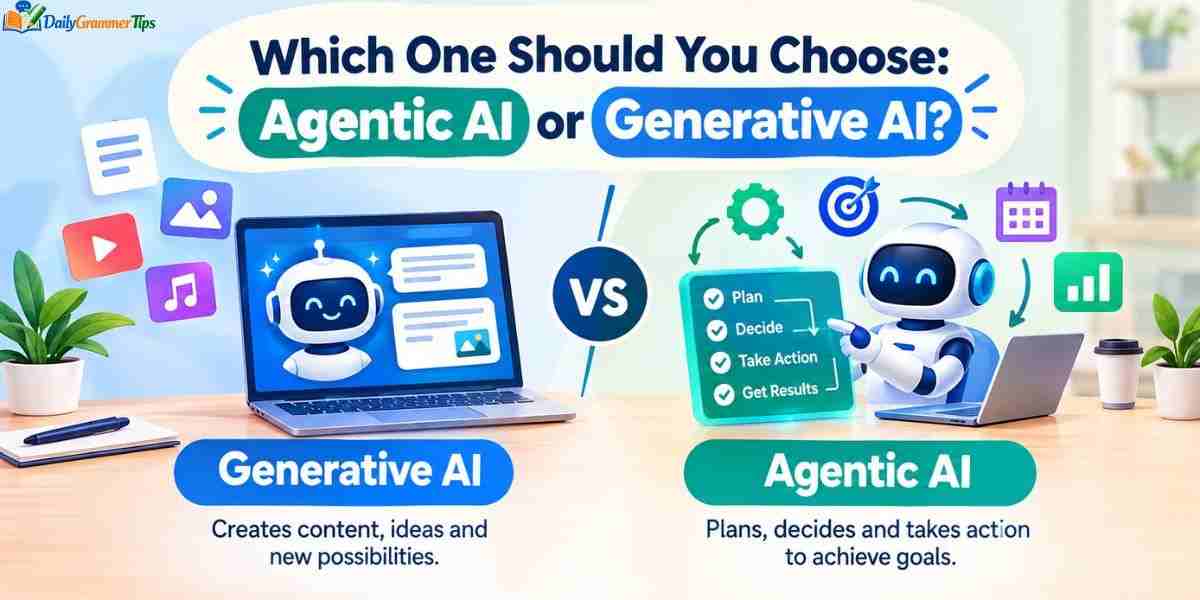
Start by looking at the shape of your task. If the output is a single piece of content that a person will check before use, generative AI is the simpler and safer fit.
If the task involves several steps across different systems, and you want it handled with minimal manual effort, agentic AI is worth the extra setup. Many teams pilot one small use case first, measure the result, and expand from there.
The honest answer for most businesses is not agentic AI vs generative AI as a contest. It is agentic AI and generative AI working side by side, each handling the part it does best.
Frequently Asked Questions
Is ChatGPT generative or agentic AI?
ChatGPT is mainly generative AI. It has gained some agentic features, like browsing and running tasks, but its core function is still responding to prompts.
What are examples of agentic AI?
Examples include automated ticket resolution, inventory reordering systems, fraud monitoring agents, and sales follow up automation.
What are the four types of generative AI?
Common categories are text generation, image generation, audio and voice generation, and code generation.
What are 7 types of AI?
A common list includes reactive machines, limited memory AI, theory of mind AI, self aware AI, narrow AI, general AI, and super AI.
What are the 5 main AI models?
Widely discussed model types include large language models, diffusion models, transformer based vision models, reinforcement learning models, and multimodal models.
Conclusion
Agentic AI vs generative AI is not a battle between two rivals. Generative AI creates. Agentic AI acts. Together, they cover both sides of getting real work done with artificial intelligence.
The best approach is to match the tool to the task. Use generative AI for drafts and creative output that a person reviews. Use agentic AI for workflows that need to run with less manual effort, and always keep clear oversight in place as these systems grow more capable.
