

Convolutional Neural Networks Every time your phone recognizes a face in a photo or a doctor uses software to spot a tumor on a scan, a specific kind of model is usually working behind the scenes. That model is often built using Convolutional Neural Networks, a technology designed specifically to make sense of visual data.
This guide breaks down what Convolutional Neural Networks are, how they work layer by layer, and where they are used in the real world. You will also see real examples, popular architectures, common frameworks, and answers to the most asked questions about this technology.
What Is a Convolutional Neural Network?
A Convolutional Neural Network is a type of deep learning model built specifically to process grid like data such as images. Instead of treating every pixel independently, it looks for patterns across neighboring pixels, letting it detect edges, textures, and shapes early on.
Unlike a traditional neural network, a Convolutional Neural Network does not connect every neuron to every input value. It uses small filters that slide across the image, which keeps the model efficient and lets it recognize an object no matter where it appears in the frame.
Convolutional Neural Networks Introduction: Why They Matter
Convolutional Neural Networks were inspired by how the human visual cortex processes images. Neurons in our eyes respond to small local regions first, and deeper layers of the brain combine that information into full scenes, an idea this architecture borrows directly.
Before this design became popular, feature extraction from images was done manually, which was slow and inconsistent. A CNN automates this process entirely, learning the best features directly from training data rather than relying on handcrafted rules.
How Do Convolutional Neural Networks Work?
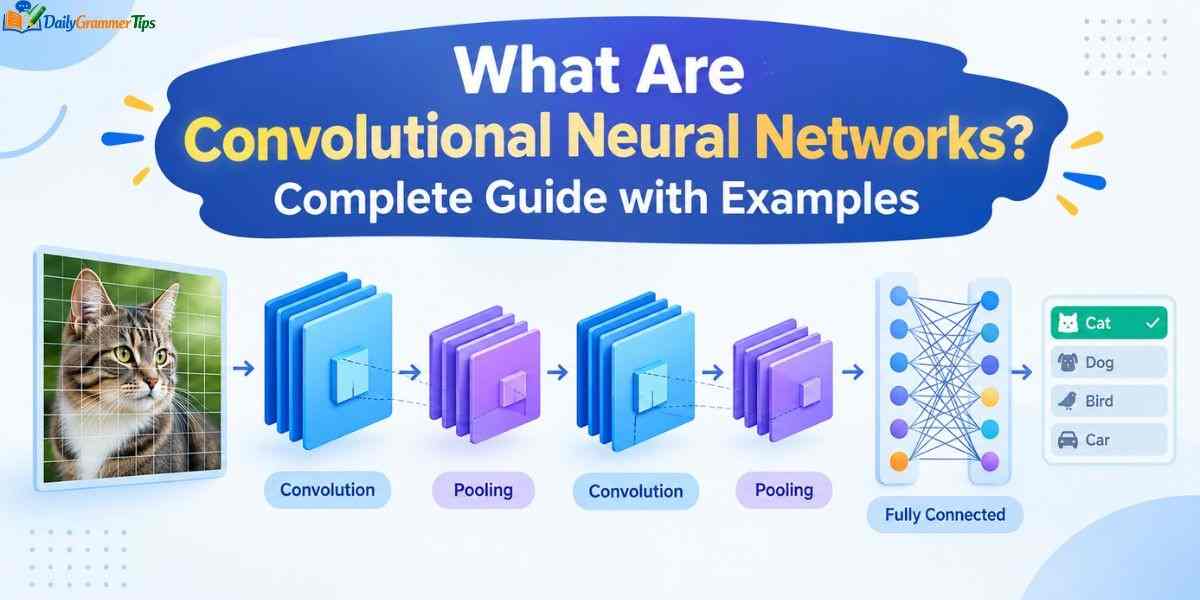
At a high level, a Convolutional Neural Network takes an image, passes it through a series of layers, and produces an output such as a class label. The core operation is convolution, where a small filter slides over the image to produce a feature map, the building block of every Convolutional Neural Network.
Training involves showing the network thousands of labeled examples and adjusting its internal weights through backpropagation. Once training finishes, the same learned weights are reused for every new prediction, a stage known as inference.
Key Components and Layers of a Convolutional Neural Network
A typical Convolutional Neural Network is built from a small set of repeating building blocks, stacked together in different combinations. The main layers found in most Convolutional Neural Network designs include the following.
- Input layer, which receives the raw pixel values of the image
- Convolutional layer, which extracts features using filters
- Activation layer, which introduces non linearity into the model
- Pooling layer, which reduces the size of the feature maps
- Fully connected layer, which performs the final classification
Not every design uses these layers in the same order or number, but this combination forms the backbone of almost every architecture in use today. ReLU is the most common activation function used in a Convolutional Neural Network, since it trains faster than older options like sigmoid.
Convolutional Layer Explained

The convolutional layer is where most of the actual computation in a Convolutional Neural Network takes place. It applies small filters, also called kernels, that slide across the input image to detect patterns like edges or textures, forming the core building block of this architecture.
The size of the filter and how far it moves at each step, called the stride, affect the output size, and padding can be added around the edges to control this further. Weight sharing keeps the same filter values reused across the entire image, reducing the total parameter count significantly.
Pooling in Convolutional Neural Networks
Pooling is a downsampling step that reduces the width and height of feature maps while keeping the most important information. This makes the Convolutional Neural Network faster and less prone to overfitting.
The two most common types are max pooling, which keeps the highest value in a region, and average pooling, which calculates the mean. Pooling also gives the model translation invariance, letting it recognize an object even if it shifts slightly within the frame.
Fully Connected Layer Explained
The fully connected layer usually appears near the end of a Convolutional Neural Network, after several rounds of convolution and pooling. The feature maps are flattened into a single vector at this point.
Each neuron in this layer connects to every value in that vector, combining all the features a Convolutional Neural Network has extracted for high level reasoning. A final softmax function then converts the output into probability scores for each possible class.
Learn more……..COBOL: What It Is, How It Works, and Why It’s Still Used in 2026
What Are Convolutional Neural Networks Primarily Used For?
Convolutional Neural Networks are mostly used wherever visual or spatial data needs to be understood automatically. Here are some of the most common real world applications.
- Image classification, such as sorting photos into categories
- Object detection, used in retail and security systems
- Facial recognition, applied in phones and access control
- Medical imaging, helping detect tumors and abnormalities
- Autonomous driving, identifying signs, lanes, and pedestrians
- Document and satellite image analysis for text and land use tracking
Because of this range, a Convolutional Neural Network is rarely limited to just one industry, and new applications continue to appear every year across agriculture, retail, and manufacturing.
Convolutional Neural Network vs Recurrent Neural Network: What Is the Difference?
People often confuse a Convolutional Neural Network with a recurrent neural network, but the two are built for very different types of data.
| Aspect | CNN | Recurrent Neural Network |
| Best data type | Images, grid like data | Sequences, time series, text |
| Memory of past inputs | None by default | Maintains hidden state |
| Processing style | Parallel | Sequential |
| Common use case | Image recognition | Language modeling |
Some modern systems combine both, using a Convolutional Neural Network to extract visual features and a recurrent model to process them over time, such as in video captioning.
Popular Convolutional Neural Network Architectures
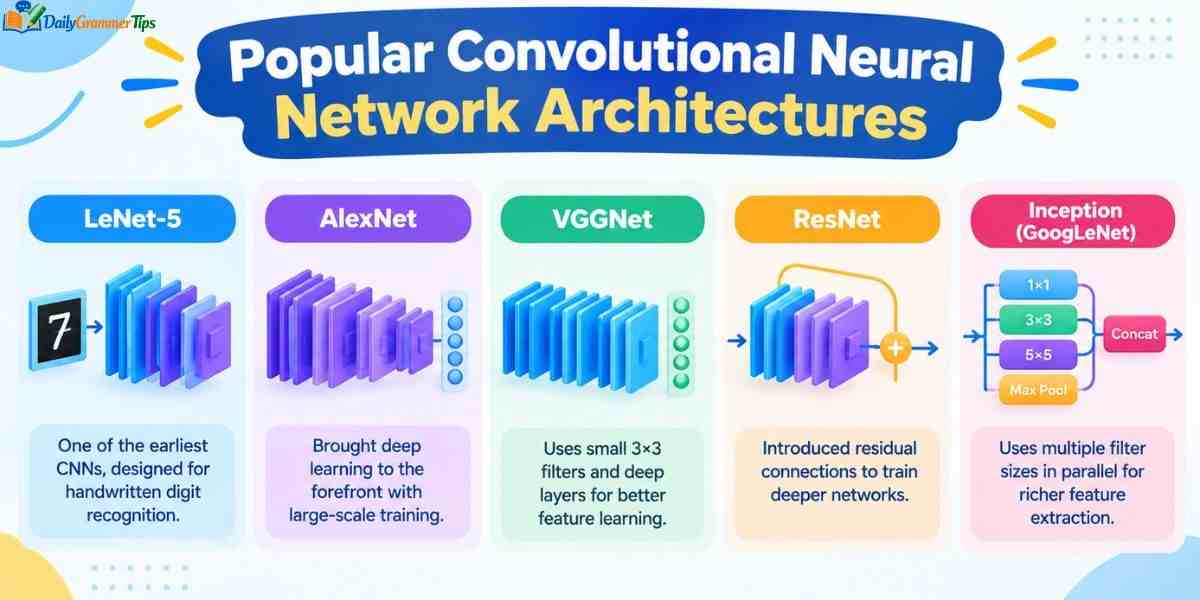
Over the years, researchers have introduced several landmark Convolutional Neural Network designs, each improving on the one before it.
- LeNet-5, one of the earliest CNNs, built for digit recognition
- AlexNet, which popularized deep CNNs using GPU training
- VGGNet, known for using small, stacked 3×3 filters
- ResNet, which enabled training of extremely deep networks
- EfficientNet, which balances depth, width, and resolution
Most of these Convolutional Neural Network architectures are available as pretrained models, which can be fine tuned for new tasks with far less data than training from scratch.
ResNet and Very Deep Networks
ResNet introduced shortcut connections that let signals skip layers, solving a major obstacle that had limited how deep earlier networks could go.
Convolutional Neural Network Examples
Seeing a concrete example often makes the architecture easier to understand than reading definitions alone. A simple case is a handwritten digit classifier, where a grayscale image passes through convolutional and pooling layers to output a probability for each digit.
A more advanced example is a Convolutional Neural Network trained as an animal classifier on labeled photos of cats, dogs, and birds, learning distinguishing features like ear shape on its own. Similar setups are used in healthcare to flag suspicious regions on medical scans for review.
Convolutional Neural Network Tutorial: Step by Step Basics
If you want to build a simple model yourself, the general workflow stays fairly consistent across frameworks.
Step 1: Prepare the Dataset
Collect and label your images, then resize and normalize them so the network receives consistent input values Convolutional Neural Networks.
Step 2: Define the Layers
Stack convolutional, activation, and pooling layers, followed by one or more fully connected layers near the end.
Step 3: Choose a Loss Function
Select a loss function appropriate for your task, such as cross entropy for classification problems.
Step 4: Train with Backpropagation
Feed batches of training data through the network and adjust the weights using gradient descent over many iterations.
Step 5: Evaluate on New Data
Test the trained Convolutional Neural Network on data it has never seen to measure how well it generalizes.
Overfitting in Convolutional Neural Networks and How to Prevent It
Overfitting happens when a model memorizes the training data instead of learning general patterns, a common risk with deep architectures like a Convolutional Neural Network.
Several techniques help a Convolutional Neural Network reduce this risk, including dropout, batch normalization, data augmentation, early stopping, and L1 or L2 regularization. Using a combination of these methods usually works better than relying on just one, especially with smaller datasets in Convolutional Neural Networks.
Best Frameworks to Build a Convolutional Neural Network
Several open source frameworks make it easier to design, train, and deploy a Convolutional Neural Network without writing every operation from scratch.
| Framework | Best For | Learning Curve |
| TensorFlow | Production deployment | Moderate |
| PyTorch | Research and experimentation | Moderate |
| Keras | Beginners and rapid prototyping | Easy |
Many teams start with Keras for simplicity, then move to TensorFlow or PyTorch as their Convolutional Neural Network projects grow more complex, since all three support GPU acceleration and pretrained models.
Advantages and Limitations of CNNs
Like any architecture, a Convolutional Neural Network comes with clear strengths as well as some notable drawbacks worth weighing before starting a new project.
Advantages
- Automatically learns features without manual engineering
- Performs very well on image and video related tasks
- Scales effectively to large and complex datasets
- Supports transfer learning through pretrained models
Limitations
- Requires large amounts of labeled training data
- Can be computationally expensive to train from scratch
- Offers limited interpretability of learned features
- Sensitive to adversarial examples and noisy inputs
Are Convolutional Neural Networks Still Relevant Today?
With the rise of newer architectures like Vision Transformers, some people wonder if this older approach is becoming outdated. In practice, that has not turned out to be the case.
A Convolutional Neural Network remains popular because it trains efficiently, performs well with smaller datasets, and has mature deployment tools built around it. Many production systems still rely on it for exactly these reasons.
Where to Find a Convolutional Neural Network PDF Guide

Many university courses publish free lecture notes and cheat sheets covering the math and theory behind this architecture in detail, which are useful for exam preparation or deeper study.
Research papers introducing major Convolutional Neural Network architectures are another valuable source, since many are freely available and include detailed explanations of their design choices.
Frequently Asked Questions
What is a Convolutional Neural Network?
It is a deep learning model designed to process grid like data such as images, using filters to detect patterns and features automatically.
Is ChatGPT a neural network?
Yes, ChatGPT is built on a neural network architecture, though it uses a transformer design rather than a Convolutional Neural Network design.
Is CNN better than YOLO?
They are not direct competitors, since YOLO is an object detection system that is actually built using convolutional layers internally.
Is ChatGPT ml or dl?
ChatGPT falls under deep learning, which is itself a specialized subset of the broader field of machine learning.
Where is CNN used in real life?
A Convolutional Neural Network is used in phone face unlock, medical scan analysis, self driving car vision systems, and photo tagging on social media.
Conclusion
Convolutional Neural Networks have become one of the most important tools in modern artificial intelligence, powering everything from photo apps to medical diagnostics. Their layered design, inspired by human vision, allows them to learn patterns directly from raw data.
You are just starting to explore deep learning or building your own image classifier, understanding how this network processes information through convolution, pooling, and classification gives you a strong foundation for the tasks ahead.
