

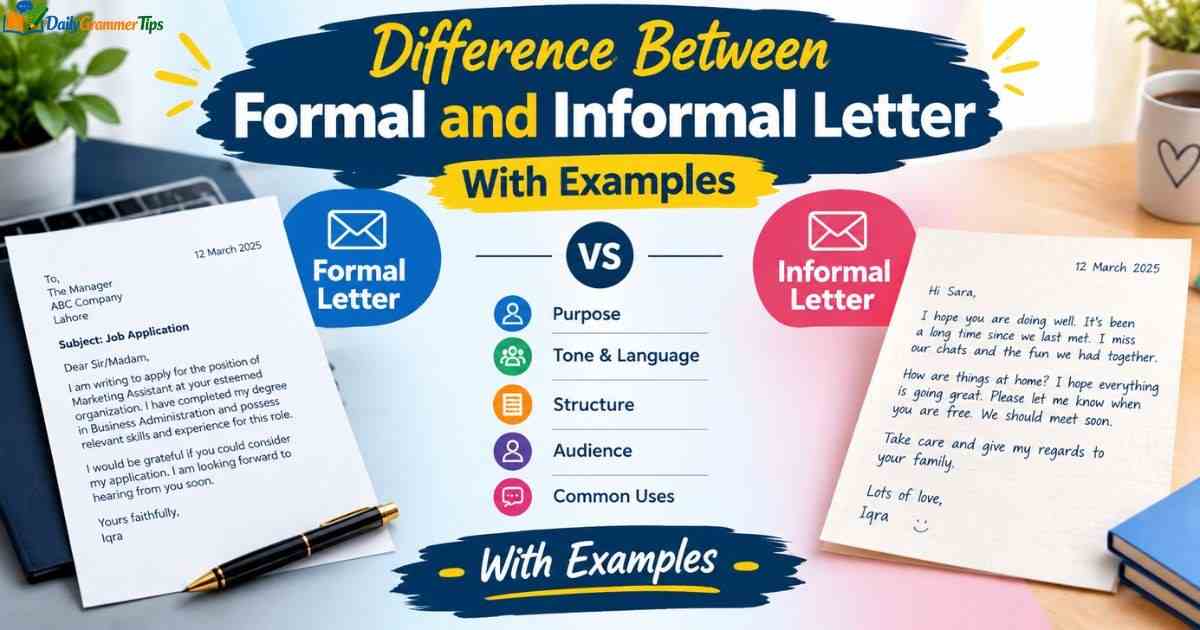
Difference Between Formal Letters are an important way of sharing information, ideas, and feelings. Although emails and digital messages are now common, letter writing is still used in education, business, and personal communication.
Understanding the formal and informal letter format helps writers choose the correct style for different situations. A letter written to a company, employer, or official person requires a professional approach. A letter written to a friend or family member needs a more personal and relaxed style.
The main difference between a formal and informal letter is based on the purpose, audience, tone, and structure. Formal letters focus on official communication, while informal letters focus on personal relationships.
For example, a person applying for a job will write a formal letter to a company. However, the same person may write an informal letter to a friend to share personal news.
Learning these differences helps students, professionals, and everyday writers communicate more effectively.
What Is a Formal Letter?
A formal letter is an official written message sent to a person, organization, or authority. It follows a specific structure and uses professional language.
People write formal letters for important purposes such as job applications, business communication, complaints, requests, and official inquiries. The writer usually does not have a personal relationship with the receiver.
A formal letter maintains a respectful tone. It avoids casual expressions, slang, and unnecessary personal details. Every sentence is written carefully to deliver the message clearly.
For example, an employee writing to a company manager about a workplace request should use a formal letter because the situation requires professionalism.
Key Features of a Formal Letter
A formal letter has several important features that make it suitable for professional communication.
The language is polite and direct. The writer explains the purpose clearly and avoids emotional expressions. The format is usually fixed, including the sender’s information, date, receiver’s information, subject, greeting, body, and closing.
Common features include:
- Professional tone
- Clear purpose
- Proper format
- Respectful language
- Formal vocabulary
These features help create a positive impression on the reader.
What Is an Informal Letter?

An informal letter is a personal message written to friends, family members, relatives, or people with whom the writer has a close relationship.
Unlike a formal letter, an informal letter does not require strict rules. The writer can use a friendly tone and share personal experiences, emotions, and opinions.
People often write informal letters to share life updates, invite someone to an event, express gratitude, or maintain relationships.
For example, writing to a childhood friend about a recent vacation is an informal letter because the communication is personal.
Key Features of an Informal Letter
An informal letter focuses on personal connection rather than official communication. The writer can use simple words and a conversational style.
The main features include:
- Friendly tone
- Personal expressions
- Simple language
- Flexible structure
- Emotional connection
An informal letter feels like a conversation written on paper. It allows the writer to express thoughts naturally.
Difference Between Formal and Informal Letter
The formal and informal letter styles differ mainly because they serve different purposes. A formal letter is used for professional communication, while an informal letter is used for personal communication.
The table below explains the major differences:
| Feature | Formal Letter | Informal Letter |
| Purpose | Official or professional communication | Personal communication |
| Audience | Companies, employers, officials, organizations | Friends, family, relatives |
| Tone | Respectful and professional | Friendly and casual |
| Language | Formal vocabulary | Simple everyday words |
| Structure | Fixed format | Flexible format |
| Feelings | Limited personal emotions | Personal feelings are common |
| Greeting | Dear Sir/Madam | Dear John, Dear Sarah |
A formal letter focuses on accuracy and professionalism. An informal letter focuses on friendship and personal expression.
Purpose of Writing Formal and Informal Letters
The purpose of a letter decides whether it should be formal or informal. Writers should always consider the relationship with the reader before choosing the style.
A formal letter is written when the message has an official purpose. For example, a person contacting a university for admission information needs a formal approach.
Common purposes include:
- Applying for a job
- Requesting information
- Making complaints
- Writing business messages
- Communicating with organizations
An informal letter is written when the purpose is personal. It allows people to communicate emotions, experiences, and memories.
Common purposes include:
- Sharing personal news
- Writing to friends
- Sending greetings
- Inviting someone to an event
- Expressing gratitude
Choosing the correct letter type makes communication clearer and more effective.
Structure of a Formal Letter
A formal letter follows a standard format because it is used for official communication. Each section has a specific purpose.
Sender’s Address
The sender’s address appears at the top of the letter. It tells the receiver where the letter came from.
Date
The date shows when the letter was written. It is important for official records.
Receiver’s Address
This includes the name, position, company, or organization of the person receiving the letter.
Subject Line
The subject briefly explains the reason for writing. It helps the reader understand the purpose quickly.
Greeting
Formal letters usually start with respectful greetings such as:
- Dear Sir/Madam
- Dear Mr. Johnson
- Dear Hiring Manager
Body of the Letter
The body contains the main message. It should be clear, organized, and focused on the purpose.
Closing
Formal letters usually end with professional closings such as:
- Sincerely
- Yours faithfully
- Yours sincerely
A proper structure makes a formal letter look professional and easier to understand.
Structure of an Informal Letter
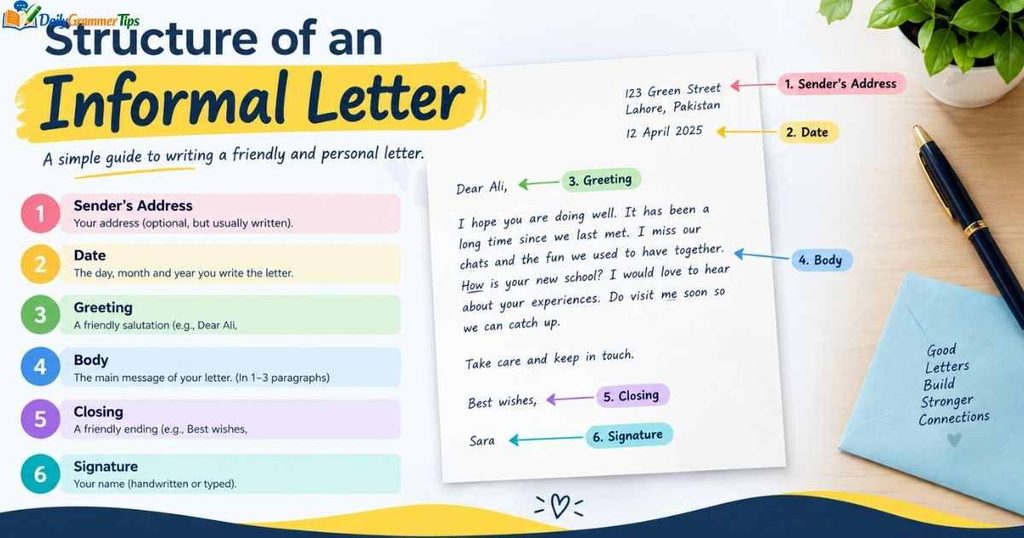
An informal letter does not follow strict professional rules, but it still has a simple structure that helps organize personal communication. Since it is written for friends, family, or close contacts, the style is more relaxed and natural.
The main parts of an informal letter include the sender’s address, date, greeting, introduction, main message, closing, and signature.
Sender’s Address and Date
The sender’s address is usually written at the top of the letter. It helps the receiver know where the message was sent from. The date is written below the address to show when the letter was created.
For example:
45 Green Street
California, USA
October 5, 2026
Greeting
An informal letter usually begins with a warm and personal greeting. The greeting depends on the relationship between the writer and the reader.
Examples:
- Dear John
- Dear Sarah
- My dear friend
Unlike a formal letter, an informal letter allows a more personal opening.
Body of the Letter
The body contains personal information, stories, feelings, and experiences. The writer can communicate naturally, just like a conversation.
For example, a person may write about a recent trip, a new job, family news, or personal achievements.
Closing
The closing of an informal letter should match the friendly tone. Common endings include:
- Best wishes
- Take care
- With love
- See you soon
The writer then adds their name.
An informal letter creates a personal connection and helps people stay connected even when they are far away.
Formal Letter Format With Example
A formal letter format is important because it maintains professionalism and makes communication easier to understand. It is commonly used in workplaces, schools, businesses, and official situations.
A formal letter usually follows this order:
- Sender’s address
- Date
- Receiver’s address
- Subject
- Greeting
- Main message
- Closing
- Signature
Example of a Formal Letter
123 Main Street
New York, NY
October 5, 2026
The Hiring Manager
ABC Marketing Company
New York, NY
Subject: Application for Marketing Assistant Position
Dear Hiring Manager,
I am writing to apply for the Marketing Assistant position available at your company. I believe my education, communication skills, and experience make me a suitable candidate for this role.
I have developed skills in content creation, digital marketing, and customer communication. I am interested in contributing my abilities to your organization and learning from your professional team.
I would appreciate the opportunity to discuss my qualifications further. Thank you for considering my application.
Sincerely,
John Smith
This example shows how a formal letter uses professional language and follows a structured format.
Informal Letter Format With Example
An informal letter has a simpler structure because it is written for personal communication. The writer can express emotions and share experiences freely.
The basic format includes:
- Address
- Date
- Greeting
- Introduction
- Main message
- Closing
- Name
Example of an Informal Letter
45 Park Avenue
Chicago, USA
October 5, 2026
Dear Michael,
I hope you are doing well. I wanted to share my recent travel experience with you. I visited California last week, and it was one of the best trips I have ever had.
The weather was beautiful, and I explored many interesting places. I wish you were there because we would have enjoyed the trip together.
I hope we can meet soon and talk about everything. Give my regards to your family.
Take care,
David
This example shows a friendly writing style with personal thoughts and emotions.
Language Differences Between Formal and Informal Letters
Language is one of the biggest differences between a formal and informal letter. The words and expressions used should match the purpose and audience.
A formal letter uses professional and respectful language. The writer avoids slang, short forms, and casual expressions.
Examples of formal expressions:
- “I am writing to request information regarding your services.”
- “I would appreciate your response.”
- “Thank you for your valuable time.”
An informal letter uses everyday language because it is written for someone familiar.
Examples of informal expressions:
- “I wanted to tell you something exciting.”
- “I hope everything is going well.”
- “I can’t wait to see you.”
The right language creates the correct impression and helps the reader understand the message easily.
Tone and Style Differences Between Formal and Informal Letters
Tone refers to the feeling or attitude expressed through writing. The tone changes depending on the relationship between the writer and reader.
A formal letter uses a serious and respectful tone. The writer focuses on facts and avoids unnecessary personal details.
Example:
“I would like to request permission to attend the upcoming training session.”
An informal letter uses a warm and friendly tone. The writer can share emotions and personal opinions.
Example:
“I am so excited to tell you about my new experience.”
The style of a formal letter is professional, while the style of an informal letter is conversational.
Read more :Examples of Present Perfect Continuous Tense in Sentences
When to Use a Formal Letter
A formal letter should be used when the communication involves an official purpose. It is suitable when writing to someone you do not know personally or when the topic requires professionalism.
Common situations include:
- Applying for employment
- Contacting a business
- Requesting official information
- Making a complaint
- Writing to government departments
- Communicating with schools or universities
For example, a student writing to a college admission office should use a formal letter because the communication is official.
A professional style shows respect and helps the receiver take the message seriously.
When to Use an Informal Letter
An informal letter is used for personal communication. It is suitable when writing to someone you know well, such as a friend or family member.
People use informal letters to share experiences, express feelings, and maintain relationships.
Common situations include:
- Writing to friends
- Sharing personal updates
- Sending invitations
- Thanking someone personally
- Sharing travel experiences
For example, writing to a friend about a birthday celebration requires an informal style because the purpose is personal.
Common Types of Formal Letters
Formal letters are used for different official and professional purposes. The type of letter depends on the reason for writing and the person or organization receiving it.
Job Application Letter
A job application letter is written by a person who wants to apply for a specific position. It introduces the applicant and explains why they are suitable for the role.
This type of letter usually includes information about education, skills, experience, and interest in the company. A professional tone helps create a positive impression on the employer.
Example:
A graduate applying for a marketing position writes a formal letter to the hiring manager explaining their qualifications and career goals.
Complaint Letter
A complaint letter is written when someone wants to report a problem with a product, service, or situation. It explains the issue clearly and requests a proper solution.
For example, a customer may write a complaint letter to a company after receiving a damaged product or poor service.
A good complaint letter should remain polite and focus on solving the problem rather than expressing anger.
Request Letter
A request letter is used when someone needs information, permission, or assistance from an organization or official person.
Examples include requesting admission information from a university, asking for leave from an employer, or requesting documents from an office.
A request letter should clearly explain the reason and make a polite request.
Business Letter
A business letter is used for communication between companies, clients, employees, or professional organizations.
Businesses use these letters to discuss agreements, offers, updates, services, and other important matters.
A business letter should always maintain a professional tone because it represents the organization.
Recommendation Letter
A recommendation letter is written to support someone’s abilities, skills, or achievements. It is often used for jobs, scholarships, and academic opportunities.
The writer explains why the person deserves consideration and highlights their positive qualities.
Common Types of Informal Letters
Informal letters are mainly written for personal communication. They allow writers to share emotions, experiences, and thoughts with people they know.
Personal Letter
A personal letter is written to friends, family members, or relatives. It may include personal news, memories, daily experiences, or feelings.
For example, someone may write a letter to a friend describing their new job or recent travel experience.
Invitation Letter
An invitation letter is used to invite someone to an event or special occasion. Since it is usually written to someone familiar, the tone is friendly.
Examples include birthday invitations, wedding invitations, and family event invitations.
Thank-You Letter
A thank-you letter expresses appreciation for someone’s help, kindness, or support.
For example, a person may write a thank-you letter to a friend who helped them during an important time.
Holiday Letter
A holiday letter is written to share travel experiences, seasonal greetings, or personal updates.
People often use these letters to stay connected with friends and family members who live far away.
Common Mistakes to Avoid While Writing Letters
Writing an effective letter requires understanding the purpose and audience. Many writers make mistakes because they use the wrong tone or structure.
One common mistake is using informal language in a professional situation. Words and expressions suitable for friends may appear disrespectful in official communication.
For example:
Incorrect formal style: “Hey, I need some details about your service.”
Better formal style: “I would like to request additional information regarding your service.”
Another common mistake is ignoring the format. A formal letter requires a proper structure, while an informal letter allows more flexibility.
Writers should also avoid unclear messages. The purpose of the letter should be easy to understand from the beginning.
Grammar and spelling mistakes can reduce the effectiveness of any letter. Reviewing the content before sending helps create a better impression.
Tips for Writing Effective Letters
A successful letter should have a clear purpose, suitable tone, and organized information. Before writing, consider the relationship with the reader and the reason for communication.
When writing a formal letter, keep the message professional and direct. Avoid unnecessary details and focus on the main purpose.When writing an informal letter, make the message natural and personal. Share experiences and emotions while keeping the content easy to follow.
Useful writing practices include:
- Understand your audience before writing.
- Choose words according to the situation.
- Keep paragraphs organized.
- Use polite language when needed.
- Review grammar and spelling before sending.
These practices help writers create letters that communicate their message effectively.
Examples of Formal and Informal Letter Writing
Understanding examples makes the difference between formal and informal letter styles easier to recognize.
Formal Letter Example: Request Letter
123 Oak Street
Boston, USA
October 5, 2026
The Manager
ABC Training Center
Subject: Request for Course Information
Dear Sir/Madam,
I am writing to request information about your upcoming professional training programs. I would like to know about the course schedule, fees, and admission requirements.
I would appreciate it if you could provide the required details at your earliest convenience.
Thank you for your assistance.
Sincerely,
Robert Smith
This example uses a respectful tone because the writer is communicating with an organization.
Informal Letter Example: Letter to a Friend
25 Lake Road
California, USA
October 5, 2026
Dear Alex,
I hope you are doing great. I wanted to share some exciting news with you. I recently started a new course, and I am really enjoying learning new skills.
The classes are interesting, and I have met many new people. I hope we can meet soon and talk about everything.
Take care,
James
This example uses a friendly tone because it is written to someone personally known.
Importance of Learning Formal and Informal Letter Writing
Knowing how to write both styles is important for students, professionals, and everyday communication.Students use formal letters for applications, school requests, and academic communication. They use informal letters to communicate with friends and family.
Professionals need formal writing skills for workplace communication, business messages, and official requests.
Understanding the difference between a formal and informal letter helps writers choose the correct words, tone, and format for every situation.Good letter-writing skills improve communication and help people express their ideas clearly.
How Formal and Informal Letters Are Used Today
Although technology has changed communication, the principles of letter writing are still important. Many emails, applications, and professional messages follow the same rules as formal letters.
Companies still use formal communication for official records, customer service, and business relationships.
Informal communication has moved to digital platforms, but personal messages still follow the same friendly style as traditional informal letters.Whether written on paper or sent digitally, choosing the right style remains important.
Final Comparison of Formal and Informal Letter
The formal and informal letter styles have different purposes, but both are important forms of communication. The correct choice depends on the reader, situation, and message.
A formal letter is best for official communication where professionalism is required. It uses a structured format, polite language, and a serious tone. Examples include job applications, business communication, and official requests.
An informal letter is best for personal communication. It allows writers to express feelings, share experiences, and communicate naturally with friends and family.
The following comparison summarizes the main differences:
| Area | Formal Letter | Informal Letter |
| Main Purpose | Official communication | Personal communication |
| Relationship | Professional relationship | Personal relationship |
| Tone | Respectful and serious | Friendly and relaxed |
| Writing Style | Structured and organized | Natural and flexible |
| Word Choice | Formal vocabulary | Simple everyday language |
| Format | Fixed format | Flexible format |
| Emotions | Usually limited | Commonly included |
| Examples | Job letters, complaints, requests | Personal messages, invitations |
Both styles have value. A writer who understands when to use each type can communicate more clearly and confidently.
Formal and Informal Letter Writing for Students
Students often learn letter writing because it improves communication skills and prepares them for academic and professional situations.
A student may need to write a formal letter when applying for admission, requesting information, or communicating with a school authority. These situations require respectful language and a proper format.
On the other hand, students may write informal letters to friends or relatives. These letters help them practice personal expression and storytelling.
Learning both styles at an early stage helps students become better writers and prepares them for future communication needs.
Formal and Informal Letter Writing in Professional Life
In professional environments, formal writing is essential. Employees, managers, and business owners use formal letters to communicate important information.
For example, companies use formal letters for employment offers, agreements, complaints, and official announcements. A professional tone helps maintain trust and respect.
Although informal letters are less common in workplaces, personal communication between colleagues may still use a friendly style.
Understanding the difference between these writing styles helps professionals communicate appropriately in every situation.
Tips to Improve Letter Writing Skills
Improving letter writing requires practice and attention to detail. A good writer should always consider the purpose of the message before choosing words.
For formal letters, focus on clarity, professionalism, and correct formatting. Avoid unnecessary information and keep the message direct.
For informal letters, focus on natural communication. Share ideas, experiences, and emotions in a way that feels comfortable for the reader.
Reading different examples of letters can also improve vocabulary and writing style. Regular practice helps writers become more confident.
Final Comparison of Formal and Informal Letter
The formal and informal letter styles have different purposes, but both are important forms of communication. The correct choice depends on the reader, situation, and message.
A formal letter is best for official communication where professionalism is required. It uses a structured format, polite language, and a serious tone. Examples include job applications, business communication, and official requests.
An informal letter is best for personal communication. It allows writers to express feelings, share experiences, and communicate naturally with friends and family.
The following comparison summarizes the main differences:
| Area | Formal Letter | Informal Letter |
| Main Purpose | Official communication | Personal communication |
| Relationship | Professional relationship | Personal relationship |
| Tone | Respectful and serious | Friendly and relaxed |
| Writing Style | Structured and organized | Natural and flexible |
| Word Choice | Formal vocabulary | Simple everyday language |
| Format | Fixed format | Flexible format |
| Emotions | Usually limited | Commonly included |
| Examples | Job letters, complaints, requests | Personal messages, invitations |
Both styles have value. A writer who understands when to use each type can communicate more clearly and confidently.
Formal and Informal Letter Writing for Students
Students often learn letter writing because it improves communication skills and prepares them for academic and professional situations.
A student may need to write a formal letter when applying for admission, requesting information, or communicating with a school authority. These situations require respectful language and a proper format.
On the other hand, students may write informal letters to friends or relatives. These letters help them practice personal expression and storytelling.
Learning both styles at an early stage helps students become better writers and prepares them for future communication needs.
Formal and Informal Letter Writing in Professional Life

In professional environments, formal writing is essential. Employees, managers, and business owners use formal letters to communicate important information.
For example, companies use formal letters for employment offers, agreements, complaints, and official announcements. A professional tone helps maintain trust and respect.
Although informal letters are less common in workplaces, personal communication between colleagues may still use a friendly style.
Understanding the difference between these writing styles helps professionals communicate appropriately in every situation.
Tips to Improve Letter Writing Skills
Improving letter writing requires practice and attention to detail. A good writer should always consider the purpose of the message before choosing words.
For formal letters, focus on clarity, professionalism, and correct formatting. Avoid unnecessary information and keep the message direct.
For informal letters, focus on natural communication. Share ideas, experiences, and emotions in a way that feels comfortable for the reader.
Reading different examples of letters can also improve vocabulary and writing style. Regular practice helps writers become more confident.
Frequently Asked Questions
What are examples of a formal letter?
Examples include job application letters, complaint letters, business letters, request letters, and recommendation letters.
How to identify the letter is formal or informal?
A formal letter uses professional language and structure, while an informal letter uses a friendly and personal writing style.
What is an informal letter?
An informal letter is a personal message written to friends, family members, or close contacts using a relaxed tone.
What are the differences between formal and informal writing?
Formal writing is professional and structured, while informal writing is casual, flexible, and personal.
What are the three types of formal letters?
The three common types are business letters, complaint letters, and application letters.
Conclusion
Understanding the difference between a formal and informal letter helps writers communicate effectively in different situations. Both styles have their own purpose and importance.
Formal letters are used for official communication and require a professional tone, clear structure, and respectful language. They are important in education, business, and workplace communication.
Informal letters are used for personal connections. They allow writers to share feelings, experiences, and messages in a friendly way. Choosing the correct letter style improves communication and helps the reader understand the message easily. By learning the rules, formats, and examples of both types, anyone can develop stronger writing skills.
