

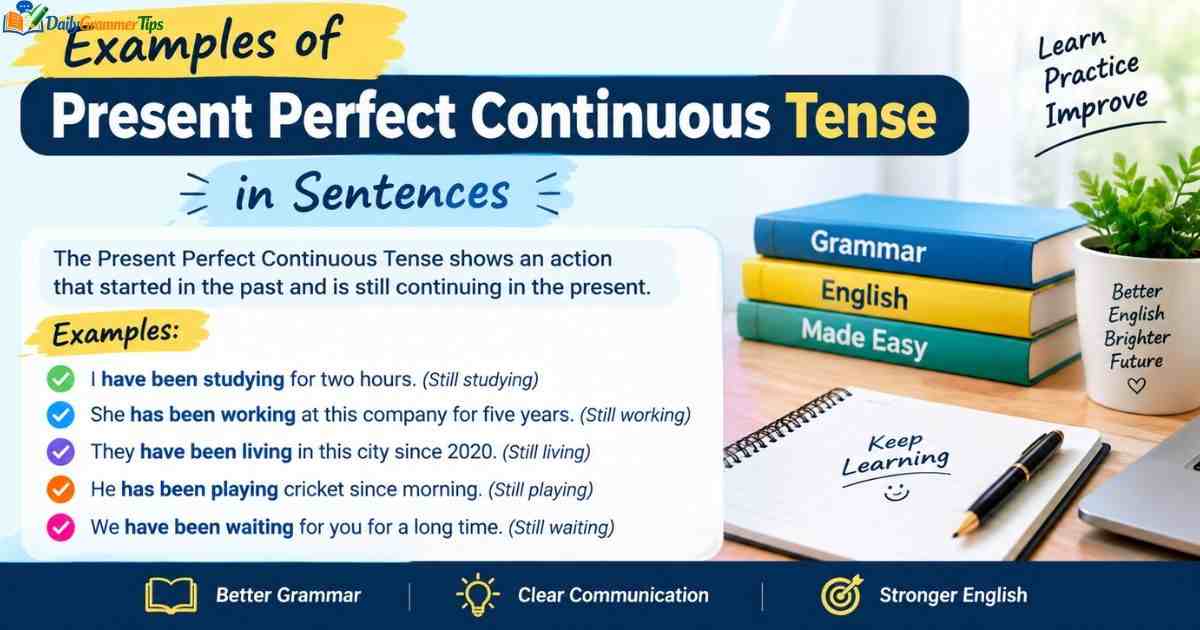
Examples of Present Perfect Learning English grammar becomes easier when learners understand how different tenses describe time and actions. The Present Perfect Continuous Tense is one of the most useful tenses because it helps explain actions that started in the past and are still continuing or have recently stopped with a visible result.
This tense is commonly used in everyday conversations, academic writing, professional communication, and storytelling. It connects past actions with the present moment and shows the duration or progress of an activity.
In this guide, we will explore the meaning, structure, rules, and examples of the Present Perfect Continuous Tense. You will also learn how to create positive, negative, and question sentences with real-life examples.
What Is Present Perfect Continuous Tense?
The Present Perfect Continuous Tense describes an action that began in the past and continues until now. It focuses mainly on the duration of an activity rather than only the result.
This tense is formed by combining the helping verbs has/have, been, and the main verb with an -ing ending. It shows that an action has been happening over a period of time.
For example:
- I have been studying English for three years.
- She has been working at the company since 2022.
- They have been waiting for the bus for thirty minutes.
In these examples, the actions started before the present time and are still connected to the current situation.
Formula and Structure of Present Perfect Continuous Tense
Understanding the correct structure helps learners create accurate sentences. The basic formula changes slightly depending on whether the sentence is positive, negative, or interrogative.
| Sentence Type | Structure | Example |
| Positive | Subject + has/have + been + verb-ing + object | She has been reading a book. |
| Negative | Subject + has/have + not + been + verb-ing + object | She has not been reading a book. |
| Question | Has/Have + subject + been + verb-ing + object? | Has she been reading a book? |
The helping verb has is used with singular subjects such as he, she, and it. The helping verb have is used with I, you, we, they, and plural subjects.
Examples:
- He has been playing football.
- They have been preparing for the exam.
- I have been practicing my writing skills.
When Do We Use Present Perfect Continuous Tense?
The main purpose of this tense is to describe ongoing actions and activities connected with the present. It explains how long something has happened or why a present situation exists.
1. Actions That Started in the Past and Continue Now
We use this tense when an activity began earlier and is still happening.
Examples:
- I have been learning English since January.
- She has been teaching students for ten years.
- We have been living in this city since 2020.
These sentences show that the activities started in the past but have not finished yet.
2. Recently Completed Actions With Present Results
The tense can also describe activities that have recently stopped but have an effect on the present situation.
Examples:
- He is tired because he has been running.
- The streets are wet because it has been raining.
- She looks happy because she has been talking with her friends.
The focus is not only on when the action happened but also on the result it created.
Difference Between Present Perfect and Present Perfect Continuous Tense
Many learners confuse these two tenses because both connect the past with the present. However, their focus is different.
| Present Perfect | Present Perfect Continuous |
| Focuses on completed results | Focuses on ongoing activities |
| Shows what has been finished | Shows how long an activity continues |
| Uses past participle form | Uses verb + ing form |
Examples:
Present Perfect:
- I have written five emails.
This sentence focuses on the completed number of emails.
Present Perfect Continuous:
- I have been writing emails for two hours.
This sentence focuses on the duration of the activity.
Understanding this difference helps learners choose the correct tense according to the meaning they want to express.
Positive Sentences Examples of Present Perfect Continuous Tense
Positive sentences show that an action has been continuing for some time. These sentences usually include time expressions such as for, since, all day, or recently.
| Sentence | Explanation |
| I have been reading this book for two hours. | The activity started earlier and continues now. |
| She has been cooking since morning. | Cooking began in the morning and is still connected to now. |
| They have been working on the project for weeks. | The project activity continues over time. |
| He has been practicing guitar every day. | Regular practice has continued recently. |
| We have been waiting for the meeting. | The waiting activity continues until now. |
More examples:
- I have been improving my English skills.
- She has been preparing for her final exams.
- They have been building a new house.
- The company has been developing new products.
- My brother has been studying computer science.
These examples show how the tense describes different activities in daily life, education, and professional environments.
Negative Sentences in Present Perfect Continuous Tense
Negative sentences explain that an activity has not been continuing or has stopped. The word not is added after has or have.
The structure is:
Subject + has/have + not + been + verb-ing
Examples:
- I have not been sleeping well recently.
- She has not been attending classes regularly.
- They have not been working on the assignment.
- We have not been using the old system.
- He has not been feeling comfortable lately.
Negative sentences are useful when explaining interrupted routines, changes, or unfinished activities.
Question Sentences Using Present Perfect Continuous Tense
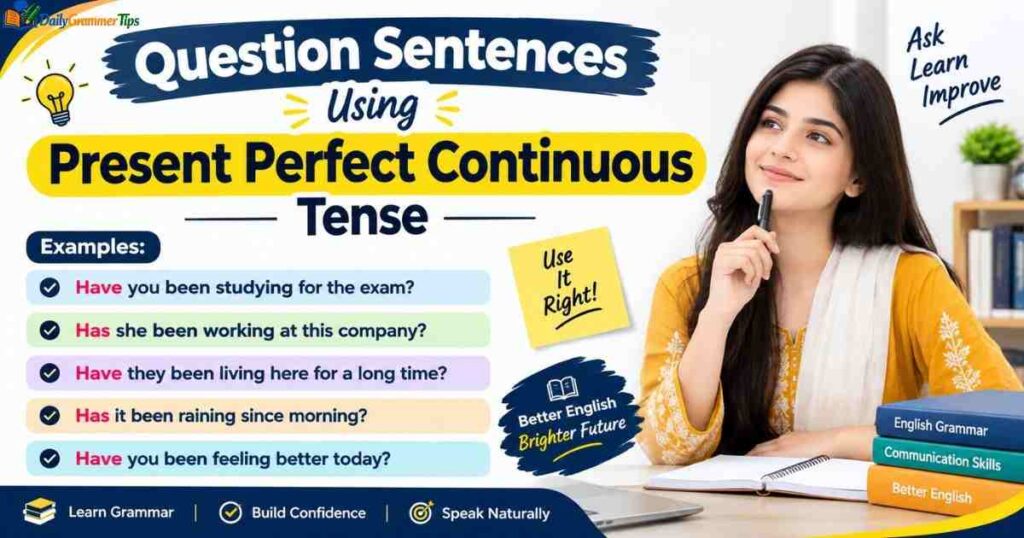
Questions help us ask about ongoing activities, duration, or reasons behind actions.
The structure is:
Has/Have + subject + been + verb-ing?
Examples:
- Have you been studying English?
- Has she been working here for five years?
- Have they been waiting for a long time?
- Has he been learning a new skill?
- Have we been following the correct process?
For questions about duration, we often use how long.
Examples:
- How long have you been living in the United States?
- How long has she been working at this company?
- How long have they been preparing for the event?
Rules of Present Perfect Continuous Tense
The Present Perfect Continuous Tense follows specific grammar rules that help describe actions correctly. The most important rule is using has or have with been and the verb’s -ing form. The choice between has and have depends on the subject of the sentence.
For singular subjects such as he, she, and it, we use has been. For plural subjects and pronouns such as I, you, we, and they, we use have been.
Examples:
- She has been working on her assignment since morning.
- They have been preparing for the competition for several weeks.
- I have been practicing my English speaking skills recently.
Another important rule is that this tense is usually used with time expressions that show duration. Words like for and since are commonly used because they explain how long an activity has continued.
For example, “I have been studying for three hours” tells us the duration of the activity, while “I have been studying since 8 AM” tells us the starting point of the action.
Use of For and Since in Present Perfect Continuous Tense
The words for and since play an important role when using the Present Perfect Continuous Tense. They help explain the relationship between the past and present.
For is used when we mention a period of time. It answers the question “How long?” For example, we use expressions like for two hours, for five days, for many years, or for a long time.
Example:
I have been working on this project for six months.
This sentence explains that the project started six months ago and is still continuing.
Since is used when we mention the exact starting point of an action. It tells us when something began.
Example:
She has been living in New York since 2021.
Here, 2021 is the specific point when the activity started.
Understanding the difference between for and since helps learners create clearer sentences and avoid common grammar mistakes.
Examples of Present Perfect Continuous Tense in Daily Life
The Present Perfect Continuous Tense is commonly used in everyday conversations because many activities continue over time. People use this tense when talking about work, studies, hobbies, health, and personal experiences.
For example, someone talking about their routine might say, “I have been exercising every morning.” This shows that the exercise routine started in the past and continues as a current habit.
Similarly, a student might say, “I have been preparing for my exam for two weeks.” The sentence explains both the activity and its duration.
Here are more natural examples:
- My parents have been traveling around the country for a month.
- She has been learning Spanish since last year.
- We have been discussing the new business plan all afternoon.
- He has been improving his writing skills recently.
- The children have been playing outside for several hours.
These examples show how the tense connects past activities with present situations.
Present Perfect Continuous Tense Examples for Students
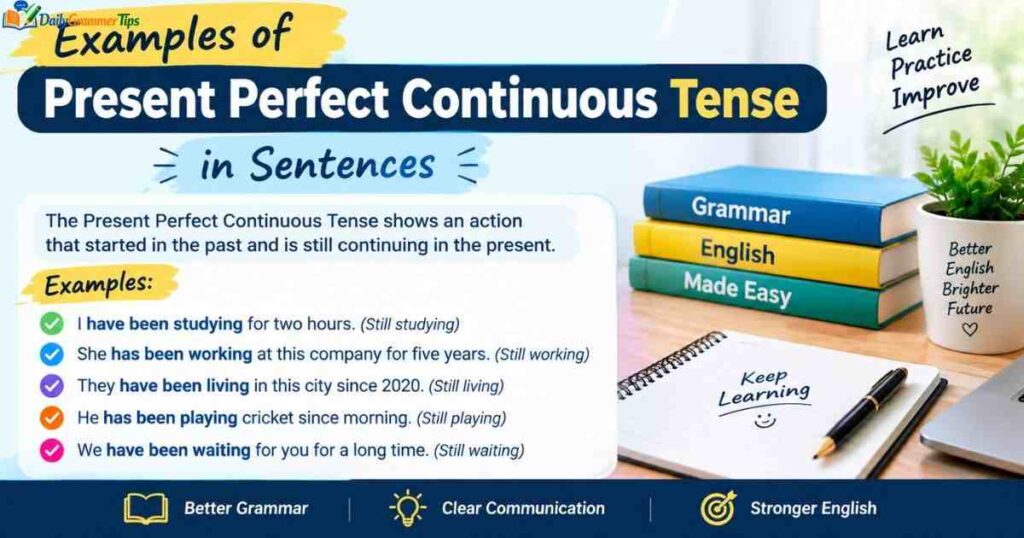
Students often use this tense when describing learning activities, preparation, and academic progress. It helps explain actions that require time and continuous effort.
A student can say, “I have been studying mathematics for three hours,” when the study session started earlier and is still happening. Another example is, “She has been practicing her presentation since Monday,” which shows continuous preparation.
The tense is useful in education because learning is usually a process that develops over time. It focuses on effort, progress, and the duration of an activity rather than only the final result.
More examples include:
- I have been attending English classes for six months.
- They have been researching climate change for their science project.
- He has been reading books to improve his vocabulary.
- We have been preparing notes for the final exam.
Present Perfect Continuous Tense Examples at Work
Professional communication also uses this tense frequently. Employees and managers use it to describe ongoing projects, responsibilities, and workplace activities.
For example, a manager may say, “Our team has been working on the new software update for three months.” This explains that the project started earlier and continues at the present time.
Similarly, an employee might explain, “I have been handling customer requests since the beginning of this year.” The sentence highlights continuous responsibility.
Workplace examples:
- The company has been expanding its services recently.
- She has been managing the marketing department for two years.
- We have been developing new strategies for business growth.
- They have been improving customer support systems.
Using this tense correctly makes professional communication clearer and more accurate.
Read more: Abstract Noun: Meaning, Types, Rules and Examples
Present Perfect Continuous Tense Examples With Questions
Questions using this tense are useful when asking about activities, progress, or duration. They are common in daily conversations and interviews.
For example, “How long have you been working here?” asks about the duration of someone’s employment. The question does not focus on a completed action but on an activity that started earlier.
Other examples include:
- How long have you been learning English?
- Have you been waiting for the doctor?
- Has she been studying for the test?
- Have they been working on the new project?
These questions help speakers understand ongoing situations and experiences.
More Examples of Present Perfect Continuous Tense in Sentences
The best way to understand the Present Perfect Continuous Tense is through practical sentence examples. This tense appears in many situations, including conversations, education, work, travel, and personal experiences.
When people want to explain an activity that started earlier and is still happening, they often use this tense. It helps listeners understand the progress, duration, or reason behind a current situation.
For example, “I have been writing this article for two hours” shows that the writing started in the past and is still connected to the present moment.
Here are more examples:
- She has been studying for her driving test for three weeks.
- I have been waiting for your response since yesterday.
- They have been building their new home for several months.
- He has been working on his fitness goals recently.
- We have been searching for a better solution.
- The teacher has been explaining the lesson for thirty minutes.
- My friends have been planning a trip since last month.
- The company has been introducing new changes this year.
- You have been improving your communication skills.
- The children have been learning new activities at school.
These sentences show that the action continues over a period of time or has a connection with the present.
Examples of Present Perfect Continuous Tense With Since
The word since is used when the speaker mentions the exact time when an action started. It connects a specific starting point in the past with the present situation.
For example, “She has been working here since 2020” means her work started in 2020 and continues until now.
Some examples using since are:
- I have been living in this city since 2018.
- She has been teaching English since graduation.
- They have been using this software since January.
- He has been playing basketball since childhood.
- We have been waiting since morning.
- My brother has been preparing for his exam since Monday.
These sentences clearly show the beginning point of an activity.
Examples of Present Perfect Continuous Tense With For
The word for is used when we talk about the length or duration of an activity. It tells us how long something has continued.
For example, “I have been working on this project for five months” explains the total period of the activity.
Examples:
- I have been studying English for four years.
- She has been working at the hospital for a decade.
- They have been traveling for two weeks.
- He has been practicing the piano for six months.
- We have been waiting for an hour.
- The students have been preparing for the competition for several days.
Using for correctly helps explain the amount of time an activity has continued.
Negative Examples of Present Perfect Continuous Tense
Negative sentences are used when we want to explain that an activity has not been happening continuously. These sentences usually describe stopped activities, interruptions, or situations that have not occurred recently.
The structure is:
Subject + has/have + not + been + verb-ing
Examples:
- I have not been sleeping well recently.
- She has not been attending the training sessions.
- They have not been working on the project this week.
- He has not been feeling comfortable lately.
- We have not been using the old system.
- You have not been paying attention in class.
These examples show how the tense can describe the absence of an ongoing activity.
Common Mistakes in Present Perfect Continuous Tense
Many English learners make mistakes when using the Present Perfect Continuous Tense because they confuse it with other tenses. Understanding these common errors can improve grammar accuracy.
One common mistake is forgetting the word been. Some learners say, “I have studying English for two years,” but the correct sentence is, “I have been studying English for two years.”
Another mistake is using the wrong helping verb. For example, “She have been working” is incorrect because a singular subject requires has. The correct sentence is, “She has been working.”
Learners also sometimes use the past form instead of the -ing form. The correct structure always requires the present participle form of the verb.
Incorrect:
- They have been worked here for five years.
Correct:
- They have been working here for five years.
Using the correct structure makes sentences clearer and more natural.
Present Perfect Continuous Tense vs Present Continuous Tense
Although both tenses describe ongoing actions, they are used differently. The Present Continuous Tense describes an action happening right now, while the Present Perfect Continuous Tense describes an activity that started in the past and continues until now.
For example:
Present Continuous: “I am reading a book.”
This means the action is happening at this exact moment.
Present Perfect Continuous: “I have been reading this book for two hours.”
This explains that the reading started earlier and continues until now.
The main difference is the connection with past time. Present Continuous focuses only on the present moment, while Present Perfect Continuous connects past and present.
Present Perfect Continuous Tense vs Past Continuous Tense
The Past Continuous Tense describes an activity that was happening at a specific time in the past. It does not usually show a connection with the present.
Example:
Past Continuous: “She was studying at 8 PM yesterday.”
This tells us about an activity happening at a past time.
Present Perfect Continuous: “She has been studying for three hours.”
This tells us the activity started earlier and may still continue.
The difference is that Past Continuous focuses on a completed past moment, while Present Perfect Continuous focuses on duration and present connection.
Present Perfect Continuous Tense Examples in Conversations
The Present Perfect Continuous Tense is frequently used in everyday conversations because people often talk about activities that started earlier and are still happening. It helps speakers explain situations naturally by focusing on time, progress, and ongoing effort.
For example, when someone asks, “What have you been doing?” the speaker may answer, “I have been working on my new project.” This explains that the activity started before the conversation and is still relevant.
Here are some conversational examples:
Person A: How long have you been learning English?
Person B: I have been learning English for three years.
Person A: Why are you tired?
Person B: I have been working since early morning.
Person A: Has she been preparing for the presentation?
Person B: Yes, she has been practicing it for several days.
These examples show how naturally this tense appears in real communication.
Present Perfect Continuous Tense Examples for Everyday Activities
Many daily activities continue over time, which makes this tense useful in normal conversations. People use it when talking about routines, hobbies, responsibilities, and personal goals.
For example, someone discussing a healthy lifestyle may say, “I have been exercising regularly for six months.” The sentence highlights continuous effort rather than only the result.
More examples include:
- I have been drinking more water recently.
- She has been cooking healthy meals for her family.
- They have been watching this series all week.
- He has been practicing photography for several months.
- We have been cleaning the house since morning.
These sentences explain activities that develop gradually and connect past actions with the present.
Present Perfect Continuous Tense Examples in Professional Communication
In professional environments, the Present Perfect Continuous Tense helps explain ongoing projects, responsibilities, and improvements. It is commonly used in meetings, reports, and workplace discussions.
For example, a team leader may say, “Our department has been working on improving customer service.” This shows a continuous effort that started earlier and is still important.
Other professional examples include:
- The team has been developing a new marketing strategy.
- The company has been investing in new technology.
- Employees have been learning new skills through training programs.
- The manager has been reviewing the project progress.
- We have been analyzing customer feedback.
This tense allows professionals to describe progress clearly and professionally.
Present Perfect Continuous Tense Examples With Weather and Nature
The tense is also used to describe natural events and situations that have recently happened. Weather conditions often use this tense when the effects are visible in the present.
For example, “It has been raining for three hours” means the rain started earlier and may still be happening.
Other examples:
- The wind has been blowing strongly since morning.
- It has been snowing all night.
- The temperature has been increasing recently.
- The plants have been growing quickly because of good weather.
- The river has been flowing faster after heavy rain.
These examples show how the tense describes continuous changes in nature.
How to Make Present Perfect Continuous Tense Sentences Easily
Creating sentences in this tense becomes simple when you remember the basic formula:
Subject + has/have + been + verb-ing
First, choose the subject. Then decide whether to use has or have. After that, add been and change the main verb into its -ing form.
For example:
Subject: She
Verb: work
Time: three years
Sentence: She has been working for three years.
Another example:
Subject: They
Verb: study
Time: since Monday
Sentence: They have been studying since Monday.
Following this simple process helps learners create correct sentences quickly.
Importance of Learning Present Perfect Continuous Tense
The Present Perfect Continuous Tense is important because it helps people express time relationships more accurately. Without this tense, speakers may find it difficult to explain activities that started in the past but still matter now.
This tense improves both speaking and writing skills because it allows learners to describe experiences, progress, and ongoing situations naturally.
Students can use it in essays, conversations, interviews, and professional communication. Understanding this tense also improves overall English fluency because many native speakers use it regularly in daily conversations.
20 Examples of Present Perfect Continuous Tense Sentences
The following examples show different situations where this tense can be used naturally:
- I have been studying English for five years.
- She has been working at this company since 2021.
- They have been playing football all afternoon.
- He has been reading that book for two hours.
- We have been waiting for the train since noon.
- My parents have been living here for a long time.
- The students have been preparing for their exams.
- I have been practicing my writing skills recently.
- She has been learning a new language this year.
- They have been building a new office near the city center.
- He has been exercising regularly for months.
- We have been discussing this issue since yesterday.
- The company has been growing rapidly.
- You have been improving your performance.
- The children have been playing outside since morning.
- I have been looking for a new job recently.
- She has been preparing dinner for an hour.
- They have been traveling around the country for weeks.
- He has been repairing the computer since morning.
- We have been working together for many years.
These examples cover common situations where English speakers use the tense naturally.
Continuing with Part 5 (Final Part).
Additional Examples of Present Perfect Continuous Tense
The Present Perfect Continuous Tense can be used in many situations where an action continues over time or has a visible effect in the present. It helps explain activities that involve effort, progress, and repeated actions.
For example, a person who is preparing for a competition can say, “I have been training for six months.” This sentence shows dedication and continuous effort.
More examples include:
- She has been writing articles for an online magazine.
- I have been improving my vocabulary through daily practice.
- They have been discussing the project details.
- He has been working from home since last year.
- We have been planning our vacation for several weeks.
- The students have been completing their assignments.
- My friend has been learning how to play the piano.
- The organization has been supporting local communities.
- The doctor has been treating patients all day.
- The workers have been repairing the road since morning.
These examples demonstrate how this tense can describe actions in personal, academic, and professional situations.
Present Perfect Continuous Tense in Academic Writing
Students and researchers often use this tense when explaining ongoing studies, research activities, and learning processes. It helps describe work that began earlier and continues at the current time.
For example, a researcher may write, “Scientists have been studying climate change for many decades.” This sentence explains a continuous research activity that started in the past.
Students can also use this tense when describing their preparation process.
Examples:
- I have been preparing for my final exams for two months.
- Researchers have been collecting data for several years.
- The students have been working on their science project since September.
- The university has been developing new learning methods.
Using the correct tense makes academic writing more accurate and meaningful.
Present Perfect Continuous Tense in Business and Marketing
Businesses often use the Present Perfect Continuous Tense to describe ongoing growth, development, and strategies. It helps explain activities that have been happening over a period of time.
For example, “The company has been expanding its services worldwide” shows continuous business growth.
Other examples:
- The brand has been attracting more customers recently.
- The marketing team has been creating new campaigns.
- The company has been improving its online presence.
- Employees have been developing better communication skills.
- The business has been investing in customer satisfaction.
This tense is useful when discussing progress and long-term activities.
Difference Between Action Duration and Completed Results
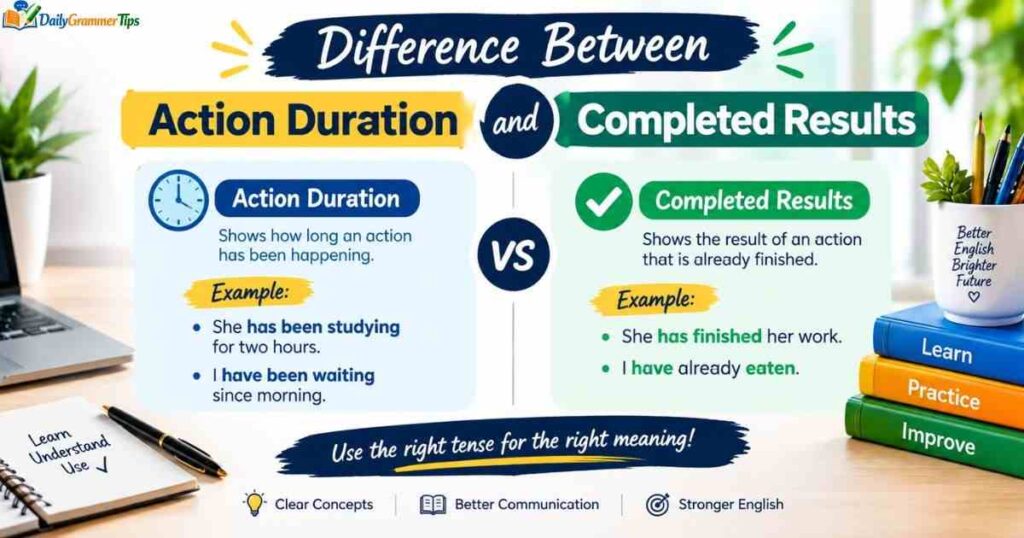
One of the most important points about the Present Perfect Continuous Tense is that it focuses on duration and activity rather than only completion.
Compare these sentences:
“I have cleaned my room.”
This sentence focuses on the completed result.
“I have been cleaning my room for two hours.”
This sentence focuses on the activity and the time spent doing it.
Both sentences are correct, but they communicate different meanings. The first one tells us that the task is finished, while the second one highlights the ongoing process.
Tips to Use Present Perfect Continuous Tense Correctly
Learning this tense becomes easier when you practice using it in real situations. Instead of memorizing rules only, try creating sentences about your daily activities.
Think about actions that started earlier and are still happening. Ask yourself questions like:
How long have I been doing this activity?
When did this activity start?
Does this action have a connection with the present?
For example:
- I have been learning English for one year.
- I have been working on my skills since January.
Regular practice helps learners naturally understand when to use this tense.
Frequently Asked Questions
What are 20 examples of present perfect continuous tense?
Examples include sentences like “I have been studying for two hours” and “She has been working since morning.” These sentences describe ongoing actions connected to the present.
Can you provide 50 examples of present perfect continuous tense?
Yes, many examples can be created using different subjects, verbs, and time expressions to show activities that continue over time.
What are 20 examples of present perfect continuous tense in a PDF?
A PDF can contain organized examples, formulas, and explanations of this tense for easier grammar practice and learning.
What are 50 examples of the present continuous tense?
Examples of present continuous tense describe actions happening now, such as “She is reading a book” or “They are playing football.”
Can you give me 20 examples of present continuous tense sentences?
Yes, examples include “I am learning English” and “He is working on a project.” These sentences describe current actions.
Conclusion
The Present Perfect Continuous Tense is an essential part of English grammar because it helps describe actions that started in the past and continue into the present. It explains the duration, progress, and connection between previous and current situations.
This tense is widely used by native English speakers, making it an important skill for anyone who wants to communicate clearly. With regular practice and attention to common rules, using the Present Perfect Continuous Tense becomes natural and effective.
