

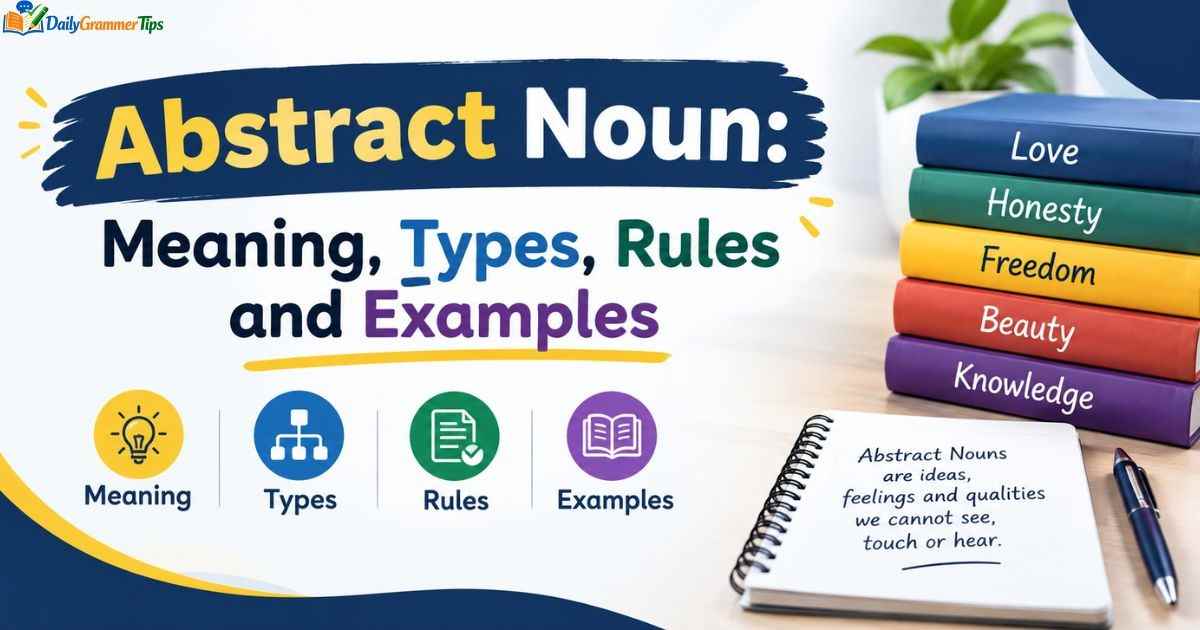
Every language needs words for ideas and feelings. An abstract noun gives you those words. You use an abstract noun every day, often without a second thought. Love, fear, and freedom all belong to this group.
This guide explains the abstract noun in simple language. You will learn its meaning, types, and rules. You will also see how it differs from a concrete noun. Clear examples and practice tasks will help you learn faster.
What Is an Abstract Noun?
An idea word names an idea, a feeling, a quality, or a state. You cannot see it. You cannot touch it. You cannot hear it, taste it, or smell it. You only feel it or think about it in your mind.
Think about the word happiness. You cannot hold happiness in your hand. You cannot put it in a box. Yet everyone understands the word. That is the power of this kind of noun.
Simple Definition
A word that names something you cannot sense with your five senses is an idea word. Grammar teachers also describe it as a noun for things that exist only in thought. Some books use the phrase “idea noun” or “quality noun” for the same thing.
The Five Senses Test
You can test any noun with five quick questions.
- Can you see it?
- Can you touch it?
- Can you hear it?
- Can you taste it?
- Can you smell it?
If you answer no to all five, you have found an idea word. If you answer yes to even one, you have found a concrete noun. The word music is a good example. You can hear music, so it is a concrete noun. The word kindness gets five no answers, so it is abstract.
Quick Examples
- Emotions: happiness, anger, jealousy, sorrow
- Qualities: honesty, bravery, kindness, wisdom
- Ideas: freedom, justice, democracy, equality
- States: childhood, poverty, health, sleep
Each word in this list names something invisible. Each one is an idea word.
Why Do We Call It Abstract?
The word abstract comes from a Latin word that means “drawn away.” An abstract idea is an idea that your mind draws away from physical things. You look at many brave people and pull out one shared quality. You name that quality bravery.
This process shows how the human mind works. You see a kind mother, a kind teacher, and a kind neighbor. You notice what they share. Then you create one word for it. That word is kindness.
Language grows in this way. Every idea word starts as a thought. People then agree on a word for that thought. Later, children learn the word from adults.
Why the Abstract Noun Matters in English
You cannot speak well without the idea word. It lets you talk about life beyond objects. It lets you share opinions, beliefs, and emotions. Without it, you could only describe tables, chairs, and trees.
Benefits for Speakers
- Speakers share feelings in a clear way
- Speakers explain their opinions with confidence
- Speakers connect with listeners on an emotional level
Benefits for Writers
Writers use the idea word to build themes. A story about courage feels deeper than a story about a boy with a sword. A poem about loss touches the heart more than a list of objects. News writers also use these words to describe problems such as inflation, pollution, and corruption.
Benefits for Students
Students who master the idea word write better essays. Teachers reward strong vocabulary. Exams also test this topic often. A student who understands it can score well in grammar sections and in writing tasks.
Abstract Noun vs Concrete Noun
A concrete noun names a thing you can sense. An idea word names a thing you cannot sense. This difference sounds simple, but learners often mix the two. The table below shows the main points.
| Feature | Idea word | Concrete Noun |
| Meaning | Names ideas and feelings | Names physical things |
| Senses | You cannot sense it | You can sense it |
| Examples | love, truth, courage | table, river, teacher |
| Counting | Often uncountable | Often countable |
| Plural | Rarely takes a plural | Usually takes a plural |
| Existence | Exists in the mind | Exists in the world |
How to Spot the Difference
Ask one simple question. Can I touch it? If the answer is no, you have an idea word. If the answer is yes, you have a concrete noun. A table is concrete. Loyalty is abstract.
Tricky Cases
Some words confuse learners. Take the word music. You can hear it, so it is concrete. Take the word pain. You cannot see pain, but you can feel it. Most teachers treat pain as abstract. Take the word air. You cannot see it, but you can feel wind on your skin. Most books treat air as concrete.
When you feel unsure, look at the meaning in the sentence. Ask what the word names in that exact sentence. Context decides the answer.
Types of Abstract Noun
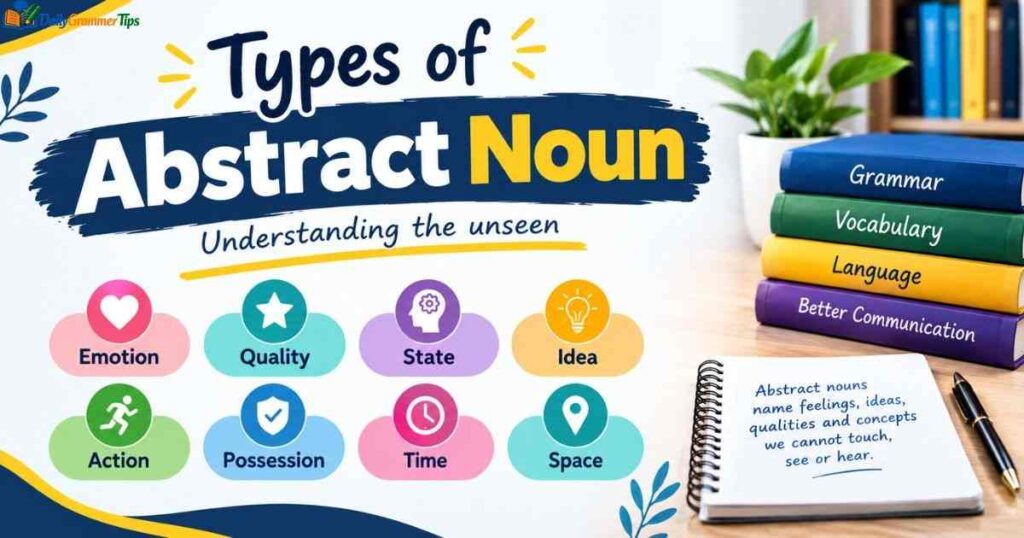
These nouns fall into several groups. Each group helps you see the topic from a new angle. You do not need to memorize the groups. You only need to understand them.
Emotions and Feelings
This group describes how people feel inside. Strong feelings often get their own word.
- Positive feelings: joy, delight, pride, relief, hope, excitement, love
- Negative feelings: anger, fear, sadness, envy, shame, grief, anxiety
- Mixed feelings: surprise, nostalgia, confusion, curiosity
Example: Her excitement filled the room.
Qualities and Character Traits
This group describes the nature of a person. Writers use these words to show character.
- Good traits: honesty, kindness, patience, generosity, bravery, humility
- Weak traits: laziness, greed, cruelty, arrogance, selfishness
- Mental traits: intelligence, wisdom, creativity, curiosity
Example: His patience impressed the whole team.
Ideas and Concepts
This group names thoughts, beliefs, and systems. These words shape politics, religion, and philosophy.
- Social ideas: freedom, justice, equality, democracy, peace
- Moral ideas: honor, duty, virtue, mercy, faith
- Thinking ideas: truth, reason, logic, theory, opinion
Example: Equality remains a goal for many nations.
States and Conditions
This group describes a situation in life. A state can last for a short time or a long time.
- Life stages: childhood, youth, adulthood, old age
- Physical states: health, hunger, sleep, weakness, strength
- Social states: poverty, wealth, slavery, freedom, friendship
Example: Poverty forces many families to make hard choices.
Events and Actions
Some idea words name a process or an event. You cannot touch the event itself, even if you can see the people in it.
- Events: celebration, war, election, meeting, journey
- Actions: decision, movement, discussion, arrival, departure
Example: The discussion lasted two hours.
Values and Beliefs
This group describes what people hold dear. Families, schools, and cultures teach these words.
- Values: respect, loyalty, honesty, integrity, trust
- Beliefs: religion, superstition, tradition, destiny
Example: Trust takes years to build and seconds to break.
Time and Measure
Some words describe time or quantity in an idea form.
- Time words: past, future, history, moment, eternity
- Measure words: length, height, weight, speed, depth
Example: Time heals many wounds.
Countable and Uncountable Abstract Nouns
Most idea words have no plural form. English treats them as one whole idea. You cannot count courage the way you count apples.
Uncountable Examples
- She showed great courage.
- He gave me good advice.
- We need more information.
- They found peace at last.
You do not say courages, advices, or informations in standard English.
Countable Examples
A few idea words have both a singular and a plural form. These words name separate cases of an idea.
- one idea, two ideas
- one dream, many dreams
- one fear, several fears
- one hope, countless hopes
- one decision, three decisions
A Helpful Tip
If you can put a number before the word, treat it as countable. If a number sounds strange, treat it as uncountable. You can say three decisions. You cannot say three honesties.
How to Form an Abstract Noun
You can build new abstract nouns from other words. English gives you three main sources. You can start with adjectives, verbs, or common nouns.
From Adjectives
Many adjectives turn into an abstract noun with a small change.
- kind becomes kindness
- brave becomes bravery
- able becomes ability
- wise becomes wisdom
- long becomes length
- strong becomes strength
- proud becomes pride
- true becomes truth
- deep becomes depth
- young becomes youth
From Verbs
Writers form an abstract noun from verbs very often.
- decide becomes decision
- move becomes movement
- believe becomes belief
- grow becomes growth
- achieve becomes achievement
- refuse becomes refusal
- arrive becomes arrival
- discuss becomes discussion
- fail becomes failure
- choose becomes choice
From Common Nouns
Some common nouns also turn into abstract ones.
- friend becomes friendship
- child becomes childhood
- hero becomes heroism
- king becomes kingdom
- member becomes membership
- neighbor becomes neighborhood
Common Suffixes
Suffixes give you a fast way to spot these words. The table below lists the most useful endings.
| Suffix | Example | Meaning of the Result |
| ness | happiness | a state or quality |
| ity | honesty | a state or quality |
| ment | achievement | an action or result |
| tion | decision | an action or process |
| ship | friendship | a relationship or skill |
| hood | childhood | a stage or condition |
| dom | freedom | a state or realm |
| ism | heroism | a belief or practice |
| ance | importance | a state or action |
| ence | patience | a state or quality |
| th | growth | a process or result |
| ure | failure | an action or result |
Spelling Changes
Some words change their spelling when you add a suffix. Watch for these patterns.
- A final y often becomes i before ness, as in happy and happiness.
- A final e often disappears before ment, as in judge and judgment.
- Some verbs change more, as in succeed and success.
Always check a dictionary when you feel unsure.
Rules for Using an Abstract Noun
Good grammar needs clear rules. Follow these rules and your sentences will sound natural.
Rule 1: Treat Most Words as Uncountable
Most of these nouns have no plural form. You say, “She has courage.” You do not say, “She has many courages.” A few words, such as dreams, fears, and hopes, can take a plural form. Even then, they keep their idea meaning.
Rule 2: Use a Singular Verb
An uncountable abstract noun takes a singular verb. For example, “Honesty matters” sounds correct. “Honesty matter” sounds wrong.
Rule 3: Use Lowercase Letters
You write an abstract noun in lowercase. You use a capital letter only when the word starts a sentence. You also use a capital letter when the word appears in a title.
Rule 4: Choose the Right Article
Use “the” when you talk about a specific idea. For example, “The honesty of the boy impressed everyone.” Skip the article when you talk about the idea in general. For example, “Honesty builds trust.”
Rule 5: Pick the Right Preposition
Some abstract nouns pair with fixed prepositions. Learn these pairs as chunks.
- interest in music
- fear of failure
- belief in destiny
- respect for elders
- need for change
- reason for delay
Rule 6: Avoid Vague Use
Do not stack too many idea words in one sentence. Readers lose focus. Add a concrete example when the idea feels heavy.
Roles of an Abstract Noun in a Sentence
An abstract noun can play many roles. It works like any other noun.
As a Subject
The subject performs the action or holds the state. Example: Freedom inspires people.
As an Object
The object receives the action. Example: The team admired her courage.
As a Complement
The complement completes the meaning of the verb. Example: Her biggest strength is patience.
After a Preposition
Many sentences place the word after a preposition. Example: He spoke with great confidence.
As a Possessive
You can make the word show ownership. Example: Honesty’s reward is trust.
Abstract Noun Examples in Sentences
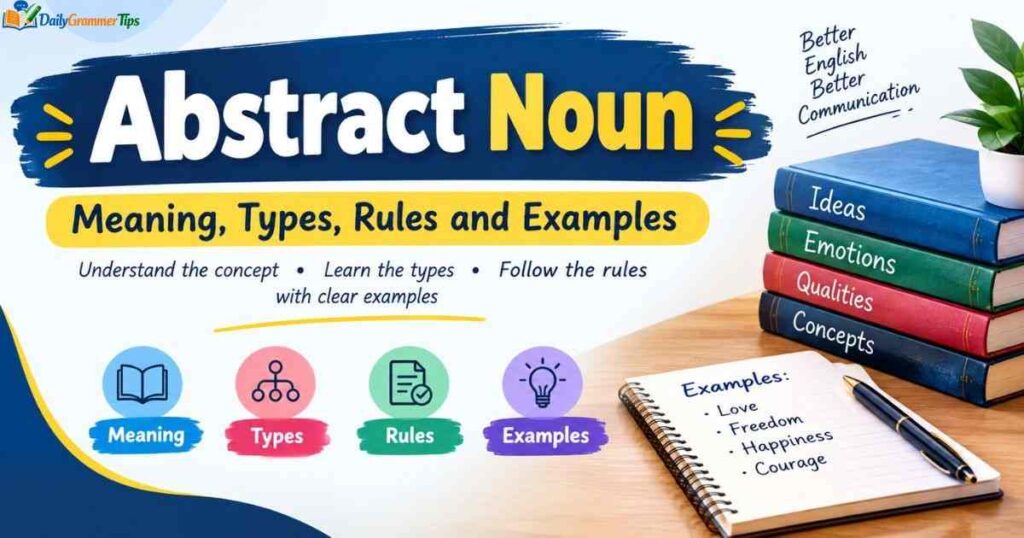
Examples teach faster than rules. Read each sentence and find the idea word.
Read more: Transitional Words: Powerful Tools That Fix Choppy, Confusing Writing
Examples with Emotions
- Her joy lit up the party.
- Fear stopped him from speaking.
- The child felt great excitement before the trip.
- Grief filled the house after the news.
- His anger cooled after a short walk.
Examples with Qualities
- Her honesty won everyone’s trust.
- The soldier showed bravery under pressure.
- Kindness costs nothing.
- The teacher admired his curiosity.
- Wisdom comes with age and experience.
Examples with Ideas
- Freedom gives people choice.
- Justice protects the weak.
- The country celebrated its independence.
- Peace needs effort from every side.
- Truth always finds a way out.
Examples with States
- Poverty limits many children.
- Good health gives you energy.
- Friendship makes life sweeter.
- His childhood shaped his dreams.
- Sleep helps your brain recover.
Abstract Noun vs Other Noun Types
English has many noun types. Some overlap with this topic. A clear view helps you avoid confusion.
Common Noun
A common noun names a general person, place, or thing. Examples include city, doctor, and book. A common noun can be concrete or abstract.
Proper Noun
A proper noun names a specific person, place, or thing. Examples include Pakistan, Ali, and Lahore. A proper noun starts with a capital letter. Most proper nouns are concrete.
Collective Noun
A collective noun names a group. Examples include team, family, and crowd. You can see the group, so it is usually concrete.
Material Noun
A material noun names a substance. Examples include gold, water, and wood. You can touch these substances, so they are concrete.
Compound Noun
A compound noun joins two words. Some compounds are abstract. Examples include childhood memories, self confidence, and brainstorming.
Abstract Noun in Daily Life
You meet these words everywhere. They fill your talks, your news, and your prayers.
In Conversation
People say, “I need some peace.” They say, “Show some respect.” They say, “I have no time.” Each sentence uses an idea word.
In News and Media
Reporters use these words to describe public issues. Common examples include inflation, unemployment, education, security, and corruption. Headlines depend on them.
In Education
Schools teach values such as discipline, honesty, and responsibility. Teachers also talk about knowledge, progress, and success. These words guide student behavior.
In Religion and Culture
Every culture has words for faith, mercy, charity, and gratitude. Religious texts and folk stories use them heavily. They carry shared meaning across generations.
In Business
Managers talk about growth, profit, trust, quality, and leadership. A company builds its brand on these ideas. Job interviews also test them.
Abstract Noun in Literature and Poetry
Poets love the abstract noun. It lets them speak about big themes in a few words. A poem can explore love, death, time, and hope without naming one object.
Novelists use these words to build themes. A story about ambition shows a hero who wants more. A story about betrayal shows a broken promise. The word names the idea, and the plot brings it to life.
Writers often give an abstract noun a human face. Teachers call this technique personification. For example, a writer may say, “Time walks slowly.” Time cannot walk. The writer gives it a human action to make the idea vivid.
Common Mistakes with the Abstract Noun
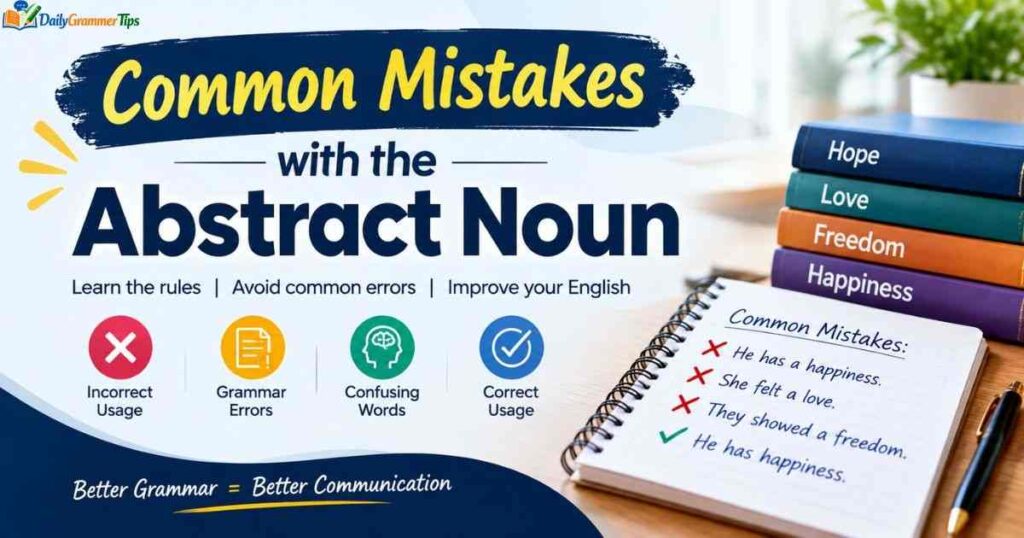
Learners make the same errors again and again. Knowing them helps you avoid them.
- Many learners confuse an abstract noun with an adjective. They write “brave” when they need “bravery.”
- Some students add an s to every idea word. Most of these words stay singular.
- Others use capital letters without reason.
- Some writers use a plural verb with an uncountable word.
- Many learners choose the wrong suffix. They write “kindity” instead of “kindness.”
- Some writers forget that the word needs a clear meaning in the sentence.
Wrong and Right Examples
| Wrong | Right |
| She has many courages. | She has great courage. |
| He gave me many advices. | He gave me good advice. |
| The Honesty is important. | Honesty is important. |
| Her brave impressed us. | Her bravery impressed us. |
| Informations are useful. | Information is useful. |
Alphabetical List of Idea Words
A long list helps you see how many of these words exist. Read each group and add your own examples.
- A: ability, ambition, anger, anxiety
- B: beauty, belief, bravery, boredom
- C: courage, curiosity, comfort, confidence
- D: democracy, devotion, discipline, doubt
- E: education, envy, equality, excitement
- F: faith, fear, freedom, friendship
- G: generosity, gratitude, grief, growth
- H: happiness, health, honesty, hope
- I: independence, innocence, intelligence, imagination
- J: jealousy, joy, justice, judgment
- K: kindness, knowledge, kinship, karma
- L: laughter, loyalty, loneliness, leadership
- M: memory, mercy, motivation, misery
- N: nature, necessity, nostalgia, nonsense
- O: obedience, opportunity, optimism, order
- P: patience, peace, pride, poverty
- Q: quality, quiet, quarrel, quest
- R: respect, responsibility, relief, reality
- S: sadness, safety, silence, success
- T: trust, truth, talent, tradition
- U: unity, understanding, uncertainty, urgency
- V: victory, virtue, vision, violence
- W: wealth, wisdom, worry, welfare
- Y: youth, yearning
- Z: zeal, zest
You can reach 100 words very fast with this list.
Opposite Pairs of Idea Words
Many of these words come in pairs. Each pair shows two sides of the same topic. Pairs also help you remember new vocabulary.
| Positive Word | Negative Word |
| love | hatred |
| honesty | dishonesty |
| courage | cowardice |
| freedom | slavery |
| peace | war |
| wealth | poverty |
| success | failure |
| trust | doubt |
| generosity | greed |
| knowledge | ignorance |
Notice how each pair changes the tone of a sentence. “Courage saved the village” sounds hopeful. “Cowardice ruined the plan” sounds sad.
Related Terms You Should Know
Grammar books use several terms that sit close to this topic. Knowing them helps you read and write with more confidence.
Intangible Noun
Some teachers say intangible noun instead. Intangible means you cannot touch it. The meaning stays the same.
Concept and Notion
A concept is a clear idea in the mind. A notion is a loose or early idea. Both words describe thought, so both often act as idea words themselves.
Quality and Trait
A quality is a feature that makes someone or something special. A trait is a quality that belongs to a person. Writers use both terms when they talk about character.
State and Condition
A state describes how something exists at a given time. A condition describes the situation around it. Health and poverty fit both terms.
Emotion and Sentiment
An emotion is a feeling that rises inside you. A sentiment is a settled view or feeling. Poets use both words to describe the heart.
Verbs and Adjectives That Pair with Idea Words
Native speakers choose natural word partners. Teachers call these partners collocations. Learn them in groups, and your English will sound smooth.
Common Verb Partners
- show courage
- express gratitude
- face fear
- gain confidence
- lose hope
- build trust
- keep peace
- seek justice
- feel pride
- take responsibility
- earn respect
- spread kindness
Common Adjective Partners
- great courage
- deep sorrow
- true friendship
- sincere apology
- pure joy
- blind faith
- heavy silence
- sweet success
- bitter disappointment
- sudden fear
- constant worry
- real happiness
Why Collocations Matter
A wrong partner sounds odd to a native ear. You say “make a decision,” not “do a decision.” You say “pay attention,” not “give attention” in most cases. Practice the right pairs, and your writing will flow.
How to Write Better Sentences with Idea Words
Idea words add depth, but they can also make writing vague. Use these tips to keep your sentences clear and strong.
Tip 1: Add a Concrete Detail
A concrete detail makes an idea real. Compare two sentences.
- Weak: She felt sadness.
- Strong: Sadness weighed on her as she packed her old books.
The second sentence shows the feeling through a scene.
Tip 2: Keep the Subject Active
Let the idea word act. Write “Fear gripped him” and let the idea word lead. Active sentences feel faster and cleaner.
Tip 3: Choose Specific Words
Pick the exact word for the feeling. Do not write “bad feeling” when you mean jealousy, shame, or regret. Precise words give your reader a clear picture.
Tip 4: Avoid Piling Up Ideas
Do not write, “The importance of the development of the education of children matters.” Break it into short parts. Write, “Education matters. It helps children grow.”
Tip 5: Use Examples and Stories
Back every big idea with a small story. A reader remembers a story longer than a definition. A short example turns courage from a word into a picture.
Idea Words in Urdu and English
Many learners speak Urdu at home and study English at school. Comparing both languages makes learning easier. Urdu also has a rich set of idea words.
| English Word | Urdu Word (Roman) |
| love | mohabbat |
| truth | sach |
| honesty | imaandari |
| courage | himmat |
| patience | sabar |
| peace | aman |
| knowledge | ilm |
| kindness | meherbani |
| justice | insaaf |
| freedom | azaadi |
You can see that both languages name feelings and values in the same way. When you learn a new English idea word, try to find the Urdu word as well. This habit builds a strong mental link.
Frequently Confused Pairs
Some idea words look like their verb or adjective partners. Learners often swap them by mistake. Study these pairs carefully.
| Noun | Verb or Adjective | Example |
| advice | advise | She gave me advice. She will advise me. |
| belief | believe | His belief is strong. I believe him. |
| choice | choose | The choice was easy. We choose a name. |
| success | succeed | Success needs effort. You can succeed. |
| proof | prove | The proof is clear. Scientists prove facts. |
| speech | speak | His speech moved us. He will speak today. |
| death | die | Death comes to all. Plants die without water. |
Remember the pattern. The noun names the idea. The verb or adjective shows action or description.
Short Model Paragraphs
Reading models helps you write your own work. Study these two short paragraphs. Each one uses several idea words.
Model Paragraph One
Kindness changes lives. A small act of generosity can bring joy to a stranger. It also builds trust in a community. When people show respect for each other, peace grows. Every family needs this gift, and every school should teach it.
Model Paragraph Two
Success demands discipline and patience. A student who shows determination rarely loses hope. Failure teaches wisdom, and wisdom builds confidence. With enough effort, ambition turns into achievement. Anyone can follow this path.
Your Turn
Write your own paragraph about friendship, honesty, or freedom. Use at least five idea words. Keep your sentences short and your verbs active.
Practice Exercises
Practice builds skill. Try these tasks before you read the answers.
Exercise 1: Find the Abstract Noun
Pick the abstract noun in each sentence.
- The girl showed great courage.
- The table stood near the window.
- His laughter filled the hall.
- We need more patience.
- The river crossed the village.
Exercise 2: Form the Noun
Change each word into an abstract noun.
- wise
- decide
- friend
- strong
- believe
Exercise 3: Complete the Sentence
Fill each gap with a word from the box: honesty, freedom, fear, success, kindness.
- Hard work leads to ______.
- ______ builds trust between people.
- ______ of the dark kept him awake.
- The prisoners longed for ______.
- A smile shows ______.
Answers
- Exercise 1: courage, patience, laughter. Sentences 2 and 5 hold only concrete nouns.
- Exercise 2: wisdom, decision, friendship, strength, belief.
- Exercise 3: success, honesty, fear, freedom, kindness.
How to Teach the Abstract Noun to Kids
Children learn best through play. Abstract ideas feel hard to young minds, so you must make them visible. Start with simple steps.
Step by Step Method
- Show a ball and a smile. Ask which one you can touch.
- Explain that an idea word names a feeling or a thought.
- Ask kids to name feelings from their day.
- Play a sorting game with two boxes. Label one “touch” and one “feel.”
- Praise every correct answer to build confidence.
Fun Classroom Activities
- Feeling faces: Draw happy, sad, and angry faces. Ask kids to name each feeling.
- Story time: Read a short story. Ask kids to find the idea words.
- Word hunt: Give kids a page of text. Ask them to circle every idea word.
- Charades: Let kids act out joy, fear, or surprise. The class guesses the word.
Tips for Parents
Parents can teach this topic at home. Talk about feelings during meals. Ask, “What made you proud today?” Praise your child for kindness. Name the idea word each time.
Kids enjoy this method. They quickly learn to spot an abstract noun in stories.
Using Idea Words in Essays
Essays depend on idea words. A good essay states a clear idea, explains it, and supports it with proof. Idea words give you the labels for your main points.
Choose a Strong Theme Word
Pick one theme word for your essay. Words like education, honesty, or technology work well. Say the word in your title and in your first paragraph. Return to it in each body paragraph.
Support Each Idea with Evidence
A theme word alone does not convince a reader. Add a fact, a story, or an example. If you write about discipline, describe a student who wakes at five every morning. The example gives the word weight.
Link Ideas with Transitions
Use short linking phrases to connect your points. Phrases such as “for example,” “as a result,” and “in contrast” guide the reader. They also keep your sentences short and clear.
Close with a Clear Message
End your essay with a final idea word that sums up your message. A line such as “Hard work builds success” leaves a strong impression.
Using Idea Words in Speaking and Interviews
You also need these words when you speak. Interviewers ask about your strengths, goals, and values. Your answers need idea words to sound confident.
Talking about Strengths
Say, “My greatest strength is patience.” Then give a short example. This approach shows honesty and skill at once.
Talking about Goals
Say, “My goal is growth in my career.” Add one clear step you plan to take. Employers respect ambition that comes with a plan.
Talking about Values
Say, “I value teamwork and respect.” Explain how you showed these values in a past job or project. A real story beats a long list.
Keep Your Voice Natural
Do not stuff your speech with big words. Short and simple choices sound sincere. Listeners trust speakers who sound natural.
Quick Check: True or False

Test your understanding with these five statements. Decide whether each one is true or false.
- You can touch an idea word.
- Most idea words have no plural form.
- The word happiness is a concrete noun.
- The suffix ness often signals an idea word.
- A proper noun always starts with a capital letter.
Answers
- False. You cannot touch an idea word.
- True. Most of these words stay singular.
- False. Happiness is an idea, so it is abstract.
- True. Ness builds words like kindness and sadness.
- True. Proper nouns always take a capital letter.
Tips to Build Your Vocabulary
A strong vocabulary needs daily habits. Use these tips to grow your word list.
- Read short stories and news articles every day.
- Underline each idea word you meet.
- Write one sentence for each new word.
- Keep a small notebook for new words.
- Learn the suffix patterns from the table above.
- Use new words in your speech within one day.
- Review your list every weekend.
Over time, these habits make idea words feel natural.
Frequently Asked Questions
What are the 20 abstract nouns?
Love, hate, joy, anger, fear, hope, freedom, honesty, courage, peace, trust, beauty, wisdom, kindness, justice, truth, pride, envy, loyalty, and patience.
What is an abstract nouns?
An abstract noun is a word that names an idea, feeling, quality, or state that you cannot see, touch, hear, taste, or smell. You only feel it or think about it.
What are 100 abstract nouns?
Start with those 50 words. Then add words with endings like ness, ity, ment, tion, and ship until you reach 100.
How to explain abstract nouns to kids?
Tell kids that abstract nouns name feelings and ideas they cannot touch. Compare a toy, which they can hold, with happiness, which they can only feel.
Can you give me 30 examples of abstract nouns?
Happiness, sadness, friendship, bravery, childhood, success, failure, knowledge, health, poverty, wealth, power, luck, laughter, loneliness, curiosity, devotion, democracy, intelligence, jealousy, generosity, creativity, strength, comfort, darkness, silence, anxiety, ambition, innocence, and discipline.
Conclusion
The abstract noun gives language its emotional power. It names love, truth, freedom, and every idea you cannot hold in your hand. You now know its meaning, types, and rules, and you can tell it apart from a concrete noun.
Practice the abstract noun in daily sentences and short stories. Form new words from adjectives, verbs, and common nouns. Soon you will spot every abstract noun with ease and use it with confidence.
