

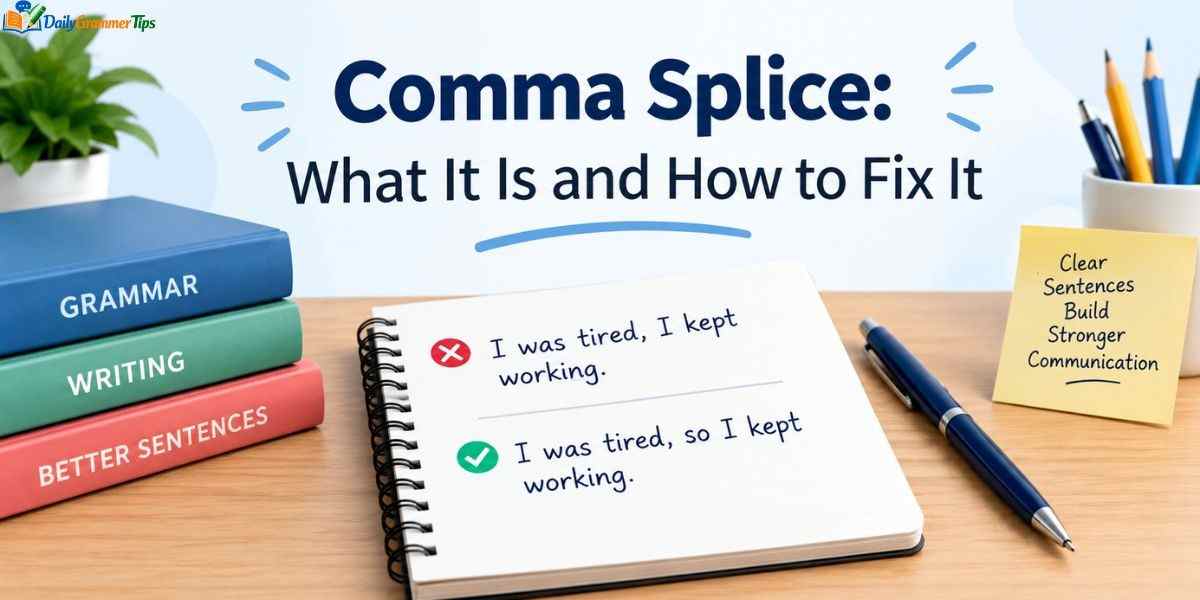
A comma splice is a common punctuation error. It happens when two complete sentences are joined with only a comma. The mistake looks small, but readers notice it quickly. Fixing a comma splice makes your writing clearer, cleaner, and more professional in school, at work, and online.
This guide explains the error in plain language. You will learn how to spot it, why it happens, and how to fix it in several ways. You will also see when it is acceptable. Each section is short and practical, so you can use the advice right away.
What Is a Comma Splice?
A comma splice joins two sentences that should stand apart. The comma is too weak to hold them together. To understand a comma splice, you first need to know what makes a sentence complete. The next sections explain the idea step by step, using simple terms.
Simple Definition of a Comma Splice
A comma splice occurs when a comma alone joins two independent clauses. An independent clause is a group of words that can stand alone as a sentence. Here is a simple case: “The rain stopped, we went outside.” Both parts are complete, so the comma is not enough.
The error has other names. Some teachers call it a comma fault or a comma blunder. The meaning is the same in each case. Two full sentences sit side by side with a comma between them, and that punctuation mark is too light for the job.
Independent Clauses Explained
An independent clause has a subject and a verb, and it expresses a complete thought. “She called” is complete. “Because she called” is not complete. Knowing this difference is the key to spotting a comma splice, since the error only appears when both sides are independent.
A dependent clause cannot stand alone. It needs another clause to finish its meaning. Words like because, although, and when often start dependent clauses. A comma can safely follow such a clause, so no error appears. The trouble starts only when both clauses are complete.
Why It Is Called a Splice
To splice means to join two pieces together, as in joining two ropes or two strips of film. In writing, a splice joins two sentences. The comma acts like weak tape. It is not strong enough to hold two complete thoughts in place. That is the idea behind the term comma splice.
Strong joins need stronger tools. A period, a semicolon, or a conjunction can do the job. Each one gives the reader a clear signal about where one idea ends and the next begins. We cover all these tools in the fixing section later in this guide.
Comma Splice vs. Fused Sentence
A fused sentence joins two independent clauses with no punctuation at all. A comma splice joins them with a comma only. Both are errors, and both are often called run-on sentences. The difference lies in the mark between the clauses, or in the lack of any mark.
Some guides use run-on sentence as a broad label for both errors. Others reserve it for fused sentences. If your teacher or editor uses a specific term, follow it. The repair is usually the same, because both problems need a stronger link between the two clauses.
Why a Comma Splice Happens
Most writers know the basic rules, yet the error still appears. It often comes from habits, not from a lack of knowledge. Understanding the causes helps you catch a comma splice early. The sections below describe the most common reasons that writers fall into this trap.
Writing the Way We Speak
In speech, we pause between ideas and keep talking. Our voice carries the link. On paper, the voice is gone, and punctuation must do the work. A comma feels like a natural pause, so writers use it where a stronger mark is needed.
Reading your draft aloud can mislead you for the same reason. Your voice fills the gap, so the sentence sounds fine. The reader has only the page. That is why a comma splice often hides in writing that sounds smooth when spoken.
Thinking a Comma Marks Every Pause
Many learners were taught that a comma means a pause. This advice is only partly true. Commas do mark some pauses, but they also follow strict rules. Using a comma for every pause leads to errors, including the comma splice, because pauses and sentence boundaries are not the same thing.
A better habit is to ask a different question. Ask whether the words on each side of the comma can stand alone. If they can, the comma is the wrong mark. This small shift in thinking prevents many mistakes and builds stronger control over punctuation.
Misusing Transition Words
Words like however, therefore, and moreover seem to connect sentences. Writers often place a comma before them and assume the link is complete. It is not. These words are adverbs, not conjunctions, so they cannot join two sentences without help. This habit creates a comma splice in many drafts.
We look at these words in detail later. For now, remember one point. A transition word shows a relationship between ideas. It does not act as glue. The glue must come from a period, a semicolon, or a true conjunction placed in the right spot.
Rushing Through Revision
Speed is a quiet cause of errors. When you write quickly, you focus on ideas, not punctuation. Your mind races ahead, and small marks slip through. Many writers fix grammar only at the very end, or skip the step entirely when a deadline is close.
Short, focused editing rounds work better. Check punctuation in its own pass, apart from content. This habit takes only a few minutes. It also makes each comma splice stand out, because your attention is on the marks and not on the message.
How to Spot a Comma Splice
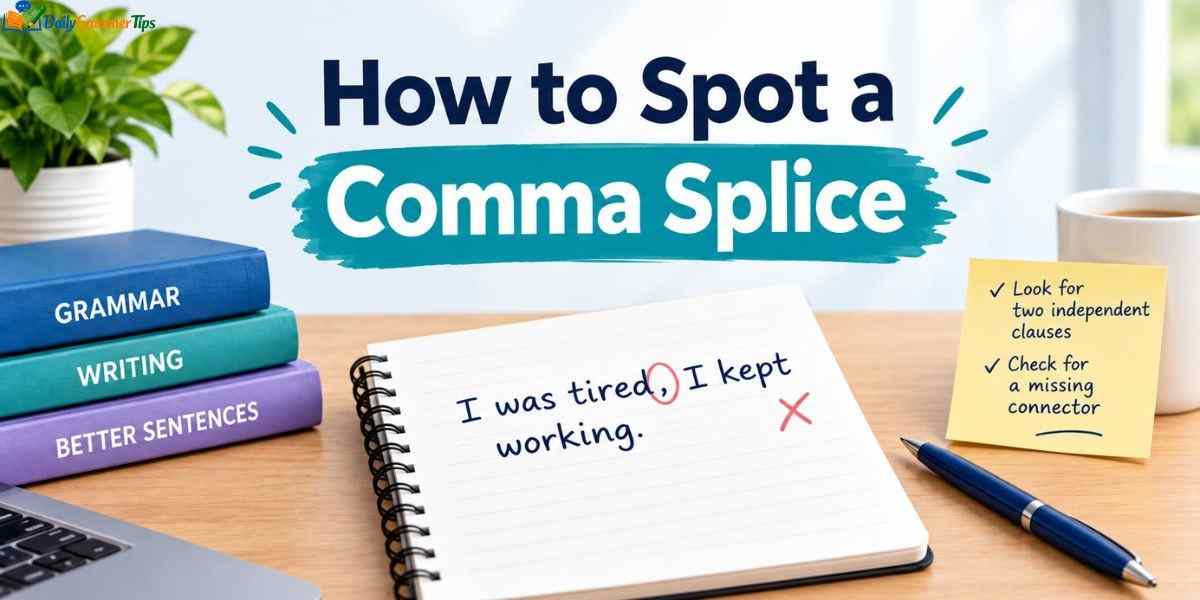
Spotting the error is the first step toward fixing it. A few simple tests will help. Each test takes only seconds. Use them together for the best results, especially when you edit your own writing. Practice makes the process feel natural, and soon you will spot a comma splice at a glance.
The Period Test
Replace the comma with a period. Then read the two parts. If both parts sound like complete sentences, you have found a comma splice. If one part feels unfinished, the comma is probably fine. This is the quickest and most reliable test available to any writer.
Try it on “The store closed, we went home.” After a period, both parts stand alone, so the sentence has the error. Now try “When the store closed, we went home.” The first part is incomplete, so the sentence is correct. The test shows the difference in seconds.
Check for a Subject and Verb on Each Side
Look at the words before the comma. Find the subject and the verb. Then look at the words after the comma and do the same. If both sides have a subject and a verb and can stand alone, the comma cannot hold them together.
Be careful with subjects that are hidden or short. A command like “Stop” has an understood subject. Also, a sentence with a long introduction can hide the main clause. Slow down and read each side closely. Patient checking reveals a comma splice even in long sentences.
Watch the Words After the Comma
Certain words often signal trouble. Pronouns such as it, he, she, they, this, and that often begin a new independent clause. When one follows a comma, check the sentence carefully. These small words are strong clues that a second full sentence has begun.
Transition words are another clue. Look for however, therefore, moreover, then, and also right after a comma. If a full clause follows, you likely have a comma splice. Keep a short list of these trigger words near your desk and scan for them during editing.
Read the Sentence Aloud
Reading aloud helps in a different way. Read slowly and mark where you pause. If you stop fully at the comma, as you would at the end of a sentence, the mark may be too weak. Your voice often shows where a period belongs.
This method works best when you read exactly what is on the page. Do not add extra pauses. Try reading each draft once on paper or in a different font. A fresh view helps you notice a comma splice that your eyes passed over earlier.
Use Grammar Tools With Care
Grammar checkers can flag many errors. They often underline a comma splice and suggest a fix. These tools save time, especially on long documents. Use them as a first filter, not as a final judge, because their suggestions are not always right.
A tool does not know your intent. It may miss an error or flag a correct sentence. Always read each suggestion and decide for yourself. Learning the rules gives you control that no software can replace, and it makes you a faster and more confident editor.
Ways to Fix a Comma Splice
A comma splice has several cures. Each one creates a slightly different effect. The best choice depends on the meaning and rhythm you want. The sections below explain each method with a clear example. We use one simple sentence, “The rain stopped, we went outside,” to show how the changes work.
Use a Period
The simplest fix is a period. Split the two clauses into two sentences. For example, “The rain stopped. We went outside.” This method is clean and clear. It works well when the ideas are only loosely related or when you want a strong pause between them.
Do not worry if the sentences feel short. Short sentences are easy to read, and they give writing a steady pace. A series of very short sentences can feel choppy, so mix in some longer ones. A period is the safest fix for a comma splice.
Use a Semicolon
A semicolon joins two closely related independent clauses. Write “The rain stopped; we went outside.” The semicolon shows that the ideas belong together while keeping each clause complete. It is a good fix when the second clause continues the thought of the first.
Use semicolons sparingly. Too many can make writing feel stiff. Also, do not capitalize the word after a semicolon unless it is a proper noun. This simple repair turns a comma splice into a correct sentence with only one small change.
Add a Coordinating Conjunction
A coordinating conjunction can join the clauses after a comma. The seven options are for, and, nor, but, or, yet, and so. Write “The rain stopped, so we went outside.” The conjunction states the relationship, and the comma before it is now correct.
Choose the conjunction that fits your meaning. And adds, but contrasts, so shows result, and or offers a choice. A wrong choice can change your message. The memory aid FANBOYS helps you recall all seven. Used correctly, a conjunction cleanly fixes a comma splice.
Use a Subordinating Conjunction
A subordinating conjunction turns one clause into a dependent clause. Words like because, although, after, when, and if do this job. Write “After the rain stopped, we went outside.” The sentence now has one main idea and one supporting idea, which gives it a smoother flow.
Place a comma after the dependent clause when it comes first. When it comes second, you usually need no comma, as in “We went outside after the rain stopped.” This method shows the link between ideas clearly and makes your writing sound more mature.
Use a Colon or a Dash
A colon works when the second clause explains or expands the first. Write “She had one goal: she wanted to win.” The colon points forward to the explanation. A dash can do a similar job in a less formal way, adding emphasis or a slight surprise.
Do not force this fix. It suits only certain relationships between clauses. The second clause must clarify the first. If it does not, choose another method. Used well, a colon or dash fixes a comma splice while adding style to the sentence.
Combine the Clauses
Sometimes the best fix is a rewrite. Turn one clause into a phrase and join the ideas into a single clause. For example, “We went outside once the rain ended” says the same thing as the original, but in one smooth clause. The new form is shorter and cleaner.
This method takes more effort. It also gives the best results in polished writing. You remove wordiness and show a clear relationship between the ideas. Consider it when several short sentences in a row feel flat or when a comma splice appears in an important document.
Choosing the Best Fix
With so many options, how do you choose? Start with the meaning. If the ideas are separate, use a period. If they are closely linked, use a semicolon. If the second idea adds a reason or result, use a conjunction. Each choice sends a different signal to the reader.
Also think about rhythm. Read the repaired sentence aloud. Does it flow well in the paragraph? Try two fixes and compare them. The best repair for a comma splice is the one that makes your meaning clearest and your paragraph easiest to read.
Comma Splice With Transition Words
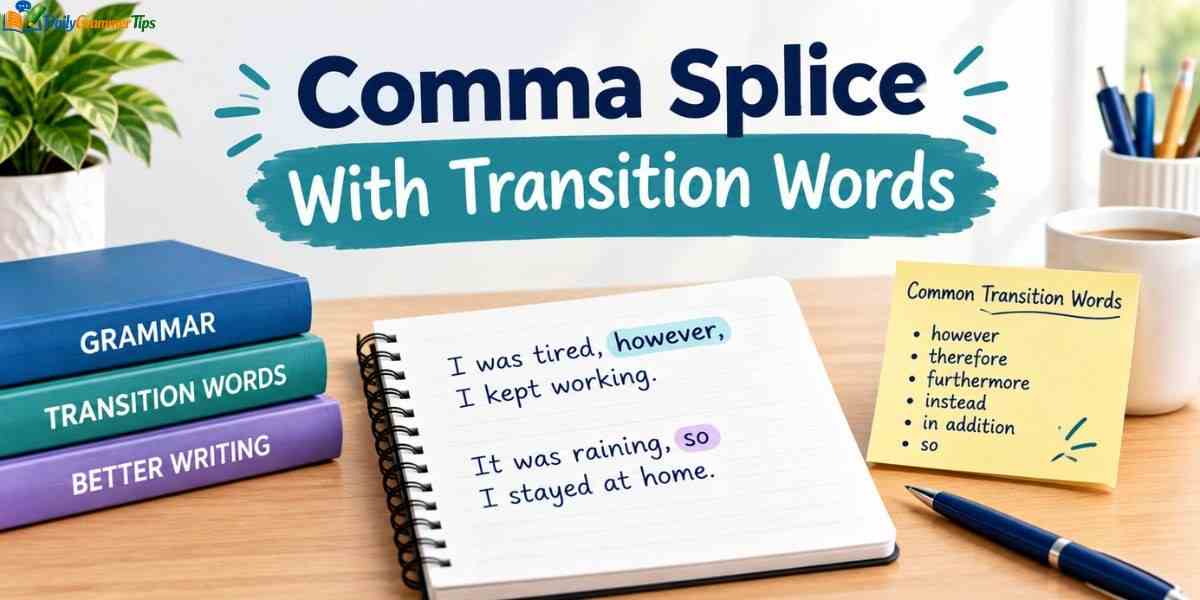
Transition words cause more trouble than most other groups of words. They look like conjunctions, but they are not. Learning how they work will remove a large share of the errors in your writing. The next sections cover each group and give simple patterns to follow when a comma splice threatens.
Conjunctive Adverbs
Conjunctive adverbs include however, therefore, moreover, furthermore, consequently, nevertheless, and thus. They show a relationship between ideas, such as contrast or result. They cannot join two clauses on their own. A comma before them creates a comma splice, as in “It was late, however, we stayed.”
The fix uses a semicolon before the word and a comma after it. Write “It was late; however, we stayed.” You can also use a period and start a new sentence with “However.” Both repairs make the relationship clear and remove the error from your sentence.
Transitional Phrases
Transitional phrases act like conjunctive adverbs. Examples include for example, in fact, as a result, on the other hand, and in addition. They also cannot join two independent clauses with a comma alone. Writers often use them to sound academic, which makes the error more likely.
The repair is the same. Use a semicolon or a period before the phrase, and place a comma after it. This pattern gives your writing a polished look. It also protects you from a comma splice in reports, essays, and formal emails where transitions appear often.
Learn more…………..Capitalization Rules for Job Titles: When to Use Them
Trouble Words Such as Then and Also
Some words are easy to overlook. Then, also, instead, and otherwise often follow a comma in careless drafts. Most style guides treat them like conjunctive adverbs. This means a comma before them, followed by a full clause, creates the same error.
Fix these cases with a period, a semicolon, or a conjunction such as and. You can also rewrite the sentence so that one verb carries both actions. Keep an eye out for these small words. They hide a comma splice more often than writers expect.
The Semicolon and Comma Pattern
A reliable pattern can help you handle all these words. Put a semicolon before the transition, then place a comma after it. This pattern works for conjunctive adverbs and for transitional phrases. Practice it until it feels natural, and you will rarely make this error again.
Remember that the pattern needs two complete clauses. If the second part is not a full clause, a semicolon is wrong. In that case, a simple comma may work. Check both sides first. The check keeps you from swapping a comma splice for a semicolon error.
When a Comma Splice Is Acceptable
Rules have exceptions. Some writers use a comma splice on purpose, and some style guides allow it in limited cases. Still, it is risky. Knowing when it is acceptable helps you decide wisely. The following sections explain the main situations and the cautions that come with each one.
Short Parallel Clauses in a Series
Many guides allow commas between very short, parallel clauses in a series. A famous example is “I came, I saw, I conquered.” The clauses are brief and share the same structure, so the commas create rhythm. Three or more clauses work best.
Even here, caution is wise. Some teachers and editors still mark this pattern as a comma splice. If you are not sure, use a semicolon or a period. When the rules of your guide are unclear, the safest path is always the standard one.
Creative and Informal Writing
Fiction writers and poets sometimes use comma splices for style. The comma can create a fast, breathless voice, or a casual tone that sounds like real speech. Skilled authors do this with care, and always with a clear purpose in mind.
Informal writing, such as text messages, also tolerates this pattern. Readers rarely mind. Still, the choice should be deliberate. If you break a rule, know that you are breaking it. A deliberate comma splice is a style choice, while an accidental one is just an error.
Why Formal Writing Avoids It
Formal writing values clarity and precision. A comma splice blurs the boundary between ideas, and readers must work harder to follow your logic. Teachers, editors, and employers often treat the error as a sign of carelessness, even when the content is strong.
For this reason, most academic and professional guides advise against it. News organizations and publishers also expect clean sentences. If your work will be graded, published, or sent to a client, repair every comma splice. The extra effort protects your credibility.
Know Your Audience
The right choice depends on your reader. A teacher grading an essay expects standard punctuation. A friend reading a text does not. A novel’s readers may enjoy a stylish break. Think about who will read your work and what they expect from it.
When you are unsure, follow the standard rule. It is accepted everywhere, and it never costs you credibility. Break the rule only when you have a clear reason and a trusted audience. Good writers treat a comma splice as a tool to use rarely and with care.
Comma Splice in Different Types of Writing
The error appears in every kind of writing. The stakes, however, differ from one setting to another. This section looks at several common settings and gives practical advice for each. Use it to adjust your editing habits to the document in front of you and to prevent a comma splice where it matters most.
Academic Essays
Academic essays demand precise punctuation. Long sentences and complex ideas make errors more likely. A single comma splice can cost marks and distract your reader from your argument. Teachers often highlight the error because it points to unclear thinking about sentence structure.
Edit each essay in a separate punctuation pass. Look especially at transitions between ideas, since these are the riskiest spots. Reading each long sentence slowly will reveal clause boundaries. Clean sentences help your argument sound confident and well organized from the first line to the last.
Emails and Workplace Writing
Workplace emails are often written fast. The tone is friendly, so writers use commas like pauses. The result is a comma splice in many messages. Readers usually understand the meaning, but the message may look careless, especially when you write to clients or senior colleagues.
Take thirty seconds to scan important emails before you send them. Check long sentences and transition words. A short, clear sentence is always better in business. Clean punctuation builds trust, and it shows that you respect the reader’s time. A quick scan can remove every comma splice.
Resumes and Cover Letters
Resumes and cover letters are short, so every mistake stands out. Hiring managers read many applications, and small errors can count against you. A comma splice in a cover letter suggests weak attention to detail, which is a risk when the job requires careful work.
Keep your sentences brief and direct. Use periods generously. When you want to link two ideas, use a conjunction such as and or but. Ask a friend to proofread your letter. A fresh pair of eyes will often catch a comma splice that you missed.
Blogs and Web Content
Online writing tends to be casual. Short paragraphs and a friendly voice are common. Writers sometimes mimic speech and drop formal rules. Still, readers value clear writing, and sloppy punctuation can reduce trust in your brand or site.
A conversational tone does not require a comma splice. Short sentences give you the same friendly feel. Use periods and simple conjunctions to keep a natural voice. Edit each post once for punctuation. Clean text keeps readers on your page and builds your authority over time.
Errors Often Confused With a Comma Splice
Several errors look like a comma splice. Each has its own cause and its own cure. Learning the differences helps you choose the right fix. It also helps you talk about grammar with teachers, editors, and colleagues. The following sections explain the most common related problems.
Fused Sentences
A fused sentence has no punctuation between two independent clauses. Nothing separates the ideas. The reader has no signal about where one ends and the next begins. This error is even harder to read than a comma splice, because the clauses run together.
The cures are the same. Use a period, a semicolon, a conjunction with a comma, or a rewrite. Because the problems are close relatives, many writers learn to spot both together. If you can fix one, you can fix the other, and your sentences will read more smoothly.
Sentence Fragments
A fragment is a group of words that lacks a subject, a verb, or a complete thought. It is the opposite problem. A comma splice joins too much, while a fragment gives too little. A dependent clause standing alone is a common type of fragment.
Fix a fragment by attaching it to a nearby sentence or by adding what is missing. Do not confuse the two errors when you edit. A comma may be the right tool in a fragment fix, while it is the wrong tool in a comma splice.
Semicolon Errors
Some writers replace a comma with a semicolon in every case. This habit creates new errors. A semicolon must join two independent clauses. If one side is a fragment or a list item, the semicolon is wrong. The mistake is sometimes called a semicolon splice.
Use the same tests you use for a comma splice. Check whether both sides can stand alone. If they can, a semicolon works. If not, use a comma or rewrite the sentence. A correct semicolon is a powerful repair, and a misused one only changes the mistake.
Missing Commas Before Conjunctions
The opposite problem also exists. When a coordinating conjunction joins two independent clauses, a comma is usually needed before it. Leaving it out can make the sentence harder to read, especially when the clauses are long or complex.
Short clauses are an exception, and many guides allow the omission. When in doubt, include the comma. It is a safe choice and aids readability. Keep in mind that this rule differs from the comma splice rule, which concerns a comma with no conjunction at all.
Tips to Avoid a Comma Splice
Prevention is easier than repair. A few habits can reduce errors in all your writing. None of them take much time. Together, they build a strong sense of sentence boundaries. Use the tips below to make clean punctuation a normal part of your process and to avoid a comma splice for good.
Learn the Clause Types
Everything starts with clauses. Learn to tell independent clauses from dependent clauses. Practice on texts you read each day. Mark the subject and verb in several sentences and decide whether each clause can stand alone. This skill supports every other rule of punctuation.
Once you see clause boundaries clearly, the error becomes easy to avoid. You will notice a comma splice almost as you write it. Strong grammar knowledge also helps with semicolons, colons, and conjunctions, so the effort pays off in many other ways.
Build a Personal Checklist
A short checklist keeps you consistent. Include three items. First, check each comma between clauses. Second, scan for pronouns and transition words after commas. Third, apply the period test where you feel doubt. Keep the list on a sticky note or in a file near your desk.
Review your checklist at the end of every draft. After a few weeks, the steps become automatic. You will find that you make fewer errors from the start. A checklist is a simple tool, yet it prevents a comma splice better than hard memorizing of rules does.
Vary Your Sentence Structure
Writers who use only short, simple sentences rarely make this error. Writers who use long, flowing sentences make it more often. Aim for variety. Mix short sentences with complex ones. This keeps your prose lively and lowers the chance of weak joins.
When you feel the urge to join two ideas with a comma, pause. Decide whether the ideas need a conjunction, a subordinate clause, or a new sentence. Making this decision on purpose improves your style and removes each accidental comma splice from your drafts.
Edit in Rounds
Editing in separate rounds works better than one long pass. Check ideas first, then structure, then word choice, and punctuation last. Each round has one goal. Your attention stays focused, and small errors become easier to see.
Take a short break between rounds if possible. A rested mind spots mistakes faster. Print the draft or change the font to see it fresh. These small tricks make it easier to catch a comma splice that hid in plain sight during earlier readings.
Practice With Your Own Drafts
Practice makes skills permanent. Pick one old piece of writing and hunt for errors. Mark every comma between clauses and test each one. Fix the problems you find, and note which fix you chose. This exercise shows your personal habits and weak spots.
Repeat the exercise every few weeks. Over time, you will see the number of errors drop. You will also gain speed. Soon, avoiding a comma splice will feel natural, and your writing will become cleaner, clearer, and more confident with each new draft.
Quick Reference and Practice
Quick tools help you apply what you learned. This section gives a short table, a simple three-step check, and a few practice sentences. Return to it whenever you need a fast reminder before you hit send or submit your work.
Quick Reference Table
The table below sums up the main fixes for a comma splice. Each row names a method and explains when to use it. Use it as a fast guide during editing. It works well as a printed sheet or a saved note on your device.
| Fix | Best used when |
| Period | The ideas are separate or the sentence is long |
| Semicolon | The ideas are closely related |
| Coordinating conjunction | You need to show addition, contrast, or result |
| Subordinating conjunction | One idea depends on the other |
| Colon or dash | The second clause explains the first |
| Rewrite | The sentence feels wordy or flat |
A Simple Three-Step Check
Use this check on every sentence with a comma. Step one: see if the comma sits between two clauses. Step two: test whether each clause can stand alone. Step three: if both can, choose a fix from the table. This takes only a few seconds per sentence.
With practice, you will run the check without thinking. It is a small habit that brings large gains in clarity. Use it on emails, essays, and reports alike. Over time, a comma splice will become easy to see and easy to correct.
Practice Sentences
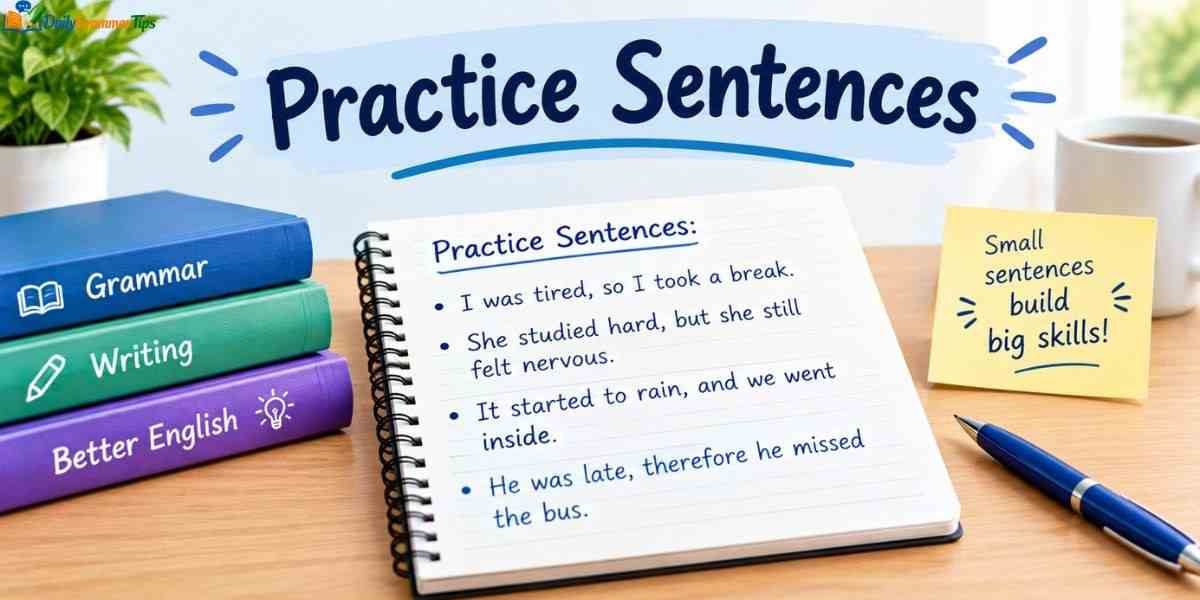
Find the error in each sentence. “The movie ended, we left the theater.” “She studied hard, however, the test was difficult.” “Although he was tired, he finished the report.” Decide which sentences need a repair and how you would fix each one before you read on.
Here are the answers. Sentence one has a comma splice; use a period or a conjunction such as “and.” Sentence two has the same error; use “; however,” instead. Sentence three is correct because the first clause is dependent. If you found all three, you have mastered the key skill.
Frequently Asked Questions
What is a comma splice example?
A comma splice happens when two complete sentences join with only a comma. Example: I love coffee, I drink it every morning.
Is a comma splice ever ok?
In formal writing, comma splices are usually incorrect, but some writers use them in creative writing for style.
Why is it called a comma splice?
It is called a comma splice because a comma incorrectly “splices” or connects two separate sentences together.
Does a semicolon fix a comma splice?
Yes, a semicolon can fix a comma splice by properly joining two related independent sentences.
What are 10 examples of comma sentences?
- I was tired, I went to bed early.
- She likes tea, she drinks it daily.
- The rain stopped, the sun came out.
- He studied hard, he passed the exam.
- I called my friend, he did not answer.
- The movie ended, everyone left quietly.
- We cooked dinner, we enjoyed the meal.
- She opened the door, the dog ran outside.
- They arrived late, the meeting had started.
- I finished my work, I went home.
Conclusion
A comma splice joins two complete sentences with only a comma. It is common, easy to make, and easy to fix. You now know how to spot it, why it happens, and how to repair it in several ways. You also know the rare cases where it is acceptable.
Keep practicing with your own writing. Use the period test, scan for trigger words, and choose the fix that suits your meaning. With steady effort, a comma splice will no longer slow you down. Your sentences will become clearer, and your readers will trust your words.
