

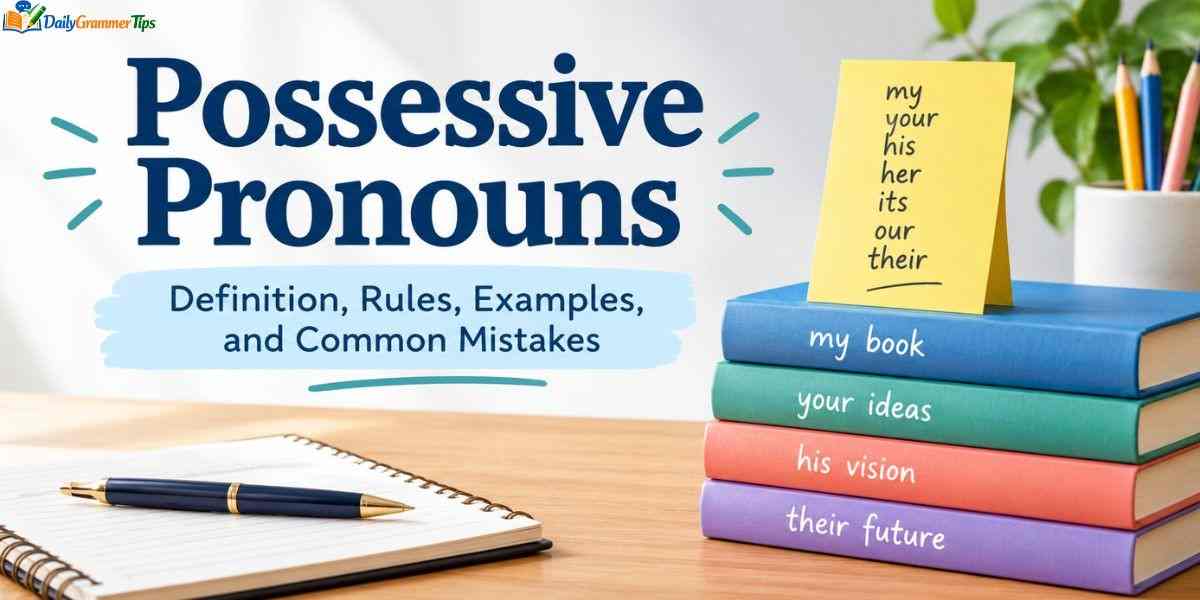
Possessive pronouns show ownership without repeating the noun. When you say “That seat is mine,” the word “mine” replaces “my seat.” This small shift keeps your sentences short, smooth, and natural.
Many learners confuse these words with possessive adjectives such as my and your. This guide separates the two with clear rules, simple examples, and fixes for the mistakes that appear most often in exams and emails. By the end, you will use possessive pronouns with confidence.
What Are Possessive Pronouns?
Possessive pronouns take the place of a noun phrase to show who owns or belongs to something. They stand alone in a sentence, so no noun follows them. The main forms are mine, yours, his, hers, ours, and theirs.
Think of them as shortcuts. Instead of saying “This book is my book and that book is your book,” you say “This book is mine and that one is yours.” The sentence loses repetition and gains rhythm.
What Is a Possessive Pronoun and Its Examples?
A possessive pronoun is a word that shows ownership and replaces a noun the listener already knows. In “The red bag is hers,” the word hers stands for her bag. The noun disappears, but the meaning stays clear.
More examples include “The decision is ours,” “Those seats are theirs,” and “Is this pen yours?” Each sentence works because the context tells the listener which noun the pronoun replaces.
Why Possessive Pronouns Matter in English
Possessive pronouns cut repetition and make your writing sound more fluent. Native speakers use them constantly, often without noticing. If you skip them, your sentences feel heavy and robotic.
They also add precision. A sentence such as “The idea was his, not hers” assigns credit in just six words. Strong writers rely on this compact ownership signal in reports, essays, and everyday talk.
List of Possessive Pronouns
English has a short, fixed set of ownership words. Learning the full set once saves you from guessing later, and the next sections break it into singular and plural forms.
Singular Forms
The singular forms are mine, yours, his, hers, and its. Mine belongs to the speaker, yours belongs to the listener, his belongs to a male owner, hers belongs to a female owner, and its belongs to a thing or an animal.
Yours works for one owner or many, so context decides the number. “The jacket is yours” can address one person or a whole group, and the sentence stays exactly the same.
Plural Forms
The plural forms are ours and theirs. Ours includes the speaker along with others, while theirs points to a group that excludes both the speaker and the listener. Both forms can take a singular or plural verb.
The verb depends on the noun being replaced. “Ours are the blue ones” uses a plural verb because the missing noun is plural. “Theirs is the corner office” uses a singular verb because the missing noun is singular.
Ten Everyday Sentences with Possessive Pronouns
Here are ten sentences that show the full range. “The laptop is mine.” “Is that umbrella yours?” “The victory was his.” “The decision is hers.” “The garden looks better than ours.” “Theirs arrived late.” “The blame is yours.” “Her idea was good, but his was better.” “The house on the corner is ours.” “Their team won, and ours came second.”
Notice that none of these sentences places a noun right after the pronoun. That pattern is the signature of this word class, and it is the fastest way to spot one in any text.
Possessive Pronouns vs Possessive Adjectives
Both groups show ownership, yet they behave differently in a sentence. One needs a noun after it, and the other replaces the noun completely.
The Core Difference
Possessive adjectives such as my, your, his, her, its, our, and their come before a noun. Possessive pronouns such as mine, yours, hers, ours, and theirs stand alone. “This is my car” uses an adjective, while “This car is mine” uses a pronoun.
Remember the simple rule: adjective plus noun, pronoun without noun. Once you apply it, most of the confusion disappears.
A Quick Test You Can Use
Try removing the noun from the sentence. If the sentence still makes sense, you are looking at a pronoun. If it breaks, you need an adjective instead.
For example, “Her bag is red” becomes “Hers is red” after you swap the phrase. “Her is red” fails, which proves that her is an adjective and hers is the pronoun.
Side-by-Side Pairs
Each possessive adjective has a matching pronoun. My pairs with mine, your with yours, her with hers, our with ours, and their with theirs. His stays the same in both roles.
Learning these pairs together builds a mental map. When you see one half, you instantly recall the other and choose the correct form.
How Each Possessive Pronoun Works
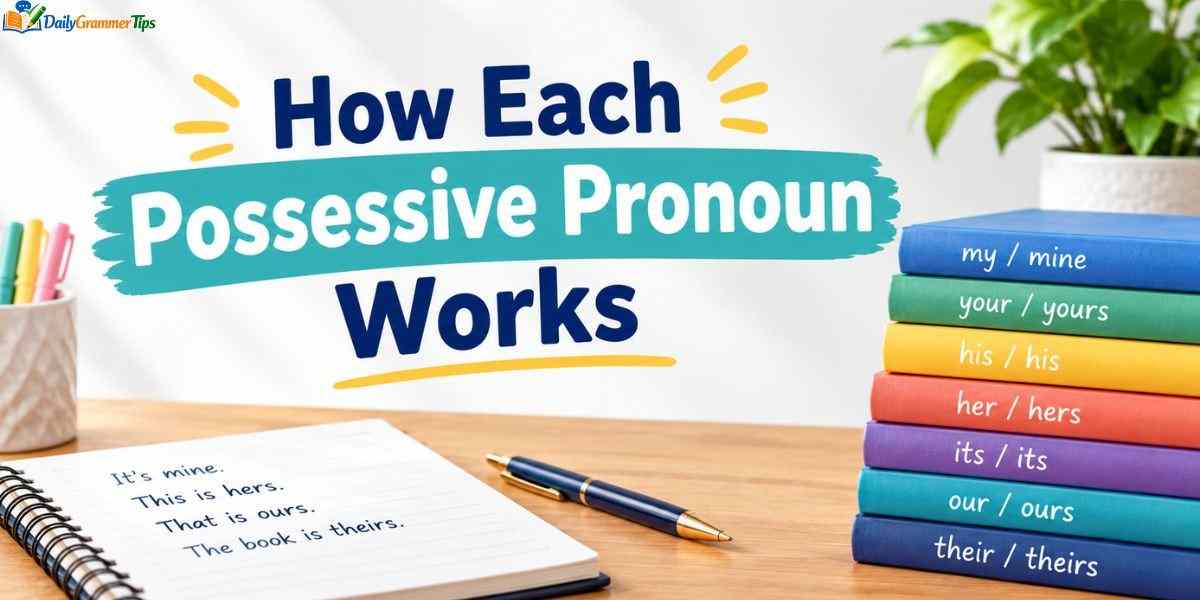
Every ownership word has its own habits, so it helps to study them one by one. The next sections show how each form behaves in real sentences.
Mine
Mine refers to the speaker. It works as a subject, an object, or a complement. “Mine is the green folder” uses it as a subject, and “You can borrow mine” uses it as an object.
Because mine already ends in a consonant sound that signals ownership, you never add an s. Write “mine,” never “mines,” in standard English.
Yours
Yours refers to the listener or listeners. “Yours is the next turn” and “Is this seat yours?” show its common roles. It also closes many letters in the phrase “Yours sincerely.”
Avoid writing “your’s” with an apostrophe. That form does not exist in standard English, and editors treat it as a spelling error.
His
His is flexible because it works as both a possessive adjective and one of the possessive pronouns. “His car is fast” uses it as an adjective, and “The car is his” uses it as a pronoun.
Context tells you which role it plays. If a noun follows, it is an adjective. If the sentence ends or moves on, it is a pronoun.
Hers
Hers refers to a female owner. “The credit is hers” and “Hers was the loudest voice” show how it stands alone. Never write “her’s,” because standard English forbids the apostrophe.
Hers pairs with the adjective her. Remember that her needs a noun after it, while hers does not.
Ours
Ours includes the speaker in the owning group. “The victory is ours” and “Ours is a small team” show common uses. It can express pride, responsibility, or shared identity.
Like the other forms, ours never takes an apostrophe. Writers sometimes slip into “our’s,” and spell checkers do not always catch it.
Theirs
Theirs refers to a group that does not include the speaker or the listener. “The choice was theirs” and “Theirs is the larger office” illustrate typical usage. It also helps you avoid repeating a long noun phrase.
Avoid “their’s” and “theirselves.” The first is a spelling error, and the second is nonstandard English.
Its
Its works mainly as a possessive adjective, as in “The dog wagged its tail.” Many grammarians hesitate to count it among true possessive pronouns because it rarely stands alone. A sentence like “The tail is its” sounds unnatural.
For that reason, most lessons teach six pronoun forms and treat its as an adjective. Still, never confuse its with it’s, which means “it is” or “it has.”
Rules for Using Possessive Pronouns
Clear rules guide correct usage. Follow them and your writing stays accurate and professional.
Never Use an Apostrophe
Possessive pronouns never take an apostrophe. Write yours, hers, ours, and theirs, not your’s, her’s, our’s, or their’s. The ownership meaning is already built into the word.
Apostrophes belong to possessive nouns such as “Sara’s book.” Keep that distinction firm in your mind and you will avoid the most common error in this topic.
Match the Owner, Not the Object
Choose the pronoun based on who owns the item, not on the item itself. “The books are hers” uses hers because a woman owns them, even though books is plural.
The verb, however, must match the replaced noun. “Hers are on the shelf” uses are because the missing noun, books, is plural.
Place Them Correctly in a Sentence
These words can act as subjects, objects, or complements. “Mine is ready” uses one as a subject, “She prefers hers” uses one as an object, and “The choice is yours” uses one as a complement.
They never sit directly before a noun. If you need a noun right after the word, switch to the adjective form.
Make the Reference Clear
Readers must know which noun the pronoun replaces. Introduce the noun first, then use the pronoun. “I brought my laptop, and Sam forgot his” works because the word laptop is clear from the start.
If the reference is vague, the sentence confuses the reader. Add the noun again whenever two possible items compete for attention.
Use the Double Possessive
English allows a double possessive structure, such as “a friend of mine” or “that idea of hers.” The pronoun follows the word “of” and replaces a noun phrase.
This pattern sounds natural and signals one item from a larger set. “A friend of mine” means one among several friends, while “my friend” points to a specific person.
Possessive Pronouns vs Personal Pronouns
Personal pronouns name the people and things in a sentence, while possessive forms show ownership. The two groups often work together in the same sentence.
What Is a Personal and Possessive Pronoun?
Personal pronouns such as I, you, he, she, we, and they act as subjects or objects. Possessive pronouns such as mine, yours, hers, ours, and theirs show who owns something. Together they build complete, natural sentences.
In “I think the folder is yours,” the word I is a personal pronoun and the word yours is a possessive one. Each plays a different role, yet both replace nouns.
Is “I Love You” a Pronoun?
The phrase “I love you” is not a pronoun, but it contains two. I is a subject pronoun, and you is an object pronoun. The verb love connects them.
A possessive version would be “I am yours.” Here, yours shows belonging, which turns a simple statement into a declaration of commitment.
Reflexive and Possessive Forms Compared
Reflexive pronouns such as myself and themselves show that the subject receives its own action. Possessive forms show ownership instead. “She hurt herself” differs completely from “The pen is hers.”
Mixing the two groups leads to errors like “That book is myself.” Keep their roles separate and your sentences stay correct.
Possessive Sentences Explained
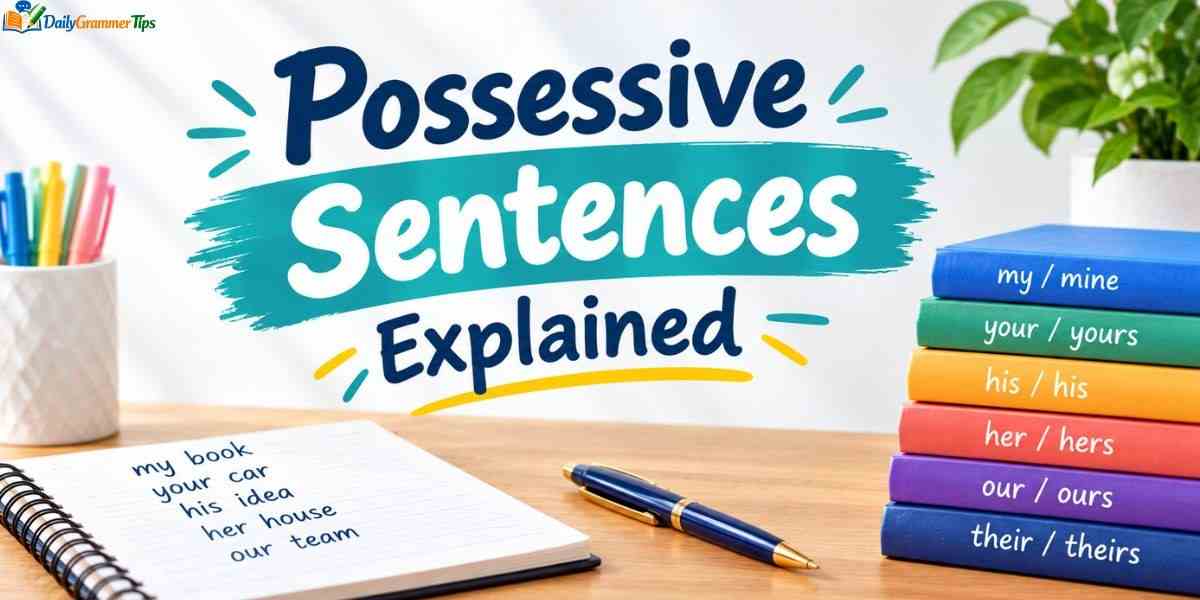
A possessive sentence shows that someone owns, has, or belongs to something. It can use pronouns, adjectives, or nouns to carry that meaning.
What Is a Possessive Sentence?
A possessive sentence expresses ownership or a close relationship. “The idea is mine” and “This is her office” both qualify. One uses a pronoun, and the other uses an adjective.
Possessive sentences also describe relationships, as in “Maya is my sister.” The word my shows connection, not just ownership of an object.
Possessive Nouns vs Possessive Pronouns
Possessive nouns add an apostrophe and an s, as in “Ali’s laptop.” Possessive pronouns replace the whole phrase, as in “The laptop is his.”
Use a noun when you want to name the owner. Use a pronoun when the owner is already clear and you want to avoid repetition.
Combining Both for Natural Style
Skilled writers mix these tools. “Ali’s presentation was strong, but mine was longer” names Ali first and then uses a pronoun for the speaker.
This blend avoids repetition and keeps attention on the comparison. It also gives your writing a smooth, conversational tone.
Learn more…………..Comma Splice: What It Is and How to Fix It
Common Mistakes with Possessive Pronouns
Even advanced writers slip with these words. Knowing the usual traps helps you proofread faster and with more confidence.
Adding an Apostrophe by Mistake
Writing “yours'” or “hers’s” is wrong. Possessive pronouns already show ownership, so extra marks add nothing. Remove the apostrophe and the sentence is correct.
Proofread every word that ends in s. If it belongs to this group, no apostrophe belongs there.
Confusing Its and It’s
Its shows ownership, while it’s means “it is” or “it has.” “The cat licked its paw” uses ownership, and “It’s raining” uses a contraction.
Test the word by replacing it with “it is.” If the sentence still works, use it’s. If it fails, use its.
Placing Pronouns Before Nouns
“Mine book” and “yours idea” are incorrect. Pronouns cannot come before nouns. Use my book and your idea instead.
Remember that adjectives need nouns and pronouns replace them. Mixing the two roles produces awkward English.
Mixing Up Your and Yours
Your needs a noun after it, while yours does not. “Your bag is here” is correct, and “The bag is yours” is also correct. “The bag is your” is wrong.
If you cannot end the sentence with the word, you need the adjective version. That simple check prevents most errors.
Creating Unclear Reference
A sentence such as “Sara told Mia that hers was ready” confuses readers because hers could point to either woman’s item. Rewrite it for clarity.
Add the noun or restructure the sentence: “Sara told Mia that Mia’s report was ready.” Precision beats brevity whenever meaning is at risk.
Possessive Pronouns in Different Contexts
Tone changes with context, but the grammar stays the same. These examples show how to adapt your usage.
In Everyday Conversation
People use these words constantly in speech. “Is this seat yours?” and “That one is mine” sound natural and quick. Short answers rely on them to save time.
Casual talk also allows double possessives such as “a cousin of ours.” These patterns feel friendly and familiar.
In Academic Writing
Essays use these words to compare ideas. “Her argument is stronger than his” avoids repeating the word argument. Academic style values clarity, so check each reference carefully.
Avoid casual or nonstandard forms in formal work, such as “theirselves.” Stick to standard options like theirs and keep every sentence precise.
In Business Emails
Professional emails often end with “Yours sincerely” or “Yours faithfully.” They also use phrases like “The decision is yours.” Possessive pronouns keep messages polite and direct.
Be careful with ownership claims in the workplace. “The credit is ours” shares success, while “The mistake is mine” shows accountability.
In Creative Writing
Authors use these words to build rhythm and character. “The throne was hers by right” feels sharper than “The throne was her throne by right.” The pronoun adds weight.
Dialogue also benefits. Characters say “Mine!” or “That’s ours” in short bursts that mirror real speech.
Origin and Development of Possessive Pronouns
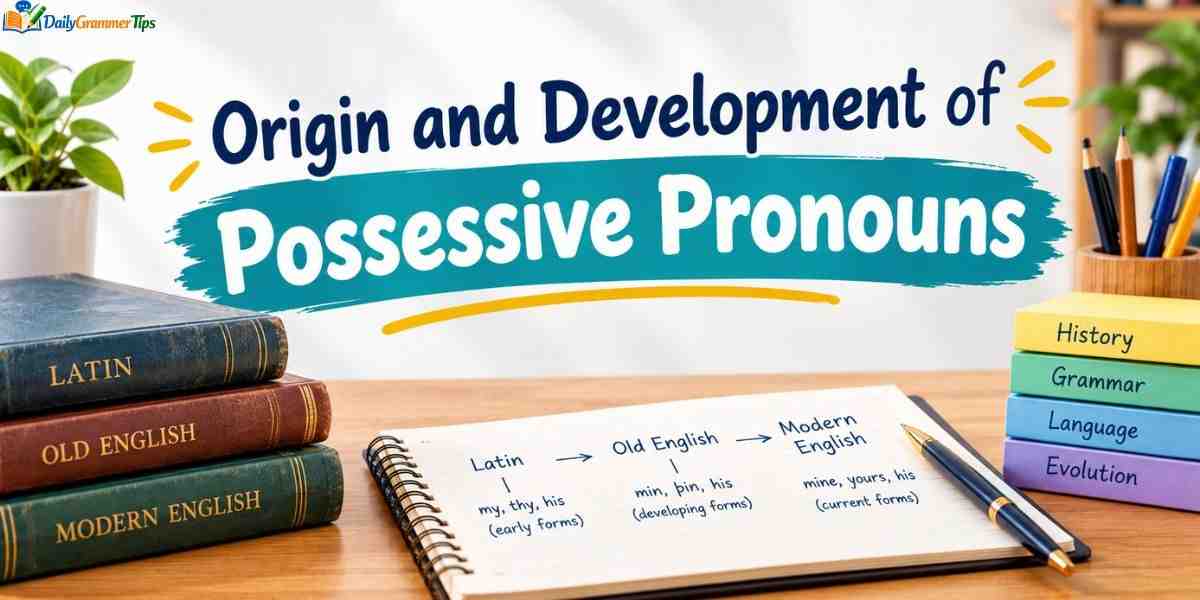
Understanding where these words come from explains why they look the way they do. The history also clears up why some forms end in s and others do not.
Where the Forms Come From
Possessive pronouns grew out of Old English ownership words, and the familiar forms settled during the Middle English period. Speakers added an s to several forms, creating yours, hers, ours, and theirs, partly by analogy with his.
Mine and thine once appeared before vowels as adjectives, which is why older texts use phrases like “mine eyes.” Modern English kept mine as the standalone pronoun and moved on.
Why the Apostrophe Never Joined the Group
The apostrophe entered English later and attached itself to nouns, not pronouns. Nouns needed a visible ownership marker, so “Sara’s” earned one.
Pronouns already carried ownership inside their spelling, so they stayed clean. That history explains why “her’s” looks wrong to trained eyes.
Possessive Pronouns and Gender-Neutral Language
Modern writing increasingly values inclusive wording. Ownership words play a real role in that shift.
Theirs as a Singular Form
Possessive pronouns now include theirs for one person whose gender is unknown or unstated. “Someone left a coat, and I think it is theirs” sounds natural to most readers today.
Major style guides accept singular they and its related forms. Using them avoids clumsy phrases like “his or hers” in everyday writing.
Choosing Inclusive Wording
Pick the form that matches the person’s stated preference. If someone uses theirs, use it. If someone uses his or hers, follow that choice.
When the owner is unknown, rephrase or use theirs. Respectful wording builds trust and keeps your writing current.
Possessive Pronouns and the Word Whose
The word whose often appears near ownership words, so learners sometimes confuse the two. A short comparison clears it up.
Whose as a Question Word
Whose asks about ownership. “Whose phone is this?” invites an answer such as “It is mine.” Here, whose is a question word, and the answer uses a standalone ownership form.
Never confuse whose with who’s, which means “who is” or “who has.” The apostrophe signals a contraction, not ownership.
Whose as a Relative Word
Whose also links ideas. “The writer whose book won the prize spoke first” joins two details in one sentence. Unlike possessive pronouns, it needs a noun right after it.
That noun requirement makes whose behave like an adjective. Treat it as a connector, not as a replacement for a noun.
Possessive Pronouns in English Exams
Grammar tests love ownership words because they reveal precise understanding. Preparing for them gives you a clear advantage.
Typical Test Questions
Possessive pronouns appear often in fill-in-the-blank and error-correction tasks. A question might ask you to choose between your and yours, or to fix “The pen is her’s.”
Examiners also test the its and it’s trap. Expect at least one question that checks whether you know when an apostrophe belongs.
Strategies for Multiple-Choice Questions
First, check whether a noun follows the blank. If it does, choose an adjective. If nothing follows, choose a pronoun.
Second, eliminate any option with an apostrophe in an ownership slot. These two steps solve most multiple-choice items in seconds.
Teaching Possessive Pronouns to Children
Young learners grasp ownership naturally because they love saying “mine.” Teachers can build on that instinct with simple, playful methods.
Start with Real Objects
Possessive pronouns become easier when children hold real items. Ask a child to point to a pencil and say “This is mine.” Then ask about a classmate’s pencil and guide them to say “That is hers.”
Physical objects connect words to meaning. Repetition with real items beats memorizing abstract rules.
Use Games and Stories
Simple games keep lessons fun. A sorting game, where children place toys into boxes marked mine, yours, and ours, builds quick recall.
Short stories help as well. Read a tale about two friends sharing a toy and pause so children can fill in the missing ownership word.
Tips to Learn Possessive Pronouns Faster
Practice beats memorization. A few steady habits help the rules stick for good.
Use the Substitution Method
Replace a noun phrase with the right word and check the result. “This is her pen” becomes “This pen is hers.” Practice possessive pronouns daily by repeating this swap with ten sentences.
Over time, the pattern becomes automatic. You stop thinking about the rule and simply write correctly.
Read Your Writing Aloud
Reading aloud exposes awkward phrases. If “mine book” sounds odd, it is wrong. Your ear often catches what your eyes miss.
Record a short paragraph and play it back. Listen for any ownership word that feels out of place.
Compare Pairs in Your Notes
Create a two-column note with adjectives on one side and pronouns on the other. My and mine, your and yours, her and hers sit side by side.
Review the note for five minutes each day. Within a week, the pairs will feel familiar.
Practice Exercises with Possessive Pronouns
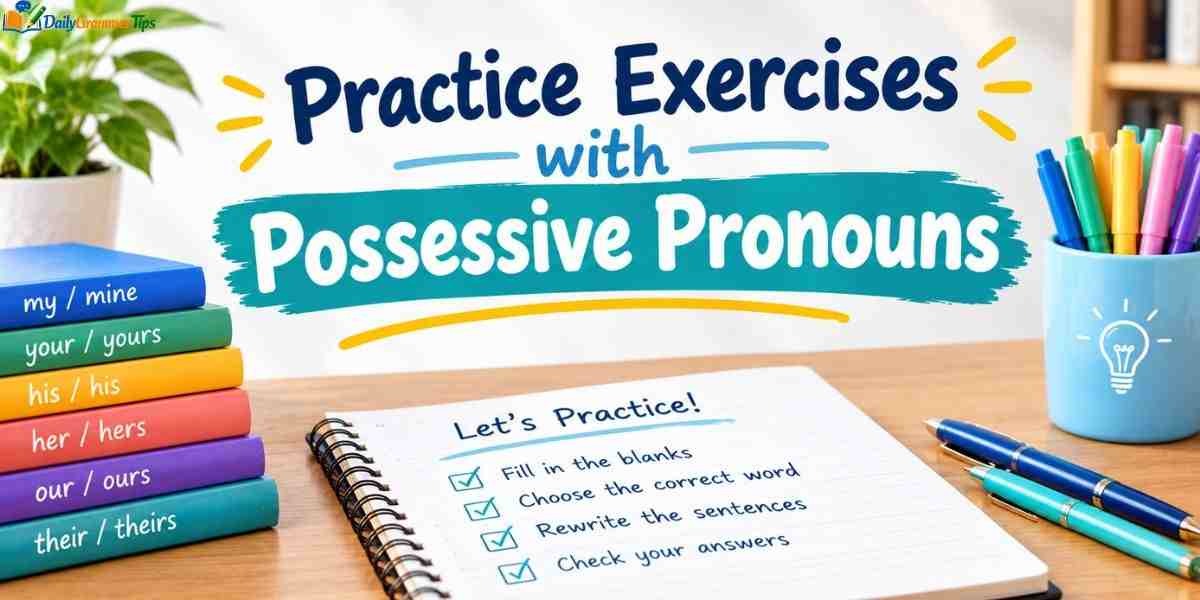
Test your skill with these short tasks. Fill each blank with the correct ownership word and check your answers below.
Fill in the Blanks
Try these four: “The blue coat belongs to me, so it is ___.” “Is this notebook ___?” asked to a friend. “The victory belongs to us, so it is ___.” “That seat belongs to them, so it is ___.”
Check Your Answers
The answers are mine, yours, ours, and theirs. If you matched all four, you understand the core pattern.
If you missed any, review your pair notes and try again tomorrow. Repetition builds accuracy.
Frequently Asked Questions
What is a possessive pronoun and its examples?
Possessive pronouns such as mine, yours, his, hers, ours, and theirs show ownership and replace a noun, as in “The book is mine.”
What are 10 possessive examples?
Mine, yours, his, hers, ours, theirs, my, your, her, and their are ten common possessive words, with the first six acting as pronouns.
Is “I love you” a pronoun?
No, it is a sentence. It contains two pronouns, I and you, joined by the verb love.
What is a personal and possessive pronoun?
Personal pronouns like I, she, and they name people or things, while possessive ones like mine, hers, and theirs show who owns something.
What is a possessive sentence?
A possessive sentence shows ownership or belonging, such as “The idea is hers” or “This is my office.”
Conclusion
Possessive pronouns are small words with a big job. They show ownership, remove repetition, and keep your sentences clear. Remember the core rules: no noun after them, no apostrophe inside them, and a clear reference for every use.
Practice with real sentences, watch for the its and it’s trap, and compare each adjective with its matching pronoun. With steady effort, mastering possessive pronouns will improve your speaking, your exam scores, and your professional writing.
