

Proper nouns name the specific people, places, and things around us. They give each one a unique identity, from Einstein to Everest. Without them, our sentences would feel vague and unclear.
This guide explains proper nouns in simple steps. You will learn the definition, the capitalization rules, and the main types. Lists, examples, and practice exercises will help every idea stick.
What Are Proper Nouns?
Proper nouns are names of specific people, places, organizations, and things. They always begin with a capital letter. They point to one particular item, not a general group.
Compare “city” with “Karachi.” The first word names any city. The second names one exact city.
Simple Definition of a Proper Noun
A proper noun is the special name of one person, place, or thing. It tells us exactly which one we mean.
Examples include Sara, Canada, and Monday. Each word names something specific. That is why each one starts with a capital letter.
Proper Nouns vs Common Nouns
Proper nouns name something specific, while common nouns name a general group. This is the main difference. Capital letters make it easy to spot.
Common nouns use lowercase letters unless they start a sentence. Here are four quick pairs:
- Common: girl. Proper: Sara.
- Common: country. Proper: Brazil.
- Common: day. Proper: Friday.
- Common: company. Proper: Toyota.
Capitalization Rules for Proper Nouns
Capitalization rules for proper nouns are simple. Start every proper name with a capital letter. In longer names, capitalize each main word.
Small words like “of,” “the,” and “and” stay lowercase inside a name. Example: “Statue of Liberty.”
Always Capitalize the First Letter
Every proper noun begins with a capital letter. Write Pakistan, not pakistan. Write Sara, not sara.
This rule applies even in the middle of a sentence.
Capitalize Each Main Word
In a name with many words, capitalize each main word. Examples: “Mount Everest” and “Pacific Ocean.”
Leave small linking words in lowercase. Example: “University of Oxford.”
Watch Out for Special Cases
Some brands use unusual capitals, such as iPhone and eBay. Follow the official style for these names.
Seasons and compass directions stay lowercase. Write spring and north. Capitalize them only inside a name like “North America.”
Types of Proper Nouns
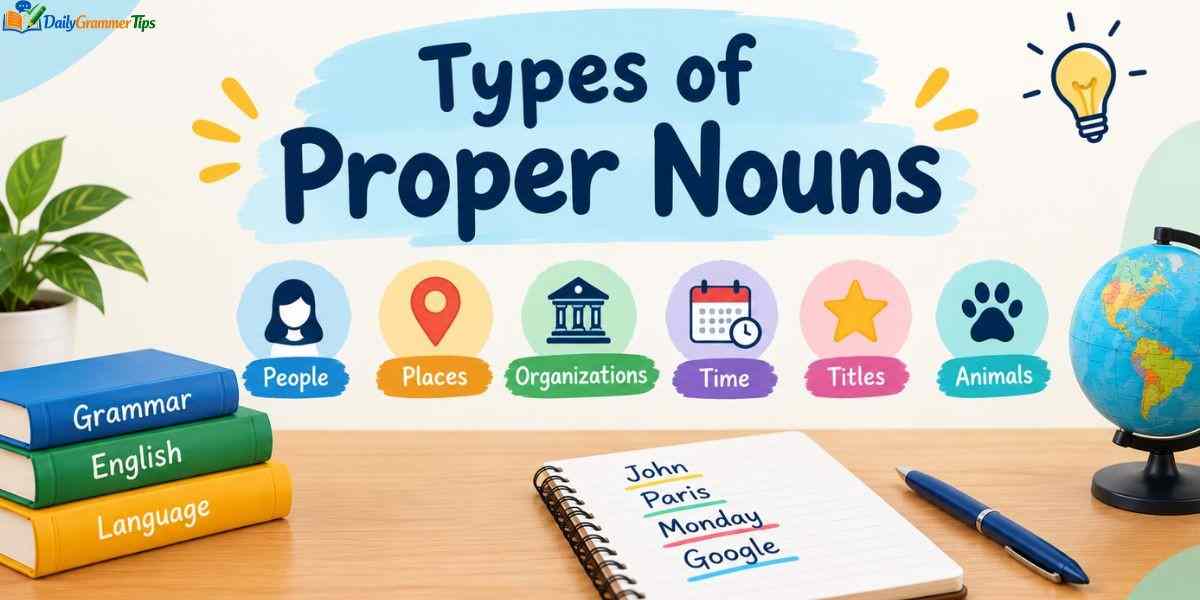
Proper nouns fall into several groups. Each group names a different kind of item.
Let us look at the main types.
Names of People
These include first names, last names, and full names. Examples: Sara, Ahmed, and Marie Curie. A title before a name also takes a capital, as in “Dr. Khan.”
Pet names and nicknames count too. Example: “Buddy” for a dog.
Names of Places
Cities, countries, rivers, mountains, and oceans all take capitals. Examples: Tokyo, Egypt, the Nile, and Mount Everest.
Streets and buildings are included. Examples: “Main Street” and “Burj Khalifa.”
Days, Months, and Holidays
Days of the week and months always take capitals. Examples: Monday and March.
Holidays and festivals also count. Examples: Eid, Christmas, and Halloween.
Organizations and Brands
Companies, schools, and groups have proper names. Examples: Google, Nike, and Harvard University.
Government bodies and agencies are included. Examples: NASA and the United Nations.
Languages, Nationalities, and Religions
Languages and nationalities take capitals. Examples: English, Urdu, and Spanish.
Religions and their followers do too. Examples: Islam, Christianity, and Hinduism.
Titles of Works and Events
Books and films have proper titles. Examples: “Moby Dick” and “Titanic.”
Events and eras do too. Examples: “World War II” and the “Renaissance.”
Proper Nouns Examples
Examples make proper names easier to recognize. The lists below group them by category.
Examples of People
- Sara loves painting.
- Albert Einstein developed the theory of relativity.
- Nelson Mandela led South Africa.
- Dr. Khan treats children.
- Emma plays the piano.
- Malala Yousafzai speaks for education.
Examples of Places
- We visited Paris last summer.
- The Nile flows through Egypt.
- Mount Everest is the tallest mountain on Earth.
- Brazil won the match.
- The Sahara Desert is huge.
Examples of Days, Months, and Holidays
- The meeting is on Monday.
- Her birthday falls in July.
- We celebrate Eid with family.
- Christmas comes in December.
- School closes on Friday.
Examples of Brands and Organizations
- Google launched a new feature.
- My brother wears Nike shoes.
- NASA sent a rover to Mars.
- Toyota makes reliable cars.
- She studies at Harvard University.
List of 10 Proper Nouns
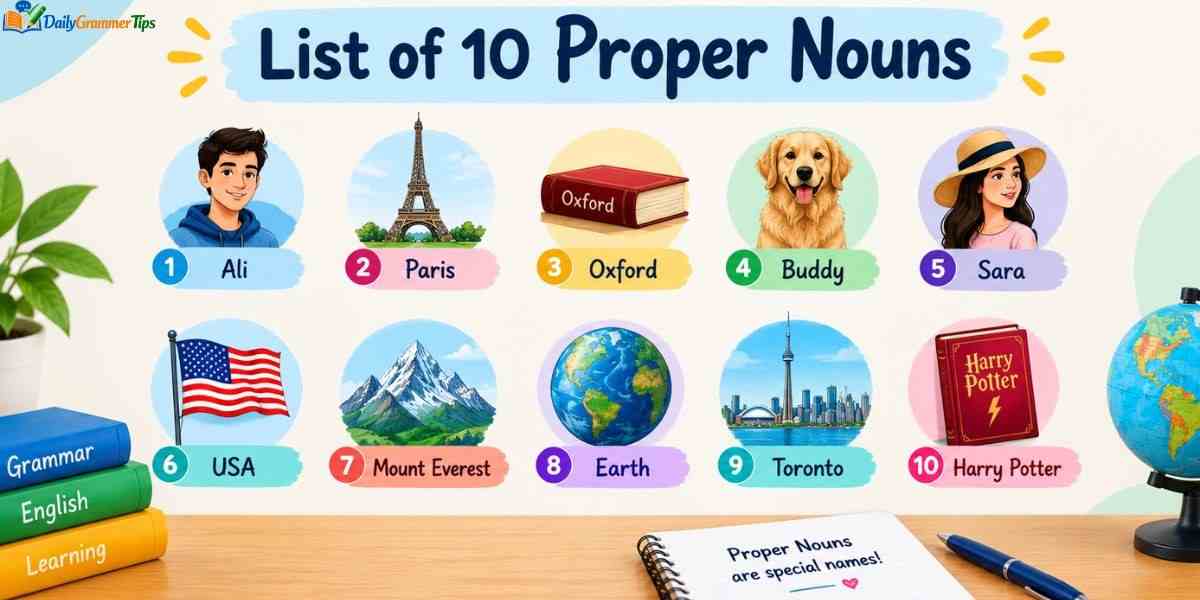
Here are ten names from different groups.
- Sara
- London
- Pakistan
- Monday
- Amazon
- Nile River
- Spanish
- Christmas
- Mount Everest
Each one begins with a capital letter.
List of 20 Proper Nouns
Here are twenty more names to study. They cover people, places, brands, and more.
- Ahmed
- Emma
- Albert Einstein
- Canada
- Brazil
- Tokyo
- Sahara Desert
- Pacific Ocean
- Friday
- July
- Ramadan
- Toyota
- Nike
- NASA
- English
- Jupiter
- Eiffel Tower
- Titanic
- Harvard University
- United Nations
List of 50 Proper Nouns
This list has fifty names, grouped into five categories. Use it as a quick reference.
10 Names of People
- Sara
- Ahmed
- Emma
- Albert Einstein
- Marie Curie
- Nelson Mandela
- Leonardo da Vinci
- Fatima
- Isaac Newton
- Malala Yousafzai
10 Names of Places
- Pakistan
- Canada
- Brazil
- Egypt
- Tokyo
- Paris
- Mount Everest
- Sahara Desert
- Pacific Ocean
- Africa
10 Days, Months, and Holidays
- Monday
- Friday
- Sunday
- January
- March
- July
- December
- Christmas
- Eid
- Halloween
10 Brands and Organizations
- Amazon
- Toyota
- Nike
- Microsoft
- Samsung
- Harvard University
- United Nations
- Red Cross
- NASA
10 Languages, Planets, and Landmarks
- English
- Spanish
- Urdu
- Mars
- Jupiter
- Statue of Liberty
- Eiffel Tower
- Titanic
- Moby Dick
- Nile River
Proper Nouns in Sentences
Proper nouns can act as subjects, objects, or part of a phrase. They fill the same roles as common nouns.
Look at the examples below.
- Subject: Sara won the race.
- Object: The teacher praised Ahmed.
- After a preposition: We traveled to Canada.
- Possessive: Emma’s book is on the table.
About your research………..Prepositional Phrases: Definition, Types, Rules, and Examples
Plural Forms of Proper Nouns
Most proper nouns become plural by adding s or es. Names ending in s, x, z, ch, or sh take es.
Examples: the Johnsons, the Joneses, and the Kennedys. Do not use an apostrophe to make a plural.
Possessive Forms of Proper Nouns
To show ownership, add an apostrophe and s to most names. Example: “Sara’s bag.” For names that end in s, both styles work.
You can write “James’s car” or “James’ car.” Pick one style and stay consistent.
Proper Nouns and Titles
Capitalize a title when it comes right before a name. Examples: “President Lincoln” and “Professor Ali.”
Use lowercase when the title stands alone. Example: “The president gave a speech.”
When Common Nouns Become Proper Nouns
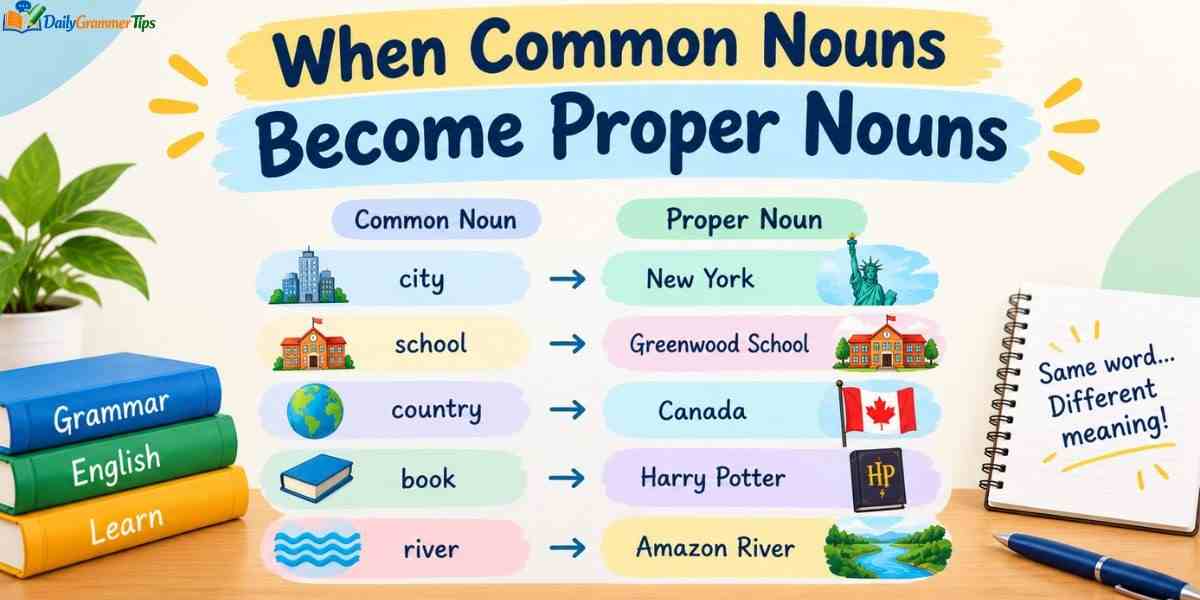
A common noun becomes a proper name when it names one specific person. Example: “Mother” in “Mother called me.”
Compare it with “my mother.” Here, “mother” stays lowercase because it is a general term.
Proper Nouns vs Proper Adjectives
Proper adjectives come from proper names. They describe other nouns. Examples: American, Chinese, and Shakespearean.
Example: “She loves Italian food.” The word “Italian” comes from “Italy.” It also takes a capital letter.
Teaching Proper Nouns to Class 1 Students
A proper noun is the special name of a person, place, animal, or thing. In Class 1, children learn that it always starts with a capital letter.
Keep lessons short, colorful, and playful. Young learners remember what they enjoy.
Use Names They Know
Start with the names of classmates, teachers, and pets. Example: “Ali has a cat named Mimi.” Children see capital letters on names they already know.
Then move on to cities and countries. Show a map or a globe.
Play a Naming Game
Ask the child to name a girl, a city, and a day. Write each answer on the board with a capital letter.
Give a star for each correct answer. Games keep young learners excited.
Easy Examples for Class 1
- Sara is my friend.
- I live in Pakistan.
- Today is Monday.
- Tom is my dog.
- We celebrate Eid.
Common Mistakes With Proper Nouns
Even good writers slip with proper nouns. Most mistakes involve capital letters.
Learn the common ones below.
Forgetting the Capital Letter
Always capitalize names.
- Wrong: we visited paris in july.
- Right: We visited Paris in July.
Capitalizing Common Nouns
Do not capitalize general words.
- Wrong: My Teacher is kind.
- Right: My teacher is kind.
Capitalizing Seasons and Directions
Seasons and directions stay lowercase.
- Wrong: I love Spring.
- Right: I love spring.
- Wrong: Drive South for ten miles.
- Right: Drive south for ten miles.
Using an Apostrophe in Plurals
Use s or es for plurals. Do not add an apostrophe.
- Wrong: The Smith’s arrived.
- Right: The Smiths arrived.
Capitalizing Titles Alone
Capitalize titles only before names.
- Wrong: The Doctor treated me.
- Right: The doctor treated me.
- Right: Doctor Khan treated me.
Tips to Remember Proper Nouns
A few simple tricks make names easy to spot. Each one takes only a minute.
Look for Capitals in the Middle of a Sentence
A capital letter in the middle of a sentence often signals a name.
Ask Which One
If the word names one specific item, it is probably a proper name. Ask yourself which one you mean.
Replace the Word With a General Term
Swap the word with a general term. “Paris” becomes “city.” If the swap works, the original is a proper name.
Make Your Own Examples
Write one sentence for each category. Add a new name each day.
Proper Nouns for English Learners
Learners often wonder when to use “the” with names. Most names need no article. A few do, so practice helps.
Small daily habits bring steady progress.
Names That Need No Article
Most people, cities, and countries need no article. Examples: Sara, Tokyo, and Canada.
Names That Need The
Some names take “the.” Examples: the Nile, the Himalayas, the United States, and the Pacific Ocean.
Read and Notice
Read news, stories, and blogs. Notice how names are capitalized and which ones take an article.
Keep a Personal List
Write new names in a notebook with a short sentence for each. Review them every week.
Practice Exercises on Proper Nouns
These short exercises will build your confidence. Try them before you check the answers.
Each exercise has five questions.
Exercise 1: Find the Proper Name
Find the proper name in each sentence.
- Sara lives in Lahore.
- We met on Friday.
- Google opened a new office.
- The Nile is a long river.
- Emma speaks Spanish.
Exercise 2: Fix the Capital Letters
Rewrite each sentence correctly.
- ahmed visited canada in june.
- my uncle works at microsoft.
- we celebrate eid every year.
- the eiffel tower is in paris.
- she studies english on monday.
Answers
Here are the correct answers.
- Exercise 1: Sara and Lahore, Friday, Google, Nile, Emma and Spanish.
- Exercise 2, one: Ahmed visited Canada in June.
- Exercise 2, two: My uncle works at Microsoft.
- Exercise 2, three: We celebrate Eid every year.
- Exercise 2, four: The Eiffel Tower is in Paris.
- Exercise 2, five: She studies English on Monday.
Why Proper Nouns Matter
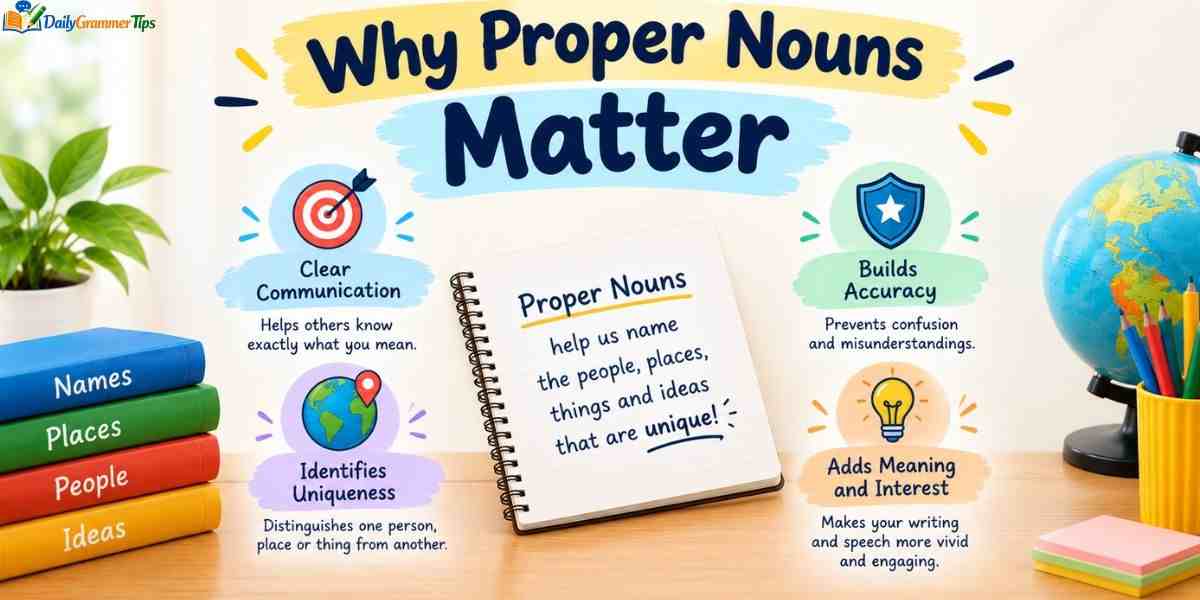
Proper nouns bring clarity and detail to every sentence. They tell readers exactly who, where, and what we mean.
Strong writers use names with care. They check each capital letter before they publish.
They Add Precision
Compare “I visited a city” with “I visited Tokyo.” The second sentence gives clear detail.
They Build Trust
Correct capitals show care. Readers trust writing that looks polished.
Frequently Asked Questions
What Are Proper Nouns and Examples?
They are names of specific people, places, and things, and they start with a capital letter. Examples include Sara, Canada, Monday, and Google.
What Are 10 Proper Nouns?
Ten examples are Sara, London, Pakistan, Monday, Amazon, Nile River, Spanish, Christmas, Mount Everest, and Google.
What Are 50 Proper Nouns?
You can find fifty examples in the grouped list above. They cover people, places, holidays, brands, and landmarks.
What Are the 20 Proper Nouns?
You can find twenty in the list above. Examples include Ahmed, Emma, Tokyo, Friday, and NASA.
What Is a Proper Noun in Class 1 English?
It is the special name of a person, place, animal, or thing. It always begins with a capital letter, like Sara or Pakistan.
Conclusion
Proper nouns are the names that give your writing precision and character. They name specific people, places, brands, and events, and they always start with a capital letter. You now know the rules, the types, and the common mistakes.
Keep practicing proper nouns in your daily writing. Spot them in your reading, capitalize them with care, and use the lists above for quick reference. With steady practice, your writing will look sharper and more professional.
