

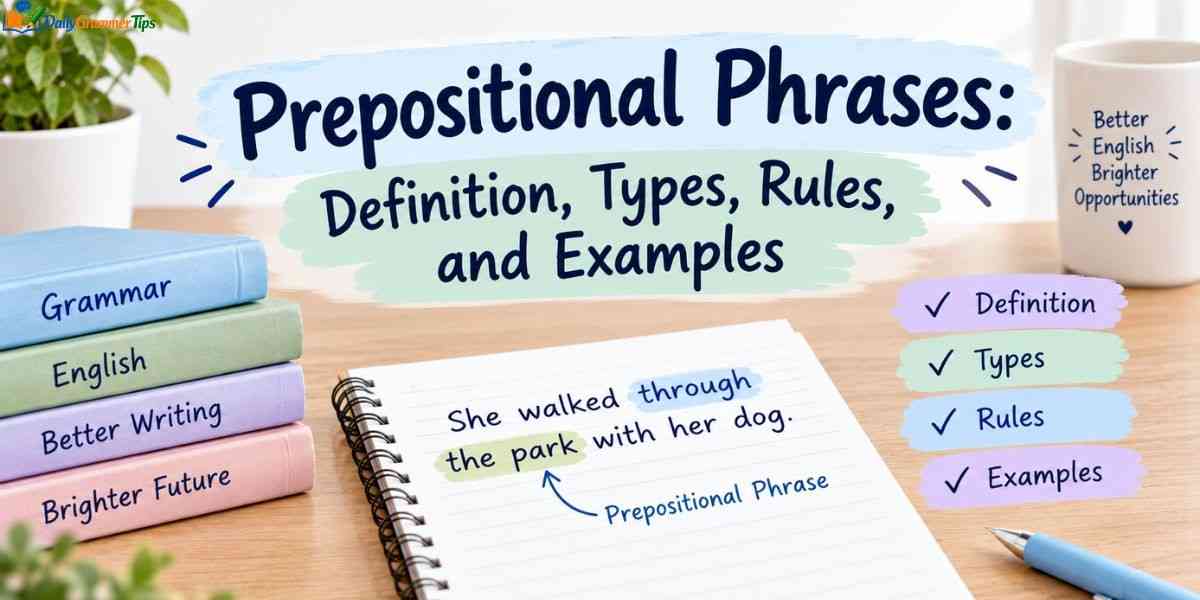
Prepositional phrases appear in almost every sentence we read or write. They add details about time, place, direction, and reason. Without them, our sentences would sound plain and incomplete.
This guide explains how prepositional phrases work in simple words. You will learn the meaning, parts, types, and rules. You will also see many clear examples that make each idea easy to follow.
What Are Prepositional Phrases?
Prepositional phrases are groups of words that begin with a preposition. They end with a noun or a pronoun. That noun or pronoun is called the object of the preposition.
Take the sentence, “The cat slept on the warm sofa.” The words “on the warm sofa” form the phrase. It tells us where the cat slept.
Simple Definition of a Prepositional Phrase
A prepositional phrase is a small group of words that connects a noun to the rest of the sentence. It shows how two things relate to each other.
It answers questions like where, when, how, which one, and why. A sentence can survive without it, but the meaning often becomes less clear.
Parts of Prepositional Phrases
Every phrase of this kind has at least two parts. These are the preposition and its object. A third part, the modifier, is optional.
Knowing these parts helps you spot a phrase quickly. It also helps you avoid common writing mistakes.
The Preposition
The preposition always comes first. Common examples include in, on, at, by, with, from, to, for, of, under, over, and between.
A preposition shows a link such as place, time, direction, or cause. On its own, it feels unfinished. It needs an object to complete the idea.
The Object of the Preposition
The object is the noun or pronoun that follows the preposition. In the phrase “with her friends,” the word “friends” is the object.
Pronouns can also be objects. In “for me,” the word “me” is the object. Always use object pronouns such as me, him, her, us, and them.
The Modifiers
Modifiers are optional words that describe the object. They sit between the preposition and the object. Adjectives and articles are the most common modifiers.
In “under the old wooden bridge,” the words “the old wooden” describe the bridge. The phrase paints a clearer picture because of them.
Basic Structure of Prepositional Phrases
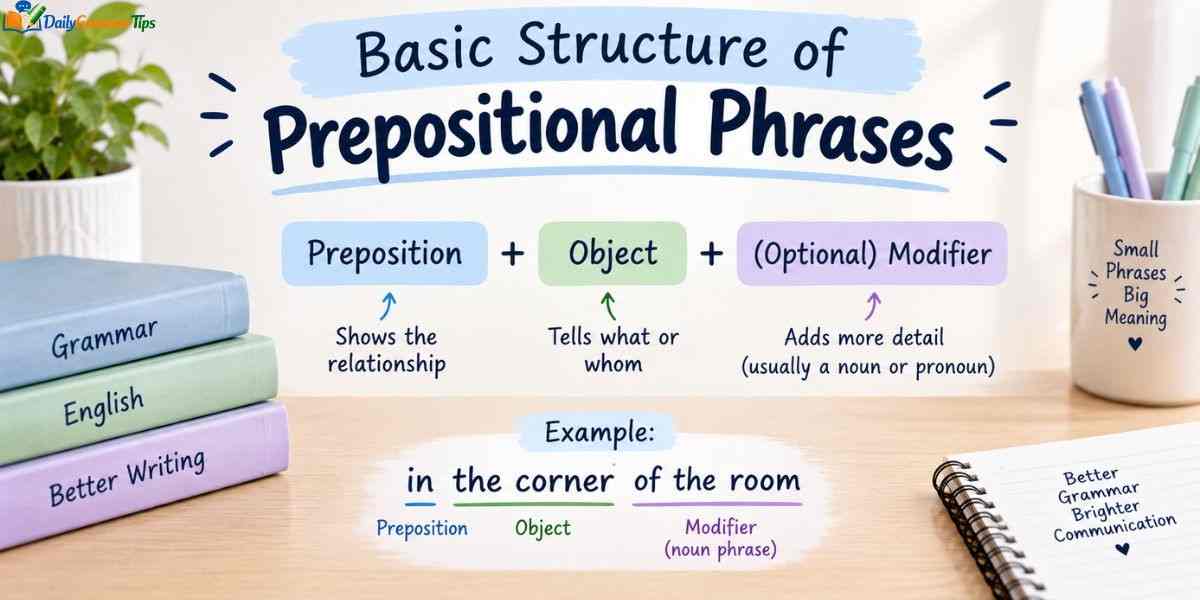
The structure is simple. First comes the preposition. Next come any modifiers. Last comes the object.
Here are three examples that follow this pattern:
- in the quiet library
- across the wide river
- during the long meeting
How to Identify Prepositional Phrases
Start by finding the preposition in the sentence. Then ask “what” or “whom” after it. The answer is the object of the preposition.
Next, check where the group of words ends. It stops right after the object. Everything from the preposition to the object makes up the phrase.
A Quick Example
Look at this sentence: “She walked to the market after lunch.” The prepositions are “to” and “after.”
The objects are “market” and “lunch.” So the phrases are “to the market” and “after lunch.”
A Common Mistake to Avoid
Do not confuse the word “to” before a verb with a preposition. In “to run,” the word “to” belongs to an infinitive verb.
Compare “to the park” with “to play.” The first is a prepositional phrase. The second is an infinitive. This small check saves you from many errors.
Types of Prepositional Phrases
Prepositional phrases fall into two main groups based on their job. They act as adjectives or as adverbs. In some cases, they also act as nouns.
Let us look at each type with clear examples.
Adjective Prepositional Phrases
Adjective phrases describe nouns or pronouns. They answer the question, “which one?” They usually come right after the noun they describe.
Here is an example: “The book on the table is mine.” The phrase “on the table” tells us which book. More examples:
- The girl with red hair won the prize.
- The road to the village is narrow.
- A cup of tea can calm you down.
Adverb Prepositional Phrases
Adverb phrases describe verbs, adjectives, or other adverbs. They answer questions such as where, when, how, why, and to what extent.
Here is an example: “We met at the station.” The phrase “at the station” tells us where we met. More examples:
- The train leaves at noon.
- She spoke with confidence.
- He stayed home because of the rain.
Prepositional Phrases as Nouns
Sometimes a phrase acts as the subject of a sentence. This mostly happens with time or place. Example: “After lunch is the best time to rest.”
Some grammar guides do not list this as a separate type. It is less common, so most writers focus on the first two types.
Prepositions Used in Prepositional Phrases
Prepositions come in many kinds. Each kind shows a different relationship. Learning them makes it easier to build strong phrases.
The next sections cover the most common groups.
Prepositions of Time
These prepositions tell us when something happens. Common ones are at, on, in, before, after, during, until, since, and by.
Use “at” for exact times, “on” for days, and “in” for months and years. Example: “We meet at nine, on Monday, in June.”
Prepositions of Place
These prepositions tell us where something is. Common ones are in, on, at, under, over, near, behind, beside, between, and among.
Example: “The keys are under the cushion.” The phrase “under the cushion” shows the exact place.
Prepositions of Direction
These prepositions show movement. Common ones are to, from, into, onto, toward, through, across, along, and around.
Example: “The children ran through the garden.” The phrase “through the garden” shows the path of movement.
Prepositions of Manner and Agent
These prepositions show how something is done or who did it. Common ones are with, by, like, and without.
Example: “The letter was written by my aunt.” The phrase “by my aunt” names the doer.
Prepositions of Cause and Purpose
These prepositions show why something happens. Common ones are for, because of, due to, and thanks to.
Example: “The match was delayed due to heavy rain.” The phrase “due to heavy rain” gives the reason.
Prepositional Phrases Examples
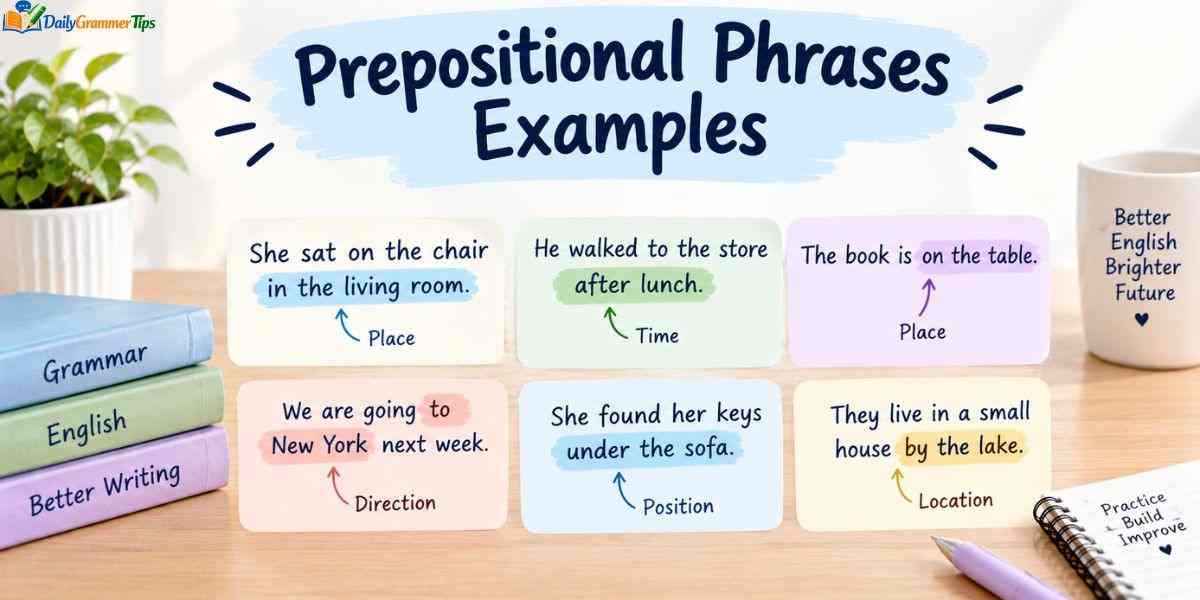
Examples make grammar easier to understand. The lists below group sentences by purpose.
In each sentence, the phrase begins with a preposition and ends with its object.
Examples of Time
- We will leave before sunrise.
- The shop opens at nine.
- She has lived here since 2015.
- They talked during dinner.
- He waited until midnight.
- The exam is on Friday.
- We travel in winter.
- Finish the report by tomorrow.
Examples of Place
- The bird sat on the fence.
- My phone is in the drawer.
- A cat hid under the bed.
- The school is near the park.
- She stood beside her brother.
- The bank is between the cafe and the pharmacy.
- He waited at the gate.
- Clouds floated above the hills.
Examples of Direction
- We drove to the airport.
- The river flows toward the sea.
- He jumped into the pool.
- She walked along the beach.
- The path leads through the forest.
- They climbed over the wall.
- Birds flew across the sky.
Examples of Manner
- She answered with a smile.
- He left without a word.
- The boy ran like the wind.
- The cake was made by hand.
- They worked in silence.
- He spoke in a calm voice.
Examples of Cause and Purpose
- We stayed inside because of the storm.
- She studied hard for the exam.
- He apologized for his mistake.
- The flight was cancelled due to fog.
- They donated money for the school.
- Thanks to your help, we finished early.
20 Examples of Prepositions in Sentences
Here are twenty sentences, each with a different preposition. The preposition begins each phrase.
- The book is on the shelf.
- We arrived at the hotel.
- She lives in London.
- The gift is for you.
- He cut the bread with a knife.
- They walked to school.
- This letter is from my uncle.
- The cat is under the chair.
- A plane flew over the city.
- She sat beside her mother.
- The ball rolled between the two chairs.
- He stood among the crowd.
- The train went through the tunnel.
- They sailed across the bay.
- The car is behind the house.
- Wash your hands before lunch.
- We watched a movie after dinner.
- He slept during the lecture.
- She wrote a book about space.
- The ladder leans against the wall.
About you research………….Relative Pronouns: Definition, List, Rules, and Examples
Position of Prepositional Phrases in a Sentence
A phrase can sit at the start, middle, or end of a sentence. Its position changes the rhythm, but not the meaning.
The key is to keep it close to the word it describes.
At the Beginning of a Sentence
Example: “In the early morning, the streets were silent.” Opening phrases often set the scene. A comma usually follows a long opener.
Short openers often skip the comma. Example: “At noon we left.”
In the Middle of a Sentence
Example: “The man in the blue coat waved at us.” The phrase sits close to the noun it describes. This keeps the meaning clear.
Place it right next to the word it modifies. Otherwise, the sentence may confuse readers.
At the End of a Sentence
Example: “We had tea in the garden.” End phrases feel natural and smooth. Most simple sentences use this pattern.
Several phrases can also appear at the end. Keep them short and clear. Example: “She waited at the station for an hour.”
Prepositional Phrases and Commas
Prepositional phrases need commas only in certain cases. Use a comma after a long opening phrase. Example: “After a long and tiring day at work, she went to bed.”
Skip the comma after short openers. Example: “In June we travel.” Also skip it when the phrase ends the sentence. Example: “I met her at the cafe.”
Subject and Verb Agreement With Prepositional Phrases
Prepositional phrases never contain the subject of a sentence. The subject sits outside the phrase. This rule helps you choose the correct verb.
Example: “The box of chocolates is on the table.” The subject is “box,” not “chocolates.” So the verb is singular.
More Agreement Examples
Cross out the phrase in your mind. The subject then becomes easy to see.
- The students in the hall are noisy.
- A bunch of flowers was on the desk.
- The price of the shoes has increased.
- The teacher with the two assistants is here.
Prepositional Phrases Compared With Other Phrases
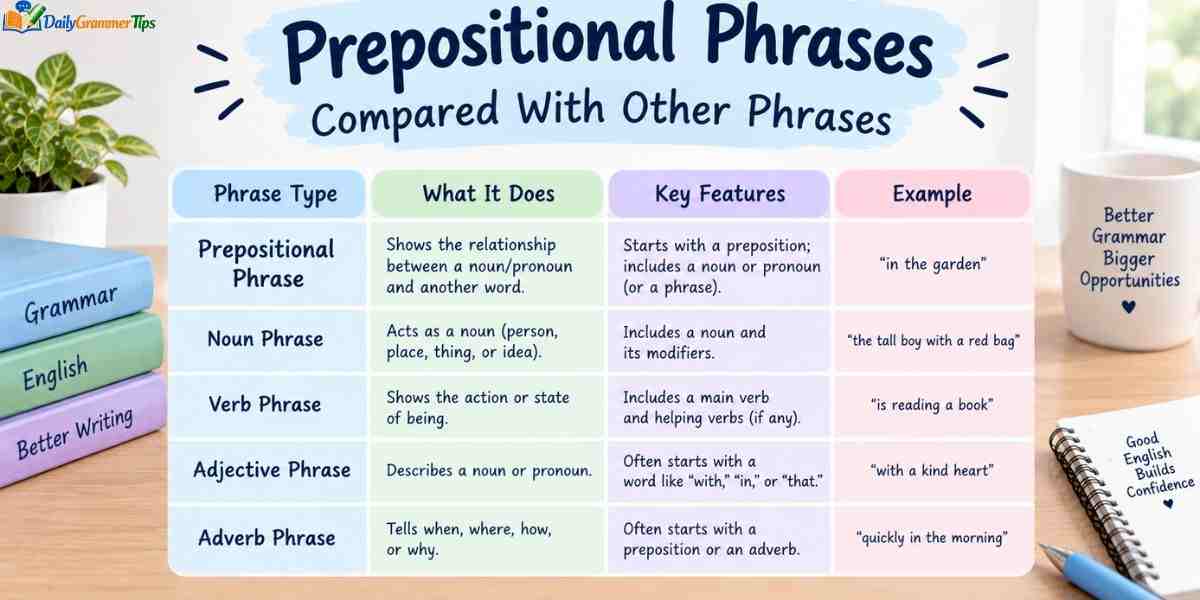
Many phrases look alike at first. A quick comparison clears the confusion. The next sections explain the main differences.
Noun Phrases
A noun phrase has a noun and its modifiers. It can serve as a subject or an object. Example: “the tall man.” It does not begin with a preposition.
A noun phrase can sit inside a prepositional phrase. In “with the tall man,” the words “the tall man” are the object.
Verb Phrases
A verb phrase has a main verb and helping verbs. Example: “has been waiting.” It shows action or state.
A prepositional phrase never shows the action. It adds detail to the action instead. Compare “is waiting” with “at the door.”
Infinitive Phrases
An infinitive phrase starts with “to” and a verb. Example: “to read a book.” It can act as a noun, adjective, or adverb.
A prepositional phrase starts with “to” and a noun. Example: “to the library.” The word after “to” tells you which one it is.
Participial Phrases
A participial phrase starts with a verb form ending in ing or ed. Example: “Running down the street, he lost his hat.”
It acts like an adjective. A prepositional phrase starts with a preposition instead.
Common Mistakes With Prepositional Phrases
Even strong writers make errors with prepositional phrases. Most mistakes come from wrong word choice or poor placement.
Learn the common errors below. They are easy to fix once you notice them.
Using the Wrong Preposition
Some prepositions look similar but have different uses. Writers often mix up in, on, and at. Here are common fixes:
- Wrong: She is good in math. Right: She is good at math.
- Wrong: I am interested on music. Right: I am interested in music.
- Wrong: He arrived to the office. Right: He arrived at the office.
Misplaced Phrases
A phrase placed far from the word it describes can confuse readers. Compare these two sentences.
Unclear: “She served cake to the guests on paper plates.” Better: “She served the guests cake on paper plates.”
Missing Objects
Every preposition needs an object. A group of words like “He looked at” feels unfinished. Add the missing noun to fix it.
Example: “He looked at the painting.” Now the phrase “at the painting” is complete.
Too Many Phrases in One Sentence
Long chains of phrases weaken your writing. Example: “The meeting in the room on the top floor of the building in the city started at noon.”
Break it down. Better: “The meeting started at noon in the city office.”
Ending a Sentence With a Preposition
An old rule says never end a sentence with a preposition. Modern guides allow it in casual writing. Example: “Who are you talking to?”
In formal writing, you can rewrite it. Example: “To whom are you talking?” Choose the style that fits your reader.
Tips to Use Prepositional Phrases Better
Smart use of prepositional phrases makes writing clear and smooth. Follow these simple tips.
Each tip below takes only a minute to apply.
Keep Phrases Close to the Words They Modify
Place each phrase right after the noun or verb it describes. This avoids confusion.
Example: “The woman with the umbrella smiled.” This is clearer than “The woman smiled with the umbrella.”
Vary Your Sentence Openers
Starting every sentence the same way feels dull. Open some with a phrase. Example: “After the storm, the air felt fresh.”
Do not overdo it. One or two openers per paragraph is enough.
Cut Extra Phrases
Many wordy phrases have shorter forms. Replace them to keep your writing tight.
- in the month of May becomes in May
- at this point in time becomes now
- due to the fact that becomes because
- in the event that becomes if
Read Your Sentences Aloud
Reading aloud shows clunky chains. If you run out of breath, the sentence is too long.
Split it into two shorter sentences. Your reader will thank you.
Prepositional Phrases in Everyday and Formal Writing
Everyday speech uses these phrases all the time. We say “at home,” “on time,” and “in a hurry” without thinking.
Formal writing uses them more carefully. Reports and essays need precise phrases. Choose each one with purpose.
In Conversation
Spoken English favors short phrases. Example: “See you at six.”
They keep speech quick and natural. Most people use them without any effort.
In Academic Writing
Academic writing uses phrases to add exact detail. Example: “The study was conducted over three months.”
Time, place, and method often appear in these phrases. They help readers follow the research.
In Business Writing
Business writing needs clear phrases. Example: “Please send the report by Friday.”
Clear deadlines and places prevent confusion. They make emails and reports easier to act on.
Prepositions That Cause Confusion
Some prepositions cause trouble inside prepositional phrases. A few simple rules clear up most doubts.
Look at the pairs below.
In and Into
Use “in” for position. Use “into” for movement.
Example: “The child is in the room.” Compare it with “The child ran into the room.”
Between and Among
Use “between” for two things. Use “among” for three or more.
Example: “Sit between Ali and Sara.” Compare it with “Sit among the guests.”
For, Since, and During
Use “for” for length of time. Use “since” for a starting point. Use “during” for a period.
Examples: “for two hours,” “since Monday,” and “during the film.”
Beside and Besides
“Beside” means next to. “Besides” means in addition to.
Example: “She sat beside me.” Compare it with “Besides tea, we had cake.”
Common Prepositional Phrases and Fixed Expressions
Some phrases appear again and again. Learning them as chunks saves time.
Use the lists below as a quick reference.
Phrases With At
Common ones are at home, at work, at night, at last, and at least.
Example: “At last, we reached the top.”
Phrases With In
Common ones are in time, in fact, in charge, in love, and in a hurry.
Example: “She was in charge of the project.”
Phrases With On
Common ones are on time, on purpose, on foot, on holiday, and on fire.
Example: “We went to school on foot.”
Phrases With By
Common ones are by chance, by hand, by mistake, and by heart.
Example: “He learned the poem by heart.”
Compound Prepositions
Compound prepositions use two or three words. Common ones are according to, because of, in front of, in spite of, instead of, on behalf of, out of, and next to.
Example: “We played outside in spite of the rain.”
Prepositional Phrases for English Learners
Learners often find prepositions tricky. Many do not translate directly from other languages. That is why prepositional phrases need regular practice.
Small daily habits bring steady progress.
Learn Them in Chunks
Memorize phrases like “on time” and “in the morning” as single units. This feels easier than learning each preposition alone.
Read and Listen Often
Books, news, and podcasts show how phrases appear in real life. Notice the preposition each time you meet a new phrase.
Practice With Short Sentences
Write five short sentences each day. Mark each phrase you use. Then check the preposition and the object.
Keep a Personal List
Write new phrases in a notebook. Add one example sentence for each. Review the list every week.
Practice Exercises on Prepositional Phrases
These short exercises will test your skill with prepositional phrases. Try them before you read the answers.
Each exercise has five questions.
Exercise 1: Find the Phrase
Find the phrase in each sentence.
- The dog slept under the table.
- We will meet after school.
- She sent a gift to her friend.
- The man with the hat is my uncle.
- They walked along the river.
Exercise 2: Choose the Correct Preposition
Fill each blank with at, in, on, by, or for.
- I will see you (blank) Monday.
- She was born (blank) 1998.
- We waited (blank) the bus stop.
- This card is (blank) my mother.
- The poem was written (blank) a young girl.
Answers
Here are the correct answers for both exercises.
- Exercise 1: under the table, after school, to her friend, with the hat, along the river.
- Exercise 2: on, in, at, for, by.
Why Prepositional Phrases Matter
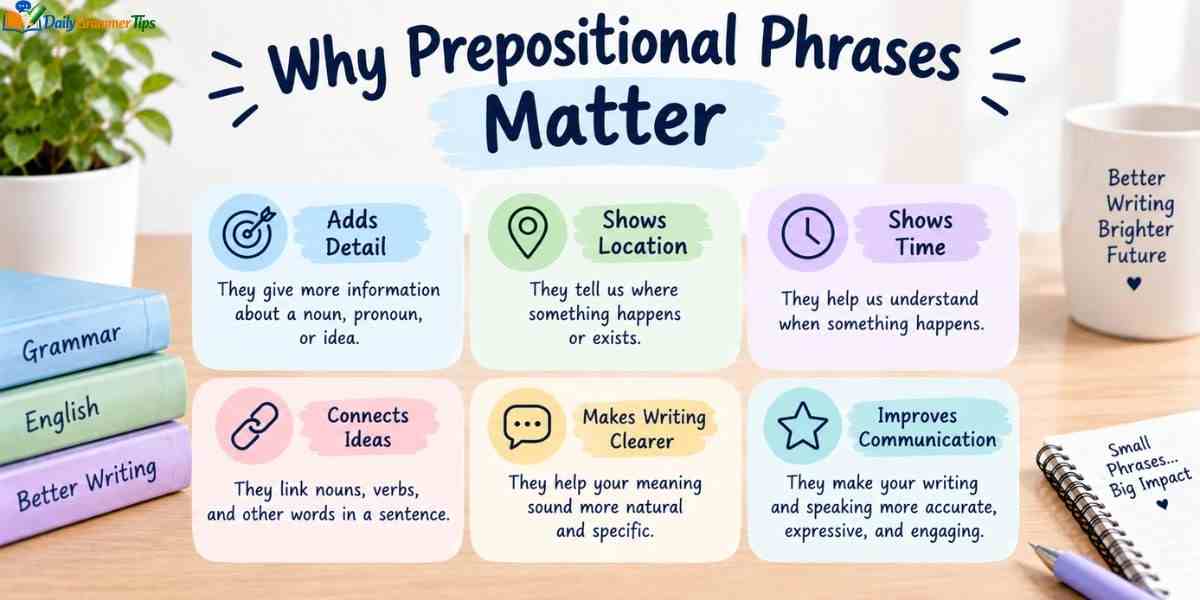
Prepositional phrases add detail and clarity to every sentence. They tell readers when, where, how, and why.
Strong writers use prepositional phrases with care. They keep each one short and place it well.
They Add Detail
Compare “The dog barked” with “The dog barked at the mailman in the morning.” The second sentence tells us much more.
They Improve Flow
Phrases link ideas smoothly. They help sentences move from one point to the next without a jolt.
Frequently Asked Questions
What Are 5 Examples of Prepositional Phrases?
Five examples are “on the table,” “in the garden,” “after school,” “with my friend,” and “under the bridge.”
What Are 20 Examples of Prepositions in Sentences?
You can find twenty sentences with different prepositions in the section above. Examples include “The book is on the shelf” and “She lives in London.”
What Are Prepositional Phrases?
They are groups of words that start with a preposition and end with a noun or pronoun, such as “in the park.”
How to Identify a Preposition Phrase?
Find the preposition, then find its object. The words from the preposition to the object form the phrase.
What Is a Sentence With a Prepositional Phrase?
“The children played in the garden” is one. The phrase “in the garden” tells us where they played.
Conclusion
Prepositional phrases are small but powerful tools in English. They begin with a preposition and end with an object. They add time, place, direction, and reason to any sentence.
Keep practicing prepositional phrases every day. Spot them in your reading, use them in your own sentences, and watch your writing become clearer.
