

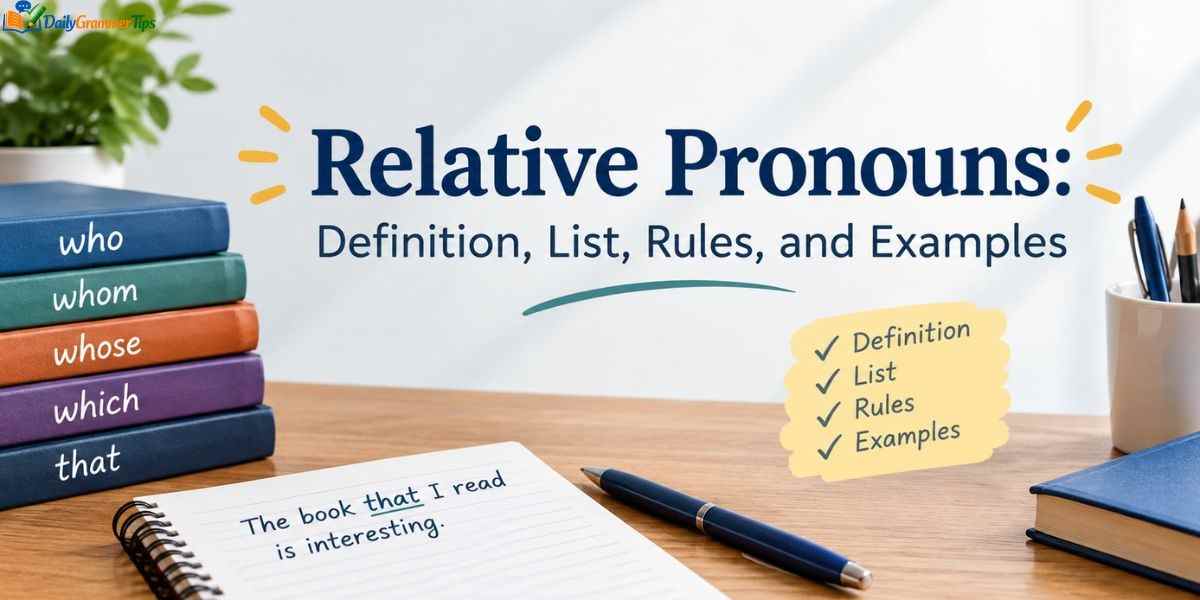
Relative pronouns link ideas and make sentences flow smoothly. They save us from short, choppy sentences. They also add useful detail about people and things.
This guide explains relative pronouns in plain words. You will learn the list, the rules, and the common mistakes. Many clear examples will help each idea stick.
What Are Relative Pronouns?
Relative pronouns are words that introduce a relative clause. The main ones are who, whom, whose, which, and that. They connect the clause to a noun in the main sentence.
Take this sentence: “The teacher who helped me is kind.” The word “who” links the clause “who helped me” to the noun “teacher.”
Simple Definition of a Relative Pronoun
A relative pronoun replaces a noun and joins two ideas. It refers back to a person or thing already named.
Without it, we would need two sentences. With it, we need only one. Compare “I met a girl. She plays chess.” with “I met a girl who plays chess.”
List of Relative Pronouns
The most common ones are who, whom, whose, which, and that. Each one has its own job. Some refer to people, and others refer to things.
A second group adds the ending “ever.” These include whoever, whomever, whichever, and whatever. The word “what” also works in some sentences.
10 Relative Pronouns With Examples
Here are ten common ones with one example each.
- Who: The man who called you is waiting.
- Whom: The woman whom I met was friendly.
- Whose: The boy whose bag is blue is my brother.
- Which: The book which I borrowed is old.
- That: The song that you chose is lovely.
- Whoever: Whoever finishes first wins a prize.
- Whomever: Invite whomever you like.
- Whichever: Take whichever seat you prefer.
- Whatever: Whatever you decide is fine with me.
- What: I understand what you mean.
Parts of Sentences With Relative Pronouns
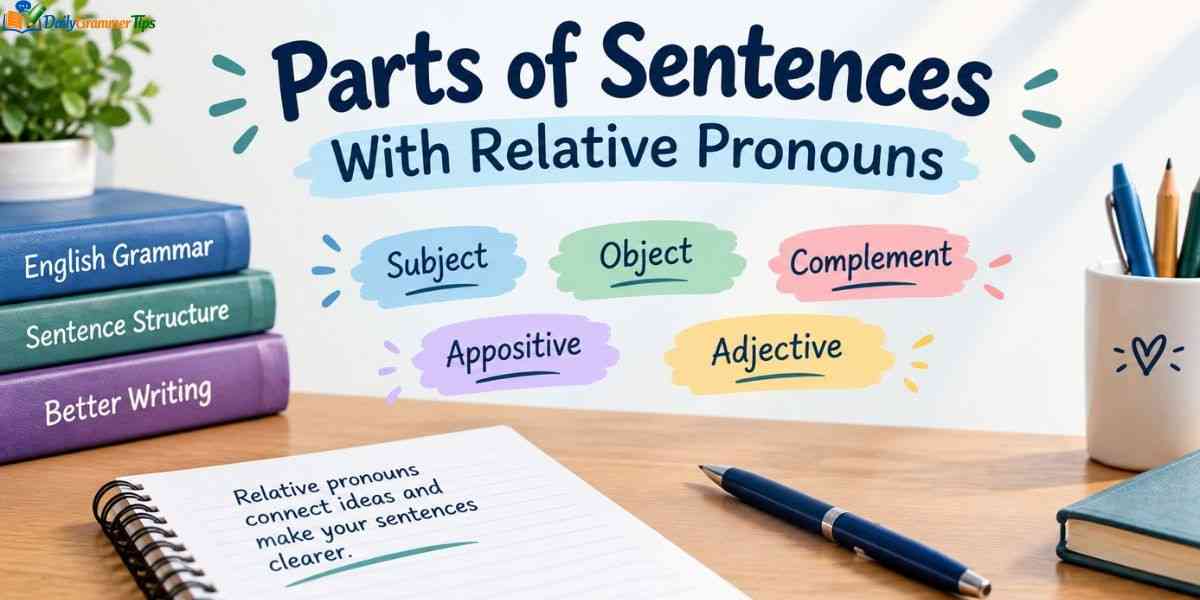
Three parts work together in these sentences. They are the antecedent, the pronoun, and the clause. Knowing them makes the rules easier.
Let us look at each part.
The Antecedent
The antecedent is the noun that the pronoun refers to. In “the car that broke down,” the antecedent is “car.” The pronoun always points back to it.
Place the pronoun right after the antecedent. This keeps the meaning clear.
The Relative Pronoun
It sits at the start of the clause. It links the clause to the antecedent. Inside the clause, it acts as a subject or an object.
In “the book that I read,” the word “that” is the object of “read.”
The Relative Clause
The clause begins with the pronoun and gives more detail. It has its own subject and verb. In “the girl who sings,” the clause is “who sings.”
A relative clause cannot stand alone. It depends on the main sentence.
How Relative Pronouns Work
These words do two jobs at once. They replace a noun, and they connect two clauses. This is why they make writing tighter.
Look at this pair: “The dog barked. The dog was loud.” We can join them: “The dog that barked was loud.”
Types of Relative Pronouns
Relative pronouns fall into groups based on what they refer to. Some refer to people, some to things, and some show ownership.
The next sections cover each group.
Relative Pronouns for People
Who, whom, and whose refer to people. Whoever and whomever work the same way. Use them when the antecedent is a person.
- The singer who won is my neighbor.
- The coach whom we admire is retiring.
- The girl whose kite flew away is crying.
Relative Pronouns for Things
Which and that refer to things and animals. Whichever and whatever also fit here.
- The table which stands in the hall is old.
- The idea that she shared was brilliant.
- The horse that won the race is famous.
Relative Pronouns That Show Possession
Whose shows ownership. It works for people and, at times, for things.
- The author whose book sold well is visiting.
- The house whose roof is red belongs to us.
Relative Pronouns in Defining Clauses
Defining clauses give essential information. Without them, the sentence loses its meaning. We do not use commas with them.
Example: “The student who studies hard passes.” The clause tells us which student.
Relative Pronouns in Nondefining Clauses
Nondefining clauses add extra information. The sentence still makes sense without them. We set them off with commas.
Example: “My brother, who lives abroad, is visiting.” The clause adds a bonus detail. Use “who” or “which” here, never “that.”
Each Relative Pronoun Explained
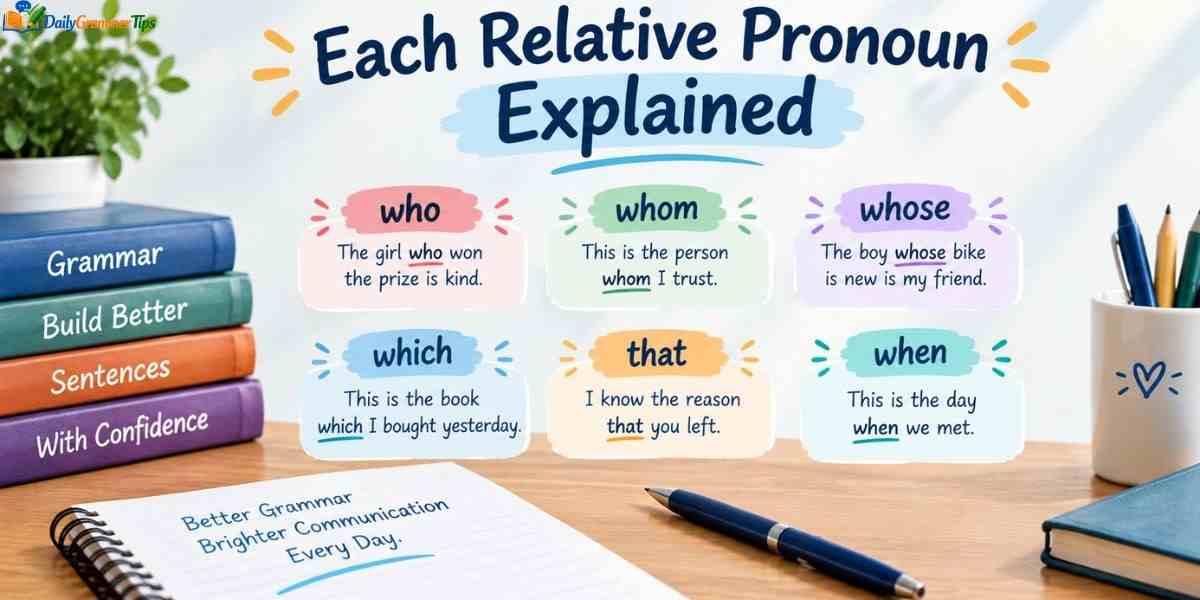
Each word has its own rules. The sections below cover them one by one.
Who
“Who” refers to people. It acts as the subject of a clause. Example: “The doctor who treated me was kind.”
Try replacing it with “he,” “she,” or “they” in your mind. If that works, “who” is correct.
Whom
“Whom” refers to people and acts as an object. Example: “The man whom we met is a pilot.”
Today, “whom” sounds formal. Many speakers use “who” instead in casual talk.
Whose
“Whose” shows ownership. It works for people and sometimes for things. Example: “The girl whose phone rang left early.”
Do not confuse it with “who’s.” The word “who’s” means “who is.”
Which
“Which” refers to things and animals. It works in both defining and nondefining clauses. Example: “The car, which is red, is mine.”
Use commas with it when it adds extra information.
That
“That” refers to people, animals, and things. It works best in defining clauses. Example: “The movie that we watched was funny.”
Never place a comma before it.
Whoever and Whomever
These words mean “any person who.” Example: “Whoever calls first gets the ticket.”
Use “whomever” when the word acts as an object. Example: “Give it to whomever you trust.”
Whichever and Whatever
“Whichever” points to a choice from a set. “Whatever” points to anything at all.
Examples: “Choose whichever you like.” and “Whatever happens, stay calm.”
What
“What” means “the thing that.” Example: “I know what you need.”
It does not need an antecedent. That makes it special.
Who vs Whom
Use “who” for subjects and “whom” for objects. Here is a quick test. Replace the word with “he” or “him.” If “he” fits, use “who.” If “him” fits, use “whom.”
Example: “The student who won is here.” We can say “he won.” Another example: “The student whom we praised is here.” We can say “we praised him.”
Which vs That
Use “that” for essential information. Use “which” with commas for extra information.
Compare “The book that I read was long” with “The book, which I read last week, was long.” The commas make the difference.
Relative Pronouns Examples
Examples make the rules easier to see. The lists below group sentences by pronoun.
Examples With Who
- The woman who lives next door is a nurse.
- I know a boy who speaks four languages.
- People who exercise often sleep better.
- She is the one who fixed my laptop.
- The man who called you left a message.
Examples With Whom
- The girl with whom I studied is a doctor now.
- He is the person whom I trust most.
- The teacher whom everyone loves retired.
- The friend whom you met is my cousin.
- The artist whom we admire is visiting.
Examples With Whose
- The man whose car was stolen called the police.
- I met a woman whose voice sounded familiar.
- The child whose toy broke started crying.
- The company whose logo is blue hired me.
- She is a writer whose books sell worldwide.
Examples With Which
- The movie which we saw was long.
- The bag, which is on the chair, is mine.
- This is the town in which I was born.
- The phone which I bought last week stopped working.
- Her car, which is very old, still runs well.
Examples With That
- The cake that she baked was delicious.
- The shoes that I wore hurt my feet.
- This is the pen that I lost.
- The app that you recommended is great.
- The letter that arrived today is for you.
Learn more…………Helping Verbs: Definition, List, Rules, and Examples
20 Examples of Relative Pronouns With Answers
Find the pronoun in each sentence. The answer follows each one.
- The boy who won the prize is my friend. Answer: who
- The book that you gave me is excellent. Answer: that
- The woman whom I met was a lawyer. Answer: whom
- The car which she drives is blue. Answer: which
- The girl whose bag is red is my sister. Answer: whose
- Whoever arrives first will get a seat. Answer: whoever
- I will help whomever you recommend. Answer: whomever
- Take whichever you like best. Answer: whichever
- Whatever you choose is fine. Answer: whatever
- I know what you did. Answer: what
- The man who fixed my sink was polite. Answer: who
- The movie that we watched was scary. Answer: that
- The lady whom he married is a singer. Answer: whom
- The house which stands on the hill is old. Answer: which
- The artist whose painting sold is famous. Answer: whose
- The students who study daily improve fast. Answer: who
- The song that played on the radio was lovely. Answer: that
- The neighbor whom I called was away. Answer: whom
- The tree which fell last night was huge. Answer: which
- She is the girl whose dream came true. Answer: whose
Relative Pronouns and Commas
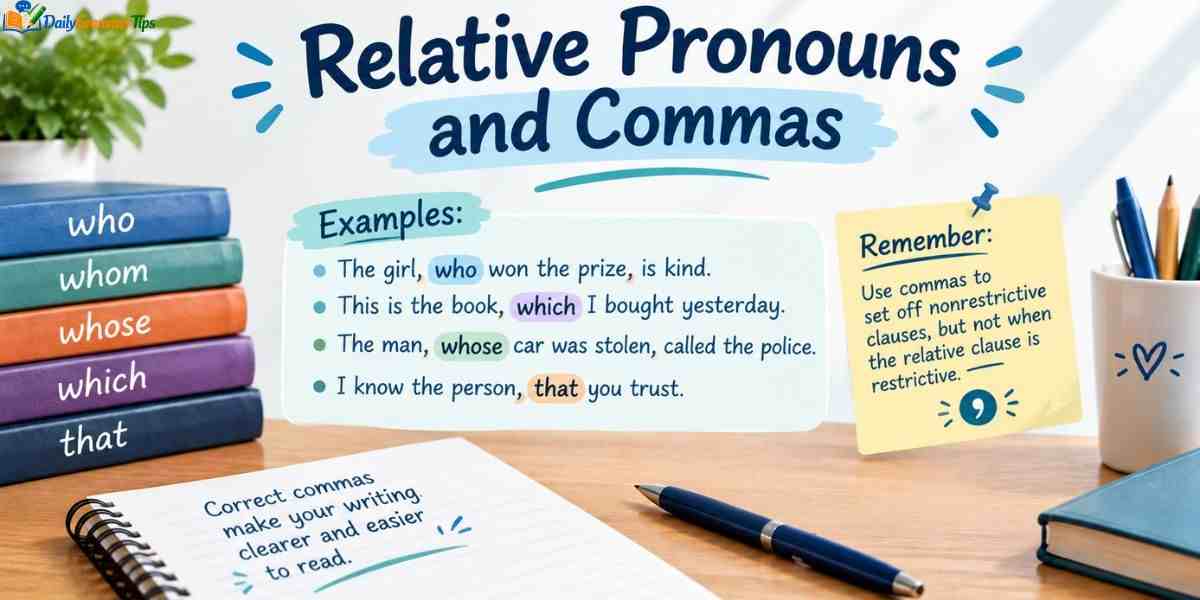
Commas depend on the type of clause. Use commas with extra information. Skip them with essential information.
Compare “My brother, who lives abroad, called me” with “The man who lives abroad called me.” The first adds a bonus detail. The second identifies the man.
Relative Pronouns as Subjects and Objects
A pronoun of this kind can be the subject or the object inside its clause. This choice affects which word you use.
As a subject, it comes before the verb. As an object, it comes before another subject.
As the Subject
In “The man who called is here,” the word “who” is the subject of “called.”
We cannot remove a subject pronoun. The sentence would break.
As the Object
In “The man whom I called is here,” the word “whom” is the object of “called.”
An object pronoun is often optional. We can say, “The man I called is here.”
Can You Omit Relative Pronouns?
You can drop the pronoun when it is the object of its clause. This is common in speech.
Example: “The movie that I saw was great” becomes “The movie I saw was great.” You cannot drop it when it is the subject.
- Keep it: The woman who called is here.
- Drop it: The woman I called is here.
Relative Pronouns and Prepositions
A preposition can come before the pronoun or at the end of the clause. The first style sounds formal. The second sounds natural in speech.
Example: “The house in which I grew up is old.” Another way: “The house that I grew up in is old.”
Remember one rule. Only “whom” and “which” can follow a preposition directly. Never place “who” or “that” right after one.
Relative Pronouns and Verb Agreement
The verb in a relative clause must agree with the antecedent. This rule trips up many writers.
Example: “The boy who plays chess is my brother.” The verb is singular because “boy” is singular.
- The students who study hard pass.
- She is one of the girls who play chess.
- The book that lies on the table is mine.
Relative Pronouns vs Relative Adverbs
Relative adverbs are where, when, and why. They also introduce clauses. The difference is that they replace adverbs, not nouns.
Example: “This is the town where I was born.” The word “where” stands for “in which.”
- I remember the day when we met.
- Tell me the reason why you left.
Relative Pronouns vs Interrogative Pronouns
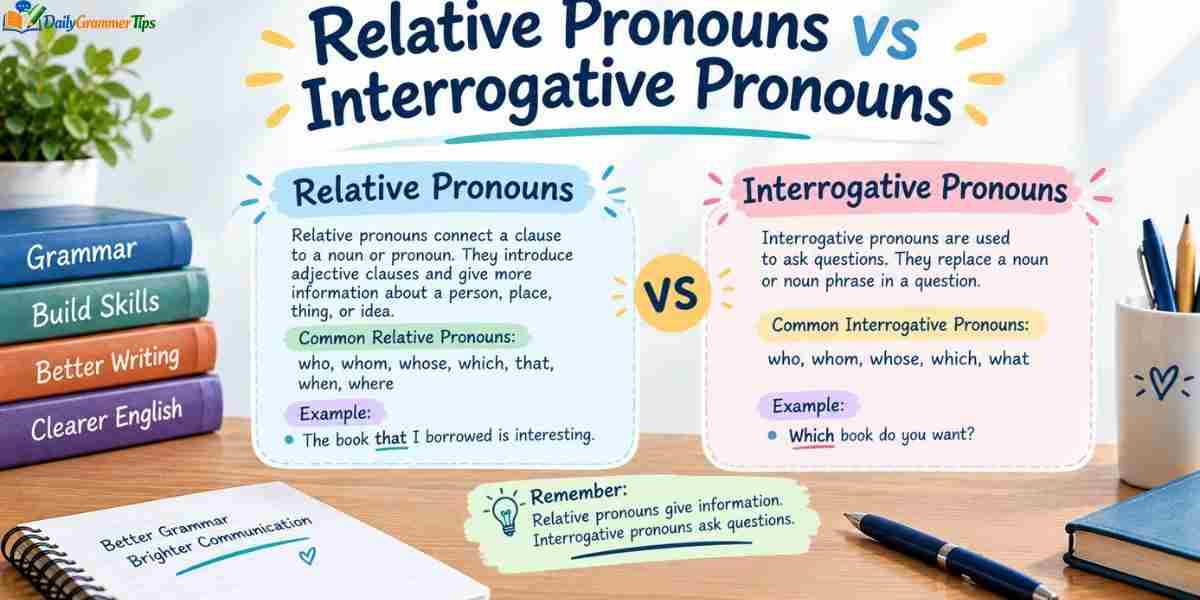
Interrogative pronouns ask questions. They include who, whom, whose, which, and what. These words look the same but act differently.
Compare “Who called you?” with “The man who called you is here.” The first asks. The second links.
Is “I Love You” a Pronoun?
No. “I love you” is a complete sentence, not a pronoun. It has a subject, a verb, and an object.
Inside it, “I” and “you” are personal pronouns. The word “love” is the verb. None of these words link a clause to a noun.
Common Mistakes With Relative Pronouns
Even good writers slip with these words. Most errors are easy to fix once you spot them.
Learn the common ones below.
Using That in Nondefining Clauses
Avoid “that” when you add extra information. Use “which” with commas instead.
- Wrong: My car, that is old, runs well.
- Right: My car, which is old, runs well.
Mixing Up Who and Whom
Use “who” for subjects and “whom” for objects. Try the “he” and “him” test.
- Wrong: The man who I met was kind.
- Right: The man whom I met was kind.
Using Which for People
Do not use “which” for people. Use “who,” “whom,” or “that” instead.
- Wrong: The girl which sings is my sister.
- Right: The girl who sings is my sister.
Adding an Extra Pronoun
Do not repeat the object inside the clause. The pronoun already stands for it.
- Wrong: The book that I read it was long.
- Right: The book that I read was long.
Placing the Clause Too Far Away
Keep the clause next to its antecedent. A distant clause confuses readers.
- Unclear: I saw a dog on the way home that was barking.
- Clear: On the way home, I saw a dog that was barking.
Tips to Use Relative Pronouns Correctly
A few habits make your sentences cleaner. Each tip takes only a minute to apply.
Match the Pronoun to the Antecedent
Use “who” for people and “which” for things. Use “that” for either one.
This simple match prevents most errors.
Keep Clauses Short
Long clauses bury the main idea. Split a sentence when a clause grows too heavy.
Short clauses read faster and sound clearer.
Use Commas Wisely
Add commas for extra information. Skip them for essential information.
Read the sentence without the clause. If the meaning holds, add commas.
Try the He and Him Test
Replace the pronoun with “he” or “him.” Pick “who” for “he.” Pick “whom” for “him.”
This trick works in seconds.
Relative Pronouns for English Learners
Learners often find these words tricky. Many languages handle them in different ways. That is why daily practice matters.
Small steps bring steady progress.
Start With Who, Which, and That
These three cover most sentences. Master them before you move on.
Then add “whose” and “whom.”
Combine Short Sentences
Take two short sentences. Join them with a pronoun. Example: “I have a friend. She lives in Paris.” becomes “I have a friend who lives in Paris.”
Read and Notice
Read news, stories, and blogs. Mark each pronoun you meet. Notice which noun it points to.
Keep a Personal List
Write new sentences in a notebook. Review them every week.
How to Explain Relative Pronouns to a Child
Use simple words and short examples. Tell the child that these words are joining words. They link a describing part to a person or thing.
Keep each lesson short and playful. Children learn best when they enjoy the activity.
Use the Glue Idea
Say that the word works like glue. It sticks two small sentences together.
Show it: “I see a dog. The dog is brown.” becomes “I see a dog that is brown.”
Play a Matching Game
Write who, which, and that on cards. Write nouns on other cards. Ask the child to match each pronoun to a noun.
Use “who” for people. Use “which” and “that” for things.
Use Child Friendly Examples
Pick topics kids love, like pets, toys, and games.
- The dog that barks is mine.
- The girl who sings is my friend.
- The toy which broke is on the floor.
- The boy whose ball rolled away is sad.
Practice Exercises on Relative Pronouns
These short exercises will build your confidence. Try them before you read the answers.
Each exercise has five questions.
Exercise 1: Fill in the Blank
Choose from who, whom, whose, which, or that.
- The girl (blank) won the race is my cousin.
- The man (blank) I met was a pilot.
- The boy (blank) bag is red is my friend.
- The car (blank) I bought is new.
- The song (blank) she sang was lovely.
Exercise 2: Join the Sentences
Join each pair with a pronoun.
- I know a girl. She plays the violin.
- This is the book. I told you about it.
- We met a man. His dog was lost.
- The shop is closed. It sells shoes.
- She is the teacher. Everyone admires her.
Answers
Here are the correct answers.
- Exercise 1: who, whom, whose, which, that.
- Exercise 2, one: I know a girl who plays the violin.
- Exercise 2, two: This is the book that I told you about.
- Exercise 2, three: We met a man whose dog was lost.
- Exercise 2, four: The shop which sells shoes is closed.
- Exercise 2, five: She is the teacher whom everyone admires.
Why Relative Pronouns Matter
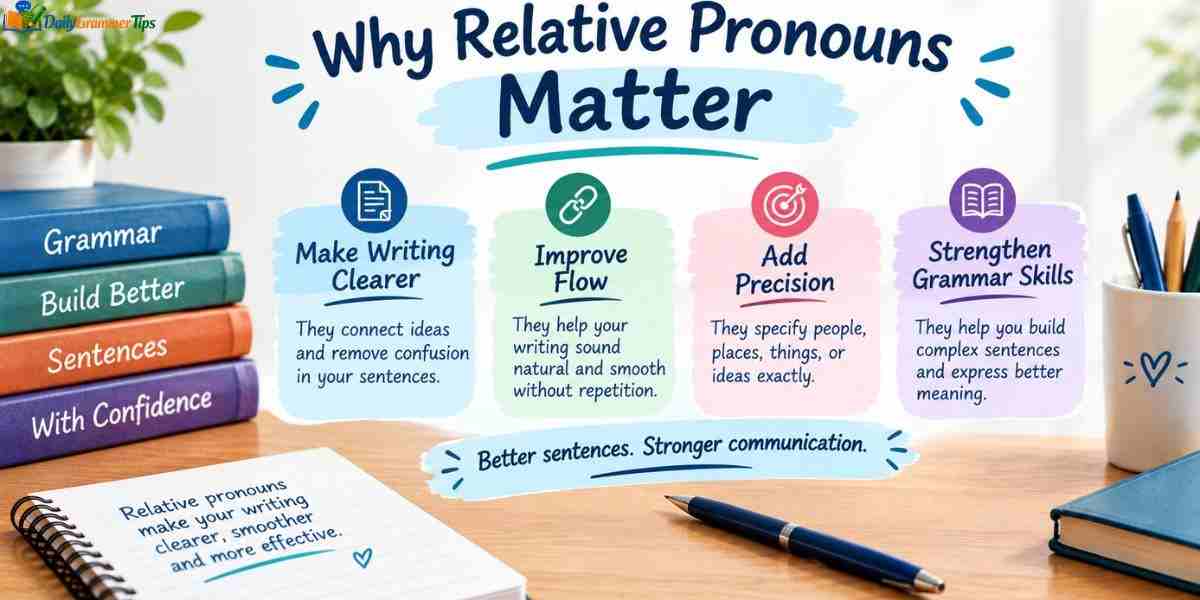
Relative pronouns help us write smooth and connected sentences. They let us add detail without extra sentences.
Good writers use relative pronouns to avoid choppy text. They keep readers engaged from start to end.
They Add Detail
Compare “I met a woman” with “I met a woman who teaches music.” The second sentence tells us much more.
They Improve Flow
Joined ideas move naturally. Readers glide from one point to the next..
Frequently Asked Questions
What Are Relative Pronouns and Examples?
They are words like who, whom, whose, which, and that. They join a clause to a noun. Example: “The girl who sings is my sister.”
What Are 10 Relative Pronouns?
The ten are who, whom, whose, which, that, whoever, whomever, whichever, whatever, and what.
What Are the 20 Examples of Relative Pronouns With Answers?
You can find twenty sentences with answers in the section above. One is “The boy who won the prize is my friend.” Answer: who.
Is “I Love You” a Pronoun?
No, it is a full sentence. The words “I” and “you” are personal pronouns inside it.
How to Explain Relative Pronouns to a Child?
Call them joining words that link a describing part to a person or thing. Use short examples like “The dog that barks is mine.”
Conclusion
Relative pronouns are small words with a big job. They join clauses, add useful detail, and help your sentences flow without choppy breaks. Once you know who, whom, whose, which, and that, you can describe people and things with clarity. You also understand the rules for commas, subjects, objects, and prepositions.
Keep practicing relative pronouns in your daily writing. Join short sentences, check each antecedent, and read your work aloud to catch errors. Use the “he” and “him” test whenever who and whom confuse you. With steady practice, your writing will sound smoother, clearer, and more confident.
