

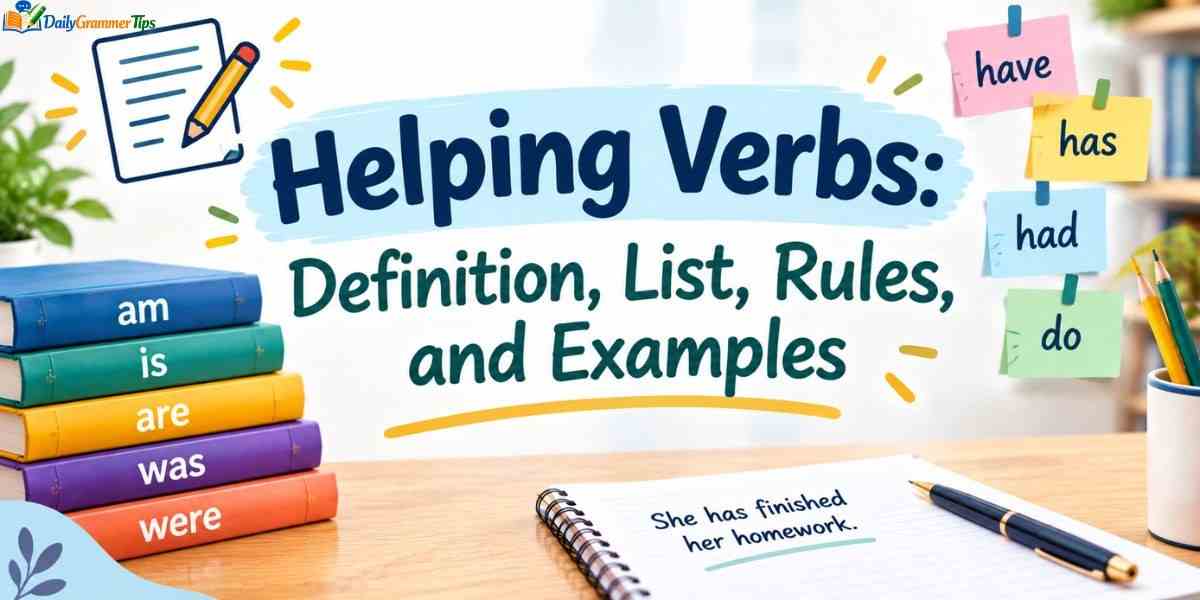
Helping verbs play a quiet but powerful role in English. They work beside the main verb and shape its meaning. With them, you can show time, ability, duty, or possibility in a few small words. Without them, your sentences would feel flat and unclear.
This guide explains helping verbs in simple, practical steps. You will see the full list of 23 verbs, learn their types, and study clear examples. You will also find common mistakes, tips, and practice exercises. By the end, you will use each helper with confidence.
What Are Helping Verbs?
Helping verbs are words that work together with a main verb. They add detail about time, ability, duty, or possibility. Grammar books also call them auxiliary verbs.
Look at this sentence: “She is reading a book.” The word “is” helps the main verb “reading.” Together they form a verb phrase.
What Is a Helping Verb?
A helping verb is a verb that comes before the main verb. It supports the main verb and shows tense, mood, or voice.
Here is a quick test. If a verb comes before another verb, it may be a helper. Example: “They will travel tomorrow.” The word “will” helps “travel.”
List of the 23 Helping Verbs
English has twenty three common helping verbs. Here is the full set in one list.
Nine of them are modal verbs. The other fourteen are forms of be, have, and do.
- Forms of be: am, is, are, was, were, be, being, been
- Forms of have: have, has, had
- Forms of do: do, does, did
- Modal verbs: can, could, may, might, shall, should, will, would, must
Types of Helping Verbs
Helping verbs fall into two groups. They are primary verbs and modal verbs.
Each group has its own job. The next sections explain both.
Primary Helping Verbs
Primary helping verbs are the forms of be, have, and do. They can also act as main verbs in other sentences.
Compare “She has a car” with “She has finished work.” In the first, “has” is the main verb. In the second, it is a helper.
Modal Helping Verbs
Modal verbs add meaning such as ability, permission, duty, or chance. They never change form. They always take the base form of the next verb.
Example: “He can swim.” We do not say “He can swims.”
How Helping Verbs Work
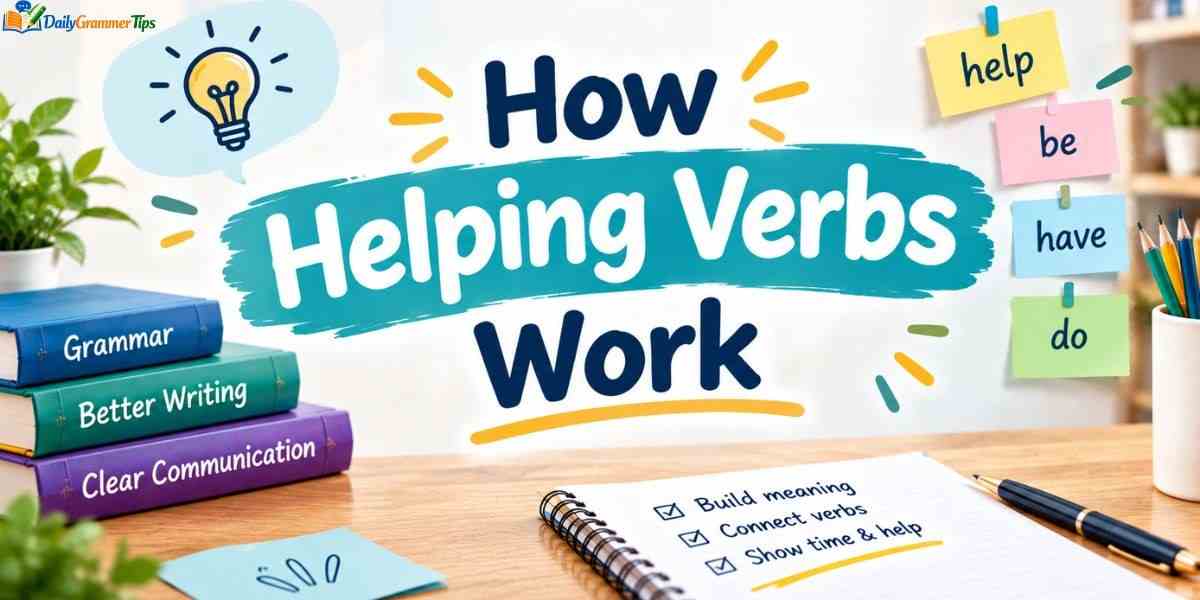
Helping verbs sit before the main verb. Together they make a verb phrase. The helper carries the tense, and the main verb carries the meaning.
Look at “They have finished.” The helper “have” shows the present perfect tense. The main verb “finished” shows the action.
Helping Verbs and Main Verbs
Helping verbs never stand alone in a verb phrase. They need a main verb to complete the idea.
Some verbs play both roles. The word “do” is a helper in “I do not know.” It is a main verb in “I do homework.”
- Helper: She does not eat meat.
- Main verb: She does her homework daily.
Helping Verbs and Verb Tenses
Helping verbs build most English tenses. Each tense uses a certain helper and verb form.
Let us look at three groups of tenses.
Simple Tenses
Simple tenses use do, does, and did for questions and negatives. They use “will” for the future.
Examples: “I will call you.” and “Did you call?”
Continuous Tenses
Continuous tenses use a form of be with an ing verb.
Examples: “She is cooking dinner.” and “They were playing outside.”
Perfect Tenses
Perfect tenses use have, has, or had with a past participle.
Examples: “We have eaten.” and “He had left before noon.”
Helping Verbs in Questions
Helping verbs also help us ask questions. We move the helper before the subject.
Example: “You are ready” becomes “Are you ready?” When no helper exists, we add do, does, or did.
- Is she coming?
- Can you help me?
- Do they live here?
- Have you finished?
Helping Verbs in Negative Sentences
Helping verbs make negative sentences easy. We add “not” after the helper.
Examples: “She is not here.” and “He does not like tea.” Short forms like “isn’t” and “doesn’t” are common in speech.
Helping Verbs in the Passive Voice
Helping verbs also build the passive voice. The pattern is a form of be with a past participle.
Example: “The cake was baked by Sara.” The helper “was” and the participle “baked” show the passive.
- The letter is written every week.
- The house was built in 1990.
- The work has been finished.
- The plan will be approved soon.
Modal Verbs Explained
Modal verbs deserve a closer look. Each one has its own shades of meaning.
The sections below explain them in pairs.
Can and Could
“Can” shows ability or permission. “Could” shows past ability or a polite request.
Examples: “I can swim.” and “Could you help me?”
May and Might
“May” shows permission or a likely chance. “Might” shows a weaker chance.
Examples: “You may go.” and “It might rain.”
Shall and Should
“Shall” shows offers or suggestions in formal English. “Should” shows advice.
Examples: “Shall we begin?” and “You should rest.”
Will and Would
“Will” shows the future or a promise. “Would” shows habits or polite requests.
Examples: “I will call.” and “Would you like tea?”
Must
“Must” shows strong duty or a firm guess.
Examples: “You must wear a helmet.” and “She must be tired.”
Helping Verbs Examples
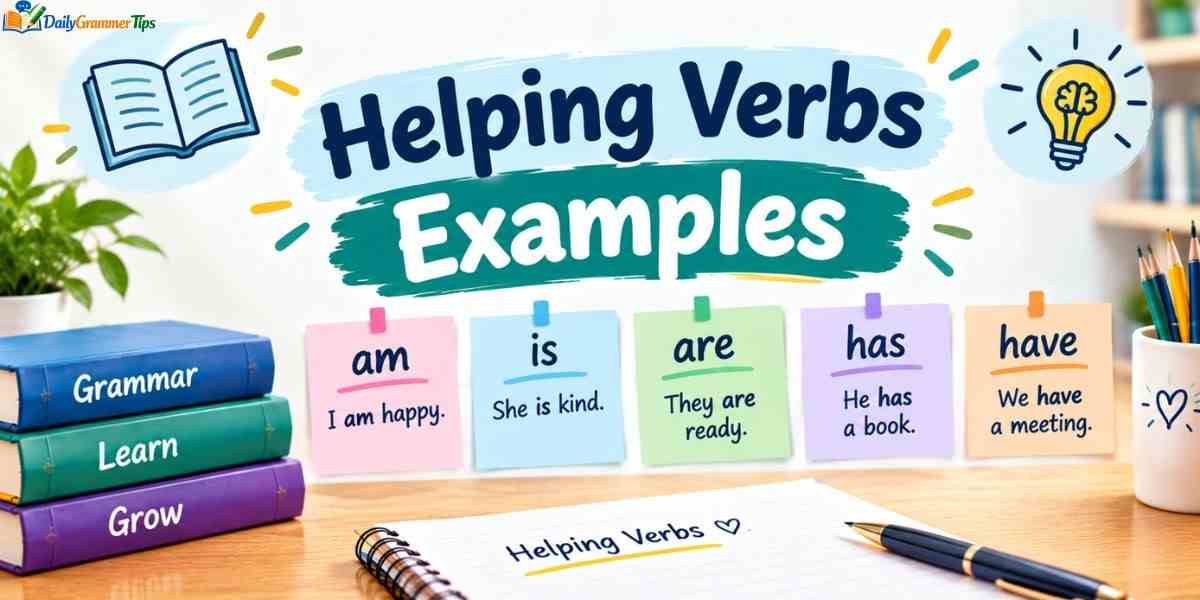
Examples show how helping verbs behave in real sentences. The lists below group them by helper.
Examples With Be
- I am learning English.
- She is writing a letter.
- They are playing football.
- He was sleeping at noon.
- We were waiting outside.
- The door has been painted.
Examples With Have
- I have finished my homework.
- She has visited Rome twice.
- They have bought a new car.
- We had eaten before the show.
- He has been working all day.
Examples With Do
- I do not know the answer.
- She does not like spicy food.
- Did you see the match?
- Do they live nearby?
- He did not call me.
Examples With Modal Verbs
- You can try again.
- It could rain tonight.
- We may leave early.
- She might join us.
- You should drink water.
- They will arrive soon.
- I would help you.
- Students must follow the rules.
List of 50 Helping Verbs in English
English has twenty three core auxiliary verbs. To reach fifty, we add semi modal verbs and common helper phrases. They work in the same way.
The first list shows the core verbs. The second list shows the extra ones.
The 23 Core Verbs
- am
- is
- are
- was
- were
- be
- being
- been
- have
- has
- had
- do
- does
- did
- can
- could
- may
- might
- shall
- should
- will
- would
- must
Learn more………Stative Verbs: Definition, Examples, Types, and Usage Rules
27 Semi Modal Verbs and Helper Phrases
These extra verbs and phrases also help the main verb. Some, like “need” and “dare,” act as helpers mostly in questions and negatives.
Example: “Need I go?” or “She is going to travel.”
- need
- dare
- ought to
- used to
- have to
- has to
- had to
- had better
- would rather
- am going to
- is going to
- are going to
- was going to
- were going to
- am able to
- is able to
- are able to
- was able to
- were able to
- be able to
- be going to
- be supposed to
- is supposed to
- are supposed to
- be about to
- is about to
- are about to
V1, V2, V3, V4, V5 Verb Forms
English verbs have five standard forms. They are called V1, V2, V3, V4, and V5. Each one has a clear job.
- V1 is the base form. Example: eat
- V2 is the past simple. Example: ate
- V3 is the past participle. Example: eaten
- V4 is the present participle, the ing form. Example: eating
- V5 is the third person singular present, the s or es form. Example: eats
Standard grammar has no V6 or V7. If you see them, they come from a teaching system that adds extra labels.
V1, V2, V3, V4, V5 of Help
The verb “help” follows a regular pattern. Here are its five forms.
- V1: help
- V2: helped
- V3: helped
- V4: helping
- V5: helps
Examples: “She helps me daily.” “She helped me yesterday.” “She has helped me before.” “She is helping me now.”
Helping Verbs vs Linking Verbs
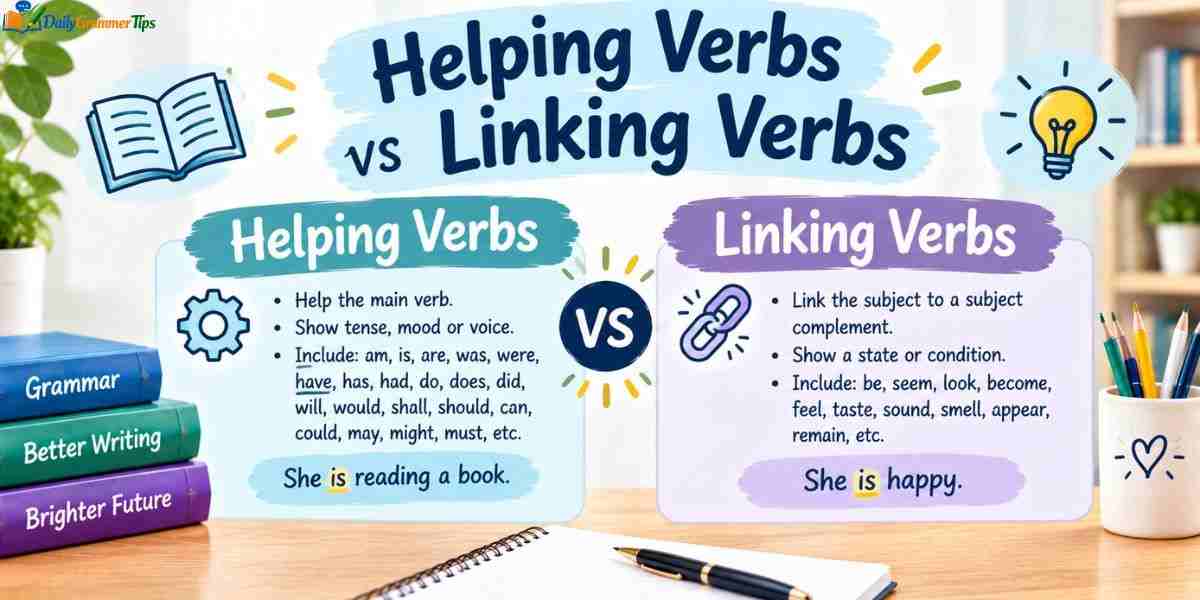
Linking verbs connect a subject to a description. Examples are is, seem, become, and feel. They differ from helpers in one key way.
A helper needs a main verb after it. A linking verb is the main verb. Compare “She is happy” with “She is singing.”
Common Mistakes With Helping Verbs
Even skilled writers slip with helping verbs. Most errors are easy to fix once you spot them.
Learn the common ones below.
Using the Wrong Verb Form After a Modal
After a modal, always use the base verb.
- Wrong: She can sings well.
- Right: She can sing well.
Using Double Modals
Standard English uses only one modal in a verb phrase.
- Wrong: You should must go.
- Right: You must go.
Mixing Up Has and Have
Use “has” with he, she, and it. Use “have” with I, you, we, and they.
- Wrong: She have a car.
- Right: She has a car.
Forgetting the Helper in Questions
Questions need a helper before the subject.
- Wrong: Where you are going?
- Right: Where are you going?
Using a Past Verb After Did
After do, does, or did, use the base verb.
- Wrong: Did she went home?
- Right: Did she go home?
Tips to Use Helping Verbs Correctly
A few habits keep your grammar sharp. Each tip takes only a minute.
Match the Helper to the Subject
Check the subject first. Then pick is, are, has, have, does, or do to match it.
This step prevents many agreement errors.
Use the Base Verb After Modals
Modals always take the base verb. This one rule fixes many errors.
Example: “They will leave soon.”
Learn the Tense Patterns
Memorize the patterns: be with an ing verb, have with V3, and will with V1.
Practice each one with five sentences.
Read Sentences Aloud
Reading aloud helps you hear mistakes. If a sentence sounds odd, check the helper first.
Helping Verbs for English Learners
Learners often find auxiliary verbs tricky. Many languages do not use them in the same way. Regular practice makes them natural.
Small daily steps bring steady progress.
Start With Be, Have, and Do
These three appear in almost every conversation. Master their forms first. Then add the modals.
Learn Modals in Pairs
Study can and could, may and might, shall and should, and will and would together. Pairs make the difference easier to see.
Write Daily Sentences
Write five sentences each day. Use a different helper in each one. Review them at the end of the week.
Listen to Real English
Watch shows, listen to podcasts, and read stories. Notice the helper in each verb phrase.
Practice Exercises on Helping Verbs
These short exercises will build your confidence. Try them before you check the answers.
Each exercise has five questions.
Exercise 1: Pick the Helper
Choose from is, are, has, have, or does.
- She (blank) watching a movie.
- They (blank) finished their work.
- He (blank) not like coffee.
- We (blank) waiting for the bus.
- The teacher (blank) checked the papers.
Exercise 2: Choose the Modal
Choose from can, must, should, may, or will.
- You (blank) wear a seat belt.
- (blank) I borrow your pen?
- I (blank) call you tomorrow.
- She (blank) speak three languages.
- You (blank) rest if you feel tired.
Answers
Here are the correct answers.
- Exercise 1: is, have, does, are, has.
- Exercise 2: must, may, will, can, should.
Why Helping Verbs Matter
Helping verbs add depth to every sentence. They show when, how, and whether something happens.
Good writers choose the right helper for the right meaning.
They Add Meaning
Compare “I swim” with “I can swim” and “I must swim.” Each helper changes the meaning.
They Build Tenses
Helpers let us talk about the past, present, and future with ease.
Frequently Asked Questions
What Is a Helping Verb?
A helping verb is a verb that works with a main verb to show tense, mood, or voice. Example: “She is reading.”
What Are the 23 Helping Verbs?
They are am, is, are, was, were, be, being, been, have, has, had, do, does, did, can, could, may, might, shall, should, will, would, and must.
What Is V1, V2, V3, V4, V5, V6, V7?
V1 to V5 are the five verb forms: base, past, past participle, ing form, and s form. Standard English has no V6 or V7.
Can You Give Me a List of 50 Helping Verbs in English?
Yes. The list above gives twenty three core verbs and twenty seven semi modals and helper phrases. Together they make fifty.
What Is the V1, V2, V3, V4, V5 of Help?
V1 is help, V2 is helped, V3 is helped, V4 is helping, and V5 is helps.
Conclusion
Helping verbs may look small, but they shape almost every sentence you write. They build tenses, form questions, and add shades of meaning like ability, duty, and possibility. When you know the 23 core verbs and their roles, you can choose the right helper with confidence. You also avoid common slips, such as using a past verb after “did.”
Keep practicing helping verbs in your daily writing. Match each helper to its subject, use the base verb after every modal, and read your sentences aloud to catch errors. Try the practice exercises again after a few days. Your grammar will feel smoother and sharper with every sentence you write.
