

Linking verbs connect a subject to more information about it. They do not show action. Instead, they describe a state, a change, or a condition.
This guide covers linking verbs the way learners actually search for them. You will find the real lists, a simple test, and answers to common doubts. You will also see clear examples and practice questions.
Linking Verbs Meaning in Plain English
Linking verbs act like an equals sign in a sentence. They connect the subject to a word that describes it or renames it. Example: “The soup smells delicious.”
The word “smells” does not show action here. It links “soup” to “delicious.” The word “delicious” is the subject complement.
How Linking Verbs Connect Subjects to Descriptions
Linking verbs create a bridge between two parts of a sentence. The subject sits on one side. The complement sits on the other.
The formula is simple: subject, linking verb, complement. Example: “My sister became a doctor.” Here “sister” is the subject, “became” is the link, and “a doctor” is the complement.
The Three Parts of a Linking Sentence
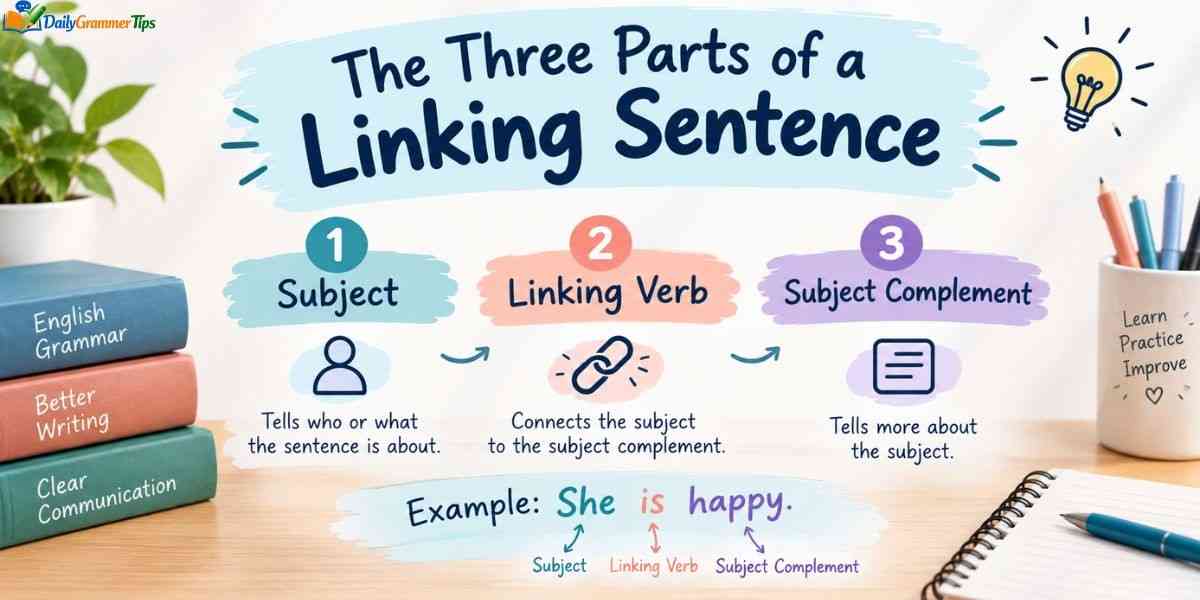
Every sentence of this kind has three parts. They are the subject, the verb, and the subject complement.
The complement is either an adjective or a noun. Each type has its own name.
Predicate Adjective
A predicate adjective describes the subject. Example: “The room feels warm.” The word “warm” describes the room.
To check it, ask which word describes the subject.
Predicate Nominative
A predicate nominative renames the subject. Example: “Maria is the captain.” The word “captain” renames Maria.
It is always a noun or a pronoun.
Is It a Linking Verb? The Swap Test
Here is the fastest way to check. Replace the verb with “is,” “are,” or “seems.” If the sentence still makes sense, it is a linking verb.
Try it on “The milk smells sour.” Swap in “is” and you get “The milk is sour.” It works, so “smells” is a linking verb here.
When the Swap Fails
Now try “She smelled the flowers.” Swap in “is” and you get “She is the flowers.” It makes no sense. So “smelled” is an action verb here.
This test works with almost every tricky verb.
Steps to Follow
Use these four steps on any sentence.
- Find the verb.
- Swap in “is” or “seems.”
- Check whether the sentence still makes sense.
- If it does, the verb is a linking verb.
The Three Verbs That Always Link
Three verbs act as links almost every time they are the main verb. They are be, become, and seem. The verb be has many forms: am, is, are, was, were, been, and being.
Examples: “He is kind.” “She became a teacher.” “They seem happy.”
Linking Verbs List: 15 Common Words
Here are fifteen common linking verbs with a quick example each.
More verbs can link too. These include smell, grow, turn, get, remain, stay, and prove.
- am: I am ready.
- is: She is happy.
- are: They are friends.
- was: He was tired.
- were: We were late.
- be: Be quiet.
- been: She has been sick.
- being: He is being silly.
- become: She became a doctor.
- seem: They seem upset.
- appear: He appears calm.
- look: You look great.
- feel: I feel tired.
- sound: That sounds fun.
- taste: The soup tastes salty.
Verbs That Switch Between Linking and Action
Many verbs can link or act depending on the sentence. The swap test shows which role they play.
Look at the pairs below.
Look and Appear
These pairs show the same word in two roles.
- Linking: You look tired.
- Action: She looked at the map.
- Linking: He appears calm.
- Action: A rainbow appeared in the sky.
Smell and Taste
Sense verbs often switch roles.
- Linking: The cake smells sweet.
- Action: He smelled the flowers.
- Linking: The soup tastes salty.
- Action: She tasted the soup.
Feel and Sound
The subject decides the role.
- Linking: I feel dizzy.
- Action: She felt the fabric.
- Linking: Your idea sounds great.
- Action: The guard sounded the alarm.
Grow, Turn, and Get
These verbs often show change.
- Linking: The sky grew dark.
- Action: Farmers grow wheat.
- Linking: The leaves turned red.
- Action: He turned the key.
- Linking: She got angry.
- Action: He got a gift.
Stay, Remain, and Prove
These verbs show a continuing state or a result.
- Linking: The room stayed cold.
- Action: We stayed at a hotel.
- Linking: She remained calm.
- Linking: The plan proved useful.
- Action: She proved the theory.
Linking Verbs With Sentences: 20 Examples
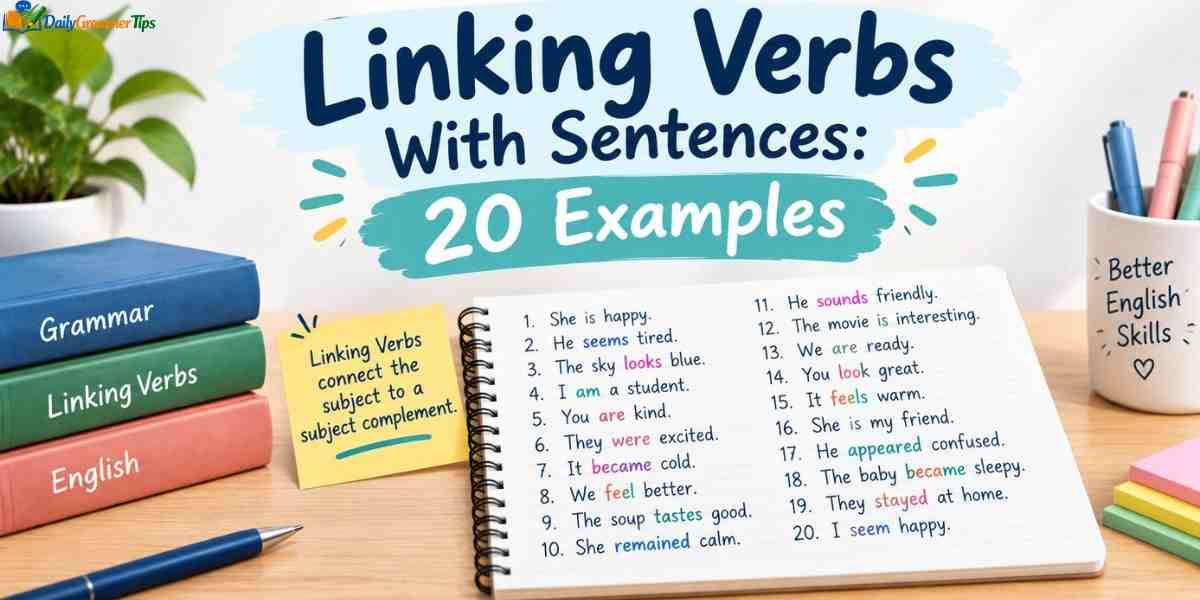
Here are twenty sentences with linking verbs. The verb and its complement appear after each one.
- The sky is blue. Verb: is. Complement: blue.
- She became a nurse. Verb: became. Complement: a nurse.
- The room feels cold. Verb: feels. Complement: cold.
- They seem tired. Verb: seem. Complement: tired.
- The soup smells delicious. Verb: smells. Complement: delicious.
- He remained silent. Verb: remained. Complement: silent.
- The music sounds beautiful. Verb: sounds. Complement: beautiful.
- My brother is a pilot. Verb: is. Complement: a pilot.
- The leaves turned yellow. Verb: turned. Complement: yellow.
- You look wonderful. Verb: look. Complement: wonderful.
- The milk went sour. Verb: went. Complement: sour.
- The answer proved correct. Verb: proved. Complement: correct.
- I am hungry. Verb: am. Complement: hungry.
- The test was easy. Verb: was. Complement: easy.
- She grew sleepy. Verb: grew. Complement: sleepy.
- The idea sounds risky. Verb: sounds. Complement: risky.
- They were happy. Verb: were. Complement: happy.
- The bread tastes fresh. Verb: tastes. Complement: fresh.
- He appears nervous. Verb: appears. Complement: nervous.
- The night got cold. Verb: got. Complement: cold.
Forms of Be as Linking Verbs
The most common linking verbs are the forms of be. They are am, is, are, was, were, be, being, and been.
Yes, “was” is a linking verb when it connects a subject to a complement. Example: “The test was easy.” It becomes a helper before another verb, as in “She was singing.”
- Linking: He is a teacher.
- Linking: They were late.
- Helper: She is singing.
- Helper: We were waiting.
Sense Verbs as Linking Verbs
Sense verbs often work as linking verbs. They describe how something looks, feels, smells, sounds, or tastes.
They answer the question, “What is the subject like?” Example: “The paint looks fresh.”
Linking Verbs vs Helping Verbs
Linking verbs connect a subject to a complement. Helping verbs support a main verb. The same word can do either job.
Compare “She is tired” with “She is sleeping.” In the first, “is” links. In the second, “is” helps “sleeping.” The verbs do and have are usually helpers or main verbs. They rarely link.
- Linking: The dog is hungry.
- Helping: The dog is eating.
Learn more………..Subordinating Conjunctions: Definition, List, Rules, and Examples
Action Verbs or Linking Verbs? How to Tell
Action verbs show what someone does. Linking verbs show what something is. This simple idea clears most confusion.
Ask two questions. Can I swap in “is”? Does the word after the verb describe the subject? Two yes answers mean the verb links.
- Action: The chef tasted the sauce.
- Linking: The sauce tastes spicy.
- Action: He grew tomatoes.
- Linking: He grew tired.
Linking Verbs in Different Tenses
Linking verbs change form across tenses, but their job stays the same.
Look at the tense examples below.
- Present: She is calm.
- Past: She was calm.
- Future: She will be calm.
- Present perfect: She has been calm.
- Past with seem: He seemed worried.
Adjectives or Adverbs After Linking Verbs
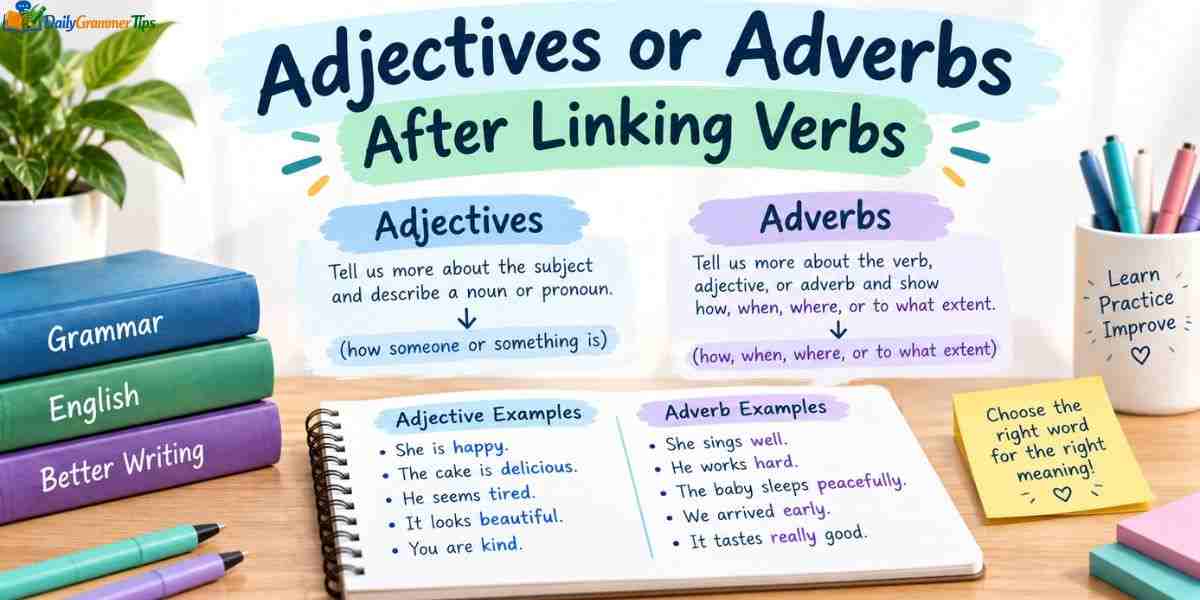
After linking verbs, use an adjective, not an adverb. The word describes the subject, not the action.
Example: “She feels bad” is correct for emotions. One exception is “well,” which works as an adjective for health, as in “I feel well.”
- Right: The song sounds good.
- Wrong: The song sounds well.
- Right: He looks happy.
- Wrong: He looks happily.
Linking Verbs in Everyday Writing
Linking verbs appear in descriptions, definitions, and opinions. They help us say what things are and how they seem.
Writers use them to set a mood. Compare “The night was cold” with “The night grew cold.” The second hints at change.
Mistakes People Make With Linking Verbs
Even confident writers trip over linking verbs. Most errors come from choosing adverbs or treating every verb as an action.
Learn the common ones below.
Using an Adverb After the Verb
Use an adjective after a link, because the word describes the subject.
- Wrong: The cake tastes sweetly.
- Right: The cake tastes sweet.
Treating Every Verb as Action
Do not assume feel, look, and taste always show action. Check each one with the swap test.
- Linking: You look tired.
- Action: She looked at me.
Confusing Linking and Helping Roles
Check whether another verb follows. If one does, the first verb is a helper.
- Linking: She is tired.
- Helping: She is working.
Choosing the Wrong Pronoun After Be
Formal English uses a subject pronoun after a form of be. Example: “It is I.”
In casual speech, many people say “It is me.” Pick the style that fits your reader.
Overusing Be
Too many is and was sentences make writing dull. Swap some for stronger verbs.
- Plain: The river is wild.
- Stronger: The river rages.
Quick Tips to Spot Linking Verbs Fast
These quick tricks help you spot linking verbs in seconds.
Practice each trick on five sentences.
Use the Equals Test
Replace the verb with an equals sign. “The sky is blue” becomes “sky equals blue.” If it works, the verb links.
Try the Swap Test
Swap the verb with “is” or “seems.” If the sentence still makes sense, you have found a link.
Look at the Word After the Verb
If that word describes or renames the subject, the verb is a link. If it receives an action, the verb is an action verb.
Remember the Core Group
Memorize be, become, and seem first. Then add the sense verbs and the change verbs.
Linking Verbs for English Learners
Learners often mix linking verbs with action verbs. Daily practice makes the pattern easy.
Small steps bring steady progress.
Learn by Groups
Study the verbs in four groups. Be forms, change verbs like become and grow, sense verbs like look and feel, and state verbs like seem and remain.
Describe Your Day
Write five sentences about your day. Use feel, look, and seem at least once each.
Read Descriptions
Read product reviews and short stories. Mark each linking word you find.
Keep a Simple Chart
Make a chart with three columns: verb, example, and complement. Add one new row each day.
Practice Questions With Answers on Linking Verbs
Test your knowledge of linking verbs with these quick questions. Check the answers at the end.
Each exercise has five questions.
Exercise 1: Find the Linking Verb
- The soup smells wonderful.
- She became a teacher.
- They seem tired.
- The leaves turned brown.
- He remained calm.
Exercise 2: Linking or Action?
Write L for linking or A for action.
- She tasted the cake.
- The cake tastes sweet.
- He grew roses.
- He grew angry.
- I felt the cold wind.
Answers
Here are the correct answers.
- Exercise 1: smells, became, seem, turned, remained.
- Exercise 2: A, L, A, L, A.
Why Linking Verbs Matter in Writing
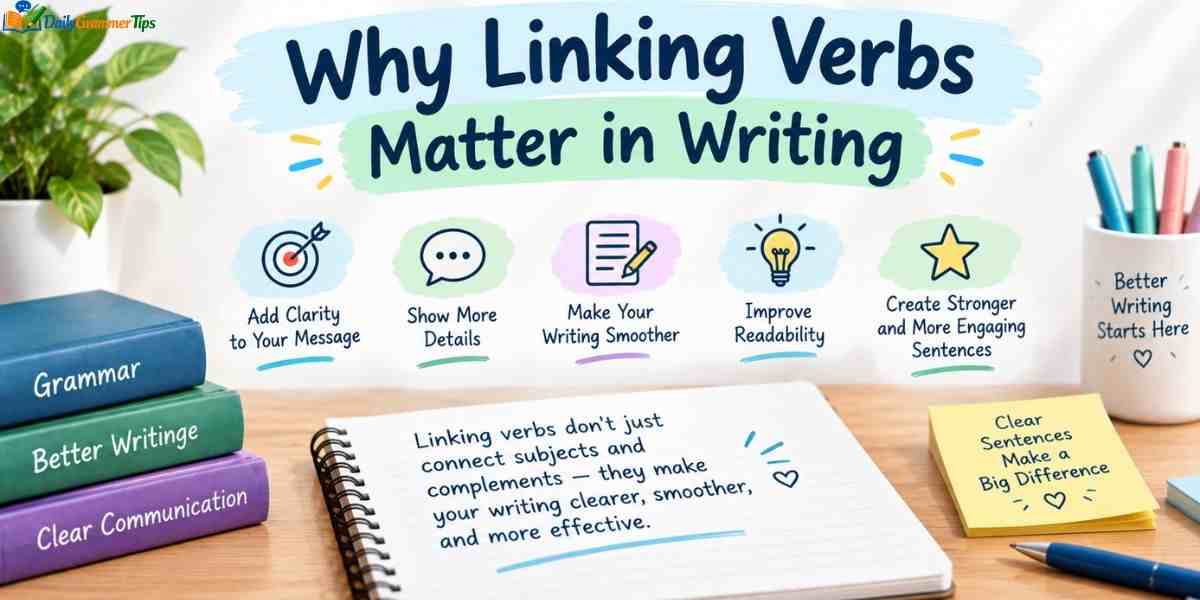
Linking verbs help us describe, define, and explain. Without them, we could not say what things are or how they seem.
They also keep writing natural. Not every sentence needs action.
They Support Descriptions
Compare “The sky is gray” with “The sky stays gray.” Each link adds a different feeling.
They Help Define Ideas
Definitions rely on links. Example: “A verb is a word that shows action or state.”
Frequently Asked Questions
What Are the 15 Linking Verbs?
Common ones are am, is, are, was, were, be, been, being, become, seem, appear, look, feel, sound, and taste.
What Are 3 Examples of a Linking Verb?
Be, become, and seem are three examples. They link a subject to a word that describes or renames it.
Is “Was” a Linking Verb?
Yes, when it connects a subject to a complement, as in “The test was easy.” It is a helper when another verb follows.
What Are the 20 Linking Verbs With Sentences?
You can find twenty sentences in the section above. One is “The sky is blue.”
How Do You Know if a Verb Is a Linking Verb?
Swap it with “is” or “seems.” If the sentence still makes sense, it is a linking verb.
Conclusion
Linking verbs connect subjects to descriptions without showing action. You now know the lists, the swap test, and the verbs that switch roles. You also know how to avoid common mistakes.
Keep practicing linking verbs in your daily writing. Use the swap test on tricky verbs, choose adjectives after them, and read your sentences aloud. Your writing will feel clearer with every sentence.
