


Intransitive verbs describe actions that finish on their own. They do not need a direct object to complete the meaning. Words like sleep, arrive, and laugh work this way.
This guide covers intransitive verbs the way learners search for them. You will get a simple test, long lists, and clear rules. You will also see real examples, tricky pairs, and practice questions.
Intransitive Verbs Meaning in Plain English
Intransitive verbs are verbs that do not take a direct object. The action involves only the subject. Example: “The baby slept.”
Nothing receives the action of sleeping. The sentence feels complete without extra words.
The No Object Rule Behind Intransitive Verbs
Intransitive verbs follow one simple rule. They take no direct object. A direct object answers “what?” or “whom?” after the verb.
Compare “She laughed” with “She kicked the ball.” You cannot laugh something. But you can kick a ball.
- Intransitive: He arrived.
- Transitive: He opened the door.
Sentence Patterns That Use Intransitive Verbs
Sentences with intransitive verbs follow a few simple patterns. Each pattern keeps the verb free of a direct object.
Learn the three patterns below.
Subject and Verb
The simplest pattern has only a subject and a verb. Example: “Birds sing.”
Another example: “Time flies.”
Subject, Verb, and Adverb
An adverb often follows the verb. Example: “She sleeps soundly.” The adverb tells how.
Another example: “He walks slowly.”
Subject, Verb, and Prepositional Phrase
A prepositional phrase adds place or time. Example: “We arrived at noon.”
The word “noon” is the object of the preposition, not a direct object.
How to Identify Intransitive Verbs: Ask What or Whom
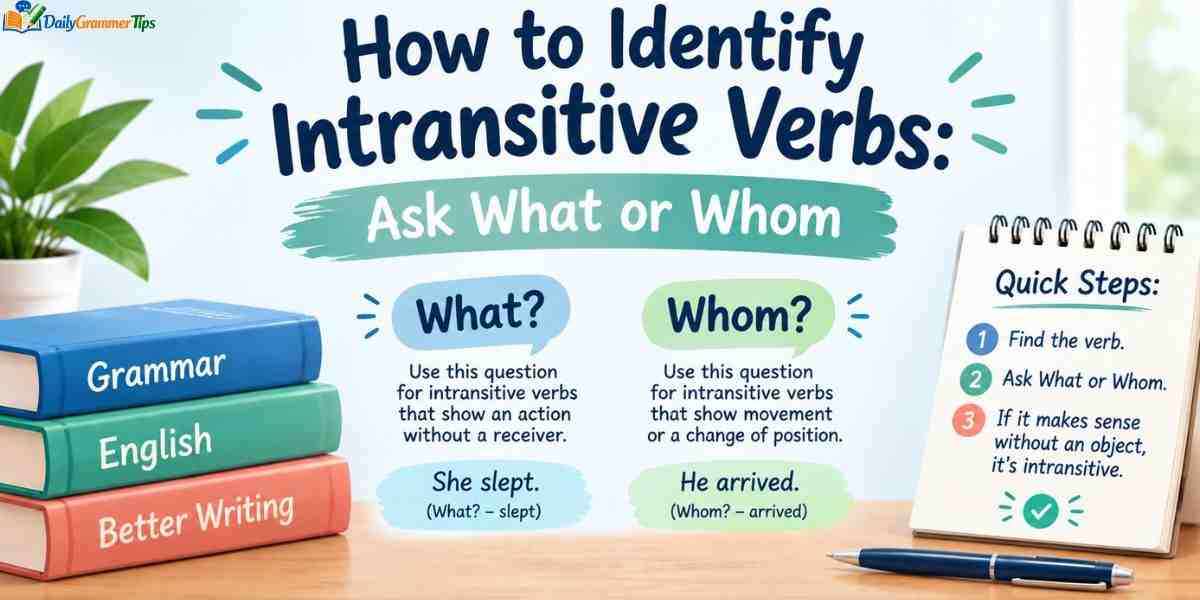
You can identify intransitive verbs with one quick question. Say the verb, then ask “what?” or “whom?”
If you get a real answer, the verb is transitive. If you get no answer, the verb is intransitive.
- She laughed. Laughed what? No answer. Intransitive.
- She baked a cake. Baked what? A cake. Transitive.
- He waited. Waited what? No answer. Intransitive.
- He called his friend. Called whom? His friend. Transitive.
A Common Trap
Prepositional phrases can fool you. In “She waited for the bus,” the bus is not a direct object. The word “for” blocks it.
Ask “what?” without the preposition. “Waited what?” has no answer. So “waited” stays intransitive.
Common Intransitive Verbs List
Here is a grouped list of common intransitive verbs. Each group shows a different kind of action or state.
Remember that some of these can also be transitive in other sentences.
Movement Verbs
- arrive
- come
- depart
- fall
- go
- rise
- sit
- stand
- travel
- wander
Body and Feeling Verbs
- blush
- cry
- faint
- laugh
- sigh
- sleep
- smile
- sneeze
- snore
- yawn
Events and Existence Verbs
- appear
- bloom
- die
- disappear
- exist
- happen
- live
- occur
- stay
- vanish
Intransitive Verbs Examples in Sentences
Real sentences make the idea stick. Here are twenty examples of intransitive verbs in real sentences.
The verb appears after each sentence.
- The baby slept peacefully. Verb: slept.
- We arrived late. Verb: arrived.
- The children laughed loudly. Verb: laughed.
- She smiled at him. Verb: smiled.
- The sun rises in the east. Verb: rises.
- He fell from the ladder. Verb: fell.
- Birds sing every morning. Verb: sing.
- The meeting ended early. Verb: ended.
- My grandfather lives in a village. Verb: lives.
- The ice melted quickly. Verb: melted.
- They waited for the bus. Verb: waited.
- The dog barked all night. Verb: barked.
- Prices will rise next month. Verb: rise.
- The guests left quietly. Verb: left.
- She sneezed twice. Verb: sneezed.
- The flowers bloom in spring. Verb: bloom.
- He stood near the door. Verb: stood.
- The accident happened yesterday. Verb: happened.
- Tears rolled down her cheeks. Verb: rolled.
- The train stopped suddenly. Verb: stopped.
Why Intransitive Verbs Have No Passive Voice
Intransitive verbs cannot form the passive voice. The passive needs a direct object to become the new subject.
Active: “She wrote a letter.” Passive: “A letter was written by her.” Now try “She slept.” There is no object to move, so no passive exists.
- Possible: She ate the apple. The apple was eaten.
- Not possible: She arrived. There is no direct object to promote.
Verbs That Can Be Both Transitive and Intransitive
Many verbs work both ways. Context decides the role. Check whether a direct object follows.
The same word can change roles in one conversation.
- Intransitive: She reads every night. Transitive: She reads a novel.
- Intransitive: The door opened. Transitive: He opened the door.
- Intransitive: They sing well. Transitive: They sing a song.
- Intransitive: He runs daily. Transitive: He runs a shop.
- Intransitive: The ice melted. Transitive: The sun melted the ice.
- Intransitive: She eats quickly. Transitive: She eats an apple.
Transitive and Intransitive Verbs: The Real Difference
Transitive and intransitive verbs differ in one key way. A transitive verb passes the action to an object, and an intransitive one does not.
This difference affects passive voice, sentence patterns, and meaning.
- Transitive: needs a direct object and can form a passive.
- Intransitive: needs no direct object and cannot form a passive.
Intransitive Verbs vs Linking Verbs
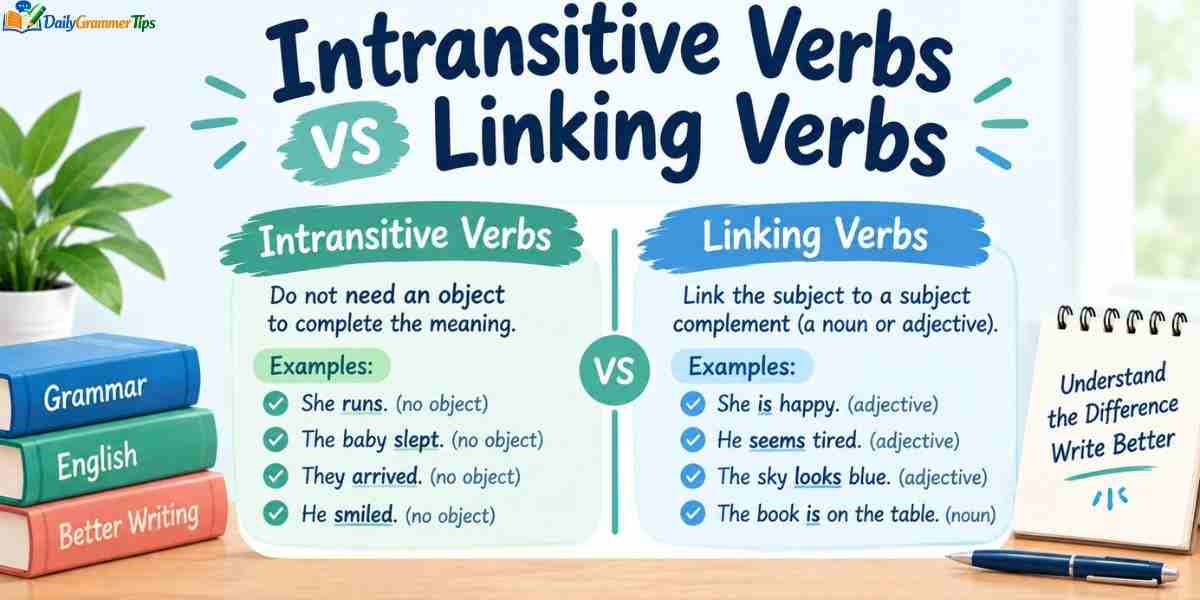
Intransitive verbs finish the action alone, while linking verbs join the subject to a complement.
Compare “She slept” with “She seems tired.” The first has no complement. The second needs “tired” to complete the idea.
- Intransitive: The baby cried.
- Linking: The baby seems calm.
Intransitive Verbs and Prepositions
Intransitive verbs often pair with prepositions. The preposition adds a detail like place, time, or reason.
The word after the preposition is not a direct object.
- She waited for the bus.
- He looked at the sky.
- They arrived in Paris.
- The cat jumped onto the sofa.
- We talked about the plan.
Intransitive Verbs in Different Tenses
Intransitive verbs work in every tense. The verb form changes, but the no object rule stays.
Look at the tense examples below.
- Simple present: She sleeps.
- Simple past: She slept.
- Future: She will sleep.
- Present continuous: She is sleeping.
- Present perfect: She has slept.
- Past perfect: She had slept.
Learn more…….Linking Verbs Explained: List, Meaning, Examples, and a Simple Test
Irregular Intransitive Verbs
Many irregular intransitive verbs change form in the past. Learn their three forms together.
Here are the most common ones, shown as base, past, and past participle.
- go, went, gone
- come, came, come
- fall, fell, fallen
- rise, rose, risen
- sit, sat, sat
- sleep, slept, slept
- swim, swam, swum
- lie, lay, lain
- grow, grew, grown
- stand, stood, stood
- sing, sang, sung
Confusing Pairs: Lie and Lay, Sit and Set, Rise and Raise
Three pairs trip up almost everyone. In each pair, one verb is intransitive and the other is transitive.
The intransitive verb needs no object. The transitive verb needs one.
Lie and Lay
“Lie” means to recline. It is intransitive. Its forms are lie, lay, lain, and lying.
“Lay” means to put something down. It is transitive. Its forms are lay, laid, laid, and laying.
- I lie on the sofa.
- I lay the book on the table.
Sit and Set
“Sit” means to take a seat. It is intransitive. “Set” means to place something. It is transitive.
- She sits near the window.
- She sets the cup on the desk.
Rise and Raise
“Rise” means to go up on its own. It is intransitive. “Raise” means to lift something. It is transitive.
- The sun rises early.
- They raise the flag.
Intransitive Verbs for Kids and Beginners
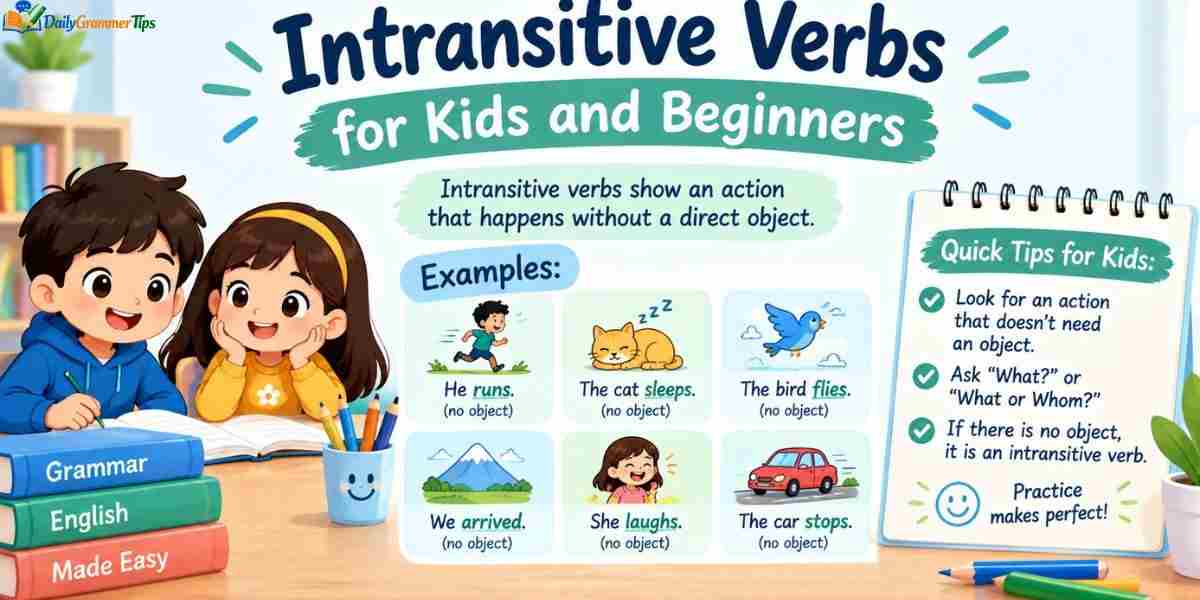
An intransitive verb is an action word that needs no object. Kids can learn it with simple movement.
Keep lessons short and playful.
Act It Out
Ask children to jump, clap, smile, and sit. Then ask them to say a sentence for each action.
Example: “I jump.”
Try the What Test
After each sentence, ask “what?” If there is no answer, the verb is intransitive.
Praise each correct guess.
Easy Sentences for Beginners
- The bird sings.
- The baby sleeps.
- Rain falls.
- We laughed.
- The sun shines.
Mistakes People Make With Intransitive Verbs
Even good writers slip with these verbs. Most errors involve adding an object or forming a passive.
Learn the common ones below.
Adding a Direct Object
Use a preposition when a noun follows.
- Wrong: She arrived the airport.
- Right: She arrived at the airport.
Forming a Passive
These verbs have no passive form.
- Wrong: The accident was happened.
- Right: The accident happened.
Mixing Lie and Lay
Use “lie” when no object follows.
- Wrong: I will lay down for a nap.
- Right: I will lie down for a nap.
Mixing Rise and Raise
Use “rise” when something goes up on its own.
- Wrong: The sun raises at six.
- Right: The sun rises at six.
Dropping the Preposition
Some verbs need a preposition before a noun.
- Wrong: She waited the bus.
- Right: She waited for the bus.
Quick Tricks to Spot Intransitive Verbs
A few quick tricks make the job easy.
Practice each one on five sentences.
The What Test
Ask “what?” or “whom?” after the verb. No answer means the verb is intransitive.
The Passive Test
Try to make a passive sentence. If you cannot, the verb is intransitive.
The Deletion Test
Remove everything after the verb. If the sentence still feels complete, the verb is likely intransitive. Example: “He slept soundly” becomes “He slept.”
Check the Dictionary
Dictionaries mark each sense of a verb as intransitive or transitive. Check the label when you feel unsure.
Intransitive Verbs for English Learners
Learners often add an object after these verbs by mistake. A few habits fix the problem.
Small steps bring steady progress.
Learn Verbs With Prepositions
Memorize pairs like wait for, depend on, and arrive at. They show how the verb connects to a noun.
Study Your Common Mistakes
Keep a list of errors you make. Review it every week.
Read and Notice
Read short stories. Mark each verb. Check whether an object follows.
Write Short Sentences
Write five sentences a day. Use a different verb each time.
Practice Exercises on Intransitive Verbs
Test your skills with these quick questions. Check the answers at the end.
Each exercise has five questions.
Exercise 1: Transitive or Intransitive?
Write T for transitive or I for intransitive.
- The baby slept.
- She baked a cake.
- The train arrived.
- He opened the window.
- The children laughed.
Exercise 2: Fix the Mistake
Rewrite each sentence correctly.
- She arrived the station.
- The glass was fallen.
- I will lay down for a rest.
- The sun raises early.
- He waited the bus.
Answers
Here are the correct answers.
- Exercise 1: I, T, I, T, I.
- Exercise 2, one: She arrived at the station.
- Exercise 2, two: The glass fell.
- Exercise 2, three: I will lie down for a rest.
- Exercise 2, four: The sun rises early.
- Exercise 2, five: He waited for the bus.
Why Intransitive Verbs Matter

These verbs keep sentences short and clear. They describe changes, movements, and states without extra words.
They also shape meaning. A small switch from intransitive to transitive changes who acts.
They Keep Writing Simple
Compare “The meeting ended” with “The manager ended the meeting.” The first sentence is shorter.
They Show Change
Verbs like grow, melt, and rise describe change that happens on its own.
Frequently Asked Questions
What Is an Intransitive Verb?
It is a verb that does not need a direct object. Example: “She slept.”
What Are Some Examples of Intransitive Verbs?
Examples include sleep, arrive, laugh, rise, and happen. Example: “The guests arrived.”
How Do You Identify Intransitive Verbs?
Ask “what?” or “whom?” after the verb. If there is no answer, the verb is intransitive.
What Is the Difference Between Transitive and Intransitive Verbs?
A transitive verb needs a direct object. An intransitive verb does not.
Can Intransitive Verbs Be Used in the Passive Voice?
No. They have no direct object, so they cannot form a passive.
Conclusion
Intransitive verbs describe actions that need no direct object. You now know the quick test, the patterns, the long lists, and the tricky pairs. You also know why they never form a passive.
Keep practicing intransitive verbs in your daily writing. Ask “what?” after each verb, watch for prepositions, and check the tricky pairs. Your sentences will become cleaner with every draft.
