

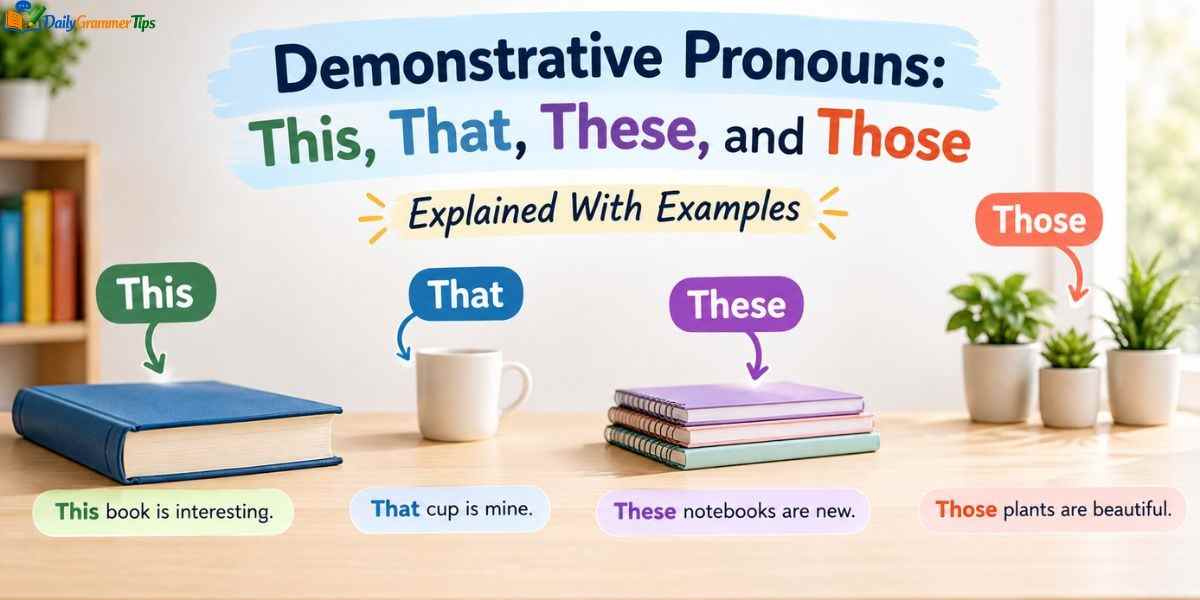
Demonstrative pronouns point to things, people, or ideas without naming them. They tell the reader which one you mean and how far away it is. A single word like “this” can replace a whole phrase.
This guide covers demonstrative pronouns the way learners search for them. You will find the four core words, clear rules, and common doubts answered. Examples, a kids section, and practice questions come along the way.
Demonstrative Pronouns Meaning in Simple Words
Demonstrative pronouns are words that replace a noun and point to it. English has four of them: this, that, these, and those. Each one shows number and distance.
Example: “This is my bag.” The word “this” stands in for “the bag.” It also tells us the bag is close.
The Four Words That Point: This, That, These, Those
Two words are singular and two are plural. Two point to things near you, and two point to things far away.
Here is the whole system in one quick view.
- This: singular, near
- That: singular, far
- These: plural, near
- Those: plural, far
This
Use “this” for one nearby item. Example: “This is delicious.” You can hold the item or point to it.
It also works for something you are about to say. Example: “This is the plan: we leave at nine.”
That
Use “that” for one item that is farther away. Example: “That looks heavy.” The item may be across the room.
It also works for something already said. Example: “That makes sense.”
These
Use “these” for several nearby items. Example: “These are my keys.”
Remember that it takes a plural verb. Example: “These are fresh.”
Those
Use “those” for several items farther away. Example: “Those are my cousins.”
It also fits groups in the past. Example: “Those were great days.”
Near or Far? How Distance Shapes Demonstrative Pronouns
Distance decides which word to pick. Near items take this and these. Far items take that and those.
Distance can be physical, as in space, or it can be about time and feeling.
- Near: This is my seat. These are my books.
- Far: That is your seat. Those are your books.
Demonstrative Pronouns in Time and Ideas
Demonstrative pronouns also point to time and ideas. Near time uses this, and past time uses that.
Example: “This is the best week so far.” Compare it with “That was a great year.”
- She said she was leaving. That surprised me.
- I want you to hear this: honesty matters.
- Those were the days.
- This is how it begins.
How to Use Demonstrative Pronouns in a Sentence
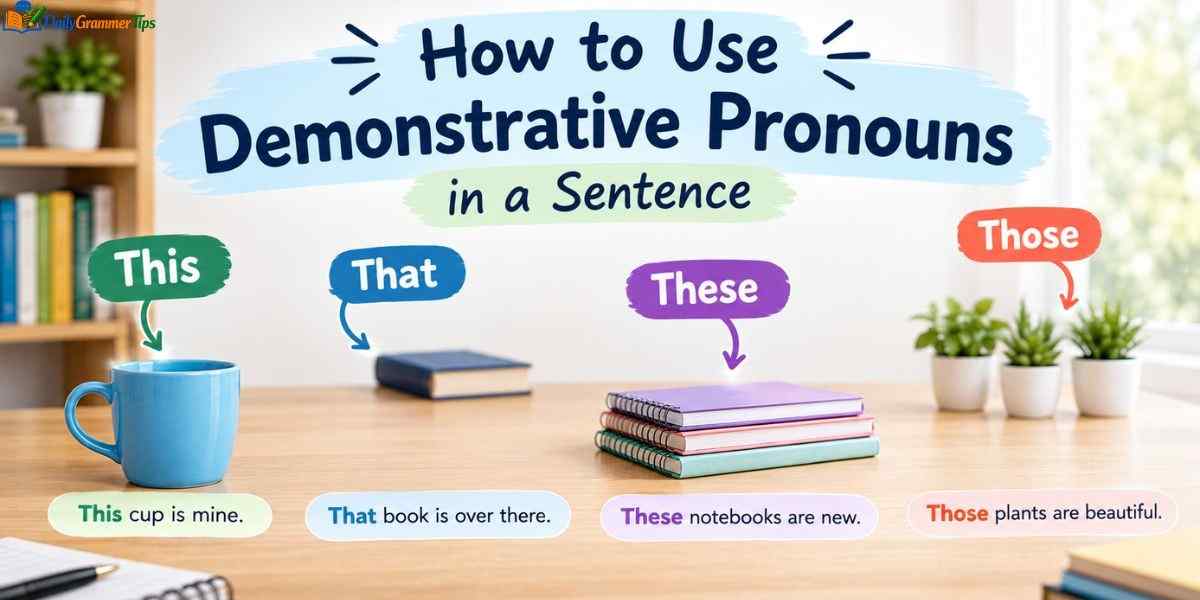
To use demonstrative pronouns well, follow four quick steps. Each step takes only a moment.
Decide the number, then the distance, then the verb, then check the meaning.
- Decide whether you mean one item or many.
- Decide whether the item is near or far.
- Pick this, that, these, or those.
- Match the verb to the number.
A Worked Example
You point to one pen on your desk. It is one item and it is near, so you say, “This is my pen.”
Now you point to two pens on a far table. They are many items and they are far, so you say, “Those are her pens.”
Demonstrative Pronouns Examples for Everyday Life
Examples help most when they match real life. The lists below show demonstrative pronouns in action.
At Home
- This is my favorite chair.
- That is the dog next door.
- These are warm socks.
- Those are my grandmother’s plants.
- This smells delicious.
At School
- This is our new teacher.
- That is the library.
- These are my notebooks.
- Those are the lab rooms.
- That was a hard test.
At Work
- This is the report you asked for.
- That was a clear presentation.
- These are the final numbers.
- Those are the new guidelines.
- This needs your approval.
While Shopping
- This costs too much.
- That looks like a good deal.
- These fit well.
- Those are on sale.
- I will take this.
Demonstrative Pronouns vs Demonstrative Adjectives: The Noun Test
Demonstrative pronouns stand alone, while demonstrative adjectives sit before a noun. The four words are the same. Only the job changes.
Try the noun test. If a noun follows the word, it is an adjective. If no noun follows, it is a pronoun.
- Pronoun: This is delicious.
- Adjective: This cake is delicious.
- Pronoun: Those belong to me.
- Adjective: Those shoes belong to me.
Demonstrative Pronouns and Antecedents
Demonstrative pronouns often refer back to an antecedent, the noun they replace. The reader should always know what the pronoun points to.
Sometimes the antecedent comes after the pronoun. Sometimes it stays unstated, so the idea must be clear from context.
- Antecedent first: I bought a laptop. This works fast.
- Antecedent after: This is what I want: a quiet room.
- Implied idea: That is unfair.
- Clear reference: The delay upset everyone. That was unfair.
Verb Agreement With Demonstrative Pronouns
Singular pronouns take singular verbs, and plural pronouns take plural verbs. This rule never changes.
Match this and that with is or was. Match these and those with are or were.
- This is mine.
- That was fun.
- These are ready.
- Those were old.
- Wrong: These is my keys. Right: These are my keys.
Can Demonstrative Pronouns Refer to People?
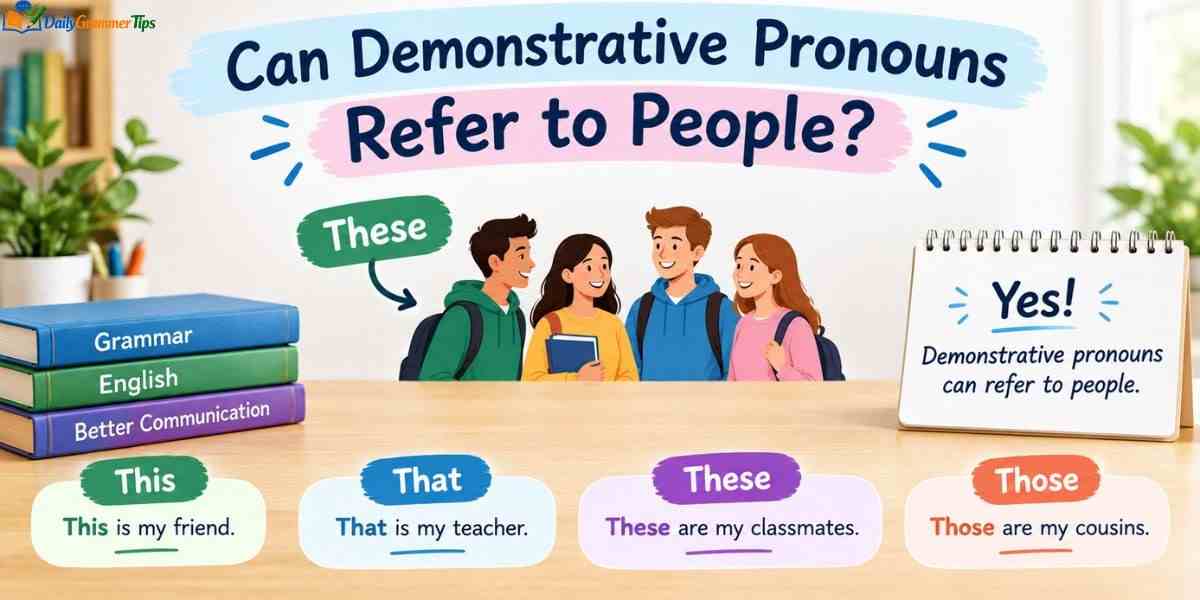
Demonstrative pronouns can refer to people when the person is clearly identified. This often happens in introductions and questions.
Example: “This is my brother, Ali.” Use them only when you point, show a photo, or name the person.
- This is my teacher, Ms. Khan.
- Who is that at the door?
- Those are my cousins from Canada.
- Are these your parents?
Demonstrative Pronouns vs Relative Pronouns
Demonstrative pronouns and relative pronouns can look the same, especially with the word “that.” The sentence shows which one you have.
A demonstrative “that” points to something. A relative “that” introduces a clause.
- Demonstrative: That is my house.
- Relative: The house that I bought is old.
Other Words Some Grammars Include
Some grammar books also list “such” and “the same” as demonstratives. Example: “Such is life.”
Example: “I will have the same.” Most school lessons focus on the four core words.
Questions and Negative Sentences With This, That, These, and Those
These four words work well in questions. The verb comes before the pointer, and the meaning stays clear. Example: “Is this yours?” and “Are those ready?”
Negative sentences are just as simple. Add “not” after the verb. Example: “This is not mine.” and “Those are not ready.”
- What is that?
- Who is this?
- Are these fresh?
- Is that your bag?
- That is not true.
- These are not new.
- This does not taste right.
- Those do not belong to me.
- Is this yours? Yes, this is mine.
- Are those yours? No, those are not mine.
- Is that the station? Yes, that is the station.
Using the Four Words With Prepositions
A pointer can follow a preposition. Common patterns include “look at this,” “listen to that,” “think about these,” and “pay attention to those.”
The preposition links the pointer to the rest of the sentence. The pointer itself never changes, so no extra rule is needed.
- Look at this.
- I agree with that.
- She talked about these.
- We argued over those.
- He is proud of this.
- They laughed at that.
- Be careful with these.
- I am thinking about those.
Subject, Object, or After a Preposition: Where These Words Sit
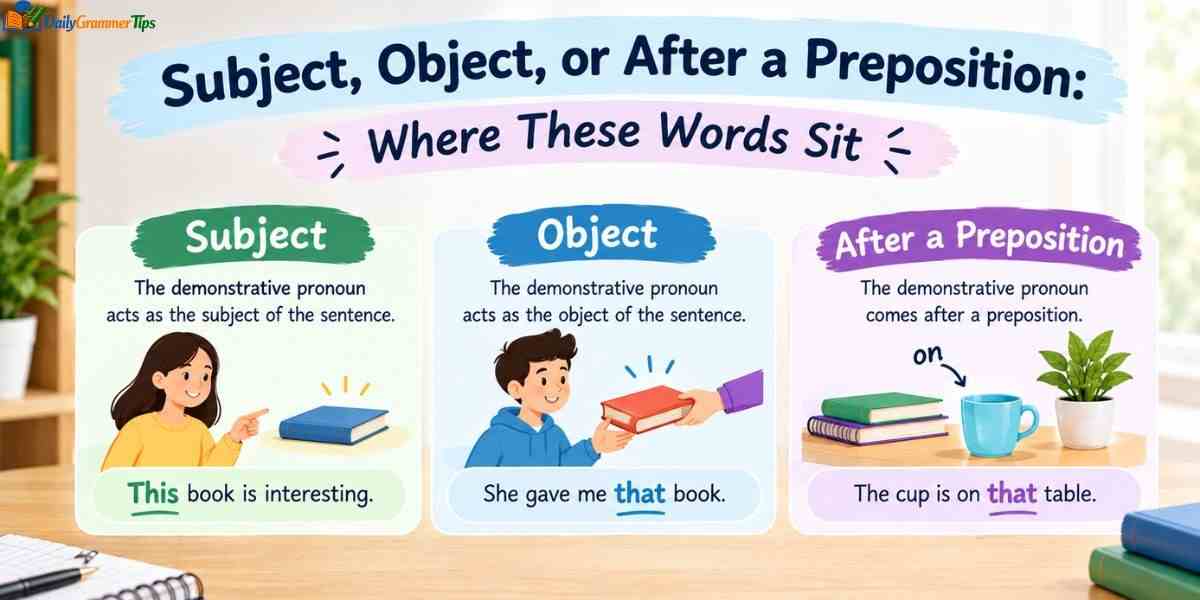
The four words can act as the subject of a sentence. They can also act as the object of a verb. Example: “This is easy” has a subject. “I like this” has an object.
Knowing the role helps you check the verb. A subject needs a verb that agrees with it. An object does not control the verb.
- Subject: That was a great idea.
- Subject: These are my friends.
- Object: I love this.
- Object: She bought those.
- After a preposition: He thought about that.
- Complement: The best part is this.
This One, That One, These Ones, and Those Ones
Speakers often add “one” or “ones” after the pointer. This gives a clear choice between similar items. Example: “I like this one, but I prefer that one.”
Here the word “one” replaces a noun, so the pointer works as an adjective. The question “which one” often comes first. Example: “Which one do you want?” and “This one.”
- Which bag is yours? This one.
- I will take that one.
- These ones look fresher.
- Those ones are on sale.
- Do you want this one or that one?
Those Who, That Of, and Those Of: Formal Patterns
Formal writing uses “those who” to mean “people who.” Example: “Those who study hard succeed.” Notice that a plural verb follows.
Writers also use “that of” and “those of” to avoid repeating a noun. Example: “My room is bigger than that of my sister.” Use “that of” for one item and “those of” for many.
- Those who wait will be served.
- Those wishing to join should sign here.
- The weather here is cooler than that of Dubai.
- Her grades are better than those of her classmates.
- The roads in this city are wider than those in the old town.
Phone Calls, Emails, and Chats: Real Life Use
Real life gives these words special jobs. On the phone we say “This is Sara” to introduce ourselves. We ask “Is that you?” to confirm who is calling.
In emails, writers often use “this” to refer to the point they just made. In chats, “that” shows a quick reaction. Example: “That is amazing!”
- Phone: Hello, this is Sara.
- Phone: Is that Ali speaking?
- Email: This is to confirm our meeting.
- Email: That is all for now.
- Chat: That sounds great!
- Chat: Those are lovely photos.
Short Dialogues With This, That, These, and Those
Dialogues show how these words sound in speech. Read each one aloud with a partner. Notice how the speakers point and respond.
Then change the nouns and write your own versions.
At a Shop
- Customer: How much is this?
- Seller: That is ten dollars.
- Customer: And these?
- Seller: Those are five dollars each.
At Home
- Mother: Whose are those?
- Child: These are my shoes.
- Mother: And that?
- Child: That is my brother’s bag.
Mini Paragraphs That Use All Four Words
Short paragraphs show the four words working together. Read each one and spot the pointers.
Then underline each pointer and say whether it is near or far.
A Day at the Market
This is my favorite stall. These are fresh apples, and those are ripe mangoes. That is the shop where my uncle works. I will buy this and take that home.
Notice how each pointer shows distance and number.
A Classroom Scene
This is my desk, and that is the teacher’s table. These are my notebooks, and those are the library books. This is the lesson we learned, and that was the test.
See how near items use this and these, while far items use that and those.
More Practice for Extra Confidence
Extra practice builds lasting habits. Try these two new exercises.
Each exercise has five questions.
Exercise 3: Rewrite With a Pointer
Replace each noun phrase with this, that, these, or those.
- The pen in my hand is blue.
- The mountains far away are tall.
- The shoes next to me are new.
- The house across the road is big.
- The idea you just shared is wonderful.
Learn more………….Intransitive Verbs: Meaning, Examples, Rules, and the Quick Test
Exercise 4: Correct the Mistakes
Rewrite each sentence correctly.
- This are my friends.
- Them are my books.
- That here is my seat.
- These is a good idea.
- Look at that book in my hand.
Answers to Exercises 3 and 4
Here are the correct answers.
- Exercise 3: This is blue. Those are tall. These are new. That is big. That is wonderful.
- Exercise 4: These are my friends. Those are my books. That is my seat. This is a good idea. Look at this book in my hand.
Teaching Demonstrative Pronouns to Kids
Teaching demonstrative pronouns works best with movement and objects. Children learn faster when they point and speak.
Keep lessons short. Praise each correct sentence.
The Point and Say Game
Place a few items near the child and a few across the room. Ask the child to point and say a sentence.
Near items get this or these. Far items get that or those.
Use Near and Far Boxes
Draw a near box and a far box on the board. Put picture cards in each box.
Let the child say a sentence for each card.
Easy Sentences for Grade 3
- This is my pencil.
- That is a big tree.
- These are red apples.
- Those are tall buildings.
- This is my school bag.
Common Mistakes With Demonstrative Pronouns
Even strong writers slip with demonstrative pronouns. Most errors involve number, vague references, or the word “them.”
Learn the common ones below.
Mixing Number
Match the word to the number of items.
- Wrong: This are my shoes.
- Right: These are my shoes.
Using Them Instead of Those
Standard English uses “those,” not “them,” as the pointing word.
- Wrong: Them are my books.
- Right: Those are my books.
Using a Vague Reference
If the reader cannot tell what “this” means, add a noun.
- Vague: The price rose, and this worried us.
- Clear: The price rose, and this change worried us.
Adding Here or There
Do not add “here” or “there” after the pronoun.
- Wrong: This here is mine.
- Right: This is mine.
Mixing Near and Far
Match the word to the true distance. Use “this” for near and “that” for far.
- Wrong: Look at that book in my hand.
- Right: Look at this book in my hand.
Easy Tricks to Choose This, That, These, or Those
A few quick tricks make the choice automatic.
Practice each one on five sentences.
Use the Finger Test
Imagine pointing. If you can touch the item, use this or these. If you cannot, use that or those.
Count the Items
One item calls for this or that. More than one calls for these or those.
Check the Verb
The words is and was go with this and that. The words are and were go with these and those.
Replace With a Noun
Swap the pronoun with a noun. If the sentence still works, the pronoun is correct.
Demonstrative Pronouns for English Learners
Learners often struggle with demonstrative pronouns, especially this and these. Short daily practice fixes the problem.
Small steps bring steady progress.
Practice in Pairs
Study this and these together. Then study that and those. Pairs make the number pattern clear.
Describe Objects Around You
Walk around your room. Say a sentence for each object. Use all four words.
Listen and Repeat
Listen to short dialogues. Notice how speakers use these words. Repeat each line aloud.
Keep a Mini Chart
Draw a chart with four columns: this, that, these, and those. Add one example sentence under each.
Practice Exercises on Demonstrative Pronouns
Test your skills with these demonstrative pronouns exercises. Check the answers at the end.
Each exercise has five questions.
Exercise 1: Choose the Right Word
Choose this, that, these, or those.
- (blank) is my bag. (one item in your hand)
- (blank) are my shoes. (many items near you)
- (blank) is the mountain. (one item far away)
- (blank) are the birds. (many items far away)
- (blank) were great years. (the past)
Exercise 2: Pronoun or Adjective?
Write P for pronoun or A for adjective.
- This is delicious.
- That cake is delicious.
- These belong to me.
- Those shoes belong to me.
- I love that.
Answers
Here are the correct answers.
- Exercise 1: This, These, That, Those, Those.
- Exercise 2: P, A, P, A, P.
Why Demonstrative Pronouns Matter
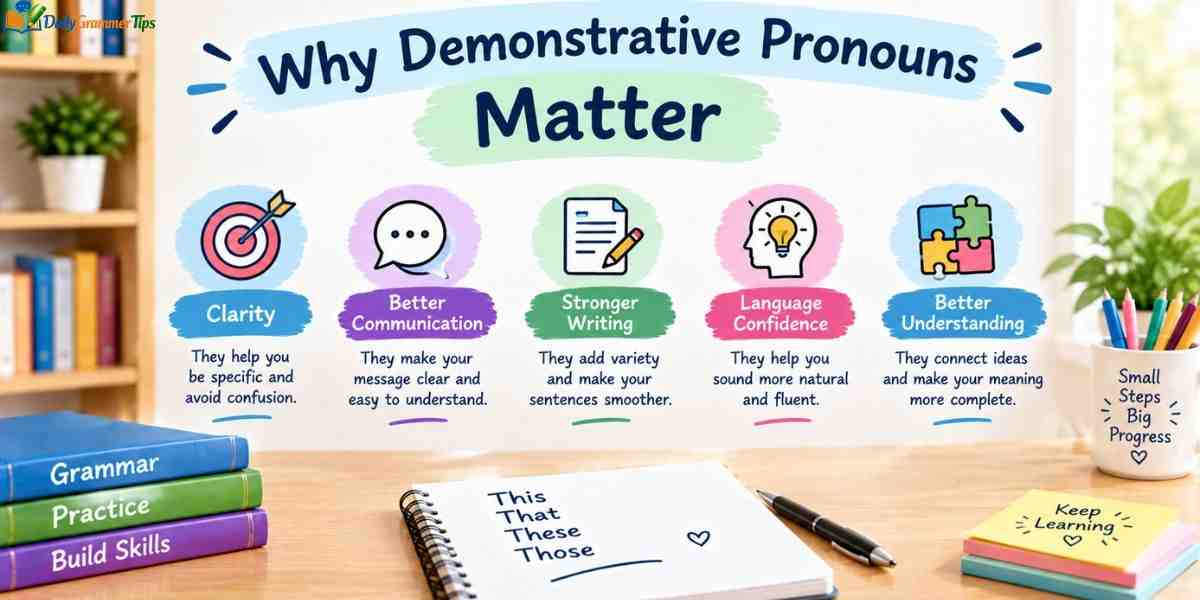
Demonstrative pronouns save space and keep writing smooth. They let us point instead of repeating long noun phrases.
They also guide the reader’s eye. A clear pointer makes a sentence easier to follow.
They Avoid Repetition
Instead of repeating “the red coat,” say “This is my coat.” The sentence stays short and clear.
They Show Distance
They tell us what is close and what is far, in space or in time.
Frequently Asked Questions
What Are the 4 Demonstrative Pronouns?
They are this, that, these, and those. This and that are singular, while these and those are plural.
What Are Some Examples of Demonstrative Pronouns?
Examples include “This is mine,” “That looks good,” “These are ready,” and “Those belong to her.”
What Is the Difference Between Demonstrative Adjectives and Demonstrative Pronouns?
A demonstrative pronoun replaces a noun. A demonstrative adjective comes before a noun and describes it.
How Do You Use Demonstrative Pronouns in a Sentence?
Pick this, that, these, or those based on number and distance. Example: “Those are my keys.”
Can Demonstrative Pronouns Refer to People?
Yes, when the person is clearly identified. Example: “This is my brother.”
Conclusion
Demonstrative pronouns are small words with a precise job. They point to things, people, and ideas, and they show number and distance. You now know the four core words, the noun test, and the common mistakes.
Keep practicing demonstrative pronouns in your daily writing. Point, count, and check the verb, and your sentences will become clearer. Use the exercises again after a few days to lock in the habit.
