

Participles are an important part of English grammar because they help describe people, objects, and actions in a more effective way. A participle is a verb form that can work as an adjective or help create different verb tenses. For example, in the sentence “The crying baby needs attention,” the word crying comes from a verb but describes the noun baby.
Many learners find participles confusing because they look similar to other verb forms, such as gerunds and regular adjectives. However, understanding their types, uses, and rules makes sentence building much easier. Learning how to use present, past, and perfect participles correctly can improve your grammar, writing style, and everyday communication.
How Are Participles Used in Sentences?
Participles have different roles in English sentences. They can work as adjectives, become part of verb phrases, or create shorter and more effective sentence structures. Understanding these uses helps learners recognize and use participles correctly.
The meaning of a participle depends on its position and function in a sentence.
Participles as Adjectives
One of the most common uses of participles is acting as adjectives. In this role, they describe nouns and provide extra information about people, objects, places, or situations.
Examples:
- The excited children opened their gifts.
- The broken window was replaced.
- The shining stars filled the sky.
- The confused student asked a question.
- The falling leaves covered the ground.
In these examples, the participles describe the condition or quality of the nouns.
Participles in Continuous Tenses
Present participles are an important part of continuous tenses. They combine with helping verbs to show actions that are happening at a specific time.
The structure is:
Subject + helping verb + present participle
Examples:
- She is learning English.
- They are watching a movie.
- He was driving carefully.
- We were waiting for the bus.
- The children are playing outside.
Here, the words ending in -ing are not describing nouns. Instead, they show ongoing actions.
Participles in Perfect Tenses
Past participles are used with helping verbs such as has, have, and had to create perfect tenses.
The structure is:
Subject + has/have/had + past participle
Examples:
- She has completed her homework.
- They have visited London.
- He had finished the project before the deadline.
- We have learned many new skills.
- The company has grown rapidly.
The past participle shows that an action has already happened or has been completed.
Participles in Passive Voice
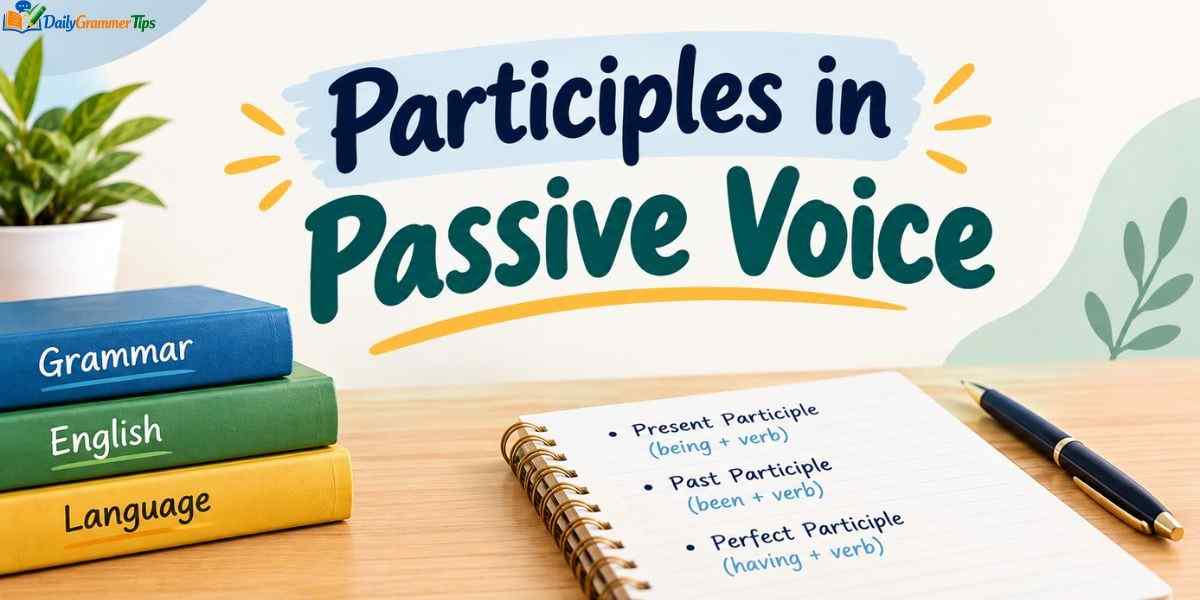
Past participles are also used in passive voice sentences. In passive structures, the focus is on the action or the object receiving the action rather than the person performing it.
The structure is:
Subject + be verb + past participle
Examples:
- The letter was written by Sarah.
- The cake was prepared by the chef.
- The building was designed by an engineer.
- The documents were signed yesterday.
- The problem was solved quickly.
What Are the Rules for Using Participles Correctly?
Using participles correctly requires attention to sentence structure and meaning. A misplaced or incorrect participle can make a sentence confusing.
Keep the Participle Close to the Word It Describes
A participle should be placed near the noun it modifies.
Incorrect:
Walking through the park, the flowers looked beautiful.
This sentence suggests that the flowers were walking.
Correct:
Walking through the park, I noticed the beautiful flowers.
Now the participle clearly describes the person walking.
Avoid Dangling Participles
A dangling participle happens when the sentence does not clearly show who or what performed the action.
Incorrect:
After reading the book, the movie seemed boring.
The movie did not read the book.
Correct:
After reading the book, I thought the movie seemed boring.
Use Commas After Introductory Participial Phrases
When a participial phrase appears at the beginning of a sentence, use a comma.
Correct:
Feeling exhausted, she went to sleep.
Incorrect:
Feeling exhausted she went to sleep.
The comma helps separate the introductory phrase from the main sentence.
Make Sure the Participle Matches the Meaning
Choose the correct participle form depending on whether something creates a feeling or experiences a feeling.
Examples:
Incorrect:
The lesson was bored.
Correct:
The lesson was boring.
Incorrect:
I am exciting about the trip.
Correct:
I am excited about the trip.
Continuing the article in the same SEO format:
What Is the Difference Between Participles and Gerunds?
Many English learners confuse participles with gerunds because both can end in -ing. Although they look similar, they have different functions in a sentence.
A gerund acts as a noun, while a present participle usually acts as an adjective or helps form a verb tense.
Understanding this difference helps you avoid common grammar errors.
Gerunds Act as Nouns
A gerund names an activity or action. It can be used as the subject, object, or complement of a sentence.
Examples:
- Reading improves your vocabulary.
- She enjoys painting.
- Swimming is good exercise.
- His favorite activity is cooking.
- They dislike waiting.
In these sentences, the words ending in -ing represent activities, so they function as nouns.
Present Participles Describe Nouns
A present participle describes a person, place, object, or situation.
Examples:
- The running athlete won the race.
- The barking dog disturbed the neighbors.
- The shining moon looked beautiful.
- The crying baby needed attention.
- The falling rain made the roads wet.
Here, the participles provide information about nouns.
Participles vs Adjectives: What Is the Difference?
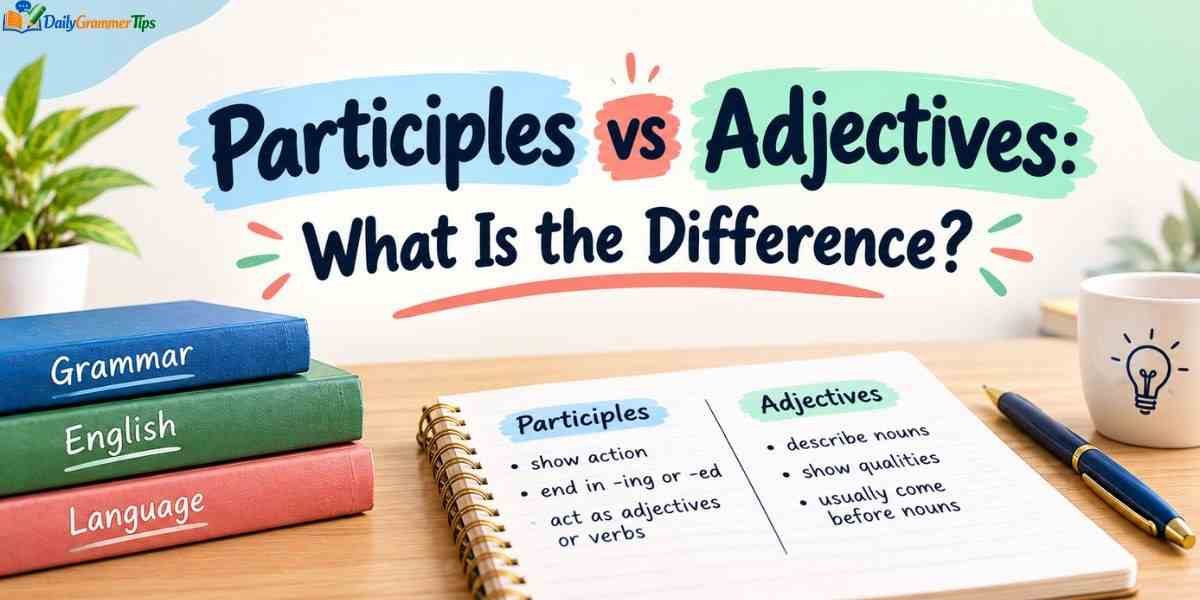
Some participles become adjectives because they describe feelings, conditions, or qualities. These forms are especially common with words ending in -ed and -ing.
The main difference is:
- -ing participles usually describe the thing that creates a feeling.
- -ed participles usually describe the person or thing experiencing the feeling.
Examples:
| -ing Form | Meaning | -ed Form | Meaning |
| interesting | creates interest | interested | feels interest |
| exciting | creates excitement | excited | feels excitement |
| confusing | creates confusion | confused | feels confusion |
| surprising | creates surprise | surprised | feels surprise |
| tiring | creates tiredness | tired | feels tired |
Examples in sentences:
- The movie was interesting.
- The audience was interested.
- The football match was exciting.
- The fans were excited.
- The instructions were confusing.
- The students were confused.
How Can You Identify Participles in a Sentence?
Finding participles becomes easier when you follow a few simple steps.
Step 1: Look for Verb Forms
Participles usually come from verbs.
Common signs include:
- Words ending in -ing
- Third forms of verbs (V3)
Examples:
- playing
- written
- broken
- laughing
- completed
Step 2: Check the Function of the Word
Ask yourself:
Is this word describing a noun?
If yes, it is probably a participle.
Example:
The damaged car was taken to the workshop.
The word damaged describes the car, so it is a past participle.
Step 3: Check Whether It Forms a Verb Tense
Sometimes participles are not adjectives. They are parts of verb phrases.
Example:
She is writing a letter.
The word writing is not describing a noun. It helps create the present continuous tense.
Example:
They have completed the work.
The word completed is a past participle used with have to form the perfect tense.
Common Types of Participles With Examples
Participles come in different forms depending on how they are used in a sentence. The main types include present, past, and perfect participles, each with its own structure and purpose.
Present Participle Examples
Present participles usually end in -ing and describe actions or conditions.
- The sleeping baby looked comfortable.
- The laughing children enjoyed the game.
- The boiling water spilled from the container.
- The glowing lights decorated the street.
- The running horse crossed the field.
- The growing tree provided shade.
- The melting ice disappeared quickly.
- The flowing river attracted visitors.
- The singing bird woke everyone early.
- The falling snow covered the roads.
Past Participle Examples
Past participles often show completed actions or conditions.
- The broken chair was repaired.
- The closed door prevented entry.
- The lost wallet was found.
- The written report explained everything.
- The damaged machine stopped working.
- The painted wall looked attractive.
- The frozen food was stored safely.
- The stolen phone was recovered.
- The finished assignment was submitted.
- The hidden message was discovered.
Learn more………Infinitive Phrases: Meaning, Examples, Rules, and Uses
Perfect Participle Examples
Perfect participles show that one action happened before another.
- Having completed his work, John went home.
- Having studied hard, Maria passed the exam.
- Having saved money, they bought a car.
- Having forgotten his password, he contacted support.
- Having prepared carefully, she performed well.
- Having reached the destination, they rested.
- Having cleaned the room, she invited guests.
- Having learned the rules, he played correctly.
- Having repaired the computer, the technician tested it.
- Having finished dinner, they watched a movie.
Common Mistakes When Using Participles
Even advanced English learners sometimes make mistakes with participles. Understanding these errors can improve both speaking and writing.
Mistake 1: Confusing “Interested” and “Interesting”
Incorrect:
I am interesting in learning English.
Correct:
I am interested in learning English.
Explanation:
- Interesting describes something that creates interest.
- Interested describes someone who feels interest.
Mistake 2: Using a Participle Without a Helping Verb
Incorrect:
She studying for the exam.
Correct:
She is studying for the exam.
A present participle needs a helping verb when it forms a continuous tense.
Mistake 3: Misplacing Participial Phrases
Incorrect:
Covered in chocolate, the children ate the cake.
This suggests the children were covered in chocolate.
Correct:
The children ate the cake covered in chocolate.
Mistake 4: Using the Wrong Past Participle
Incorrect:
He has went to the market.
Correct:
He has gone to the market.
Some verbs have irregular past participle forms that must be memorized.
Continuing the article in the same format:
Practice Exercises on Participles
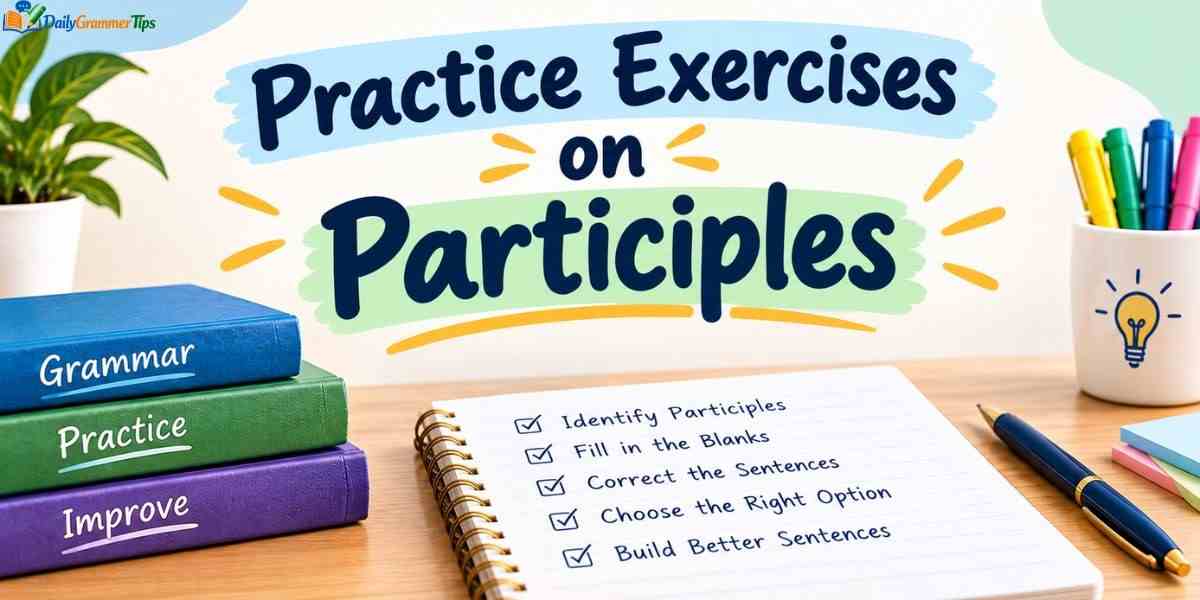
Practicing with examples is one of the best ways to understand participles. The following exercises will help you identify different types of participles and use them correctly in sentences.
Exercise 1: Identify the Participle
Find the participle in each sentence and identify whether it is a present participle, past participle, or perfect participle.
- The broken window was replaced yesterday.
- The running athlete won the competition.
- Having finished his homework, Ali watched television.
- The excited students entered the classroom.
- The falling leaves covered the garden.
- Having completed the project, the team celebrated.
- The written instructions were easy to follow.
- The children are playing outside.
- The damaged car was taken to the garage.
- Having learned the rules, she played the game correctly.
Answers:
- broken → Past participle
- running → Present participle
- Having finished → Perfect participle
- excited → Past participle
- falling → Present participle
- Having completed → Perfect participle
- written → Past participle
- playing → Present participle
- damaged → Past participle
- Having learned → Perfect participle
Exercise 2: Choose the Correct Participle Form
Choose the correct option.
1. The movie was very ______.
a) bored
b) boring
Answer: boring
Explanation: The movie creates the feeling of boredom.
2. I was ______ after the long journey.
a) tiring
b) tired
Answer: tired
Explanation: The person experiences tiredness.
3. The students were ______ by the difficult question.
a) confusing
b) confused
Answer: confused
Explanation: The students experienced confusion.
4. The ______ baby started crying loudly.
a) sleeping
b) slept
Answer: sleeping
5. ______ the work, she went home.
a) Having completed
b) Completing having
Answer: Having completed
Exercise 3: Correct the Mistakes
Rewrite the incorrect sentences correctly.
1. The lesson was very bored.
Correct:
The lesson was very boring.
2. She is interest in science.
Correct:
She is interested in science.
3. Walking to school, the rain started.
Correct:
Walking to school, I noticed the rain.
4. He has ate his lunch.
Correct:
He has eaten his lunch.
5. The students studying English improved quickly.
Correct:
The students studying English improved quickly.
Tips to Learn Participles Easily
Learning grammar becomes easier when you understand patterns instead of memorizing every sentence.
Learn Common Verb Forms
Create a list of common verbs with their three forms:
| Base Verb | Past | Past Participle |
| go | went | gone |
| eat | ate | eaten |
| write | wrote | written |
| see | saw | seen |
| take | took | taken |
| break | broke | broken |
| speak | spoke | spoken |
Knowing these forms makes it easier to recognize past participles.
Read English Regularly
Reading books, articles, and stories helps you see how writers use participles naturally.
Pay attention to:
- Words ending in -ing
- Third forms of verbs
- Descriptive phrases
Practice Creating Your Own Sentences
Instead of only studying rules, create examples.
For example:
Verb: excite
Present participle:
The exciting match attracted many fans.
Past participle:
The fans were excited.
Frequently Asked Questions
What is a participle?
A participle is a verb form that works as an adjective or helps create different verb tenses.
What are the three types of participles?
The three main types are present participles, past participles, and perfect participles.
How do you identify a participle in a sentence?
Look for verb forms like -ing words or third forms of verbs that describe nouns or help form tenses.
What is the difference between a participle and a gerund?
A participle describes a noun or forms a tense, while a gerund acts as a noun in a sentence.
Why are participles important in English?
Participles help make sentences clearer, more descriptive, and grammatically correct.
Conclusion
Understanding participles helps you create clearer, more natural, and grammatically correct sentences. These verb forms allow you to add descriptions, show completed actions, and build important English structures such as continuous tenses, perfect tenses, and passive voice. By learning the differences between present, past, and perfect participles, you can improve both your writing and speaking skills.
Regular practice is the best way to master this grammar concept. Pay attention to how writers use participles in books, articles, and everyday conversations, then try creating your own examples. With consistent practice, using participles correctly will become an easy and natural part of your English communication.
