

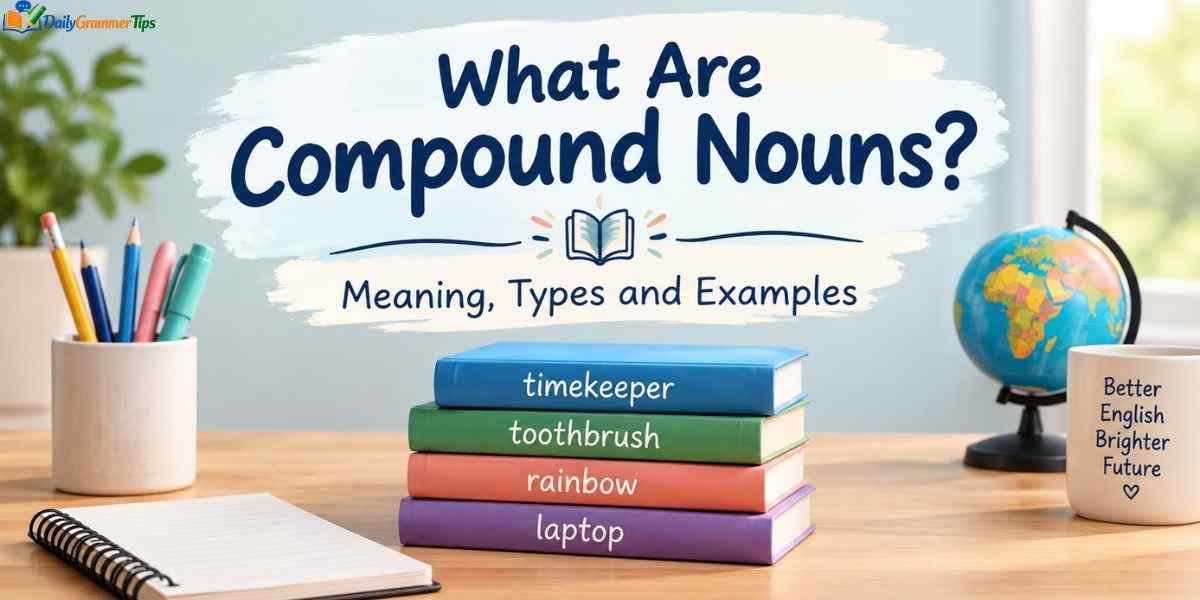
Compound nouns are words created by combining two or more words to form a new noun with a specific meaning. These combinations can include two nouns, an adjective and a noun, or a verb and a noun. Common examples include toothbrush, classroom, swimming pool, and mother-in-law.
English speakers use compound nouns every day to describe people, places, objects, and ideas more clearly. Learning how these nouns are formed, spelled, and used can help you improve your vocabulary, understand English conversations better, and write more accurate sentences.
What Are Compound Nouns?
A compound noun is a noun that consists of two or more words that work together as a single unit. Although these words may have separate meanings, their combination creates a new meaning.
For example:
- Tooth + brush = toothbrush
- Class + room = classroom
- Rain + coat = raincoat
A toothbrush is not simply a brush related to anything else; it is a specific tool used for cleaning teeth. Similarly, a classroom is a specific place where students learn.
Compound nouns can represent:
- People
- Places
- Objects
- Activities
- Ideas
Examples:
- Police officer → person
- Airport → place
- Football → activity
- Friendship → idea
Why Are Compound Nouns Important?
Compound nouns make communication easier because they allow us to express complex ideas using fewer words. Instead of describing something with a long phrase, English combines words to create a single meaningful term.
For example:
Without a compound noun:
A room where students attend lessons
With a compound noun:
Classroom
Without a compound noun:
A machine that washes clothes
With a compound noun:
Washing machine
Using compound nouns helps speakers and writers make sentences shorter, clearer, and more natural.
How Do Compound Nouns Work?
Compound nouns work by joining different words together to create a new meaning. The meaning of the complete noun may be directly related to the original words, or it may have a completely different meaning.
Examples:
Direct Meaning
Bedroom
- Bed + room
- A room used for sleeping
Football
- Foot + ball
- A sport played with a ball
Different Meaning
Butterfly
- Butter + fly
A butterfly is not a fly made of butter. It is a type of insect.
Deadline
- Dead + line
A deadline means the final time something must be completed.
Understanding the meaning of the whole word is important because compound nouns do not always follow the meanings of their individual parts.
Types of Compound Nouns
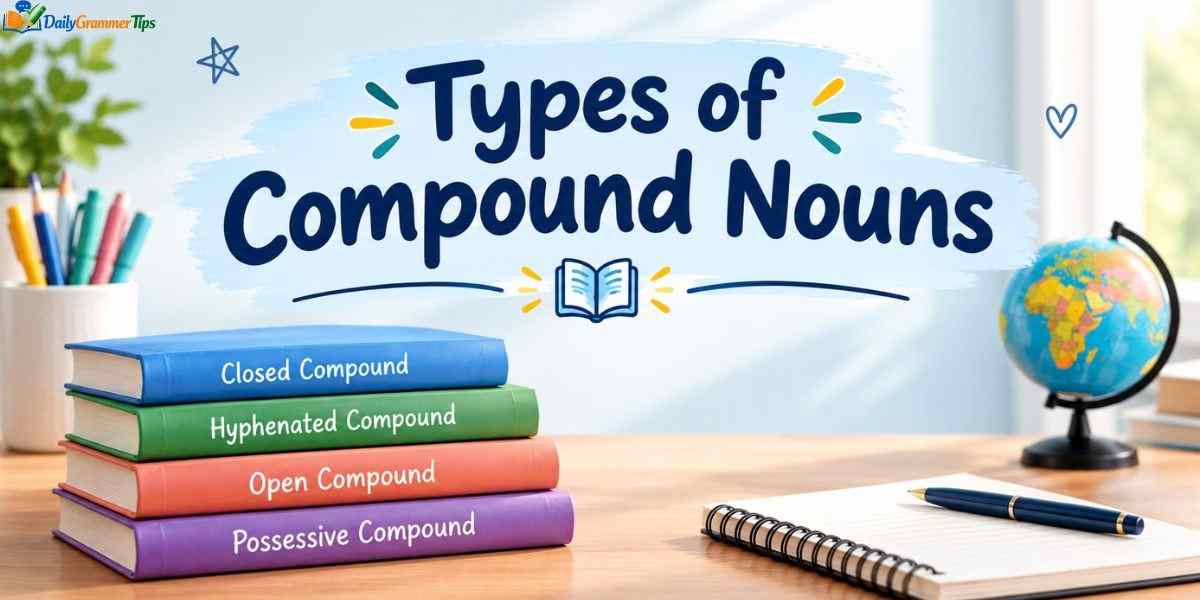
There are three main types of compound nouns based on how they are written:
- Closed compound nouns
- Open compound nouns
- Hyphenated compound nouns
Each type follows a different spelling pattern.
Closed Compound Nouns
Closed compound nouns are written as a single word without spaces or hyphens.
Examples:
| Compound Noun | Meaning |
| toothbrush | a tool for cleaning teeth |
| classroom | a room for learning |
| airport | a place for airplanes |
| notebook | a book for writing notes |
| sunflower | a type of flower |
| keyboard | a computer device |
Sentence Examples:
- I forgot my notebook at school.
- The students entered the classroom.
- She bought a new toothbrush.
- The plane arrived at the airport.
Open Compound Nouns
Open compound nouns are written as two separate words, but they work together as one noun.
Examples:
| Compound Noun | Meaning |
| ice cream | a frozen dessert |
| post office | a place for sending mail |
| swimming pool | a place for swimming |
| living room | a room for relaxing |
| police officer | a law enforcement worker |
Sentence Examples:
- We enjoyed ice cream after dinner.
- My brother works at the post office.
- The children played in the swimming pool.
- The police officer helped the family.
Hyphenated Compound Nouns
Hyphenated compound nouns use a hyphen (-) between the words.
Examples:
- Mother-in-law
- Father-in-law
- Check-in
- Runner-up
- Self-confidence
Sentence Examples:
- My mother-in-law visited us yesterday.
- The hotel provides online check-in.
- She developed strong self-confidence.
How Are Compound Nouns Formed?
Compound nouns can be formed by combining different types of words. English allows several combinations, and each combination creates a noun with a unique meaning.
Noun + Noun Compound Nouns
This is one of the most common patterns. Two nouns combine to create a new noun.
Examples:
| Combination | Compound Noun |
| tooth + paste | toothpaste |
| book + store | bookstore |
| rain + coat | raincoat |
| football + field | football field |
| bedroom + door | bedroom door |
Sentence Examples:
- I bought a new raincoat for the winter.
- She visited the bookstore yesterday.
- The players practiced on the football field.
Adjective + Noun Compound Nouns
In this pattern, an adjective describes a noun, and together they form a new noun.
Examples:
| Combination | Compound Noun |
| black + board | blackboard |
| green + house | greenhouse |
| fast + food | fast food |
| full + moon | full moon |
| high + way | highway |
Sentence Examples:
- The teacher wrote on the blackboard.
- We saw a beautiful full moon.
- They stopped at a fast food restaurant.
Verb + Noun Compound Nouns
A verb can combine with a noun to create a compound noun related to an action or object.
Examples:
| Combination | Compound Noun |
| washing + machine | washing machine |
| swimming + pool | swimming pool |
| dining + room | dining room |
| driving + license | driving license |
Sentence Examples:
- The washing machine needs repair.
- We ate dinner in the dining room.
- He applied for a driving license.
Noun + Verb Compound Nouns
Some compound nouns combine a noun with a verb to describe events, actions, or natural processes.
Examples:
- Sunrise
- Sunset
- Rainfall
- Snowfall
- Haircut
Learn more……………..What Is a Participle? | Meaning and Examples
Sentence Examples:
- The sunrise looked amazing.
- Heavy rainfall caused problems.
- She got a new haircut.
Rules for Using Compound Nouns Correctly
Using compound nouns correctly requires understanding their spelling, pronunciation, and plural forms.
Rule 1: Compound Nouns Can Be Singular or Plural
Most compound nouns become plural by adding -s or -es at the end.
Examples:
- one classroom → two classrooms
- one notebook → five notebooks
- one toothbrush → three toothbrushes
However, some compound nouns change the main word when they become plural.
Examples:
- mother-in-law → mothers-in-law
- father-in-law → fathers-in-law
- passer-by → passers-by
Rule 2: Pay Attention to Word Order
The order of words in compound nouns is usually fixed. Changing the order can make the phrase incorrect or change the meaning.
Correct:
- bedroom
- swimming pool
- police officer
Incorrect:
- room bed
- pool swimming
- officer police
Rule 3: Learn the Correct Spelling
Some compound nouns are written as one word, some as two words, and some with hyphens.
Examples:
One word:
- classroom
- airport
- football
Two words:
- post office
- ice cream
- living room
Hyphenated:
- mother-in-law
- check-in
- self-confidence
Rule 4: Compound Nouns Have Their Own Meaning
The meaning of a compound noun may not always be the direct combination of its parts.
Examples:
Homework
It does not mean “work inside a home.”
It means school tasks completed at home.
Butterfly
It does not mean “butter + fly.”
It means a type of insect.
Newspaper
It does not mean “paper that is new.”
It means a publication containing news.
Common Mistakes With Compound Nouns
Many learners make mistakes while using compound nouns because they are unsure about spelling, word order, or plural forms. Understanding these common errors can help you use them correctly.
Mistake 1: Writing Compound Nouns With Incorrect Spaces
Some compound nouns are written as one word, but learners separate them incorrectly.
Incorrect:
I cleaned my bath room.
Correct:
I cleaned my bathroom.
Incorrect:
She bought a note book.
Correct:
She bought a notebook.
Always check whether a compound noun is normally written as one word.
Mistake 2: Using Incorrect Plural Forms
Some compound nouns do not become plural by simply adding -s to the last word.
Incorrect:
I visited my mother-in-laws.
Correct:
I visited my mothers-in-law.
Incorrect:
He met three passer-bys.
Correct:
He met three passers-by.
The main word usually receives the plural form.
Mistake 3: Confusing Compound Nouns With Similar Words
Some words look similar but have different meanings.
Example:
Blackbird
= A specific type of bird
Black bird
= Any bird that has black color
Example:
- I saw a blackbird in the garden.
- I saw a black bird sitting on the tree.
The space between words can change the meaning.
Mistake 4: Changing the Word Order
Compound nouns usually have a fixed word order.
Incorrect:
Room living
Correct:
Living room
Incorrect:
Stop bus
Correct:
Bus stop
Changing the order can make the phrase incorrect.
Mistake 5: Using Compound Nouns as Two Separate Ideas
A compound noun works as one unit and should be understood as a single concept.
Incorrect:
I need a tooth brush.
Correct:
I need a toothbrush.
Although some compound nouns use spaces, their combined meaning should be treated as one idea.
How Can You Identify Compound Nouns?
You can identify a compound noun by following these simple steps:
Look for Combined Words
Find two or more words that work together.
Examples:
- football
- classroom
- police officer
- swimming pool
Check the Meaning
Ask:
“Do these words create a new meaning together?”
Example:
Rain + coat = raincoat
A raincoat is a specific type of clothing used during rain.
Check Its Function

A compound noun must act as a noun in a sentence.
Example:
My birthday is tomorrow.
Birthday names a specific event, so it is a compound noun.
Frequently Asked Questions
What is a compound noun in simple words?
A compound noun is a noun made by joining two or more words that create one meaning. Examples include toothbrush, classroom, football, and swimming pool.
What are the three types of compound nouns?
The three main types are closed compound nouns, open compound nouns, and hyphenated compound nouns. Examples are airport, ice cream, and mother-in-law.
How do you make compound nouns plural?
Most compound nouns become plural by adding -s or -es, such as classrooms and toothbrushes. Some hyphenated compound nouns change the main word, like mothers-in-law.
Are all compound nouns written as one word?
No. Some are written as one word (bedroom), some as two words (post office), and others with a hyphen (check-in).
Why are compound nouns important?
Compound nouns improve vocabulary and help speakers express ideas more clearly. They are commonly used in everyday conversations, professional writing, and academic communication.
Conclusion
Compound nouns help English speakers combine words to express specific meanings in a simple and effective way. From everyday words like classroom and toothbrush to more complex forms like mother-in-law, these nouns appear frequently in both spoken and written English.
Learning the types, formation rules, and common mistakes of compound nouns can improve your grammar and vocabulary. By practicing their usage and noticing them in real sentences, you can communicate more clearly and use English with greater confidence.
