


Adverbs of place are words that tell us where an action happens. They give information about the location, direction, or movement of a person, object, or activity in a sentence. Common examples include here, there, everywhere, outside, inside, above, below, and nearby.
These adverbs help make sentences clearer by showing the exact place or position related to an action. For example, in the sentence “The children are playing outside,” the word outside tells us where the children are playing. Understanding adverbs of place allows learners to describe locations and movements more naturally in everyday English.
What Is an Adverb of Place?
An adverb of place is a type of adverb that describes the location or direction of an action. It answers the question “Where?” in a sentence.
These words usually appear after the main verb or after the object of the sentence.
Examples:
- She looked everywhere for her keys.
- The dog is sleeping outside.
- Please come here.
- The children went upstairs.
In each sentence, the adverb of place explains where the action takes place.
Why Are Adverbs of Place Important in English?
Adverbs of place make communication more specific and meaningful. Without them, sentences may sound incomplete because the listener does not know the location of an action.
Compare these sentences:
Without an adverb of place:
The students are studying.
With an adverb of place:
The students are studying inside the library.
The second sentence gives a clearer picture because it tells us the location.
Adverbs of place help you:
- Describe locations accurately
- Explain movement and direction
- Give clear instructions
- Improve writing and speaking skills
- Create more detailed sentences
Common Types of Adverbs of Place With Examples
Adverbs of place can be grouped according to the information they provide. Some show location, while others describe direction, distance, or movement.
Adverbs That Show Location
These adverbs tell us where someone or something is located.
Common examples:
- here
- there
- everywhere
- somewhere
- nowhere
- inside
- outside
- nearby
Examples:
- My bag is here.
- The children are playing outside.
- I searched everywhere for my phone.
- She lives nearby.
- The keys are inside.
Adverbs That Show Direction

Some adverbs of place show movement toward a specific direction.
Common examples:
- up
- down
- away
- back
- forward
- backward
- ahead
Examples:
- The bird flew away.
- He stepped back.
- The child moved forward.
- Please go ahead.
- The hikers walked up.
Adverbs That Show Position
These adverbs explain the position of one thing compared to another.
Common examples:
- above
- below
- under
- over
- behind
- near
- around
Examples:
- The picture hangs above.
- The cat is hiding under the table.
- She stood behind me.
- The village is near.
- The children gathered around.
Adverbs That Show Distance
These adverbs explain how far away something is.
Common examples:
- far
- nearby
- close
- away
Examples:
- The school is nearby.
- The mountains are very far.
- My office is close.
- The shop is two miles away.
Continuing the article:
List of Common Adverbs of Place With Meanings
Adverbs of place appear frequently in daily conversations and writing. Learning their meanings helps you use them correctly in different situations.
| Adverb of Place | Meaning | Example |
| here | in this place | Please sit here. |
| there | in that place | Your book is there. |
| everywhere | in all places | Flowers are growing everywhere. |
| somewhere | in an unknown place | I left my keys somewhere. |
| nowhere | not in any place | The lost item was nowhere to be found. |
| inside | in an inner area | The children are playing inside. |
| outside | in an outer area | The dog is waiting outside. |
| above | at a higher position | The bird is flying above. |
| below | at a lower position | The temperature dropped below. |
| near | at a short distance | The store is near. |
| far | at a long distance | The village is far. |
| away | at a distance from a place | The train moved away. |
| around | surrounding a place | People stood around. |
| behind | at the back of something | The car is parked behind. |
| ahead | in front or forward | Walk ahead. |
| upstairs | on a higher floor | My room is upstairs. |
| downstairs | on a lower floor | The kitchen is downstairs. |
| abroad | in another country | She lives abroad. |
| home | to or at one’s house | He went home. |
How Do You Use Adverbs of Place in a Sentence?
Adverbs of place usually come after the main verb because they explain where an action happens. However, their position can change depending on the sentence structure.
After the Main Verb
This is the most common position for adverbs of place.
Examples:
- The children are playing outside.
- She looked everywhere.
- They waited there.
- The dog ran away.
About your research…………What Are Compound Nouns? | Meaning, Types and Examples
After the Object
When a sentence has an object, the adverb of place often comes after it.
Examples:
- She placed the book on the table.
- He searched the room everywhere.
- They built a house nearby.
At the Beginning of a Sentence
Some adverbs of place can appear at the beginning to emphasize location.
Examples:
- Here is the information you need.
- There goes the bus.
- Outside, the weather was beautiful.
Using an adverb at the beginning can make the location more noticeable.
What Are the Rules for Using Adverbs of Place?
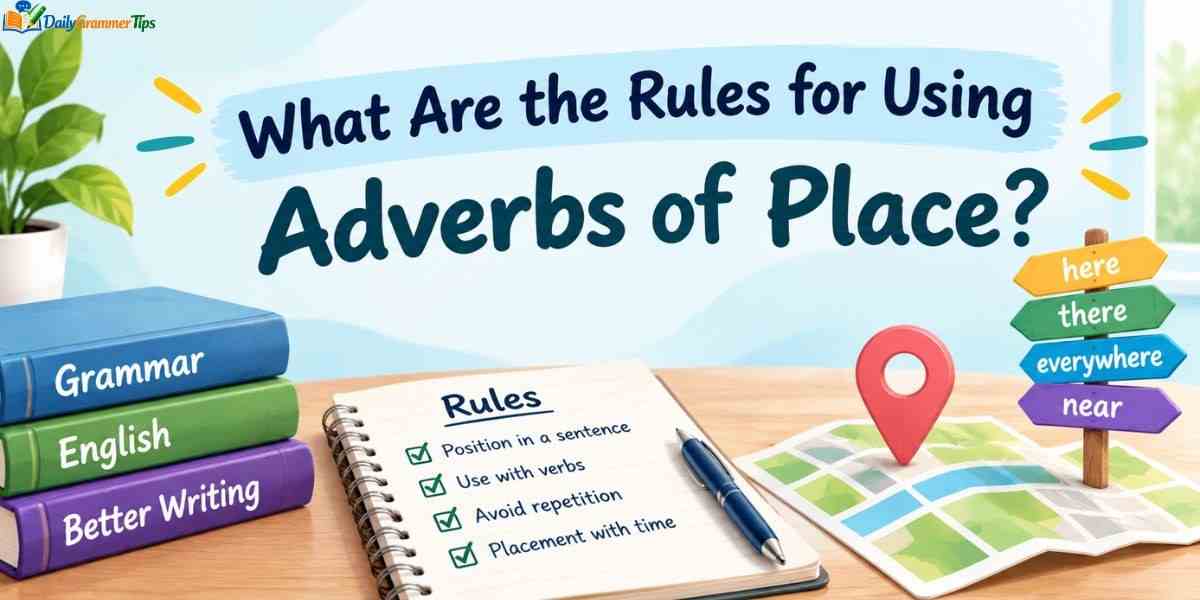
Using adverbs of place correctly requires understanding their position and meaning.
Rule 1: Use Adverbs of Place to Answer “Where?”
The main purpose of these adverbs is to show location or direction.
Example:
The children are playing outside.
Question:
Where are the children playing?
Answer:
Outside.
Rule 2: Place the Adverb Near the Action
The adverb should clearly connect with the verb it describes.
Incorrect:
She everywhere searched for her phone.
Correct:
She searched everywhere for her phone.
Rule 3: Do Not Use Unnecessary Prepositions
Some adverbs already include the meaning of location, so adding extra words can create mistakes.
Incorrect:
Come to here.
Correct:
Come here.
Incorrect:
Go to there.
Correct:
Go there.
Rule 4: Understand Direction and Location Differences
Some adverbs describe a place, while others describe movement.
Examples:
Location:
- The dog is inside.
Movement:
- The dog went inside.
The same word can have different meanings depending on the sentence.
Difference Between Adverbs of Place and Prepositions
Many learners confuse adverbs of place with prepositions because both can describe location.
The main difference is that prepositions usually need an object, while adverbs of place can stand alone.
Prepositions
A preposition connects a noun or pronoun to another word.
Examples:
- The book is on the table.
- She sat under the tree.
- The car is behind the house.
Here, table, tree, and house are objects of the prepositions.
Adverbs of Place
An adverb of place does not need an object.
Examples:
- Come inside.
- The children are playing outside.
- Please wait here.
- He looked everywhere.
Comparison Table
| Preposition | Adverb of Place |
| needs an object | does not need an object |
| shows relationship between words | shows location or direction |
| Example: The cat is under the chair | Example: The cat is outside |
Common Mistakes With Adverbs of Place
Learning common errors can help you use these words more accurately.
Mistake 1: Adding Extra Prepositions
Incorrect:
Come to here and sit.
Correct:
Come here and sit.
Explanation: The word here already shows location.
Mistake 2: Using the Wrong Location Word
Incorrect:
The bird flew here from the tree.
Correct:
The bird flew away from the tree.
Explanation: Here means this place, while away shows movement to another place.
Mistake 3: Confusing “There” and “Their”
Incorrect:
Their is my bag.
Correct:
There is my bag.
Explanation:
- There = a place
- Their = shows possession
Mistake 4: Incorrect Word Order
Incorrect:
Everywhere she looked her keys.
Correct:
She looked everywhere for her keys.
Continuing the article:
30+ Examples of Adverbs of Place in Sentences
The best way to understand adverbs of place is to see how they work in real sentences. These examples show how different words describe location, direction, and movement.
Examples Showing Location
- Please sit here and wait for your turn.
- Your shoes are there near the door.
- I searched everywhere for my missing notebook.
- She found her wallet somewhere in the room.
- The children are playing outside.
- The guests are waiting inside.
- My friend lives nearby.
- The shop is located far from my house.
- The answer is written above.
- The temperature is shown below.
Examples Showing Direction or Movement
- The dog ran away when it heard the noise.
- Please move back a little.
- The teacher asked the students to move forward.
- The car slowly moved ahead.
- The child walked upstairs to his room.
- She went downstairs to prepare dinner.
- The birds flew away before the storm.
- The hikers continued forward on the trail.
- The ball rolled down the hill.
- The plane traveled abroad.
Examples Showing Position
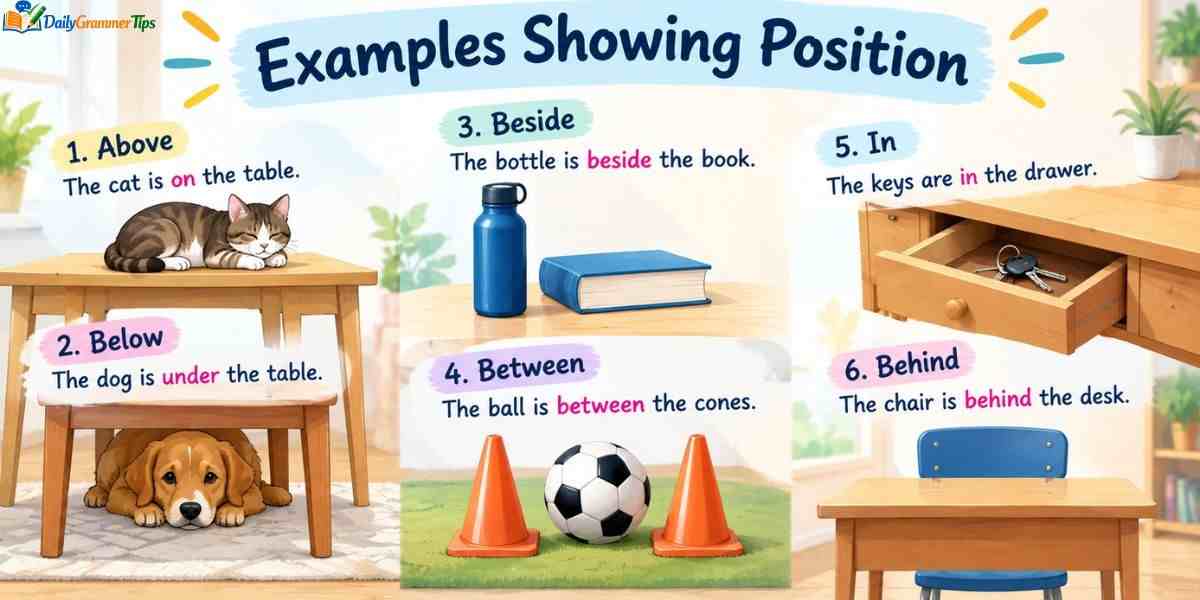
- The cat is hiding underneath the table.
- The picture is hanging above the sofa.
- The children stood behind the wall.
- The crowd gathered around the stage.
- The car stopped near the building.
- The village is located below the mountain.
- The books are placed inside the cupboard.
- The workers stayed outside the building.
- The dog followed its owner everywhere.
- The visitors looked around the museum.
Frequently Asked Questions
What are adverbs of place?
Adverbs of place are words that describe where an action happens. They answer the question “Where?” in a sentence. Common examples include here, there, outside, inside, everywhere, nearby, and away.
What are some common examples of adverbs of place?
Common adverbs of place include here, there, everywhere, somewhere, nowhere, inside, outside, above, below, nearby, and away. These words help explain location, position, or movement.
Where do adverbs of place appear in a sentence?
Adverbs of place usually appear after the main verb or after the object. For example, “She looked everywhere” and “The children are playing outside.” They can also appear at the beginning for emphasis.
What is the difference between adverbs of place and prepositions?
Adverbs of place can stand alone and show location, while prepositions usually need an object. For example, “Come inside” uses an adverb, while “Come inside the house” uses a preposition.
Why are adverbs of place important?
Adverbs of place make sentences clearer by showing exact locations and directions. They help speakers and writers explain where actions happen and make communication more detailed.
Conclusion
Adverbs of place play an important role in English because they help us describe locations, directions, and movements clearly. Words like here, there, outside, inside, and everywhere make sentences more meaningful by answering the question “Where?”
Learning how to use these adverbs correctly improves your grammar and communication skills. With regular practice and attention to sentence structure, you can use adverbs of place naturally in both speaking and writing.
