

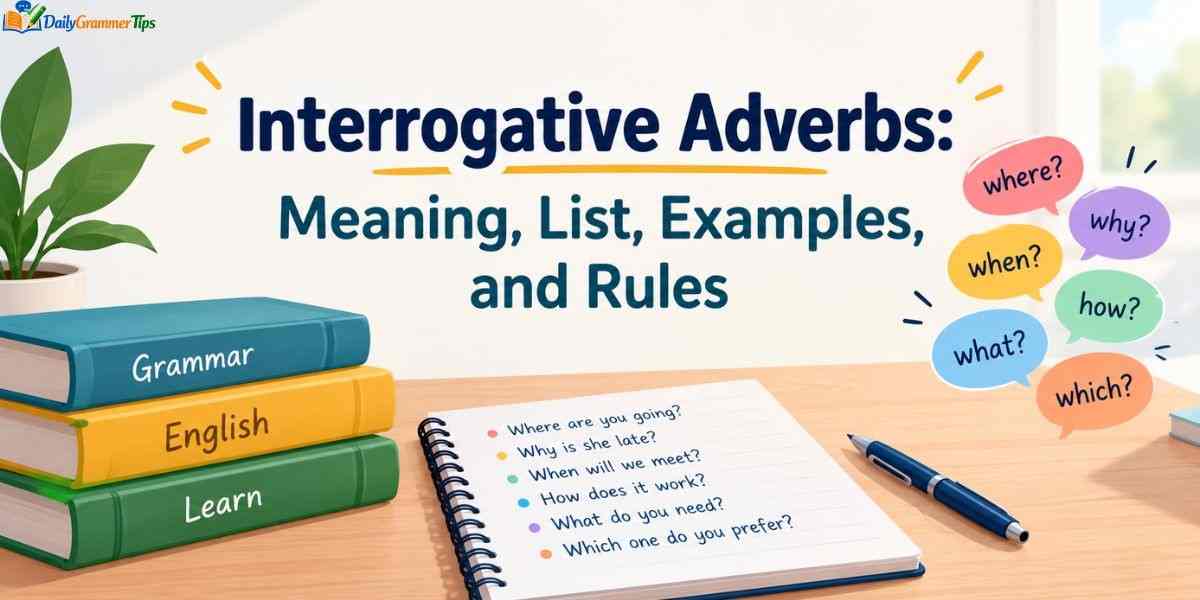
Interrogative adverbs help you ask for exact information in English. When you ask when, where, why, or how, you open the question with one of these words, and the word guides the answer.
This guide explains interrogative adverbs in simple steps. You will learn the list, the word order, the common mistakes, and the practice tasks, so you can ask clear questions at school, at work, and in exams.
What Are Interrogative Adverbs?
These words start questions that ask for time, place, reason, manner, or amount. They also modify the verb in the question. Let us begin with a clear definition.
Definition of Interrogative Adverbs
Interrogative adverbs are adverbs that introduce questions. They ask about when, where, why, or how something happens. “Where do you live?” is a good example, because where asks for a place.
Compare a statement with a question. “You live in Paris” gives information. “Where do you live?” asks for it.
Why They Are Called Interrogative
The word interrogative comes from the idea of questioning. An interrogative sentence asks something, and these adverbs lead the question. They sit at the front, so listeners know a question is coming.
People also call them question words or wh words. Most of them begin with wh. How is the exception, but it still belongs to the group.
What Interrogative Adverbs Modify
Like other adverbs, they modify verbs, adjectives, and other adverbs. In “How did he fix it?” how modifies the verb fix. In “How tall is he?” how modifies the adjective tall.
In “How quickly can you read?” how modifies the adverb quickly. This flexibility makes how the busiest word in the group.
Interrogative Adverbs and Interrogative Sentences
An interrogative sentence asks a question and ends with a question mark. Interrogative adverbs often open that sentence. They signal the question type before the verb appears.
Other sentence types behave differently. A declarative sentence states a fact. An imperative gives an order. Only the interrogative type uses these question words.
Why Learners Need Them
Questions drive conversation. You ask for directions, reasons, plans, and methods all day. Short question words make those questions quick and exact.
Exams test these words often. Fill in the blank tasks, error correction, and speaking tests all use them. A firm grasp raises both accuracy and confidence.
Interrogative Adverbs List
The core group is small and easy to memorize. Extra forms add detail. Here is the full picture.
The Four Main Interrogative Adverbs
The four main words are when, where, why, and how. Most grammar guides agree on this list. Each word asks about a different kind of information.
When asks about time. Where asks about place. Why asks about reason. How asks about manner, degree, and amount.
Compound Forms with How
How forms many useful phrases. How much, how many, how long, how far, how often, how old, and how tall are common. Each phrase asks for a measure or a count.
Examples: “How often do you swim?” “How far is the station?” “How old is your sister?” The second word tells you what kind of answer to give.
Informal Forms: How Come and What For
How come means why, but it works in casual speech. “How come you are late?” keeps normal word order after come. What for also asks about reason or purpose.
“What did you do that for?” sounds informal. “Why did you do that?” sounds neutral. Both ask for a reason.
Emphatic Forms of Interrogative Adverbs
English adds emphasis with extra words. “Where on earth did you go?” “How ever did you manage?” “Why on earth is he late?” These forms show surprise.
Whenever, wherever, and however can also appear in questions. They sound dramatic and belong to casual speech.
Old and Literary Forms
Older English used whence, whither, and wherefore. Whence means from where. Whither means to where. Wherefore means why.
You may meet them in poems, plays, and legal texts. Shakespeare’s famous balcony line uses wherefore to mean why, not where.
Types of Interrogative Adverbs
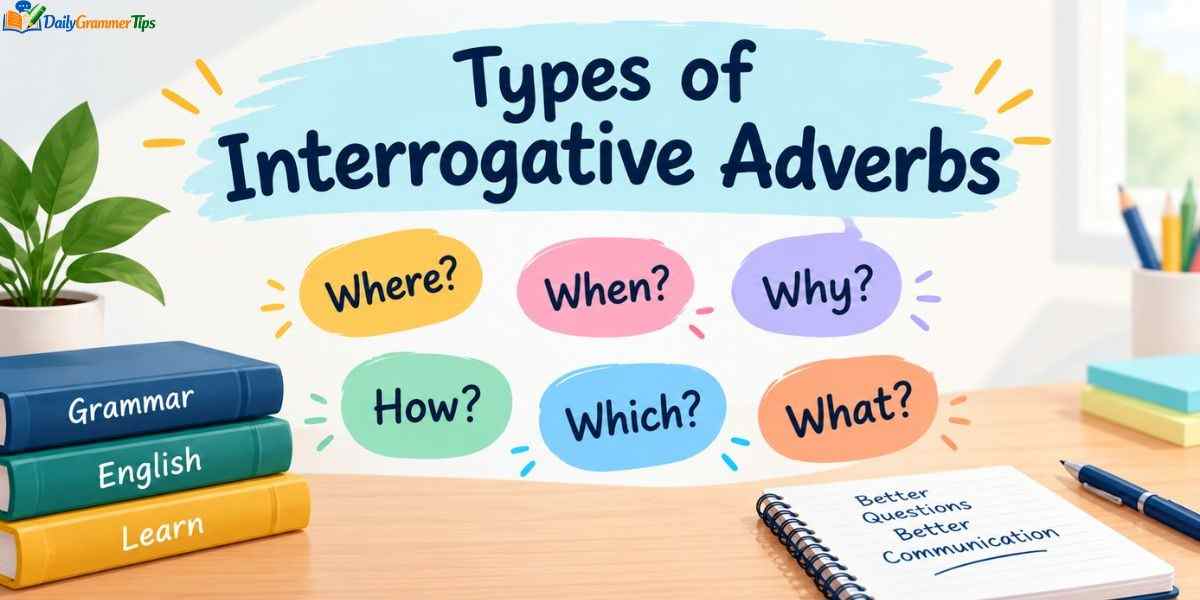
Grammarians sort these words by the kind of information they ask for. This sorting helps you pick the right word fast.
Interrogative Adverbs of Time
When asks about time. “When does the train arrive?” “When is your birthday?” The answer gives a time, a date, or a period.
How can also ask about time in phrases like how long and how soon. “How long will you stay?” asks about duration.
Interrogative Adverbs of Place
Where asks about place or direction. “Where is my passport?” “Where did they go?” The answer names a location or a path.
Where also works with from. “Where are you from?” asks about origin. The preposition often moves to the end.
Interrogative Adverbs of Reason
Why asks about reason or cause. “Why are you so late?” The answer often starts with because.
It can also ask about purpose. “Why did you learn French?” may get the answer “To work abroad.”
Interrogative Adverbs of Manner
How asks about the way an action happens. “How did you make this sauce?” “How do you start the car?” The answer explains the method.
The answer may use an adverb or a phrase. “Slowly” and “with a key” both fit.
Interrogative Adverbs of Degree and Quantity
How also asks about degree and amount. “How tall are you?” “How much flour do I need?” “How many people are coming?”
Use much with uncountable nouns and many with countable nouns. This rule prevents a very common error.
Open Questions with Interrogative Adverbs
Questions with these words are open questions. They invite a full answer rather than yes or no. “Where did you stay?” needs a place.
Yes or no questions work differently. “Did you stay at a hotel?” expects yes or no. Choose the type that fits your goal.
Interrogative Adverbs Examples
Examples show the pattern better than rules. Read each sentence aloud and notice the word order.
Examples with When
“When does the class start?” “When did you arrive?” “When will the results come out?” Each question expects a time.
Possible answers: “At nine.” “Yesterday evening.” “Next week.” Each answer gives a time.
Examples with Where
“Where is the library?” “Where do you work?” “Where have they gone?” Each question expects a place.
Possible answers: “Near the park.” “At a bank.” “To the market.” Each answer names a location or a direction.
Examples with Why
“Why are you smiling?” “Why did the meeting end early?” “Why can’t we leave now?” Each question expects a reason.
Possible answers: “Because I passed my exam.” “The manager felt unwell.” “It is too late.” Each answer explains a cause.
Examples with How
“How do you spell your name?” “How can I help you?” “How did he solve the problem?” Each question expects a method.
Possible answers: “J, O, H, N.” “Please send the file.” “He asked an expert.” Each answer describes the way.
Examples with How Much and How Many
“How much does this cost?” “How many days are left?” “How many students passed?” Each question asks for an amount or a number.
Possible answers: “Ten dollars.” “Three days.” “Almost all of them.” Each answer gives a measure.
Examples in Formal Writing
Writers use rhetorical questions to guide readers. “Why does this matter?” “How can schools improve results?” The writer then answers the question.
The question opens a point. The next sentence answers it. Use this device once or twice in an essay.
Examples in Short Dialogues
A: “When does the shop open?” B: “At ten.” A: “Where do you study?” B: “At a college in town.”
A: “Why did you choose that course?” B: “I love languages.” A: “How do you travel to work?” B: “By bus.”
Learn more………….Negative Adverbs: Meaning, List, Examples, and Rules
Interrogative Adverb When
When is the main word for time questions. It is simple, but it has a few useful patterns.
Using When for Time
When asks for a point in time. “When did you move here?” “When is the exam?” Answers give dates, days, or hours.
Use it with any tense. “When will she return?” looks forward. “When did she return?” looks back.
When with Prepositions
Prepositions can join it to form phrases. Since when, until when, and by when are common. “Until when can I stay?” asks for a limit.
“Since when do you like jazz?” often shows surprise. The phrase can ask about time or express doubt.
When vs What Time
What time asks for a clock time. “What time does the film start?” When allows broader answers such as “Tomorrow.”
Use what time for exact hours. Use when for days, dates, and general periods.
Interrogative Adverb Where
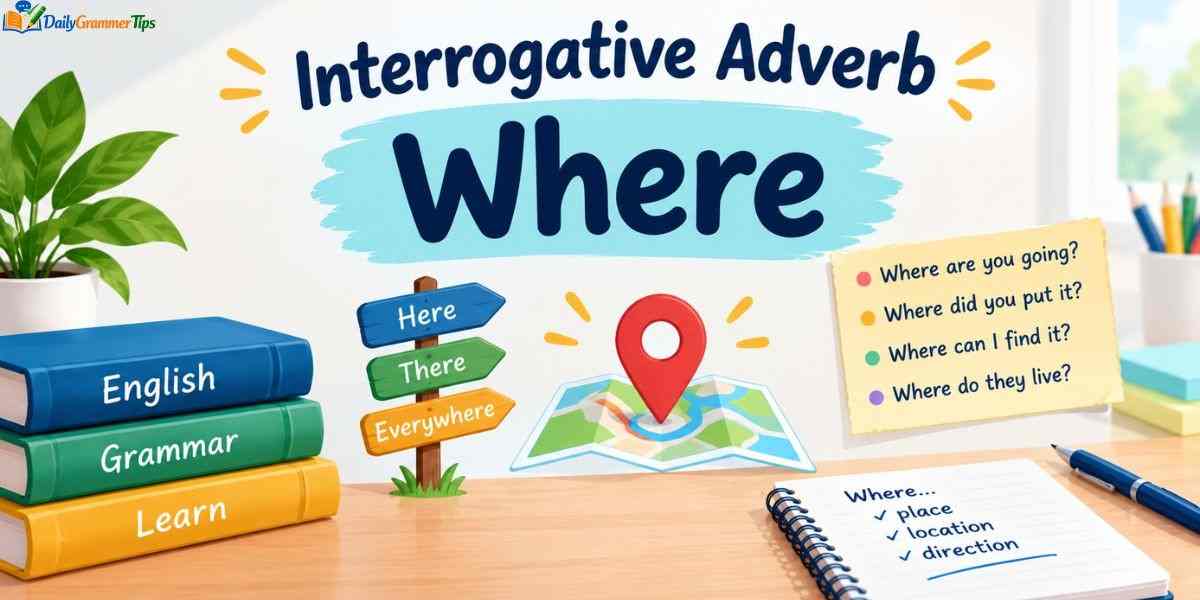
Where is the main word for place questions. It also asks about direction and source.
Using Where for Place
Where asks about a location. “Where is the bank?” “Where do you live?” The answer names a place.
It works with many verbs. “Where did he put the keys?” “Where will we meet?” The auxiliary comes before the subject.
Where with Prepositions
Prepositions usually sit at the end in speech. “Where are you from?” “Where did she go to?” This order sounds natural.
Formal writing may move the preposition forward. “From where did the rumor start?” This version sounds stiff in daily talk.
Where Questions for Directions
Where questions help travelers find their way. “Where is the nearest pharmacy?” “Where can I buy a ticket?” Locals answer with landmarks and streets.
Pair them with how. “How do I get to the airport?” asks for the route. Together, the two words cover most travel needs.
Where in Formal and Informal Style
In casual talk, people shorten questions. “Where to?” and “Where from?” are common in taxis and shops. The full forms are safer in writing.
Keep the full form in emails and essays. “Where are you traveling to?” sounds clear and polite.
Interrogative Adverb Why
Why asks for reasons, causes, and purposes. It also helps make suggestions.
Using Why for Reason
Why asks for a cause. “Why is the road closed?” “Why did he leave early?” The answer explains what led to the event.
It works with be, do, and modal verbs. “Why can she not come?” is correct but formal. “Why can’t she come?” is more natural.
Why Not and Why Don’t We
Why not makes a suggestion. “Why not ask the teacher?” means you should ask. Why don’t we invites a shared action.
“Why don’t we meet at six?” is friendly and polite. The structure sounds like a question, but it works as a suggestion.
Answering Why Questions
Answers often use because. “Because the bus was late.” Other options include since, as, and so that.
Short answers can use to plus a verb. “Why did you call?” “To say thanks.” This form states a purpose.
How Come vs Why
How come keeps normal word order. “How come he left?” The subject comes before the verb.
Why needs inversion. “Why did he leave?” This difference trips many learners. Remember it when you switch between casual and formal speech.
Interrogative Adverb How
How is the most flexible word in the group. It asks about manner, degree, amount, and frequency.
How for Manner
How asks about the way something happens. “How do you make tea?” “How did she open the door?” The answer describes a method.
It can also ask about means. “How do you travel?” “By train.” The answer names a tool or a route.
How with Adjectives
How plus an adjective asks about degree. “How tall is he?” “How old is your house?” “How angry is she?”
The adjective stays next to how. Do not separate them. “How is he tall?” asks something very different.
How Much and How Many
How much asks about uncountable amounts. “How much flour do I need?” “How much time do we have?”
How many asks about countable things. “How many people are coming?” “How many books do you own?”
How with Other Adverbs
How can modify adverbs. “How often do you go to London?” “How quickly can you read this?” The answer gives a rate or a frequency.
“How loudly does your brother scream?” asks about degree. The adverb after how sets the topic of the answer.
How Long, How Far, and How Soon
These phrases ask about measures. “How long is the road?” “How far is the beach?” “How soon can you arrive?”
How long can ask about length or time. “How long have you lived here?” asks about duration.
Asking for Opinions with How
How also asks for opinions and feelings. “How was your trip?” “How do you like the new office?” The answer expresses a view.
These questions invite a short story. Follow up with why. “Why did you enjoy it?” keeps the talk going.
How Are You and How About
Some fixed phrases use how. “How are you?” opens a chat. “How about a walk?” makes a suggestion.
These phrases do not seek facts. They build friendly talk. Learn them as set expressions.
Is What an Interrogative Adverb?
Many learners ask this question. The answer depends on the grammar book. Most modern guides place what elsewhere.
Why Some Lists Include What
Some lists include what because it starts many questions. “What time is it?” looks like a time question. That similarity causes the confusion.
Strict grammar separates the words by function. Adverbs modify verbs, adjectives, and adverbs. What usually does a different job.
What as an Interrogative Pronoun
What often acts as a pronoun. “What happened?” “What do you want?” In each question, what replaces a noun.
The answer is a thing or an idea. “A storm.” “A cup of tea.” That is typical pronoun behavior.
What as an Interrogative Determiner
What can also come before a noun. “What color is your car?” “What time is the meeting?” Here it works like an adjective.
The noun that follows narrows the question. So what time is a fixed phrase and does not make what an adverb.
What For and What Is It For
What for asks about purpose. “What is this button for?” “What did you do that for?” The preposition for stays at the end.
Some guides treat what for as an adverbial phrase. Others treat what as a pronoun. Both views appear in grammar books.
Interrogative Adverbs vs Interrogative Pronouns and Adjectives
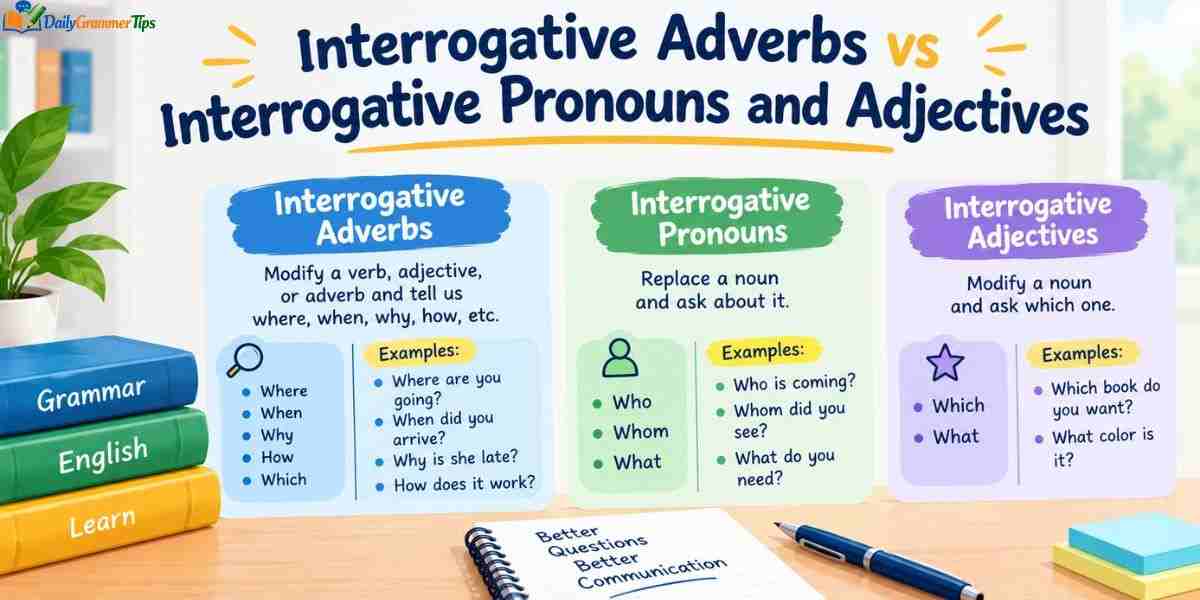
English has three families of question words. They look similar but do different jobs. Knowing the jobs helps you choose the right word.
Interrogative Pronouns
Interrogative pronouns replace nouns. The list includes who, whom, whose, what, and which. “Who called?” asks about a person.
“Whose bag is this?” asks about an owner. The answer is a noun or a pronoun.
Interrogative Adjectives
Interrogative adjectives come before nouns. Which, what, and whose are typical. “Which book do you want?” “Whose car is that?”
They ask you to identify or choose. The noun stays right after the question word.
Quick Comparison
Compare “Who left?” with “When did he leave?” The first asks about a person. The second asks about time.
Compare “Which road is shorter?” with “How far is the road?” The first chooses a road. The second measures distance.
Interrogative Adverbs vs Relative Adverbs
Interrogative adverbs and relative adverbs share the same spelling. Their jobs differ. A clear test keeps them apart.
What Are Relative Adverbs
Relative adverbs join clauses. The main ones are when, where, and why. “This is the place where we met” shows where at work.
They add information about a noun. They do not ask questions.
Same Words, Different Jobs
Compare “Where do you live?” with “This is the house where I live.” The first is a question. The second is a statement.
Compare “Why did she go?” with “That is the reason why she went.” The first asks. The second explains.
How to Tell Them Apart
Check the sentence type. A question ends with a question mark. A relative clause sits inside a statement.
Also check the word order. A question uses inversion. A relative clause keeps normal order.
Word Order Rules for Interrogative Adverbs
Word order is the heart of the topic. One simple pattern covers most cases. Learn it well and your questions will sound natural.
The Basic Pattern
Place the interrogative adverb first. Then add the auxiliary verb. Add the subject next and the main verb last.
“Where did you go?” follows this pattern. Where comes first, then did, then you, then go.
Questions with the Verb Be
With be, the verb comes before the subject. “Where is my passport?” “Why are you late?” No extra auxiliary is needed.
The same pattern works in the past. “When was the party?” “How were the results?”
Questions with Do, Does, and Did
Other verbs need do, does, or did. “When does the train arrive?” “Why did he leave?” The main verb stays in base form.
Do not use two past forms. Say “Why did he leave?” not “Why did he left?
Questions with Modal Verbs
Modal verbs act as auxiliaries. “How can I help?” “Where should we meet?” “Why must she go?”
The modal comes before the subject. The main verb follows in base form.
Subject Questions with How Many
Some questions ask about the subject. “How many people came?” has no auxiliary. The phrase how many people is the subject.
Compare “How many people did you invite?” Here you is the subject, so did appears. This contrast confuses many learners.
Short Answers to Questions with Interrogative Adverbs
Short answers drop repeated words. “Where did you go?” “To the market.” “When will it start?” “At noon.”
Full answers repeat the verb. “I went to the market.” Choose short answers in speech and full answers in writing.
Prepositions at the End
Prepositions often finish the question. “Where does he come from?” “How did you pay for it?” This pattern is natural in speech.
Formal writing may move the preposition forward. The shorter pattern still works in most settings.
Negative Questions
Negative questions use not or n’t after the auxiliary. “Why didn’t you call?” “Where haven’t we looked?”
They often show surprise or complaint. “Why can’t she come?” suggests the speaker expected a yes.
Interrogative Adverbs with Tenses and Modals
These words work with every tense. The adverb stays first and the tense shows in the verb. Study each group below.
Present Simple and Present Continuous
Present simple asks about habits and facts. “Where do you work?” “How does it work?”
Present continuous asks about actions now. “Why are you laughing?” “When are they arriving?”
Past Simple and Past Continuous
Past simple asks about finished events. “When did you arrive?” “How did it happen?”
Past continuous asks about actions in progress. “Where were you going?” “Why was he crying?”
Present Perfect
Present perfect links the past to now. “How long have you lived here?” “Why has she left?”
The auxiliary have or has comes before the subject. The past participle follows the subject.
Future and Modal Forms
Future questions use will or going to. “When will they arrive?” “Where are we going to stay?”
Modals add ability, duty, or permission. “How could he know?” “Why should we wait?” The pattern stays the same.
Perfect Continuous and Past Perfect
Perfect continuous asks about duration up to now. “How long have you been waiting?” “Why have they been arguing?”
Past perfect looks further back. “Why had she left?” “Where had he hidden the keys?” The auxiliary had comes before the subject.
Interrogative Adverbs in Indirect Questions
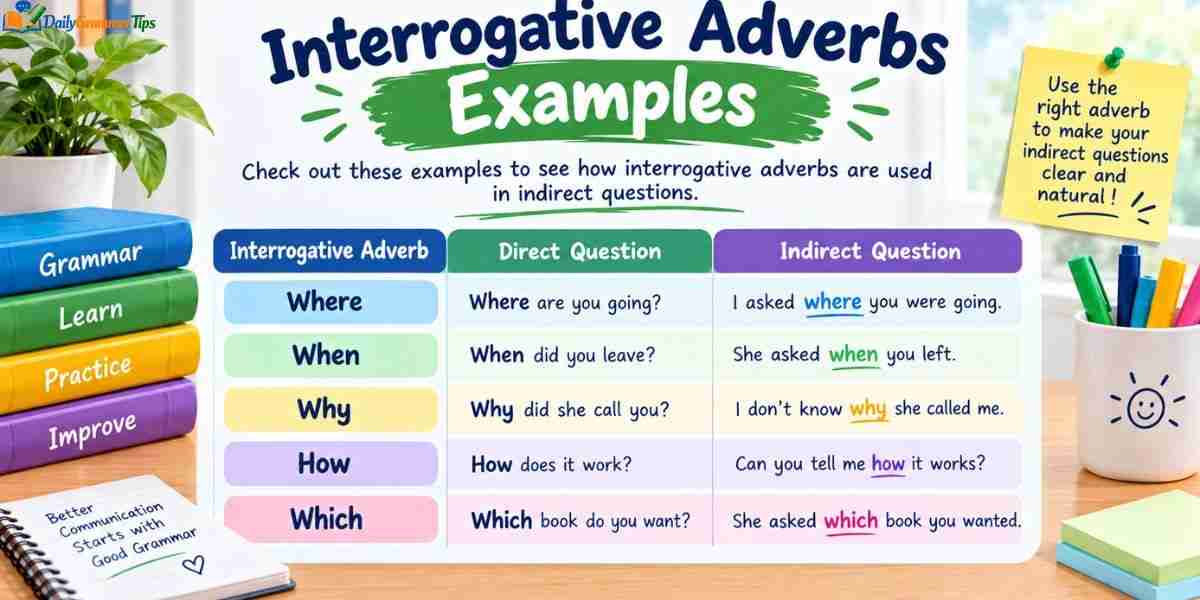
Indirect questions sit inside another sentence. They sound more polite and are common at work. Word order changes in them.
What Are Indirect Questions
An indirect question reports or softens a direct question. “Where is the bank?” becomes “Can you tell me where the bank is?”
The question word stays. The structure inside it changes.
Word Order in Indirect Questions
Use normal word order after the question word. “I wonder when the train arrives.” Do not say “I wonder when does the train arrive.”
Drop do, does, and did. Keep the subject before the verb. “She asked why he left.”
Polite Phrases
Common openers include could you tell me, do you know, and I wonder. “Do you know where she lives?” is polite and clear.
These phrases make requests gentler. Use them with strangers and in formal emails.
Reported Questions
Reported speech turns direct questions into indirect ones. “Where do you live?” becomes “She asked where I lived.” The tense often shifts back.
“When does the train leave?” becomes “He asked when the train left.” The reporting verb is usually asked or wondered.
Punctuation in Indirect Questions
A question mark appears only when the main clause asks. “Do you know why he left?” needs one.
“I know why he left” is a statement. It ends with a period. Check the main clause first.
Common Mistakes with Interrogative Adverbs
Learners make a few predictable errors. Each one has a quick fix. Review them before every exam.
Missing Inversion
A common error leaves out the auxiliary. “Where you are going?” is wrong. Say “Where are you going?”
Check the second word after the question word. It should be a verb, not a subject.
Extra Auxiliary Verbs
Some learners add do to a be question. “Where does he is?” is wrong. Say “Where is he?”
Use one auxiliary at a time. Too many auxiliaries make the question hard to follow.
Using How Instead of What
“How do you call this?” is a frequent error. The correct form is “What do you call this?” You ask for a name, not a method.
Use what for names and things. Use how for methods and ways.
Much vs Many
“How much people came?” is wrong. People are countable, so use many. Say “How many people came?”
Use much with uncountable nouns such as water, time, and money.
Tense Errors in Questions
Learners often keep the past form on the main verb. “Where did you went?” is wrong. After did, the main verb returns to base form, so say “Where did you go?”
The same rule applies after do and does. “When does she arrives?” is wrong. Say “When does she arrive?” Interrogative adverbs never change this rule.
Mixing Why and Because
Do not use because inside the question. “Why did you leave because it rained?” is wrong. Keep the reason for the answer.
Ask “Why did you leave?” and answer “Because it rained.”
Overusing How Come
How come is casual. Avoid it in essays, reports, and formal emails. Use why instead.
Compare “How come the plan failed?” with “Why did the plan fail?” The second sentence sounds more professional.
Confusing Where, Were, and Wear
These words sound alike but differ in meaning. Where asks about place. Were is a past form of be. Wear means to have clothes on.
Check spelling in writing. “Where were you?” uses both words in one question.
Wrong Question Mark Use
Do not add a question mark to an indirect question that is a statement. “I asked where he lived.” ends with a period.
Add the mark only when the whole sentence asks. This habit improves your writing score.
Interrogative Adverbs in Other Languages
Other languages share the same idea. Comparing them helps learners notice patterns. Here are two examples.
Spanish Question Words
Spanish uses cómo, cuándo, dónde, and por qué. They match how, when, where, and why. Written accents are part of the spelling.
“¿Dónde vive tu hermana?” means “Where does your sister live?” Spanish also has para qué for purpose.
French Question Words
French uses comment, quand, où, pourquoi, and combien. They match how, when, where, why, and how much. “Où est la gare?” means “Where is the station?”
“Combien coûte ce livre?” asks about price. The French pattern often places the verb right after the question word.
Tips for Learners
Do not copy word order from another language. English needs an auxiliary in most questions. Spanish and French do not work that way.
Make short flash cards with each question word. Add a model question on the back.
Interrogative Adverbs in IELTS and Daily Speech
These words appear in every speaking test and in every conversation. Strong control of them makes your answers sound smooth.
IELTS Speaking Part 2
Cue cards often tell you to say when, where, why, and how. Use those words as a plan for your talk. Each word gives you one idea to develop.
For example, answer when first, then where, then why. This order keeps your story clear.
IELTS Speaking Part 3
Examiners ask how and why questions here. “Why do people travel?” “How has technology changed travel?” These questions need reasons and examples.
Start with a direct answer. Then add a reason and a short example.
IELTS Writing Task 2
Writers may open a paragraph with one rhetorical question. “Why do cities grow so fast?” Then they answer it with reasons.
Do not stack many questions. One clear question and a strong answer score better than a long list.
Daily Conversation
Small talk uses these words all day. “How was your weekend?” “Where did you go?” “When are you free?” Short, friendly questions keep a chat moving.
Listen to the adverb and answer the right type of information. A time question needs a time answer.
Tips to Remember Them
Group the words by answer type. Time goes with when. Place goes with where. Reason goes with why. Method goes with how.
Practice five questions each day. Say them aloud and check the word order.
Interrogative Adverbs Exercises
Practice fixes rules in memory. Try each task before you read the answers. Write your answers on paper first.
Exercise 1 Choose the Correct Word
Pick the correct word. 1. (When / Where) is the nearest bank? 2. (Why / How) did you open the lock? 3. (How many / How much) students joined? 4. (When / Why) does the shop close? 5. (How / Where) are you from?
Exercise 2 Correct the Mistake
Fix the error in each question. 1. Where you are going? 2. How do you call this tool? 3. Why he left early? 4. How much people came? 5. When does the train arrives?
Exercise 3 Rewrite as Indirect Questions
Start each sentence with “Do you know.” 1. Where is the bank? 2. When does the film start? 3. Why did he leave? 4. How far is the station? 5. How many tickets are left?
Exercise 4 Fill in the Blanks
Use one word from the box: when, where, why, how, how often. 1. ___ do you spell your name? 2. ___ is the party tonight? 3. ___ did she cry? 4. ___ do you visit your uncle? 5. ___ can I find a pen?
Answer Key for Exercises 1 and 2
Exercise 1: 1. Where. 2. How. 3. How many. 4. When. 5. Where.
Exercise 2: 1. Where are you going? 2. What do you call this tool? 3. Why did he leave early? 4. How many people came? 5. When does the train arrive?
Answer Key for Exercises 3 and 4
Exercise 3: 1. Do you know where the bank is? 2. Do you know when the film starts? 3. Do you know why he left? 4. Do you know how far the station is? 5. Do you know how many tickets are left?
Exercise 4: 1. How. 2. When. 3. Why. 4. How often. 5. Where.
Interrogative Adverbs Worksheet
Use this worksheet in class or at home. It has three short tasks. Answers come at the end.
Task 1 Underline the Interrogative Adverb
Underline the question word in each sentence. (a) When does the class end? (b) Where did you buy that book? (c) Why are they waiting? (d) How can I reach the airport? (e) How often does it rain here?
Task 2 Match the Question to the Answer Type
Match each question word with the information it asks for: when, where, why, how, how many, how often. The choices are time, place, reason, method, number, and frequency.
Task 3 Write Your Own Questions
Write a question for each answer. 1. “At six o’clock.” 2. “In the garden.” 3. “Because it was cold.” 4. “By taxi.” 5. “Twice a week.”
Worksheet Answers
Task 1: when, where, why, how, how often. Task 2: when is time, where is place, why is reason, how is method, how many is number, how often is frequency.
Task 3 sample answers: 1. When does the film start? 2. Where are the children? 3. Why did you wear a coat? 4. How did you get there? 5. How often do you swim?
Frequently Asked Questions
What are interrogative adverbs?
Interrogative adverbs are question words that ask about time, place, reason, or manner. The main ones are when, where, why, and how.
What are the four interrogative adverbs?
The four main interrogative adverbs are when, where, why, and how. How also forms phrases such as how much and how often.
Is what an interrogative adverb?
Most grammar books call what a pronoun or a determiner, not an adverb. Some lists still include it for convenience.
What is the difference between interrogative adverbs and interrogative pronouns?
Interrogative adverbs ask about time, place, reason, or manner. Interrogative pronouns such as who and what replace nouns.
What is an example of an interrogative adverb?
“Where do you live?” is a clear example. The word where asks about a place.
Conclusion
Now you know how to ask for time, place, reason, and method with confidence. Remember the simple pattern: question word first, auxiliary next, subject after that, and the main verb last. That one habit fixes most mistakes.
Keep practicing every day. Ask five real questions aloud, check the word order, and notice how native speakers do it. Soon when, where, why, and how will feel natural in your speech and writing.
