

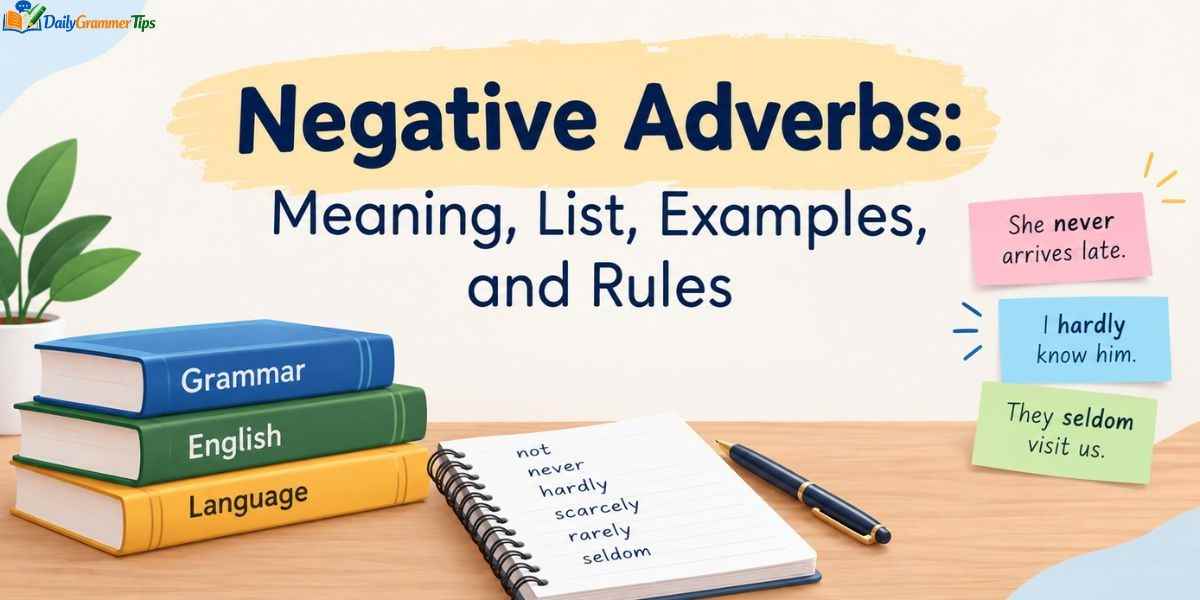
Negative adverbs shape how we say no, never, and almost not in English. Words like never, hardly, and seldom turn a plain statement into a denial or a near denial, and you hear them in everyday speech.
This guide explains negative adverbs in plain steps. You will learn the list, the placement rules, inversion, common mistakes, and practice tasks, so you can use these words with confidence in school, exams, and daily talk.
What Are Negative Adverbs?
These words make a clause or phrase negative. They tell us that something is not true, not done, or almost not true. Let us begin with the basics.
Definition of Negative Adverbs
Negative adverbs are adverbs that deny or limit an action, a quality, or another adverb. They modify verbs, adjectives, and other adverbs. Never, nowhere, hardly, and seldom are typical words.
Take this sentence: “He never lies.” The word never denies the verb lies. Now take this one: “The room was hardly clean.” Here hardly limits the adjective clean.
Other Names for Adverbs of Negation
Grammar books use several names for this group. Some call them adverbs of negation. Others call them negators. The word not is often called a negative particle.
You may also meet the terms absolute negators and approximate negators. These terms show the strength of the negative meaning. The next sections explain both terms in detail.
How Negative Adverbs Change a Sentence
A negative word flips the meaning of a clause. “She plays tennis” becomes “She never plays tennis.” The second sentence says the action does not happen at any time.
The verb stays in the affirmative form. We do not add not. Standard English uses one negative element in a clause. So “She never plays” is correct, but “She doesn’t never play” is not.
Negative Adverbs vs Other Negative Words
Negative adverbs are not the only negative words in English. Other word classes carry negative meaning too. Knowing the difference prevents confusion.
Negative Determiners and Pronouns
Negative determiners such as no and neither come before nouns. Negative pronouns such as nobody, nothing, and none replace nouns.
Compare “I have no money” with “I never have money.” The first sentence uses a determiner. The second sentence uses a negative adverb.
Negative Prefixes and Conjunctions
Negative prefixes such as un, in, and dis change a word from inside. Unhappy, incorrect, and dishonest are examples.
Neither and nor work as conjunctions. They join two negative ideas. “She likes neither tea nor coffee” uses both words.
Adverbs with Negative Prefixes
Some adverbs carry a negative prefix, such as unfairly, impolitely, and dishonestly. They give a negative idea, but they are not true negators. The clause around them stays positive.
Compare “He acted unfairly” with “He never acted fairly.” The first sentence is affirmative in form. The second uses a real negative word.
Negative Adverbs List
Here is a clear list. It groups the most common words so you can learn them in sets. Each group has its own meaning and its own pattern.
Common Negative Adverbs in English
The most common words are not, never, nowhere, no longer, neither, and nor. Many guides also include hardly, barely, scarcely, seldom, rarely, and little.
Some lists add no and not very. Others add phrases such as by no means and not at all. The exact list changes slightly from one grammar book to another.
Negative Adverbs Beginning with N
Many absolute negators start with the letter n. Not, never, nowhere, no longer, neither, and nor all begin with n. This pattern helps learners remember the group.
Approximate negators start with other letters. They include hardly, barely, scarcely, seldom, and rarely. Remember them as the “almost not” group.
Formal and Less Common Negative Words
Some negative expressions sound formal. By no means, in no way, and at no time are examples. “It is by no means easy” means it is not easy at all.
American English also uses no place in informal speech, as in “I have no place to go.” Another pattern is none the plus a comparative, as in “I feel none the better.”
Types of Negative Adverbs: Absolute and Approximate Negators
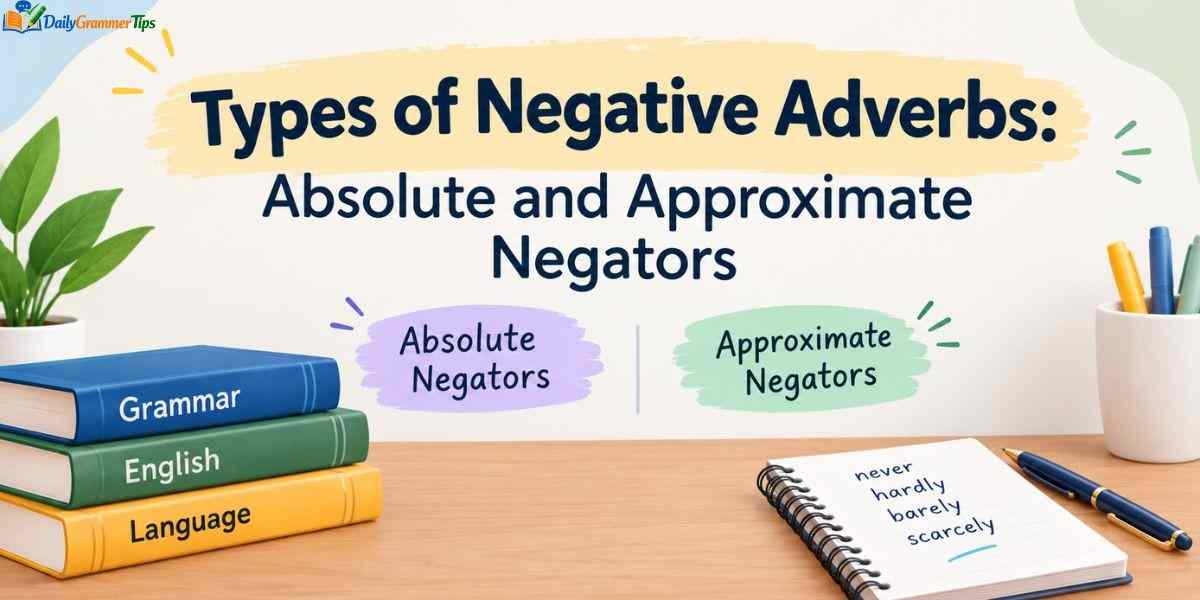
Grammar books divide these words by strength. Some deny completely, and some come close to zero. The two groups behave a little differently.
Absolute Negators
Absolute negators express complete zero. They say that something never happens or is not true at all. Not, no, never, nowhere, neither, nor, and no longer belong here.
Examples: “I did not call him.” “She is nowhere to be found.” “They no longer live here.” Each sentence denies the idea fully.
Approximate Negators
Approximate negators express a quantity close to zero. They are also called restrictive adverbs. Hardly, barely, scarcely, seldom, rarely, and little belong here.
Examples: “I barely slept last night.” “He seldom eats sweets.” The action is not totally absent, but it is very small or very rare.
Negative Adverbs Examples
Examples make the rules clear. This section shows the main words in real sentences. Read each sentence aloud to feel the rhythm.
Examples with Never
Never means at no time. “I have never seen snow.” “She never forgets a birthday.” “He never came back after that day.”
Never works with all tenses. “They will never agree.” “We had never met before.” The verb stays affirmative each time.
Examples with Not
Not is the most common word in this group. “I am not ready.” “She does not like coffee.” “They have not arrived.”
Not goes after be and after the first auxiliary. With other verbs, English uses do. So we say “He does not run,” never “He not runs.”
Examples with Nowhere and No Longer
Nowhere means in no place. “The keys are nowhere to be found.” “He went nowhere last weekend.” “He is nowhere near ready.”
No longer means not anymore. “She no longer works here.” “We are no longer friends.” “The shop no longer sells books.”
Examples with Hardly, Barely, and Scarcely
Hardly means almost not. “I can hardly hear you.” “She hardly knows him.” “It is hardly surprising.”
Barely and scarcely mean only just. “He barely passed the test.” “We scarcely had time to eat.” “The room was barely warm.”
Examples with Seldom and Rarely
Seldom and rarely mean not often. “They seldom visit us.” “He rarely drinks tea.” “Snow rarely falls here.”
These words are common in formal writing. “A film seldom earns such praise.” “Such talent is rarely seen.” Both sentences keep an affirmative verb.
Examples with Little
Little can act as a negative adverb with verbs of thinking and feeling. “He little knew what lay ahead.” “They little understood the risk.”
This use sounds literary. At the start of a sentence, it triggers inversion: “Little did she know the truth.” You will see it in novels and speeches.
Examples with Not Very and Not at All
Not very reduces a quality. “The film was not very long.” “She is not very tall.” The quality exists, but only a little.
Not at all denies fully. “I am not at all tired.” “It was not at all easy.” Use it for strong, polite denial.
Negative Adverbs in Everyday Conversation
In daily talk, people choose simple forms. “I hardly ever cook.” “I am not going anywhere.” “We don’t go out much, and neither does she.”
Short answers also use no. “Are you tired?” “No, I am not.” Notice that the full answer needs not after the verb.
Positive and Negative Adverbs
Adverbs can be positive or negative in meaning. Understanding the contrast helps you build correct sentences. Let us look at both sides.
What Are Positive Adverbs
Positive adverbs state that something is true or happens. Always, often, quickly, here, and very are positive adverbs. They add information without denying anything.
Examples: “She always arrives early.” “He speaks quickly.” “The tea is very hot.” Each sentence affirms an idea.
Adverbs of Affirmation
Adverbs of affirmation confirm a statement. Yes, certainly, surely, indeed, definitely, and absolutely belong here. They show agreement or certainty.
Examples: “Certainly, I will help.” “She is indeed talented.” “He will surely come.” These words are the opposite of negative adverbs.
Comparing Positive and Negative Meaning
Compare “She often visits” with “She seldom visits.” The first sentence is positive. The second sentence uses a negative word and reduces the frequency.
Compare “I know him” with “I hardly know him.” The word hardly weakens the meaning. Compare “He is here” with “He is nowhere.” Nowhere denies the place.
Turning Positive Sentences into Negative Sentences
You can turn a positive sentence negative in two ways. Add not, or replace a positive adverb with a negative one. “She always sings” becomes “She never sings.”
Another example: “He is somewhere in town” becomes “He is nowhere in town.” Notice that always becomes never, and somewhere becomes nowhere. These pairs are easy to memorize.
Negative Adverbs of Frequency
Some of these words tell us how often something happens. They sit at the low end of the frequency scale. This section explains each one.
Never
Never is the strongest frequency word in the group. It means at no time. “I have never been late.” “She never eats fish.”
Never already holds the negative meaning. So do not add not. Say “He never calls,” not “He doesn’t never call.”
Seldom and Rarely
Seldom and rarely mean almost never. They are close in meaning and use. “We seldom travel in winter.” “He rarely complains.”
Rarely is more common in modern speech. Seldom sounds a little formal. Both words usually come before the main verb.
Hardly Ever and Barely Ever
Hardly ever means almost never. “I hardly ever watch television.” “She hardly ever speaks in class.”
Barely ever appears in some grammar lists with the same meaning. Hardly ever is the safer choice. Hardly and scarcely can also mean almost never alone, as in “She hardly sees her parents.”
The Frequency Scale
Adverbs of frequency form a scale. Always is at the top. Then come usually, often, sometimes, seldom, rarely, and never. Negative words take the lower end.
Use the scale to choose the right word. If something happens twice a year, seldom fits. If it never happens, use never. The correct point makes your meaning clear.
Frequency vs Degree
Some of these words belong to two groups. Seldom and rarely are adverbs of frequency. Hardly, barely, and scarcely are mainly adverbs of degree.
Frequency words answer “how often.” Degree words answer “how much.” Compare “He seldom eats” with “He barely eats.” The first speaks about time. The second speaks about amount.
Frequency Words in Questions and Answers
Questions with how often invite frequency answers. “How often do you eat out?” “Hardly ever.” “How often does it snow here?” “Rarely.”
Short answers sound natural in speech. For a full answer, say “I hardly ever eat out.” Keep the adverb before the main verb in full sentences.
Where to Place Negative Adverbs in a Sentence
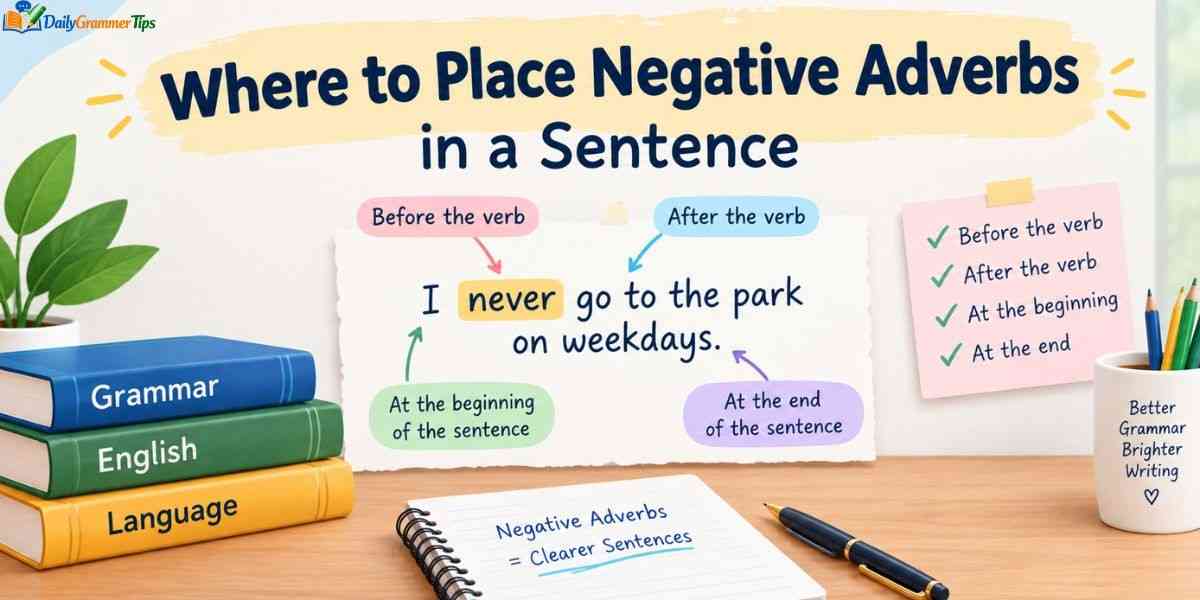
Position matters. A negative word in the wrong place can sound odd or change the meaning. These rules cover the usual cases.
Before the Main Verb
The adverb usually comes before the main verb. “She never drinks coffee.” “He hardly speaks.” “They seldom visit.”
This pattern is the safest choice. It works with present and past simple tenses. “We rarely ate out.” “He barely noticed me.”
After the Verb Be
After be, the negative adverb comes next. “She is never late.” “He was hardly ready.” “They are seldom at home.”
The same pattern works with am, is, are, was, and were. The adverb follows the verb and comes before the complement.
With Auxiliary and Modal Verbs
With an auxiliary or a modal verb, the adverb comes after the first one. “I have never seen it.” “He could hardly breathe.” “They would seldom go out.”
When several auxiliaries appear, use the first one. “She has never been invited.” “He might never have known.” The adverb sits after has or might.
Learn more………Adverbs of Degree: Definition, Types, and Examples
Hardly with Any, Anyone, and Ever
Hardly often pairs with any, anyone, anything, ever, and at all. “There is hardly any tea left.” “Hardly anyone replied.” “She hardly ever calls.”
These pairs mean almost none, almost nobody, or almost never. Do not replace any with no. “Hardly no tea” is wrong.
Before Adjectives and Adverbs
These words can modify adjectives and other adverbs. “The noise was hardly noticeable.” “It was barely visible.” “His voice was scarcely audible.”
Place the adverb directly before the word it modifies. Moving it away changes the meaning or weakens the negative force.
At the End of a Sentence
A negative adverb at the end of a sentence loses force. “He had spoken about the issue hardly at all” feels weak and unusual. The first part sounds positive.
Place the negative word early instead. Say “He had hardly spoken about the issue.” The sentence now reads as clearly negative.
Negative Adverbs in Questions and Tag Questions
Questions need special care with these words. The auxiliary and the adverb must sit in the right order. Tag questions add one more rule.
Questions with Negative Adverbs
These words also appear in questions. “Have you never visited Rome?” “Why do they seldom travel?” These questions often show surprise.
The adverb sits after the subject in a normal question. A fronted adverb makes the question formal and dramatic.
Tag Questions with Negative Adverbs
Tag questions follow the verb. “She never calls, does she?” “They seldom complain, do they?” Notice the positive tag after a negative statement.
This pattern is common in speech. The tag checks the idea or invites agreement.
Negative Adverbs Inversion
Inversion changes normal word order. It is common in formal and literary English. It also appears in many exam tasks.
What Is Inversion
Inversion means placing the auxiliary before the subject. Normal order is subject, then auxiliary. Inverted order is auxiliary, then subject.
Compare “I have never seen this” with “Never have I seen this.” The second sentence puts have before I. The meaning is the same, but the tone is stronger.
How to Form Inversion
Start the sentence with the negative adverb. Add the auxiliary or modal next. Then add the subject and the rest of the sentence.
“Seldom does he complain.” If the verb has no auxiliary, add do, does, or did. “Rarely did we eat out.” The main verb returns to its base form.
Inversion with Never, Seldom, and Rarely
These words are the most common triggers. “Never have I felt so nervous.” “Seldom does a film win such praise.” “Rarely do we see such talent.”
The fronted word adds emphasis. Writers use it in speeches and essays. Use it sparingly so the style does not become heavy.
Hardly and Scarcely with When
Hardly and scarcely often pair with when. They show that one event followed another very quickly. “Hardly had we sat down when the lights went out.”
“Scarcely had the sun set when the wolves began to howl.” Notice the past perfect after the adverb. The second event uses past simple after when.
No Sooner with Than
No sooner works like hardly and scarcely, but it pairs with than. “No sooner had she left than it began to rain.” The structure also uses past perfect.
Do not mix the pairs. Use hardly or scarcely with when. Use no sooner with than. Mixing them is a common error.
Little, Not Until, and Only
Little can start a sentence with verbs of knowing. “Little did he know about the plan.” Not until also triggers inversion. “Not until midnight did they arrive.”
Only phrases trigger it too. “Only then did she understand.” “Only after the test could we relax.” These patterns are formal.
When Inversion Does Not Happen
Inversion does not occur when the negative word belongs to the subject. “Not one student agreed.” The subject phrase is not one student, so word order stays normal.
It also does not occur when the adverb follows the subject. “She had seldom drunk wine.” Only a fronted negative word triggers inversion.
Inversion with Neither and Nor
Neither and nor trigger inversion when they join clauses. “He never called, nor did he write.” “She does not like spicy food, and neither do I.”
These words also support short agreement. “I can’t swim.” “Neither can I.” Use so for positive agreement and neither for negative agreement.
Quick Checklist for Inversion
Follow four steps. First, put the negative word first. Second, add the auxiliary or modal. Third, add the subject. Fourth, finish with the main verb.
Check the tense. Add do, does, or did when no auxiliary exists. “Rarely did she complain” passes the test. This checklist keeps negative adverbs under control.
Negative Adverbial Phrases
Some groups of words work like single negative adverbs. They express absolute negation. They sound firm and often appear in rules and notices.
What Are Negative Adverbial Phrases
A negative adverbial phrase is a group of words with a negative meaning. It acts as an adverb in the sentence. It modifies the verb or the whole clause.
These phrases behave like single negators. The verb stays affirmative. At the start of a sentence, they trigger inversion too.
Common Negative Adverbial Phrases
The list includes under no circumstances, in no way, on no condition, at no time, and on no account. Some writers also use by no means and not at all.
“At no time did he admit the mistake.” “In no way is this your fault.” “On no condition may you leave the room.” Each phrase denies fully.
Phrases with the Word No
Many of these phrases contain the word no. Under no circumstances means never, whatever the situation. On no account means absolutely not.
Compare “You must not open this door” with “On no account should you open this door.” The second sentence sounds stronger and more formal.
Inversion with Negative Adverbial Phrases
At the start of a sentence, the phrase needs inversion. “Under no circumstances are you to go out.” “At no time was the manager informed.”
The auxiliary comes before the subject. In the middle of a sentence, normal order returns. “You are under no circumstances to go out” is the usual form.
Phrases vs Single Words
Single words are short and common. Phrases add emphasis and formality. Compare “Never leave the gate open” with “At no time should the gate be left open.”
Choose phrases for rules, signs, and formal writing. Choose single words for daily speech. Both forms follow the same grammar pattern.
Negative Adverbs and Verb Tenses
Negative adverbs work in every tense. The pattern stays the same, so tenses are easy to manage. Study each group below.
Simple Present and Simple Past
Examples: “She never eats meat.” “He seldom called us.” “We rarely ate out.”
The simple tenses place the adverb before the main verb. No auxiliary is needed, and the verb stays affirmative.
Perfect Tenses
Examples: “She has never eaten meat.” “They had hardly started when it rained.” “By noon, he will have barely begun.”
The adverb sits after the first auxiliary. The past participle follows it.
Future Tense and Modal Verbs
Examples: “She will never eat meat.” “He could hardly wait.” “They might seldom see each other.”
Modal verbs follow the same rule. The adverb comes after the modal and before the main verb.
Double Negatives with Negative Adverbs
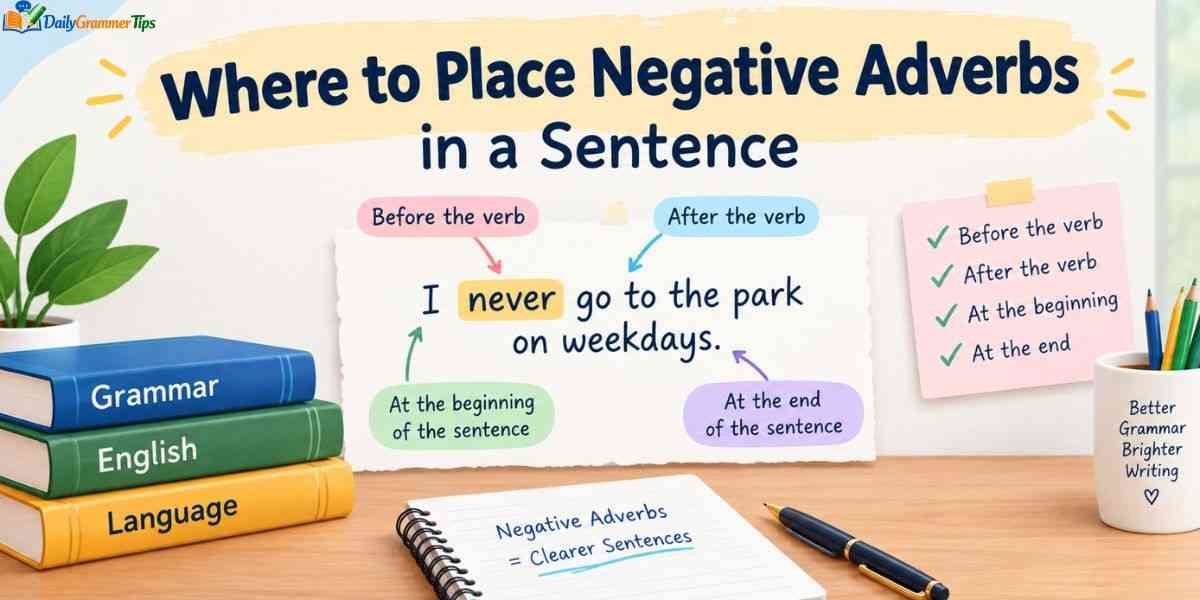
A double negative is one of the most common errors in this area. Standard English allows one negative idea per clause. These sections show the fix.
Double Negatives
A double negative uses two negative words in one clause. “I don’t need nothing” breaks standard grammar. The two negatives cancel each other in logic.
Fix it by keeping one. Say “I need nothing” or “I don’t need anything.” The same rule applies to never and hardly.
Negative Adverbs with Any Words
After a negative adverb, use any words, not negative words. Say “I never eat anything sweet.” Do not say “I never eat nothing sweet.”
The same rule works for anyone and anywhere. “She never goes anywhere” is correct. “She never goes nowhere” is a double negative.
Common Mistakes with Negative Adverbs (Double Negatives, No vs. Not)
Even advanced learners slip on these words. Knowing the usual errors helps you avoid them. Each mistake below comes with a fix.
Using Not with Hardly, Scarcely, or Barely
Hardly, scarcely, and barely are already negative. Do not add not or n’t. “I can’t hardly believe it” is wrong.
Say “I can hardly believe it.” Say “She could barely walk,” not “She couldn’t barely walk.” This error is very common in speech.
Confusing Hardly with Hard
Hard can be an adjective or an adverb. As an adverb, it means with effort. “She works hard.” Hardly means almost not.
“She works hardly” is wrong and changes the meaning. Compare “He tried hard” with “He hardly tried.” The first shows effort. The second shows almost none.
No vs Not
Not negates verbs, adjectives, and adverbs. “She is not here.” “It is not very large.” Use no before a noun. “I have no time.”
No also answers yes or no questions. “Are you ready?” “No.” A full sentence needs not. “No, I am not ready.”
Wrong Word Order
Learners sometimes place the adverb wrongly. “I hardly can believe it” is not natural. Put the adverb after can, could, have, or be.
Say “I can hardly believe it.” Watch inversion too. “Never I have seen it” is wrong. The correct form is “Never have I seen it.”
Misusing Barely for Almost Never
Hardly and scarcely can mean almost never. Barely mostly means only just. “She hardly ever calls” is clear and natural.
“She barely calls” suggests she calls with difficulty. Use hardly ever or seldom when you mean almost never. This choice keeps your meaning exact.
Mixing Neither with Not
Neither and nor are negative. Do not add another negative with them. “Neither of them didn’t come” is wrong.
Say “Neither of them came.” Say “He didn’t call, and neither did she.” The second clause uses inversion after neither.
Overusing Inversion
Some learners use inversion in every sentence. It sounds unnatural in daily talk. Save it for formal writing and strong emphasis.
Compare “Never have I eaten this” with “I have never eaten this.” The second sentence is calmer and more usual in conversation.
Negative Adverbs in French vs. English
French and English build negation in different ways. This difference explains many learner errors. The comparison below is short and practical.
Two Part Negation in French
French usually builds negation in two parts. The word ne comes before the verb. A second word comes after it.
“Je ne mange pas de viande” means “I do not eat meat.” Here ne and pas surround the verb. English has no matching two part pattern.
One Word Negation in English
English uses a single negative word. Not, never, and nowhere do the job alone. The verb stays affirmative.
“I never eat meat” needs no second word. Adding a second negative creates a double negative. So “I don’t never eat meat” is wrong.
Common French Negative Pairs
Common pairs include ne … pas, ne … jamais, ne … plus, and ne … nulle part. They match not, never, no longer, and nowhere.
Example: “Il ne travaille plus ici” means “He no longer works here.” Example: “Je ne vais nulle part” means “I go nowhere.” The pair ne … guère is close to hardly.
Typical Errors for French Speakers
Learners may copy the French pattern into English. They might say “I don’t never go” or “She doesn’t have nothing.” The extra negative is the problem.
Remember one negative per clause. Keep the single word that fits. Practice with short model sentences until the pattern feels natural.
Negative Adverbs in Formal Writing and IELTS
Formal English uses these words often. They add precision and a serious tone. IELTS candidates can use them to show range.
Why Formal Writing Uses Inversion
Inversion gives emphasis without extra words. “Rarely does a policy succeed without public support” sounds polished. It reads like a strong claim.
Reports, speeches, and essays use this style. Daily chat does not. Match the pattern to the setting.
Using Negative Adverbs in IELTS Writing
In Task 2 essays, one or two inverted sentences show control of grammar. “Never has technology changed daily life so quickly.” This sentence adds range.
Do not overuse the pattern. Too many inversions sound forced. Keep the rest of your essay clear and direct.
Using Negative Adverbs in IELTS Speaking
In speaking, simple forms work best. “I hardly ever go out on weekdays.” “I have never tried that.” These answers sound natural.
Save inversion for a rare emphasis. “Never have I been so surprised.” Say it with confidence and a calm pace.
Tips to Remember Negative Adverbs
Memory improves with small habits. These tips fit into a busy day. Try one this week.
Learn Them in Groups
Group the words by meaning. Keep one list for absolute negators and one for approximate negators. Add three example sentences under each word.
Review the lists often. Say each word aloud with its sentence. Short daily reviews work better than one long session.
Read and Listen
Notice these words in books, news, and videos. Write down each sentence you find. Mark the position of the adverb.
Listen for inversion in speeches. You will hear “Never before has…” and “Rarely do we…” Real examples fix the pattern in memory.
Practice Inversion Daily
Take one plain sentence each day. Rewrite it with a negative opening. “I have never seen this” becomes “Never have I seen this.”
Check the auxiliary each time. Say the new sentence aloud. A minute of practice builds speed.
Keep a Mistake Log
Write down every error you make. Add the correct form beside it. “I can’t hardly see” becomes “I can hardly see.”
Read the log once a week. Patterns will appear. Fix the repeating ones first.
Negative Adverbs Worksheet
Use this worksheet in class or at home. It has three short tasks. Answers come at the end.
Task 1 Underline the Negative Adverb
Underline the negative word in each sentence. (a) She seldom complains. (b) We could barely see the road. (c) He has never been abroad. (d) They no longer live here. (e) The answer is nowhere in the book.
Task 2 Sort by Type
Sort these words into absolute and approximate negators: never, hardly, nowhere, scarcely, no longer, barely, rarely, not. Write two lists on your page.
Task 3 Write Your Own Sentences
Write five sentences. Use never, seldom, hardly, nowhere, and no longer. Then rewrite two of them with inversion at the start.
Worksheet Answers

Task 1: seldom, barely, never, no longer, nowhere. Task 2: absolute negators are never, nowhere, no longer, and not. Approximate negators are hardly, scarcely, barely, and rarely.
Task 3 answers will vary. Sample sentences: “Never have I seen such a view.” “Seldom does he miss a class.” Check that each sentence keeps an affirmative verb.
Frequently Asked Questions
What is an example of a negative adverb?
In “She never drinks coffee,” never is the negative adverb. It means she does not drink coffee at any time.
What are affirmative and negative adverbs?
Affirmative adverbs confirm a statement, such as yes, certainly, and indeed. Negative adverbs deny it, such as not, never, and nowhere.
What is an example of a negative?
“I do not like tea” is a negative sentence. The word not turns the statement into its opposite.
What is a bad adverb?
Grammar has no category called a bad adverb. People usually mean a misused adverb, such as hardly used instead of hard.
What is the difference between affirmative and negative?
An affirmative sentence says something is true. A negative sentence says it is not true, usually with not or another negative word.
Conclusion
You now know how these words work. They deny an idea, shrink it to almost nothing, or add punch when you place them at the start of a sentence. You also learned where to put them and how to avoid double negatives.
Keep practicing with real sentences. Read a little, listen closely, and write a few examples each day. Soon you will use never, hardly, and seldom with confidence.
