

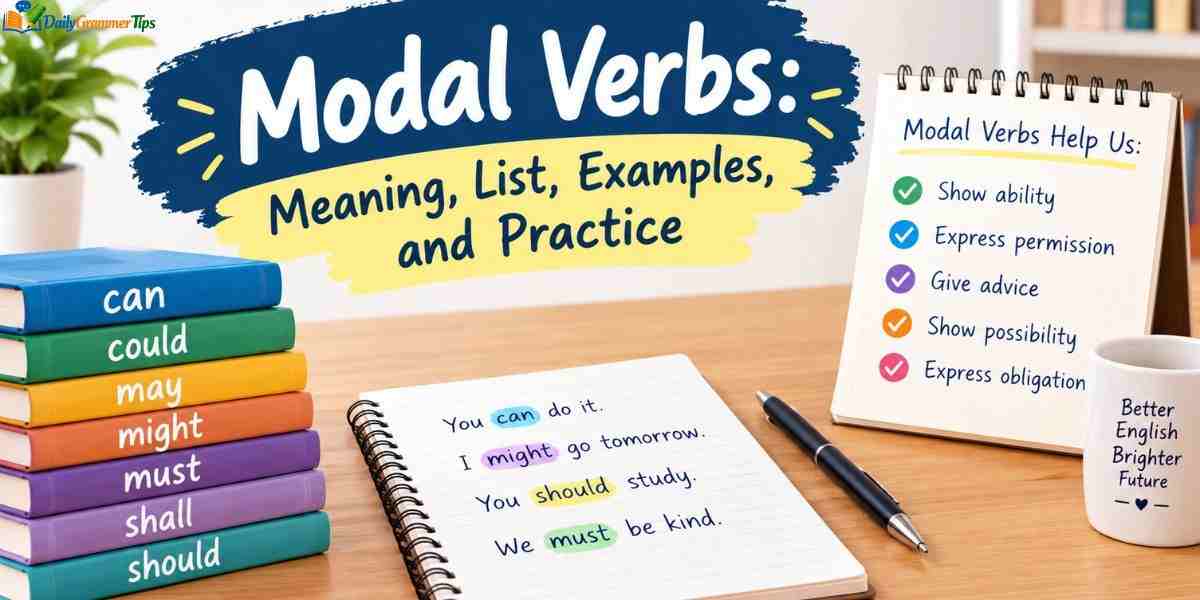
Modal verbs help you show ability, permission, advice, and certainty. They add meaning to a main verb. English speakers use them in almost every conversation.
This guide explains the topic step by step. You will find a list, clear examples, and practice tasks. You will also see how German and Urdu handle the same ideas. Every section is short, so you can learn at your own speed.
Modal Verbs Examples
Examples make grammar easy to see. Read each sentence aloud and notice the pattern. The modal always comes before the base verb.
What Are Modal Verbs?
Modal verbs are helping verbs. They do not describe an action by themselves. They change the meaning of the main verb that follows them.
Compare three sentences. “She sings” is a fact. “She can sing” shows ability. “She might sing” shows a possibility. One small word changes the whole message.
Simple Sentences With Modals
You can swim very fast. We must leave now. They should call the doctor. He may arrive late. I would help you if I had time.
Notice that the verb after the modal stays in its base form. Nobody says “She cans swim.” The modal never changes for he, she, or it.
Examples by Function
Ability: “I can cook pasta.” Permission: “May I come in?” Advice: “You should rest.” Necessity: “We must pay the bill.” Possibility: “It might rain.”
Each sentence has one clear job. When you read a new sentence, ask what job the modal is doing. That question builds understanding fast.
Three Grammar Rules
First, no s is added in the third person. Second, questions use inversion, so “she can go” becomes “can she go?” Third, the next verb has no to. We say “He must leave,” not “He must to leave.”
All modal verbs follow these patterns. Ought to is the one small exception, because it keeps the word to.
Negatives and Questions
Add not after the modal to make a negative. “He should not go.” Many speakers use short forms such as can’t, won’t, and shouldn’t.
For questions, move the modal before the subject. “Could you help me?” “Must we leave?” Add a question word at the start if you need more detail. “When can we start?”
Modal Verbs Exercises
Practice turns knowledge into habit. Try these modal verbs exercises before you read further. Short daily drills work better than one long session.
Gap Fill Practice
Choose can, must, or might.
- You …… wear a seatbelt.
- She …… speak three languages.
- It …… rain later.
- …… I open the window?
- Children …… not play with matches.
Answers: 1 must, 2 can, 3 might, 4 Can, 5 must.
Error Correction Practice
Fix each mistake.
- He cans swim well.
- She must to go home.
- Do you can help me?
- They should went early.
Answers: 1 He can swim well. 2 She must go home. 3 Can you help me? 4 They should go early.
Modal Verbs List
The modal verbs list below follows what most teachers use. It includes ten core forms. Each one has a main job, though many have more than one.
The Core Ten
The ten forms are can, could, may, might, will, would, shall, should, must, and ought to. Teachers treat them as true modals because they follow all three grammar rules.
Ought to is the only one that takes to. Even so, it acts like the others in questions and negatives. “Ought we to leave?”
Quick Meaning of Each Modal
Can and could show ability. May and might show possibility. Will and would show future and habit. Shall is used for offers and suggestions.
Should gives advice. Must shows strong need. Ought to is close to should. Learn these jobs first. Then add the finer shades of meaning.
Order of Strength
Think of a scale. Must sits at the top for certainty and need. Should and ought to come next. May, might, and could sit near the bottom.
Choosing the right strength keeps your message polite and clear. A boss says “You must finish today.” A friend says “You could finish tomorrow.”
What Are the 24 Modal Verbs?
Lists of English modals vary. No official rule fixes the number at 24. Some sources reach that number by adding semi modals and modal phrases.
Ten Core Modals Plus Fourteen Extras
Start with the ten core forms. Then add need, dare, used to, had better, have to, have got to, be able to, be allowed to, be going to, be supposed to, would rather, be bound to, be likely to, and be about to.
That gives twenty four items. Different books count in different ways. Do not worry about the exact total. Focus on how each form works.
Core Modals Versus Semi Modals
Core modals never change form. Semi modals act partly like normal verbs. For example, have to becomes has to, and had to in the past.
Be able to helps where can has no form. We say “I will be able to come.” We never say “I will can come.”
Probability
We use modals to show how sure we are. The speaker may feel certain, fairly sure, or unsure. Modal verbs of probability work like a scale from sure to unsure.
Strong Certainty
Must shows a strong conclusion. “The lights are off, so they must be asleep.” Can’t shows the opposite. “That can’t be his car.”
Use these forms when you have clear evidence. Without evidence, choose a weaker form. Strong words need strong reasons.
Weak Possibility
Could, may, and might show a real chance. “It might snow tonight.” “She could be at the gym.” The chance is about half, or lower.
Might feels a little less sure than may. In daily speech, people use them almost the same way. Both are safe choices when you are guessing.
Possibility About the Past
Add have and a past participle to guess about earlier events. “He must have left early.” “They could have missed the train.” “It can’t have been easy.”
This pattern is useful when you did not see what happened. You use clues from the present to explain the past.
Ability
Ability means a skill or power to do something. Two forms lead this group. Other phrases fill the gaps.
Can for Present Ability
Can shows what you are able to do now. “She can speak six languages.” “I can’t drive.” The negative form is cannot or can’t.
Can also shows general facts about what is possible. “Birds can fly.” “Water can freeze.” These sentences describe what things are able to do.
Could for Past Ability
Could shows a general skill in the past. “My grandfather could play golf very well.” “We could swim at age five.”
For one single event, use was able to. “I was able to finish the report yesterday.” Do not use could in a positive sentence about one event.
Other Ways to Say Ability
Be able to works in every tense. “She will be able to join us.” Know how to also fits. “He knows how to cook.”
Manage to shows success after effort. “They managed to climb the hill.” This phrase tells the listener that the task was not easy.
Learn more…………Could Have, Should Have, Would Have: Meaning, Rules, and Examples
Obligation and Advice
Some modal verbs tell people what is needed. Others give gentle guidance. Strength is the key difference between them.
Must and Have To
Must shows a strong need or a rule. “Children must do their homework.” It often comes from the speaker’s own feeling.
Have to shows an outside rule. “We have to wear a uniform at work.” In the past, use had to. Must has no past form.
Mustn’t and Don’t Have To
Mustn’t means something is forbidden. “You mustn’t touch the wires.” Don’t have to means it is not necessary. “You don’t have to come.”
Mixing these two causes many mistakes. Check the meaning before you speak. One means no, and the other means free choice.
Should and Ought To
Should gives advice. “You should stop smoking.” Ought to has a similar meaning. “You ought to see a doctor.”
Had better is stronger. “You had better leave now, or you will miss the bus.” It suggests a bad result if the person ignores the advice.
Permission

Modal verbs also help us ask for and give permission. We use them to say what is not allowed too. Politeness changes the choice of word.
Asking Politely
“Could I leave early today, please?” “May I sit here?” “Can we swim in the lake?” Could and may sound polite. Can is friendly and common.
Use may in formal settings. Use can with friends and family. A polite tone matters more than perfect grammar in daily life.
Giving and Refusing
“You can use my phone.” “You may enter now.” “You may not use the car tonight.” These sentences give or refuse permission.
Can’t and mustn’t also refuse permission. “You can’t park here.” Signs often use may not or must not to sound official.
Offers and Requests
“Shall I carry your bag?” “Shall we start?” Shall is common in offers, mostly in British English.
“Would you mind waiting?” “Could you send the file?” Would and could make requests sound soft and respectful.
Habits
Will and would can describe repeated actions. They appear in stories and memories. Keep the meaning clear.
Would for Past Habits
“When I lived in Italy, we would often eat at the restaurant next door.” Would describes actions you repeated long ago.
It does not work for states. Say “I used to live there,” not “I would live there.” States are conditions, not repeated actions.
Will for Present Habits
Will shows a typical behavior. “John will always be late.” With stress, it can show annoyance.
Will also states general truths. “Oil will float on water.” This is a habit of nature, not of a person.
Used To
Used to shows past habits and past states. “She used to smoke.” “We used to live near the sea.” It is not a true modal, but it fits this group.
Questions and negatives use did. “Did you use to play chess?” “I didn’t use to like coffee.” Notice that used becomes use in these forms.
Past Modals
Modal verbs can also look back at the past. They use have and a past participle. Three forms cause the most confusion.
Could Have
Could have shows a missed chance. “I could have called, but I forgot.” It can also be a guess. “He could have missed the bus.”
Couldn’t have means impossible. “She couldn’t have finished with that injury.” Context tells you which meaning the speaker wants.
Should Have
Should have shows regret or advice about the past. “I should have studied harder.” “You should have told me.”
Shouldn’t have shows a bad action that already happened. “We shouldn’t have waited so long.” It sounds like mild criticism.
Would Have
Would have shows a plan that failed or an unreal result. “I would have joined you, but I had a deadline.”
It often pairs with the past perfect. “If I had known, I would have helped.” The past perfect sets the condition, and would have gives the result.
Might Have, May Have, and Must Have
Might have and may have show weak guesses about the past. “She might have forgotten.” Must have shows a strong guess. “He must have overslept.”
Can’t have shows disbelief. “They can’t have arrived yet.” Use the participle, which is the third form of the verb. Say gone, not went.
Modal Verbs in German
German modal verbs, called Modalverben, work in a clear pattern. They send the main verb to the end of the clause. The idea is the same as in English.
The Six German Modals
The six are können, müssen, dürfen, sollen, wollen, and mögen. They match can, must, may, should, want to, and like.
Examples: “Ich kann schwimmen.” “Du musst lernen.” “Darf ich gehen?” Each sentence mirrors the English meaning closely.
Word Order and Differences
In German, the main verb goes to the end in its base form. “Wir wollen heute Fußball spielen.” English keeps the verb right after the modal.
Watch false friends. Nicht müssen means do not have to. Nicht dürfen means must not. German modals also change with the subject, so “wir können” differs from “ich kann.”
Modal Verbs in Urdu

Urdu has no separate class called modal verbs. It uses helper verbs and set phrases to show the same ideas. Learners find the match easy with practice.
Common Urdu Equivalents
Can matches سکنا. “میں تیر سکتا ہوں۔” means I can swim. “آپ کو جانا چاہیے۔” means You should go.
Must often matches پڑنا or ضرور. “مجھے جانا پڑے گا۔” means I will have to go. “کیا میں جا سکتا ہوں؟” means May I go?
Tips for Urdu Speakers
Urdu places the verb at the end. English places the modal before the verb. Practice the English order with short sentences.
Do not translate word by word. “Mujhe jana chahiye” becomes “I should go,” not “I should to go.” Think in meaning, not in single words.
Modal Verbs Worksheet
This modal verbs worksheet builds skill in three steps. Choose, rewrite, and create. Cover the answers before you begin.
Part A: Choose the Modal
Pick the best word in brackets.
- You …… be quiet in the library. (must / can)
- …… you pass the salt, please? (Could / Must)
- He …… be at home. His car is outside. (must / can’t)
- She …… run fast when she was ten. (could / should)
Answers: 1 must, 2 Could, 3 must, 4 could.
Part B: Rewrite and Create
Rewrite each sentence with a modal. 1. It is necessary to wear a helmet. 2. Perhaps she is late. 3. I advise you to rest.
Answers: 1 You must wear a helmet. 2 She might be late. 3 You should rest. Now write three sentences of your own. Use one for advice, one for ability, and one for possibility.
Modal Verbs PPT
A slide deck on modal verbs helps teachers and students review fast. A good deck stays simple. Keep one idea on each slide.
What to Include
Start with a title slide and a simple definition. Add the list, then one slide for each function such as ability, advice, permission, and probability.
End with a short quiz and an answer slide. Add pictures to show each meaning. Visual support makes abstract words easier to remember.
Sample Slide Plan
Slide one gives the title. Slide two gives the definition. Slide three shows the list of ten. Slides four to eight cover one function each.
Slide nine holds the quiz. Slide ten holds the answers and a short summary. This plan fits a single lesson of about thirty minutes.
Tips for Teaching With Slides
Use large fonts and short sentences. Show one example per line. Ask learners to complete sentences aloud.
Add a mini game, such as guess the meaning. Fun tasks keep learners active and help them remember the forms.
Common Mistakes
Small errors repeat often. Knowing them helps you avoid them. Check your writing against these three.
Adding To After a Modal
Learners often write “She can to swim.” The correct form is “She can swim.” Only ought to keeps the word to.
If you feel unsure, remove to and read the sentence again. It will usually sound right.
Writing Could Of
In speech, have sounds like of. Many writers type could of by mistake. Always write could have or could’ve.
The same rule applies to should have and would have. Say them softly, but write them in full.
Changing the Modal for He and She

Write “He can,” not “He cans.” Write “She should,” not “She shoulds.” The form stays the same for every subject.
Only the main verb stays in base form too. Do not add s or ed after a modal.
Frequently Asked Questions
What is modal verb and examples?
A modal verb is a helping verb that shows ability, permission, advice, or certainty. Examples are can, must, should, and might.
What does “modal” mean?
In grammar, modal relates to mood. It shows whether an action is possible, needed, or allowed.
How to teach modal verbs?
Start with real situations and role plays. Then add gap fill and error correction tasks, and review often.
What is a modal verb easy?
It is a small helper word that stands before a main verb and changes its meaning. Can, will, and should are the easiest examples.
What is a synonym for “modal”?
The usual grammar terms are modal auxiliary, auxiliary verb, and helping verb.
Conclusion
Modal verbs shape the way we talk about ability, rules, advice, and chance. They look small, but they carry strong meaning. Learn the core ten first, such as can, must, and should. Then add the semi modals and the past forms step by step.
Practice with the exercises and the worksheet in this guide. Write your own sentences every day and check each one for the correct form. Read short texts and notice how speakers use these helper words. With steady effort, you will use them with confidence in speaking and writing.
