

Present perfect exercises help you move from knowing the rule to using it with ease. This guide gives you short practice sets with clear answers, so you can finish one in a few minutes.
The sets follow a simple path. You begin with basic forms, then move to continuous forms and tense choices. Work in order, and these present perfect exercises will feel easy.
Review Before You Start
Good present perfect exercises begin with a quick review. Read the two short notes below. Then jump into the practice.
How to Make the Tense
Use have or has with the past participle. “I have finished.” “She has left.” For a negative, add not after have or has. For a question, move have or has before the subject.
Regular verbs add ed to make the participle. Irregular verbs change form, such as gone, seen, and written. Learn the irregular ones in small groups.
How to Use the Tense
Use it for life experience, recent news, and time that is not finished. “I have visited Rome.” “She has lost her keys.” “We have lived here for ten years.”
Do not add a finished time word. Say “I saw him yesterday,” not “I have seen him yesterday.” Words like for, since, already, yet, and just fit this tense well.
Present Perfect Continuous Tense
The present perfect continuous tense shows an action that began in the past and still goes on. It also shows an action that just stopped, with a clear result. The focus is on the activity and its length.
Build it with have or has, then been, then the ing form. “I have been reading since noon.” “It has been raining all day.” Time words such as for, since, all day, and lately often appear.
Present Perfect Tense Examples
Examples show the tense in real life. Experience: “I have tried Thai food.” Recent result: “She has broken her phone.” Unfinished time: “We have played twice this week.”
Change over time: “The city has grown a lot.” Repeated action: “He has called me three times today.” Each sentence links the past to the present moment.
Present Perfect Tense Formula
The formula is simple. Use the subject, then have or has, then the past participle. Use has with he, she, and it. Use have with I, you, we, and they.
Positive Form
“I have finished.” “She has arrived.” Short forms save time in speech, such as I’ve, you’ve, he’s, and they’ve.
The participle of a regular verb ends in ed. Irregular verbs need memory, such as seen, taken, and done.
Negative and Question Forms
For a negative, add not after have or has. “We have not left.” “He has not replied.” Short forms are haven’t and hasn’t.
For a question, put have or has before the subject. “Have you seen it?” “Has she called?” Keep the participle after the subject.
Present Perfect Continuous Tense Examples
Here are clear examples. “I have been waiting for an hour.” “She has been working here since 2020.” “They have been playing cards all evening.”
Visible results work too. “His eyes are red because he has been crying.” Negative: “We have not been sleeping well.” Question: “How long have you been learning English?”
Present Perfect Tense Urdu to English
Translation practice builds confidence. Read each Urdu sentence and say the English version aloud.
- میں نے اپنا کام مکمل کر لیا ہے۔
- وہ پانچ سال سے یہاں رہ رہی ہے۔
- ہم نے یہ فلم دیکھی ہے۔
- اس نے ابھی تک فون نہیں کیا۔
Answers: 1 I have completed my work. 2 She has been living here for five years. 3 We have seen this film. 4 He has not called yet.
Present Perfect Tense in Urdu
Urdu shows this tense with a verb form and the helper word ہے or ہیں. A common pattern is a past form plus ہے. The sentence “میں نے کھانا کھا لیا ہے۔” means I have eaten.
The word چکا ہے often shows that an action is complete. “وہ جا چکا ہے۔” means He has gone. For duration, Urdu uses سے. “میں دو گھنٹے سے پڑھ رہا ہوں۔” means I have been studying for two hours.
Present Perfect Tense Structure
Sentence structure matters as much as the formula. Short adverbs sit between have and the participle. “I have just finished.” “She has never flown.” “They have already left.”
Yet goes at the end of questions and negatives. “Have you called yet?” “He has not replied yet.”
For and Since
For shows a length of time, such as for two years. Since shows a starting point, such as since 2024.
Both words come after the verb phrase. “We have lived here for years.” “She has worked here since May.”
Present Perfect Simple
The present perfect simple is the basic form of the tense. It uses have or has and the past participle. It stresses the result, the experience, or the number of times.
“I have read three books this month.” “She has finished her report.” Choose the continuous form instead when you want to stress how long an activity lasted.
Practise Making the Present Perfect
These present perfect exercises focus on form. Write your answer first. Then check it against the key.
Positive Sentences
Complete each sentence with have or has and the verb in brackets.
- I …… (finish) my homework.
- She …… (visit) Paris twice.
- They …… (buy) a new car.
- He …… (write) three emails today.
- We …… (see) that film.
Answers: 1 have finished, 2 has visited, 3 have bought, 4 has written, 5 have seen.
Negative Sentences
Make each sentence negative.
- I have eaten lunch.
- She has called me.
- They have arrived.
- He has read the book.
- We have met before.
Answers: 1 I have not eaten lunch. 2 She has not called me. 3 They have not arrived. 4 He has not read the book. 5 We have not met before.
Questions
Turn each statement into a question.
- You have finished the report.
- She has booked the tickets.
- They have left.
- He has seen the doctor.
- It has stopped raining.
Answers: 1 Have you finished the report? 2 Has she booked the tickets? 3 Have they left? 4 Has he seen the doctor? 5 Has it stopped raining?
Mixed Exercise 1
Mixed present perfect exercises test every form at once. Choose the correct word.
- She (has / have) lived here since 2019.
- (Have / Has) you ever tried sushi?
- They (haven’t / hasn’t) finished yet.
- I (has / have) just heard the news.
- He (hasn’t / haven’t) called me today.
Answers: 1 has, 2 Have, 3 haven’t, 4 have, 5 hasn’t.
Mixed Exercise 2
Put the verb in the correct form. Some answers are negative, and some are questions.
- We …… (not see) him for weeks.
- …… you …… (try) the new cafe?
- She …… (already leave).
- I …… (never ride) a horse.
- …… he …… (finish) yet?
Answers: 1 have not seen, 2 Have you tried, 3 has already left, 4 have never ridden, 5 Has he finished.
Learn more………….Modal Verbs: Meaning, List, Examples, and Practice
Been or Gone
Been means the person went and came back. Gone means the person is still away. Choose been or gone.
- Tom is not here. He has …… to the bank.
- I have …… to Japan twice.
- Where is Sara? She has …… to the shop.
- Have you ever …… to Spain?
- They have …… home, so the office is empty.
Answers: 1 gone, 2 been, 3 gone, 4 been, 5 gone.
Present Perfect Continuous Exercises

The continuous form shows an action in progress, or one that just stopped. Build it with have or has been plus the ing form. Like other present perfect exercises, these sets include answers.
Positive and Negative
Complete each sentence with the present perfect continuous.
- I …… (wait) for an hour.
- She …… (study) all day.
- They …… (not work) here long.
- He …… (not sleep) well lately.
- We …… (play) football since noon.
Answers: 1 have been waiting, 2 has been studying, 3 have not been working, 4 has not been sleeping, 5 have been playing.
Questions
Write a question from the words given.
- how long / you / learn / English
- she / cook / all morning
- they / wait / long
- what / he / do / lately
- it / rain / since breakfast
Answers: 1 How long have you been learning English? 2 Has she been cooking all morning? 3 Have they been waiting long? 4 What has he been doing lately? 5 Has it been raining since breakfast?
Past Simple or Present Perfect
Learners often mix these two tenses. These present perfect exercises train your ear for the difference. Look for time clues in each sentence.
Exercise 1: Choose the Right Tense
Pick the correct form.
- I (saw / have seen) that film last week.
- She (lived / has lived) in Rome for five years, and she still lives there.
- We (visited / have visited) the museum yesterday.
- (Did you finish / Have you finished) your homework yet?
- They (moved / have moved) in 2020.
Answers: 1 saw, 2 has lived, 3 visited, 4 Have you finished, 5 moved.
Exercise 2: Fill the Gaps
Write the past simple or the present perfect.
- He …… (lose) his wallet. He cannot find it now.
- I …… (meet) her in 2018.
- We …… (never be) to Canada.
- She …… (call) me an hour ago.
- They …… (already eat).
Answers: 1 has lost, 2 met, 3 have never been, 4 called, 5 have already eaten.
Exercise 3: Fix the Mistakes
Each sentence has one tense error. Rewrite it.
- I have seen him yesterday.
- We have met last year.
- He did not finish yet.
- Have you eaten breakfast at seven?
- I lived here since 2015.
Answers: 1 I saw him yesterday. 2 We met last year. 3 He has not finished yet. 4 Did you eat breakfast at seven? 5 I have lived here since 2015.
Exercise 4: Time Words
Time words guide your choice. Pick the correct form.
- She (has worked / worked) here since January.
- I (have lost / lost) my keys last night.
- We (moved / have moved) here two years ago.
- I (have known / knew) her for ten years, and we are still friends.
- The shop (opened / has opened) in 1999.
Answers: 1 has worked, 2 lost, 3 moved, 4 have known, 5 opened.
Present Perfect Simple or Continuous
Both tenses link the past and the present. Use the simple form for results and counts. Use the continuous form for duration and activity. These present perfect exercises make the difference clear.
Exercise 1: Choose the Form
Pick the best option.
- I (have read / have been reading) this book three times.
- She (has painted / has been painting) since morning.
- They (have built / have been building) two houses this year.
- He looks tired because he (has run / has been running).
- We (have written / have been writing) six emails.
Answers: 1 have read, 2 has been painting, 3 have built, 4 has been running, 5 have written.
Exercise 2: Fill the Gaps
Write the simple or continuous form.
- I …… (read) for two hours.
- She …… (finish) her essay.
- It …… (snow) all night.
- They …… (visit) five countries.
- How long …… you …… (wait)?
Answers: 1 have been reading, 2 has finished, 3 has been snowing, 4 have visited, 5 have been waiting.
Exercise 3: Stative Verbs
Some verbs describe states, not actions. They rarely take the continuous form. Fix each sentence.
- I have been knowing him for years.
- She has been having a car since May.
- They have been owning this shop since 2010.
- I have been liking this song for years.
- She has been believing him.
Answers: 1 I have known him for years. 2 She has had a car since May. 3 They have owned this shop since 2010. 4 I have liked this song for years. 5 She has believed him.
Common Mistakes in Present Perfect Exercises
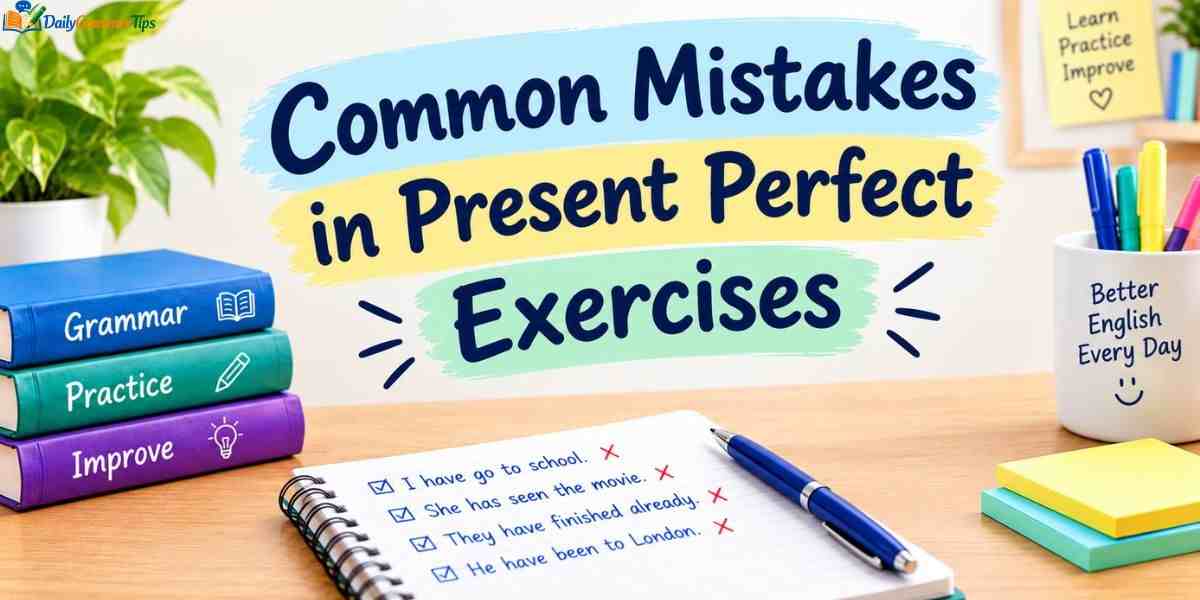
Small errors repeat in most present perfect exercises. Spot them early, and you will save time.
Using Finished Time Words
Words such as yesterday, last year, and in 2010 point to a finished time. Use the past simple with them. “I met her in 2010.”
Many present perfect exercises hide this trap in plain sight. Underline the time word before you choose.
Mixing Been and Gone
Been means the person went and came back. Gone means the person is still away. “She has been to Peru” is an experience. “She has gone to Peru” means she is there now.
Ask yourself one question. Is the person here or away?
Using Wrong Participles
Say “I have gone,” not “I have went.” Say “She has eaten,” not “She has ate.” The participle is the third form of the verb.
Keep a short list of irregular forms near your desk. Review it each week.
How to Get More From Present Perfect Exercises
Doing present perfect exercises is only the first step. How you practise matters even more.
Check Answers, Then Rewrite
After each set, mark your mistakes. Rewrite each wrong sentence correctly. This turns errors into memory.
Wait a day, then redo the same present perfect exercises without looking at the key.
Practise Little and Often
Ten minutes a day beats one long session. Do one set in the morning. Read your corrected sentences at night.
Short, steady practice makes present perfect exercises feel light, and the forms stay in your mind.
Learn Irregular Participles in Groups

Group verbs by sound. Begin, began, begun. Drink, drank, drunk. Sing, sang, sung. Another group follows a different pattern. Break, broke, broken. Speak, spoke, spoken. Choose, chose, chosen.
A third group has one form for both past tenses. Buy, bought, bought. Bring, brought, brought. Think, thought, thought. Add these lists to your present perfect exercises notes.
Frequently Asked Questions
What Are Present Perfect Exercises?
Present perfect exercises are practice tasks for the have or has plus participle pattern. They train form, meaning, and tense choice.
When Do We Use the Present Perfect?
We use it for experiences, recent results, and actions that continue to now. It links the past to the present moment.
Which Tense Is Hardest to Learn?
It depends on the learner. Many people find the present perfect and its continuous form hard, because they connect the past with the present.
What Is Present Perfect and Example?
It is a tense that links a past action to the present moment. Example: “I have finished my homework.”
What Is V1, V2, V3, V4, and V5 of Know?
V1 is know, V2 is knew, V3 is known, V4 is knowing, and V5 is knows. The present perfect uses V3, as in “I have known her for years.”
Conclusion
Present perfect exercises turn a tricky tense into a daily habit. Start with the form, then add tense choices, continuous forms, and the simple and continuous contrast. Check every answer and fix each mistake.
Return to these present perfect exercises whenever you feel unsure. Redo the hard sets after a few days and write your own sentences. With steady practice, the tense will feel natural.
