

A preposition is a small word with a big job. It connects nouns, pronouns, and phrases to the rest of the sentence and shows relationships of time, place, direction, and cause. Without the right word, even a simple sentence can sound confusing, awkward, or simply wrong to a native listener.
This guide explains how each preposition works, which types exist, and how to avoid common mistakes. You will find clear examples, memory tips, and a short practice set at the end. By the end, choosing the correct word will feel natural instead of random, and you will speak and write with more confidence.
What Is a Preposition?
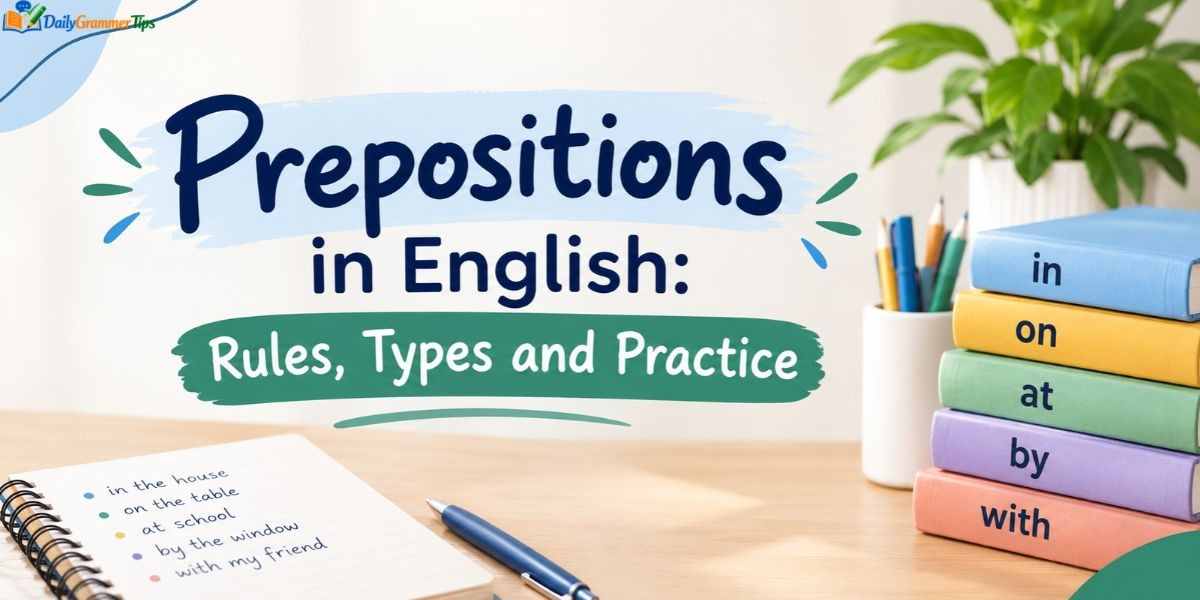
A preposition is a word that links a noun or pronoun to another word in the sentence. It usually comes before the noun and shows how two things are related to each other. Common examples include in, on, at, by, with, and for, and each one carries its own meaning.
These words answer questions such as where, when, and how. In the sentence “The keys are on the table,” the word on shows position, while in “We met after lunch,” the word after shows time. Learning this simple idea gives you a clear starting point for every other rule in this guide.
- The cat is under the chair.
- She arrived before noon.
- He travels by train.
- The film starts at eight and ends around ten.
- Please put the keys in the drawer.
- She sat next to her brother at the wedding.
The Job of a Preposition in a Sentence
A preposition always works together with an object, which is the noun or pronoun that follows it. Together they form a phrase, such as in the garden or after lunch. The phrase can describe a noun or add detail to a verb, which makes the sentence richer and more exact.
Compare “I met her” with “I met her at the station after work.” The second sentence gives location and time through small linking words, and the listener understands the full picture. Without these connectors, English would sound short, flat, and incomplete.
- The book on the shelf is mine. (describes a noun)
- She waited for an hour. (adds detail to a verb)
- They talked about the plan. (shows the topic)
- The woman with the red bag is my aunt.
- We stayed at home during the storm.
- He spoke to the manager about the delay.
Types of Prepositions
English grammar groups these words by meaning. The main groups show time, place, direction, and relationship, while smaller groups cover cause, manner, and agent. Some words belong to more than one group, depending on how they are used in the sentence.
Knowing the group helps you choose the right word faster. If the sentence talks about a moment, think of a time word. If it talks about a position, think of a place word, and if it talks about movement, think of a direction word.
- Time: at, on, in, before, after, during
- Place: under, over, between, behind, next to
- Direction: to, from, into, through, across
- Manner and cause: by, with, because of, due to
- Agent and tool: by, with, as in written by a student, cut with a knife
- Purpose: for, as in a tool for cleaning
- Company: with, without, along with
Prepositions of Time
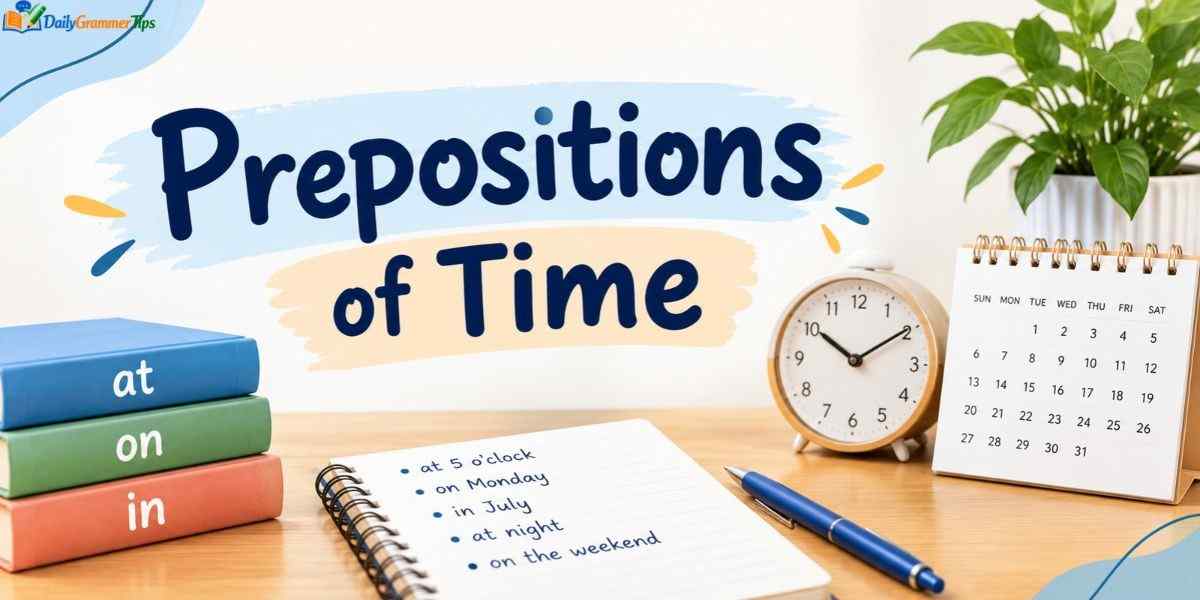
Three words handle most time expressions: at, on, and in. We use at for exact times, as in at six o’clock. We use on for days and dates, as in on Monday or on 5 May, and we use in for months, years, seasons, and long periods.
Other time words include for, since, during, before, and after. Each preposition has a specific job, so mixing them changes the meaning of the sentence. Choosing the right one makes your schedule, plans, and stories clear to the listener.
- The class starts at nine.
- My exam is on Thursday.
- We usually travel in summer.
- She finishes work at five and goes home by six.
- The shop opens on weekdays and closes on Sundays.
- We met in 2019 and married in June.
Using At, On and In for Time
A simple picture helps. Think of at as a point, on as a surface, and in as a space. Small moments get at, days get on, and large periods get in. This mental image works for most examples and saves you from memorizing long lists.
Some phrases are exceptions, such as at night, at the weekend, and in the morning. These need memorizing as fixed expressions. They show why a preposition cannot always be guessed from logic, and why reading and listening matter as much as rules.
- at noon, at midnight, at 7:30
- on Friday, on my birthday, on 12 June
- in winter, in the afternoon, in 1999
- at the moment, at lunchtime, at the end of the day
- on Monday morning, on New Year’s Day, on time
- in the evening, in a week, in the future
For, Since and During
For measures how long something lasts, as in for three hours or for two years. Since gives the starting point of a period, as in since Monday or since 2015. Learners often mix these two, so always check whether you are mentioning a length or a start.
During answers when something happens inside a period, as in during the film or during the holiday. It does not tell you the length of the event. Choosing the correct word here improves the accuracy of your time expressions and makes your English sound more natural.
- I have lived here for ten years.
- I have lived here since 2016.
- She called me during dinner.
- He studied for three hours before the test.
- They have been friends since childhood.
- Nobody spoke during the long meeting.
Prepositions of Place
Place words describe where something is. The core group includes at, in, on, under, over, between, behind, next to, and in front of. They help listeners picture a scene clearly, whether you describe a room, a street, or a whole city.
We use in for enclosed spaces, on for surfaces, and at for points or addresses. For example, “She is in the room,” “The book is on the desk,” and “He is at the bus stop.” Each word gives a different mental image, so the choice changes the meaning of the sentence.
- The lamp is above the sofa.
- The bank is between the school and the park.
- The dog is sleeping behind the door.
- The museum is opposite the central station.
- Our flat is on the third floor.
- She lives in a small village near the sea.
Prepositions of Direction and Movement
Direction words show movement from one place to another. Common examples are to, from, into, out of, through, across, along, and towards. We say “She walked into the shop” and “He drove across the bridge,” and the choice shows the path of the movement.
Be careful with to and at after verbs of motion. We say “I went to school,” not “I went at school.” A clear grasp of direction makes every choice easier, especially when you give directions to a stranger or describe a trip in detail.
- The train goes from London to Paris.
- They walked along the river.
- The ball rolled through the gate.
- The cat jumped onto the table and off again.
- We drove past the school and turned towards the market.
- He ran out of the room and down the stairs.
Prepositions After Verbs
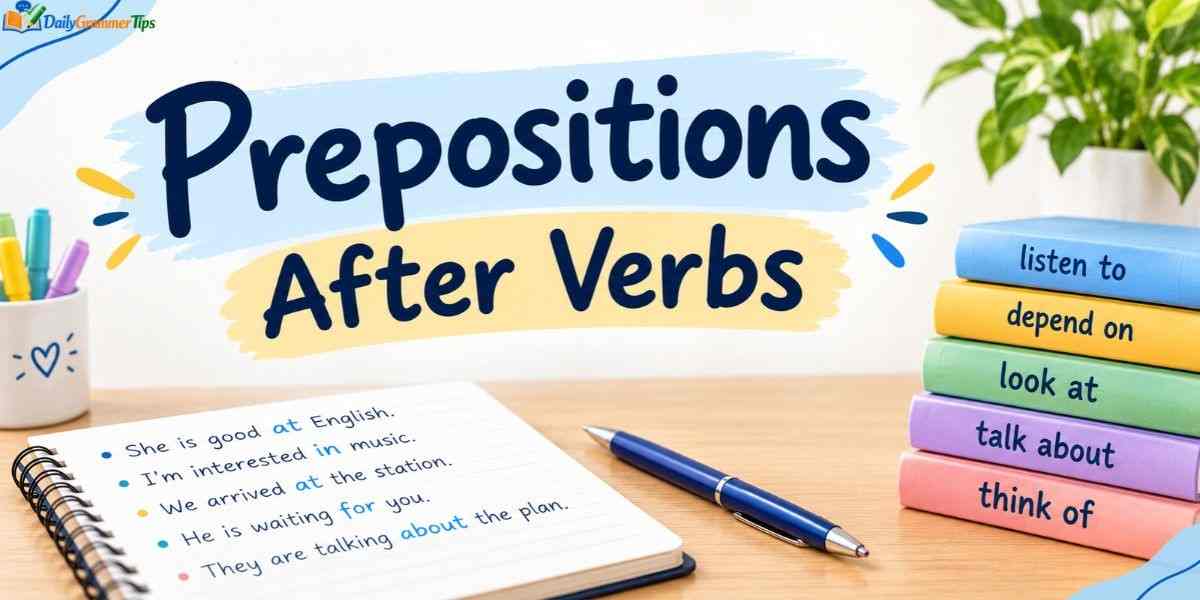
Many verbs need a specific partner word to complete their meaning. We listen to music, depend on friends, and agree with someone. These pairs are called verb and preposition combinations, and they appear in almost every conversation and every written text.
Changing the partner can change the meaning. Look at the difference between look at, look for, and look after. Study these pairs as complete chunks rather than separate words, because your memory stores a full chunk much faster than two unrelated pieces.
- I am waiting for a call.
- She belongs to a local club.
- We talked about the new project.
- She apologized to her friend for being late.
- I rely on my sister for good advice.
- They complained about the noise to the landlord.
Read also………….Irregular Verbs: A Complete Guide to Past Simple Forms
Prepositions After Adjectives
Adjectives also pull certain words behind them. We say good at, afraid of, interested in, and proud of. These patterns appear in daily speech and formal writing alike, and a wrong partner word is one of the quickest signs of a learner mistake.
Learn each adjective together with its partner. Writing full sentences locks the pattern in and prevents errors with the word that follows. A short note in your notebook, with one example for each pattern, will help you more than a long list of rules.
- She is excellent at maths.
- He is afraid of heights.
- They are proud of their team.
- I am tired of waiting.
- He is jealous of his brother’s success.
- We are grateful for your help.
- She is married to a doctor.
Prepositions After Nouns
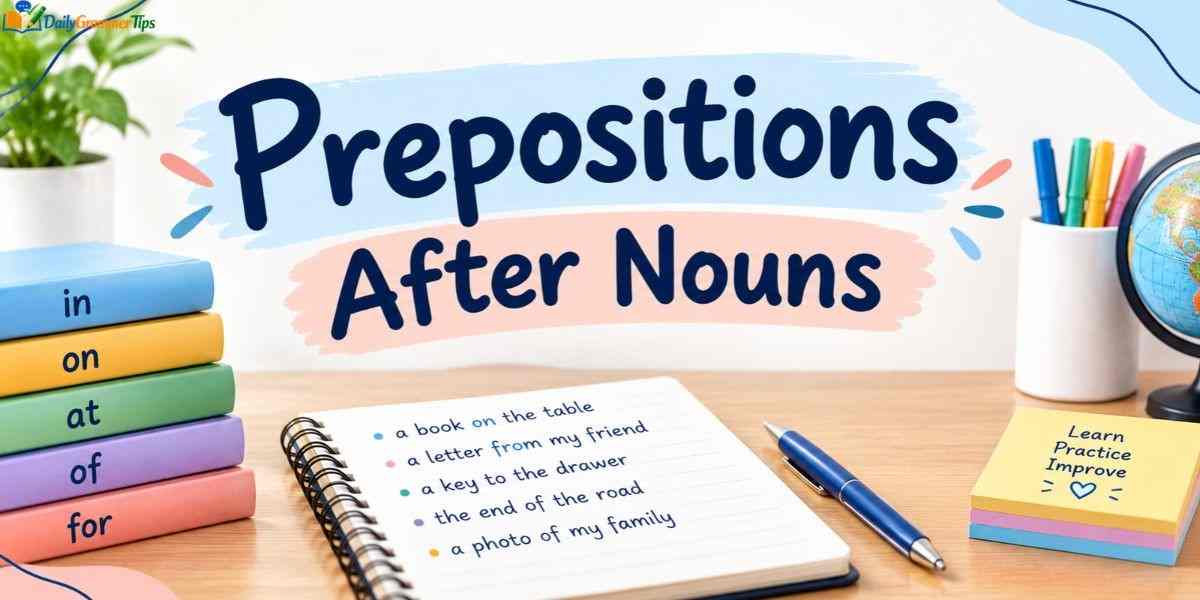
Some nouns also prefer a fixed partner, such as reason for, answer to, increase in, and need for. These patterns look small, but they affect accuracy in essays, emails, and reports. A single wrong word can make a professional sentence sound unnatural.
Dictionaries show these partners in example sentences. Check them whenever you learn a new noun. Over time, each pattern will start to sound right before you even think about it, and your writing will feel smoother and more confident.
- the reason for the delay
- an answer to the question
- an increase in prices
- a need for change
- a solution to the problem
- a picture of my family
- a difference between the two plans
Fixed Phrases with Prepositions
Fixed phrases follow no logical rule, so they simply need to be remembered. Examples include in a hurry, on time, by mistake, at risk, and out of order. Native speakers use them without thinking, and learners who know them sound far more fluent.
Collect these phrases in a notebook by theme, such as travel, work, or health. Reading and listening will help you notice them naturally. A single wrong word can make a phrase sound strange, so always copy the full chunk and never change the small word.
- We arrived on time.
- I took your bag by mistake.
- The lift is out of order.
- She is in charge of the whole team.
- He did the work on purpose.
- We lost the key by accident.
Prepositions Followed by Gerunds
After a preposition, English uses a gerund, which is the ing form of a verb. We say “She is good at drawing” and “He left without saying goodbye.” The infinitive is not used in this position, even when the meaning points to the future.
The word to is a special case. In “I look forward to seeing you,” to is a preposition, so the gerund seeing is correct. This is one of the most common traps in English, and even advanced learners fall into it when they speak quickly.
- She is interested in learning Spanish.
- He is tired of waiting.
- They left after finishing the job.
- He insisted on paying for dinner.
- They succeeded in finishing early.
- I apologize for being late.
Common Mistakes with Prepositions
Learners often translate directly from their first language, which leads to errors such as “married with” instead of “married to.” Another mistake is adding a word that is not needed, as in “discuss about,” because the verb discuss already carries the full meaning.
Confusion between in, on, and at is also frequent. Careful checking and regular reading reduce these mistakes. A teacher or study partner can point out patterns you miss, and recording your own speech can reveal errors you did not notice before.
- Wrong: I arrived to the station. Right: I arrived at the station.
- Wrong: She is good in tennis. Right: She is good at tennis.
- Wrong: We discussed about money. Right: We discussed money.
- Wrong: He depends of his parents. Right: He depends on his parents.
- Wrong: I am agree with you. Right: I agree with you.
- Wrong: She entered in the room. Right: She entered the room.
Tips to Memorize Prepositions
Learn in chunks, not single words. Write the whole phrase, such as depend on or interested in, on a card. Chunks keep the partner word attached to the main word, which is how native speakers store them, and this method reduces mistakes more than any list.
Review a few cards daily and say them aloud. Short, regular sessions beat long, tiring ones. Each correct answer you recall builds confidence for the next one, and a habit of ten minutes a day will bring clear progress within a month.
- Use colored cards for time, place, and partner words.
- Say each phrase aloud three times.
- Write one personal sentence for every new chunk.
- Test yourself with a short quiz every weekend.
- Teach a friend three new phrases each week.
- Mark every new chunk in the texts you read.
Ending a Sentence with a Preposition
Many people believe a sentence must never end with a preposition. In modern English, this is perfectly acceptable, especially in speech. “Who are you talking to?” sounds more natural than “To whom are you talking?” and most native speakers choose the first option.
Formal writing sometimes prefers the longer structure. Choose the style that fits your audience. Both forms are grammatically correct, and neither is wrong, so you can relax and focus on clear communication instead of an old and unnecessary rule.
- What are you looking for?
- This is the house I grew up in.
- Which team do you belong to?
- That is the song I was thinking about.
- Who did you give the book to?
- The chair she sat on was broken.
Prepositions in Spoken and Written English
Spoken English often uses short, flexible patterns, while written English prefers precise choices. For example, we say “get on a bus” in speech and “board a bus” in formal writing. The meaning stays the same, but the tone changes with the situation.
Reading widely shows you how skilled writers use these words. Notice the patterns and copy useful ones. Over time, your choices will become more natural, and you will switch easily between a friendly message to a friend and a formal letter to a manager.
- Spoken: Can you pick me up at six?
- Written: Please collect me at six.
- Spoken: I’m fed up with this noise.
- Written: He was fond of classical music.
- Spoken: I’m really into jazz.
- Written: The committee will reply within two weeks.
Practice Exercises for Prepositions
Choose the correct word for each sentence.
- The meeting starts (at / on) nine o’clock.
- My birthday is (in / on) March.
- She is afraid (of / from) spiders.
- He is good (at / in) football.
- We walked (across / through) the bridge.
- I am waiting (for / to) the bus.
- They have lived here (since / for) 2018.
- She was thinking (of / at) her holiday.
The answers are at, in, of, at, across, for, since, and of. Check any mistake and note the rule behind it. Regular practice works better than reading rules alone, so repeat the set after a few days and see how many answers you remember.
Try these extra sentences on your own and fill each gap.
- The bus leaves ___ half past seven.
- She is very interested ___ art and music.
- We stayed ___ a small hotel near the beach.
- He has worked here ___ five years.
- The cat jumped ___ the wall.
- I am fed up ___ this weather.
Answers: at, in, in, for, over, with.
Learning Strategies That Work
Songs, stories, and games make patterns stick. Write a short story using ten verb and word pairs, or play a matching game with cards. Even a single preposition learned in context is worth more than a list memorized and forgotten the next day.
Keep a small notebook of new phrases you meet each week. Review it on the weekend and use three phrases in your own sentences. Small wins keep motivation high, and a clear weekly routine turns a difficult topic into a simple habit.
- Read one short article every day and underline the small linking words.
- Listen to a podcast and note three new phrases.
- Describe your day aloud using time and place words.
- Play a card game that matches verbs with their partner words.
- Rewrite one paragraph from a news story in your own words.
- Ask a teacher to check one short text every week.
Frequently Asked Questions
What is a preposition?
It is a word that links a noun or pronoun to another part of the sentence, showing time, place, or direction. Examples are in, on, at, and by.
What are the main types of prepositions?
The main types show time, place, direction, and relationship. Others cover cause, manner, and agent.
How can I learn prepositions quickly?
Learn them in chunks with the verb, adjective, or noun they follow. Then review short cards for a few minutes every day.
Can a sentence end with a preposition?
Yes. In modern English it is acceptable, especially in speech, as in “Who are you talking to?”
Why do some verbs change meaning with different prepositions?
The partner word forms a fixed chunk with the verb. Look at, look for, and look after all mean different things.
- Learn chunks, not single words.
- Read and listen every day.
- Review mistakes and repeat the practice set.
Conclusion
Prepositions may look random, but they follow patterns that you can learn step by step. Group them by time, place, direction, and partner words, and practice with real sentences. Progress will come faster than you expect, especially if you study a little every day.
Keep reading, keep speaking, and keep noticing small words in everything you meet. Steady effort turns hesitation into instinct, and soon your sentences will sound smooth and accurate. Return to this guide whenever a doubt appears, and trust the patterns you have learned.
