


Learners meet this tense early, and they often feel unsure about it. The reason is simple. It links the past to the present, which makes it feel different from other tenses. This guide breaks it down step by step, with clear rules, short examples, and practical tips you can use today.
Every sentence in this tense needs have or has plus a past participle. That one pattern powers the whole present perfect verb tense. You will learn how to build statements, negatives, and questions. You will also see when to use it, when to avoid it, and how it works with adverbs and the passive voice.
Grammar: Present Perfect Tense
What is the present perfect tense? It is a verb tense that describes past actions with a clear link to now. The action may continue, or its result may still matter. English speakers use it to talk about experiences, changes, and news. It answers the question, what has happened up to this moment?
Grammar books place this tense among the four present tenses. The others are the simple, continuous, and perfect continuous forms. Each one shows a different view of time. This tense focuses on completion and connection. It looks back from the present and says, this has happened, and it still matters.
The Present Perfect Simple Tense
The word simple here means the verb has no ing ending. You build the verb with have or has and the past participle only. This keeps the structure compact and easy to see. Teachers use the label simple to separate it from the continuous form, which adds been and ing.
The tense formula is easy to remember: subject plus have or has plus past participle. She has finished her report. We have booked the tickets. They have moved to a new house. Each sentence names a past action and points to a present result. The listener understands why the news matters now.
How to make the present perfect simple
Making this tense takes three small steps. First, pick the subject. Second, choose have or has to match it. Third, add the past participle of the main verb. Follow these steps in order, and you will build correct sentences every time. The next sections explain each step in detail.
Spelling and pronunciation add two extra checks. Regular participles end in ed, but the ending sounds different in different words. It sounds like t in walked, like d in played, and like id in wanted. Say each form aloud to hear the difference. Good pronunciation makes your sentences easier to understand.
Definition of the present perfect tense
This tense joins a past action to the present moment. The speaker does not state when the action happened. Instead, the speaker stresses the experience, the result, or the time period that has not ended. I have lost my keys means the keys are still missing now. Exact time is not the point.
Think of it as a bridge between two points. One end stands in the past, and the other end stands in the present. The speaker walks across and brings the past action along. Urdu learners can compare it with sentences ending in hai or hain, such as Maine kitab parhi hai.
Forming the present perfect
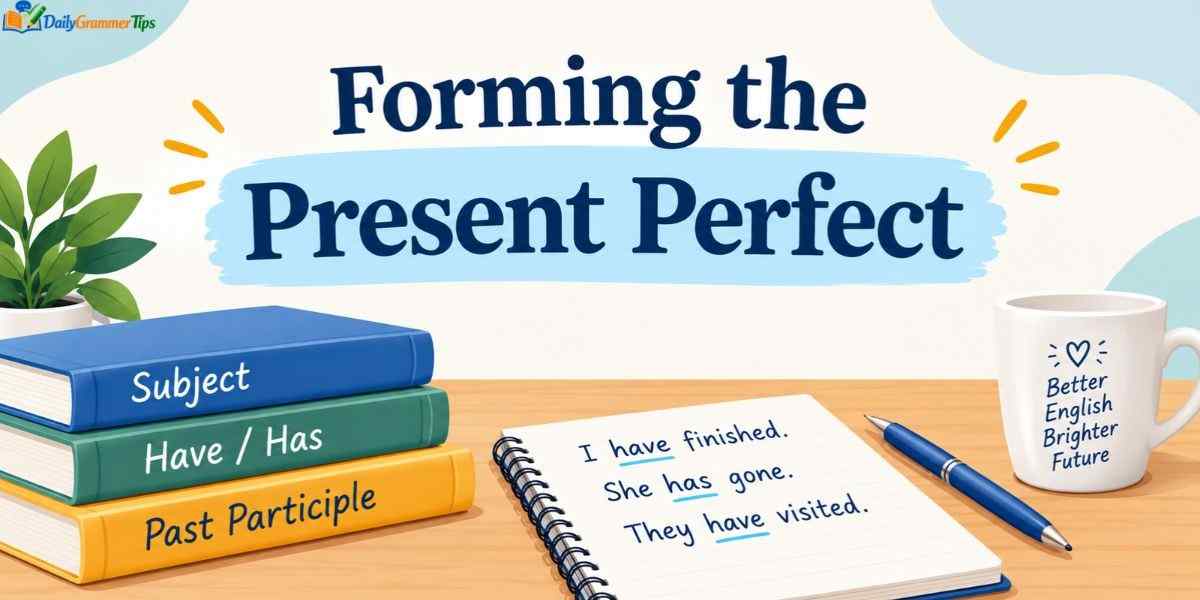
The present perfect verb tense uses two parts. The first part is have or has, which acts as the helper verb. The second part is the past participle of the main verb. Use has with he, she, and it. Use have with I, you, we, and they. Speakers shorten them to I’ve and she’s.
Regular verbs form the participle by adding ed. play becomes played. walk becomes walked. Some spellings change. study becomes studied. stop becomes stopped. travel becomes travelled in British English. Irregular verbs change in unique ways. write becomes written. go becomes gone. eat becomes eaten. Learn the common irregular participles early.
To walk, present perfect
Here is the full model with the verb walk. I have walked. You have walked. He has walked. She has walked. It has walked. We have walked. You have walked. They have walked. Only the helper changes, and only for he, she, and it. The participle stays the same in every form.
Write this model in your notebook. Then repeat it with three other verbs, such as work, call, and finish. Say each line aloud to train your ear. Repetition builds automatic habits, and automatic habits make fast, confident speech. Try it for five minutes each day this week.
How to use the present perfect tense
The present perfect tense appears in conversation, news, emails, and exams. Speakers use it to share experiences, report recent news, and describe changes. Writers use it to connect background events to current points. The sections below show how it works in statements, negatives, questions, adverb patterns, and the passive voice.
Context decides your choice of tense. Ask two quick questions before you write. Does the time period continue to now? Does the result matter in the present? If the answer is yes, this tense fits. If the answer is no, choose the past simple. This habit prevents most common errors.
The present perfect tense for statements
The positive present perfect form states a fact that links past and present. I have visited Rome twice. He has learned three languages. The company has grown quickly. Each statement carries a result or an experience. The speaker does not mention the exact date, because the date does not matter here.
Short forms make statements sound natural. I’ve finished. She’s arrived. We’ve decided. Notice that ‘s can mean has or is. In this structure, ‘s means has. Context tells the listener which meaning you intend. Use full forms in formal writing, and use short forms in speech and informal messages. Both styles are correct.
The present perfect tense for negatives
Add not after have or has to make a negative. I have not seen that film. She has not called yet. They have not arrived. The negative present perfect form works the same for every verb. You never need a do helper, because have and has already carry the grammar.
Short negatives are very common. I haven’t eaten. He hasn’t replied. We haven’t started. Use haven’t with I, you, we, and they. Use hasn’t with he, she, and it. Negatives often show that something is still waiting to happen. The bus hasn’t come means we are still waiting.
The present perfect tense for questions
Put have or has before the subject to ask a yes or no question. Have you finished? Has she called? Have they arrived? The present perfect form of a question keeps the participle in the same place. Answer with short phrases. Yes, I have. No, she hasn’t.
Add a question word at the start to ask for details. What have you done today? Where has he gone? Why have they left early? How long has she lived here? Keep the order: question word, have or has, subject, participle. Many learners reverse this order, so practice it aloud.
Learn more………..Prepositions in English: Rules, Types and Practice
How to use the present perfect tense with adverbs
Adverbs add precise meaning to this tense. Already, just, ever, and never usually sit between have or has and the participle. I have already eaten. She has just left. Have you ever tried sushi? We have never met. Place them there, and your sentences will sound natural.
Yet usually comes at the end of negatives and questions. I haven’t finished yet. Has he called yet? Still goes before the negative helper to show surprise or frustration. She still hasn’t replied. Already can also move to the end for emphasis. I have eaten already. Practice each adverb with its own set of sentences.
How to use the present perfect tense in the passive voice
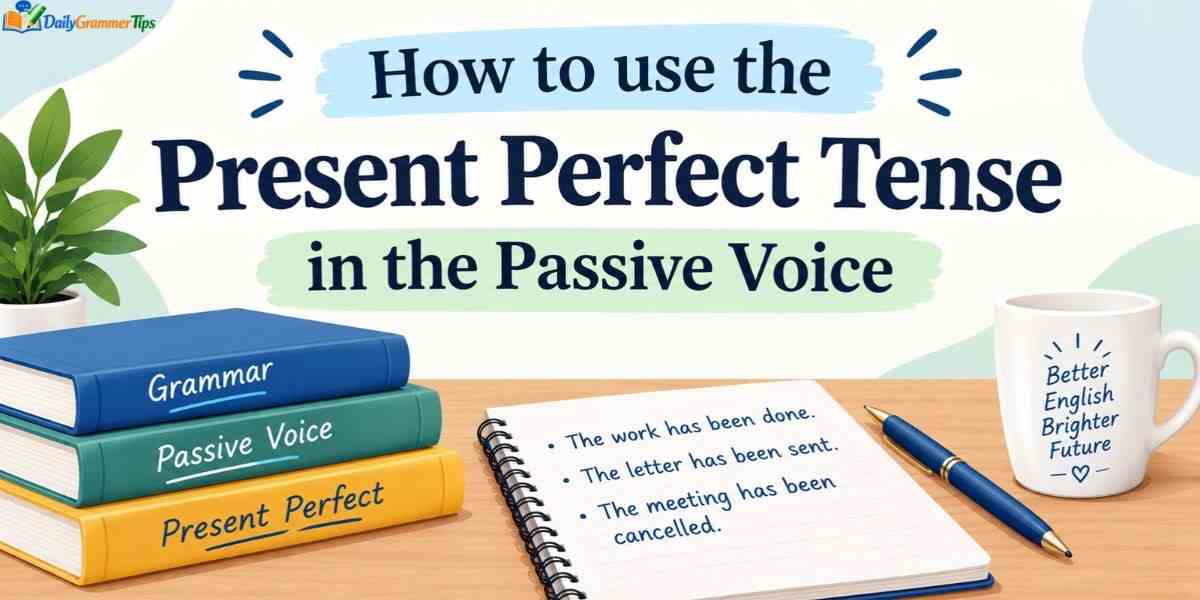
The passive voice shifts the focus from the doer to the action. Form it with have or has plus been plus the past participle. The report has been finished. The windows have been cleaned. Several roads have been closed. The speaker cares about the result, not the person who caused it.
Negatives and questions follow familiar patterns. The package has not been delivered. Has the email been sent? Have the results been published? Add by plus the doer only when it matters. The book has been written by a famous author. Passive sentences sound formal, so you will see them often in news and reports.
How to use the present perfect continuous tense
The continuous form stresses an activity that started in the past and continues now, or just stopped. Form it with have or has plus been plus the verb with ing. I have been working since eight. She has been learning Spanish for a year. The speaker focuses on the process, not only the result.
Visible evidence also calls for this form. You look tired. Have you been studying all night? The grass is wet. It has been raining. Questions with how long often use it. How long have you been waiting? Use it for activities that feel temporary or recent, and add for or since to show duration.
6 examples of when to use the present perfect tense
First, use it for life experiences. I have climbed a mountain. Second, use it for unfinished time periods. She has written three emails today. Third, use it for recent results. He has broken his phone. Each use links a past action to a present idea, so the exact time stays unimportant.
Fourth, use it for actions that began earlier and continue now. They have lived here since 2020. Fifth, use it for repeated actions up to now. We have seen that film four times. Sixth, use it for changes over time. Prices have risen sharply. Together, these six uses cover most real situations.
When not to use the present perfect tense
Do not use this tense with finished time expressions. Words like yesterday, last week, in 2019, and two days ago point to a closed period. Use the past simple instead. Say I saw him yesterday, not I have seen him yesterday. A finished time marker and a present link cannot share one sentence.
Also avoid it when the focus is a specific past event. Questions with when, what time, and how long ago need the past simple. When did you arrive? I arrived at six. Use it only when the time does not matter or the period continues. Check every sentence for a finished time word first.
IELTS preparation
Examiners notice grammatical range and accuracy. This tense helps you show both. In Speaking, use it to describe experiences, such as I have travelled to several countries. In Writing Task 1, use it to describe change, such as The number of users has increased. Mix it with other tenses for a strong score.
Practice with real prompts. Describe a place you have visited, a skill you have learned, or a change you have noticed. Record your answer and listen for errors. Then repeat the answer with better grammar. Daily short recordings build fluency and accuracy together, which supports your band score.
Understand your English level
Before you practice, check your level. Write ten sentences about your life using have or has. Then mark every mistake. Look for wrong helpers, wrong participles, and wrong time words. Ask yourself, what is the present perfect tense, and can I explain it in one clear sentence?
Your results guide your study plan. If you confuse have and has, drill the helper verbs first. If you misspell participles, review the irregular list. If you mix it with the past simple, practice time words. Track your progress weekly, and retest after a month to see real improvement.
Present perfect
This tense is one of the most useful verb forms in English. It connects what happened before with what matters now. The present perfect verb tense also helps you sound natural, because native speakers use it every day. Master it, and you will gain a flexible tool for daily talk and writing.
Keep this quick guide in mind. The formula is have or has plus the past participle. The main uses are experiences, recent news, unfinished time, and changes. The common signals are already, yet, just, ever, never, for, and since. Review this checklist before every writing task or speaking test.
have been and have gone
These two phrases look similar, but they mean different things. She has been to Paris means she visited Paris and came back. She has gone to Paris means she went there and has not returned. The speaker uses gone when the person is still away or on the way.
Test yourself with a simple scene. If a friend says, Where is Tom? you may answer, He has gone to the shop. That answer means he is out now. If Tom walks in later, you say, He has been to the shop. Now the trip is over. Small differences carry big meaning.
Present perfect with time adverbials
Time adverbials show how long or how recently an action happened. Use for with a length of time. I have worked here for five years. Use since with a starting point. She has lived here since 2018. Both words connect the past to now, and both need this tense instead of the past simple.
Unfinished time words also fit well. Today, this week, this month, and this year all describe periods that are still open. We have had two meetings this week. Recently, lately, and so far also work. Prices have changed recently. So far, he has scored twice. Avoid yesterday, last year, and ago.
Present perfect continuous
Choose between the present perfect simple and the continuous form by asking one question. Do you care about the result or the activity? I have painted the room shows a finished result. I have been painting the room shows an activity with its effects still visible. Both are correct, but they send different messages.
Stative verbs rarely take the continuous form. Verbs such as know, like, love, own, and believe describe states. Use the simple form with them. I have known her for years. They have owned the shop since 2010. Do not say I have been knowing her. That sentence sounds wrong to native ears.
Present perfect for future

This tense can also describe a completed action in a future context. Use it after time conjunctions such as when, after, before, until, as soon as, and once. I will call you when I have finished. She will leave after she has eaten. The verb form looks present, but the meaning is future.
The same pattern works in time clauses with until and as soon as. Wait here until I have checked. We will start as soon as everyone has arrived. Do not use will inside the time clause. Say when I have finished, not when I will have finished. This rule helps in exams and in real conversations.
Frequently Asked Questions
What is present perfect and example?
It is a tense that links a past action to the present, built with have or has plus the past participle. Example: I have finished my homework.
What’s the difference between present perfect and present tense?
The present simple describes habits and facts, as in I work here. The perfect form links the past to now, as in I have worked here for ten years.
What’s present perfect simple?
It is the basic form with have or has plus the past participle and no ing ending. Example: She has cooked dinner.
Why is it called present perfect?
Present refers to the helper verb have or has and the link to now. Perfect means completed, because the action is finished when seen from the present.
How to teach present perfect?
Start with real experiences and a timeline, then model have or has plus the participle. Follow with gap fills and speaking tasks, and contrast it with the past simple.
Conclusion
This tense gives you a simple way to connect the past with the present. You build it with have or has plus the past participle, and you use it for experiences, recent results, unfinished time, and changes. Remember the key signals: already, yet, just, ever, never, for, and since. These small words sharpen your meaning.
Avoid the common traps, too. Skip finished time words like yesterday and ago, and choose the past simple for them. Check have and has, and double check irregular participles. Then practice daily. Write five sentences about your week, record a short answer, and review your mistakes. Steady practice turns rules into natural habits.
