

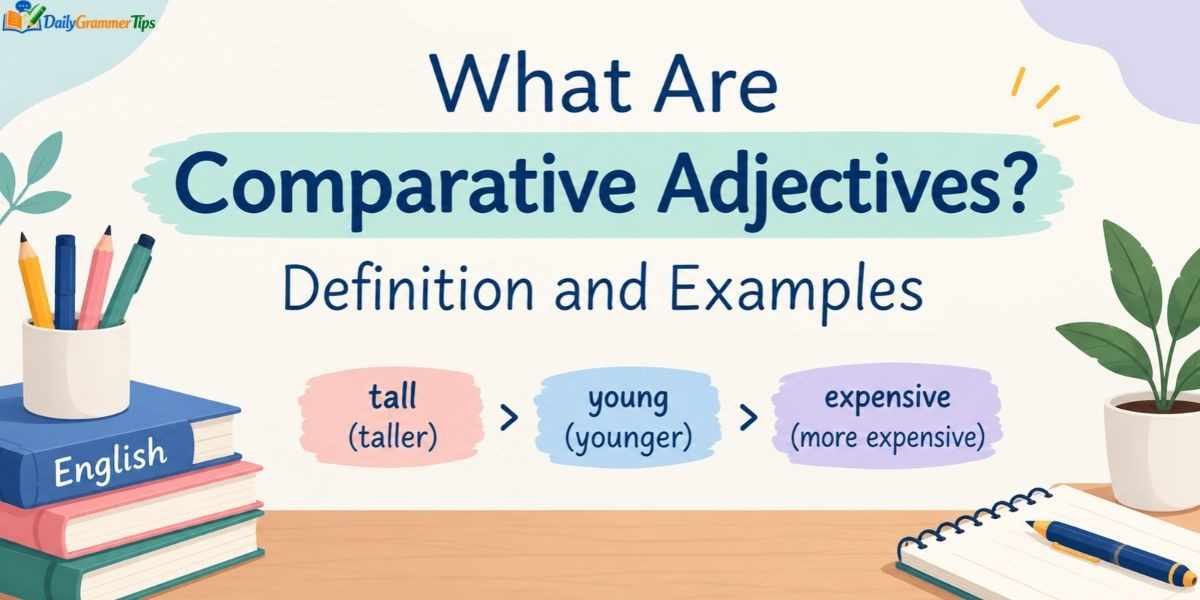
Comparative adjectives help you compare two people, places, things, or ideas. They show which item has more or less of a quality. Words like taller, faster, and more interesting do this job in daily speech and writing.
This guide explains comparative adjectives in plain language. You will learn the definition, the sentence patterns, the spelling rules, the irregular forms, and the most common mistakes. Every section includes short examples, so you can see each rule in action.
What are comparative adjectives?
Comparative adjectives are describing words that show a difference between two nouns. They change the base form of an adjective to express a higher or lower degree. For example, tall becomes taller, and expensive becomes more expensive.
Grammar books call the base form the positive degree. The comparative form is the second degree, and the superlative form is the third. Comparative adjectives sit in the middle of this scale.
Look at these simple sentences:
- Maya is taller than Sam.
- This soup is more flavorful than that one.
- My new phone is lighter than my old phone.
Each sentence compares two items. The adjective changes its form, and the word than introduces the second item.
Most comparative adjectives follow clear patterns. Short adjectives usually take the suffix -er. Longer adjectives usually take the word more. A small group of adjectives follows no pattern at all, so learners must memorize them.
Like every adjective, comparative adjectives modify nouns and pronouns. They can appear after a linking verb, as in “The room is quieter.” They can also appear before a noun, as in “We need a quieter room.”
Some adjectives cannot be compared, because their meaning is already absolute. Words such as unique, perfect, empty, and dead are called non-gradable adjectives. Something cannot be more unique than another thing. So these words rarely appear in the comparative form.
The term gradable matters here. A gradable adjective describes a quality that can rise or fall on a scale. Words like warm, tall, and interesting are gradable. You can say warmer, taller, and more interesting without any problem.
How to use comparative adjectives in a sentence
The easiest pattern has five parts. Write the first noun. Add a linking verb. Add the comparative form. Add the word than. Finish with the second noun.
Noun A + be + comparative form + than + Noun B
Here are three examples:
- The movie was more boring than the book.
- Her brother seems calmer than she does.
- The new bridge is wider than the old one.
In each sentence, the first noun has more of the quality than the second noun.
The word than does important work. It tells the reader what you compare with the first noun. Without than, the comparison feels unfinished.
Pay attention to the pronoun after than. In formal writing, many speakers choose a full clause: “She is taller than I am.” In casual speech, people often say: “She is taller than me.” Both patterns appear in real English, but the clause version sounds more careful.
Sometimes both items are already clear from context. In that case, you can drop than and the second item. For example: “My laptop is slow. I need a faster one.” Here the listener already knows the comparison is with the old laptop.
You can place comparative adjectives before a noun too. For example, “She wants a faster car” and “He chose a quieter seat” both work well. In these sentences, the comparison is implied rather than stated.
Intensifiers make a comparison stronger or softer. Words such as much, far, a lot, slightly, and a bit change the strength of comparative adjectives. Compare these two sentences: “This route is slightly shorter” and “This route is much shorter.” The second sentence shows a bigger gap.
Use less when you want to show a lower degree. Less works with any adjective and never changes its spelling. For example, “This task is less difficult than the last one” means the last task was harder.
Do not confuse a comparison of difference with a comparison of equality. Equality uses the pattern as, adjective, as. For example: “This bag is as heavy as that one.” The adjective stays in its base form. No comparative ending appears.
You can also show change over time by repeating the comparative. “The weather is getting colder and colder” describes a steady drop in temperature. Another pattern uses the twice: “The more you practice, the better you write.” This structure links two changes that grow together.
Comparative adjectives can also build adjective phrases. For example, “Stronger than a bull, the athlete lifted the bar with ease.” The phrase begins the sentence and describes the athlete.
When to use more with comparative adjectives
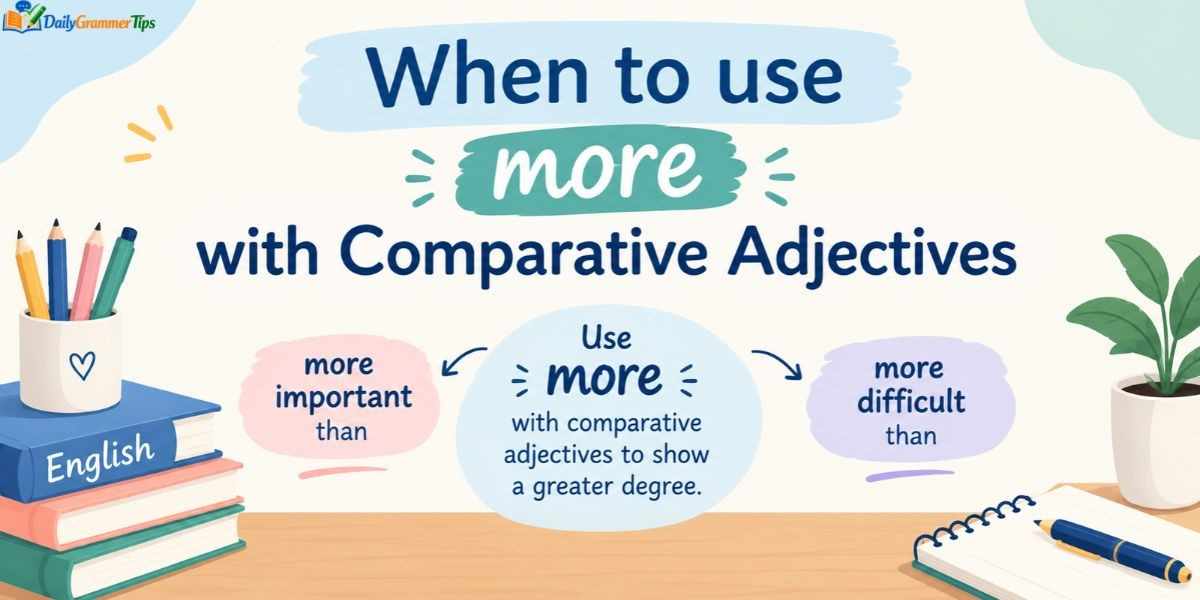
Syllable count decides whether you add -er or use more. A syllable is one beat in a word. The word tall has one syllable. The word happy has two. The word beautiful has three. Count the beats first, then choose the pattern.
Use more with these adjectives:
- All adjectives with three or more syllables, such as beautiful, important, and dangerous
- Most two-syllable adjectives that do not end in -er, -ow, -le, or -y, such as careful, modern, and crowded
Here are two examples. “This chair is more comfortable than that sofa.” “The sequel was more exciting than the original.”
Never combine more and -er in the same phrase. Say taller, not more taller. Say easier, not more easier. This double comparison is one of the most common errors in student writing.
You can also use less with any adjective. Less does not change spelling: less expensive, less crowded, less dangerous. The word less gives you a simple way to show a lower degree without learning new endings.
Some two-syllable adjectives accept both forms. Examples include simple, polite, narrow, gentle, quiet, clever, and common. Both simpler and more simple are correct. Writers often choose the shorter form because it sounds smoother. When you feel unsure, check a good dictionary. With these words, both comparative adjectives are acceptable.
A quick test helps. Say the -er form out loud. If it sounds natural, use it. If it sounds awkward, use more. Adjectives like beautiful and famous fail this test, since beautifuler and famouser sound wrong.
5 spelling rules for forming comparative adjectives
Spelling changes depend on the last letters of the adjective. Follow these five rules to form comparative adjectives correctly. Each rule includes examples you can copy into your notes.
1. One-syllable adjectives
For most one-syllable adjectives, add -er. The base word stays the same.
- smart becomes smarter
- kind becomes kinder
- old becomes older
- clean becomes cleaner
- slow becomes slower
Examples: “Her answer was cleaner than mine.” “The river is slower than the highway.”
2. One-syllable adjectives ending in -e
When the adjective already ends in e, add only r. Do not write a double e.
- large becomes larger
- nice becomes nicer
- safe becomes safer
- free becomes freer
Examples: “The new room is larger than the old one.” “This street feels safer at night.”
3. One-syllable adjectives ending in consonant-vowel-consonant
Double the final consonant when the adjective ends in one vowel plus one consonant. Doubling keeps the vowel sound short.
- big becomes bigger
- hot becomes hotter
- thin becomes thinner
- sad becomes sadder
Do not double the letters w, x, or y. Slow becomes slower, and new becomes newer.
Examples: “Today is hotter than yesterday.” “Her new apartment is bigger than her old one.”
A common error is writing biger instead of bigger. Always double the last consonant in this group.
4. One- or two-syllable adjectives ending in -y
If the adjective ends in a consonant plus y, change y to i and add -er.
- happy becomes happier
- easy becomes easier
- noisy becomes noisier
- dry becomes drier
- lazy becomes lazier
- likely becomes likelier
These changes apply to comparative adjectives of one and two syllables. Many two-syllable adjectives ending in y behave like short adjectives, so they rarely take more.
Examples: “This test is easier than the last one.” “The classroom gets noisier after lunch.”
Watch out for easyer. The correct form is easier.
Read also……..What Is the Present Perfect Tense? Definition and Examples
5. Two-syllable adjectives ending in -er, -ow, or -le
Two-syllable adjectives that end in er, ow, or le can take the -er ending. Add -er after er or ow. Add only r after le.
- clever becomes cleverer
- bitter becomes bitterer
- narrow becomes narrower
- shallow becomes shallower
- simple becomes simpler
- gentle becomes gentler
Examples: “The lake is shallower near the shore.” “This rule is simpler than it looks.”
Here is a quick summary of all five rules:
| Ending | Rule | Example |
| One syllable | Add -er | smart, smarter |
| Ends in e | Add r | nice, nicer |
| Consonant, vowel, consonant | Double the last letter | big, bigger |
| Consonant plus y | Change y to i, add -er | happy, happier |
| Two syllables ending in er, ow, le | Add -er or r | narrow, narrower |
Irregular comparative adjectives
A small group of adjectives ignores the normal rules. These irregular forms appear often in speech and writing, so they deserve extra practice.
| Base form | Comparative form |
| good | better |
| bad | worse |
| far | farther or further |
| little | less |
| many | more |
| much | more |
| old | older or elder |
| fun | more fun or funner |
Examples: “Your English is better than last year.” “The traffic is worse this morning.” “The airport is farther than the station.”
Farther and further overlap. Farther usually refers to physical distance. Further often means more or additional, as in “We need further information.”
Elder is used mainly for family members, as in “my elder sister.” Older works for everything else.
The word fun needs a note. Funner is accepted in modern English, yet more fun sounds more natural to most speakers.
Irregular comparative adjectives never take more or -er. Avoid forms like more good, badder, and more bad. Say better and worse instead. These errors show up often in learner writing. Memorizing the list is the fastest fix.
Comparative vs. superlative adjectives
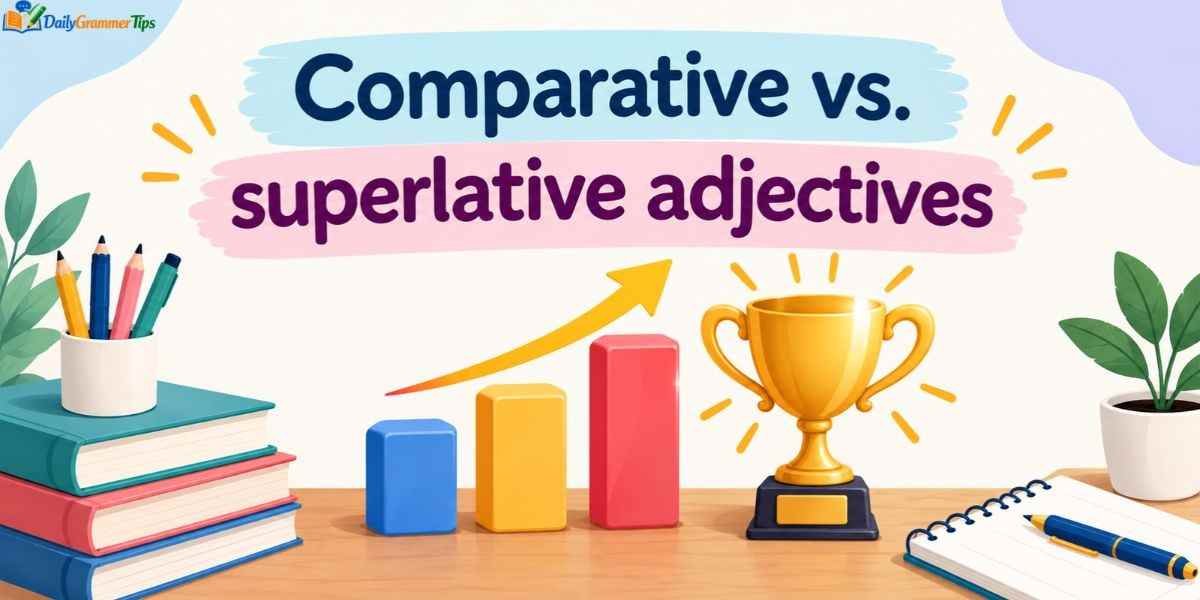
Both forms compare, yet the number of items differs. Comparative adjectives compare two items. Superlative adjectives compare three or more items, or one item against a whole group.
The superlative uses -est or most, and it usually needs the word the. For example: “Lena is taller than Omar, but Rafi is the tallest player on the team.”
Compare these sets:
- fast, faster, fastest
- happy, happier, happiest
- big, bigger, biggest
- important, more important, most important
- good, better, best
- bad, worse, worst
Many spelling rules for comparative adjectives also apply to superlatives. Double the consonant in big, bigger, biggest. Change y to i in easy, easier, easiest. Drop the extra e in nice, nicer, nicest.
A common mistake is mixing degrees. “She is the taller student in the class” is wrong when the class has many students. Use tallest. In reverse, “He is tallest than his father” is wrong. Use taller.
To choose correctly, count the items. Two items need the comparative. Three or more need the superlative.
Resources for Learning English
Practice turns rules into habits. Short daily exercises beat long weekly sessions. Try these methods:
- Read news articles and underline every comparison you find
- Write five comparison sentences each day about food, cities, or jobs
- Take multiple-choice quizzes and review each wrong answer
- Keep a notebook of irregular forms
- Listen to podcasts and note the comparisons you hear
- Ask a teacher or friend to check your writing
Grammar apps and online level tests can also help. Choose materials that match your level, from beginner to advanced. Graded readers show comparative adjectives in real contexts, which builds natural instinct.
Try this short exercise. Choose the correct form in each sentence.
- This lesson is (easy) than the last one.
- My bag is (heavy) than yours.
- That film was (good) than the book.
- Mount K2 is (dangerous) than the hill near my town.
- Today is (bad) than yesterday.
Answers: easier, heavier, better, more dangerous, worse.
The comparative and the superlative
This section gives a quick recap of both degrees. Use it as a study sheet before a test.
Comparative adjectives
Comparative adjectives describe a difference between two things. They answer questions like which one is bigger or which one is more useful.
Examples
- This bag is cheaper than that one.
- The blue jacket is more expensive than the black one.
- My brother is taller than me.
- The exam was easier than I expected.
- Today feels warmer than yesterday.
Superlative adjectives
Superlative adjectives show the highest or lowest degree in a group of three or more. They usually follow the word the.
Examples
- This is the cheapest bag in the shop.
- She is the most talented singer in the choir.
- It was the hottest day of the year.
- He wrote the shortest essay in the class.
- That is the best idea we heard today.
Forming regular comparatives and superlatives
Use this checklist:
- One syllable: add -er and -est (tall, taller, tallest)
- Ends in e: add -r and -st (nice, nicer, nicest)
- Consonant, vowel, consonant: double the last letter (hot, hotter, hottest)
- Consonant plus y: change y to i (easy, easier, easiest)
- Long adjectives: use more and most (comfortable, more comfortable, most comfortable)
Remember the little words. Comparative adjectives take than before the second item. Superlatives take the before the group.
Irregular comparatives and superlatives
| Base form | Comparative | Superlative |
| good | better | best |
| bad | worse | worst |
| far | farther | farthest |
| little | less | least |
| many | more | most |
Learn these five sets by heart. They appear on almost every grammar test.
English Comparative Adjectives
English comparative adjectives follow a logical system once you know the pattern. This section gives a compact overview that you can review in two minutes.
The system has three steps. First, count the syllables. Second, check the last letters. Third, apply the matching rule. If the adjective is on the irregular list, use the special form.
Grammar explanation
We use comparative adjectives to compare two things or to show change. The form depends on the number of syllables. For change, think of sentences like “The soup is getting hotter” or “My English is becoming better.”
Adjectives with one syllable
Add -er to most one-syllable adjectives. Add only r after a final e. Double the last consonant after a single vowel and consonant.
- old, older
- safe, safer
- hot, hotter
“Their house is cleaner than ours.” “Traffic is slower in the city than in the countryside.”
Adjectives with two or more syllables
For two-syllable adjectives ending in a consonant plus y, change y to i and add -er. For most other two-syllable adjectives and all longer adjectives, use more.
- noisy, noisier
- crowded, more crowded
- stressful, more stressful
- dangerous, more dangerous
“After the race, I was more tired than Anne.” “Life in the countryside is simpler than in the city, yet city life can feel more convenient.”
Irregular adjectives
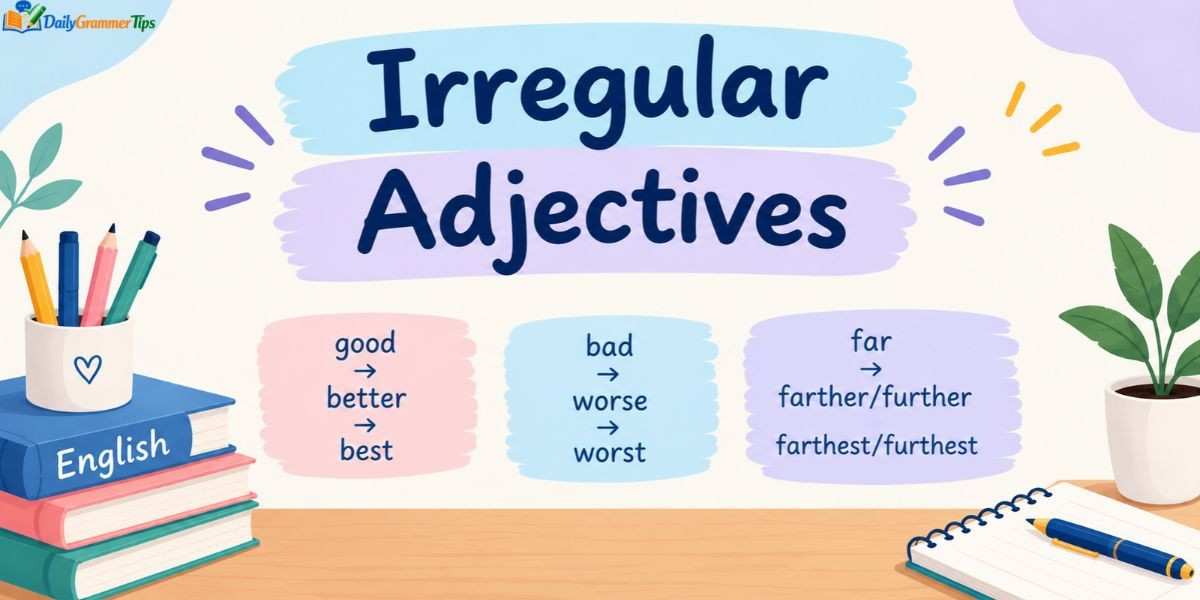
Good, bad, and far have special forms. Good becomes better. Bad becomes worse. Far becomes farther or further.
“This phone is better than my old one.” “The weather is worse today.” “The beach is farther than I thought.”
Frequently Asked Questions
What is a comparison adjective?
A comparison adjective is an adjective that compares two things. Most people call it a comparative adjective. It changes form with -er or more, as in taller or more helpful.
What is a comparative example?
A comparative example is a sentence that uses a comparative form to compare two items. “This road is wider than that one” is a clear case. Here, wider is the comparative, and than introduces the second item. Another example is “The test was more difficult than the quiz.”
What are the rules for comparative adjectives?
Short adjectives add -er. Adjectives ending in e add r. Adjectives with one vowel and one consonant double the last letter. Adjectives ending in a consonant plus y change y to i. Longer adjectives use more. Irregular ones like good and bad change completely. Learn these rules, and you can form comparative adjectives with ease.
What are examples of comparative adjectives?
Common examples include taller, faster, smaller, bigger, happier, easier, more important, more confident, better, and worse. Each one compares two items. For instance: “Her idea is better than mine.”
What is a comparative adjective in English?
A comparative adjective in English is a form that compares two nouns. Most comparative adjectives end in -er or follow the word more. Irregular comparative adjectives, such as better and worse, need memorizing.
Conclusion
Comparative adjectives give your writing a simple way to show difference. Once you know the pattern, the choice is easy. Count the syllables, check the last letters, and add than before the second item. Short words take -er, longer words take more, and a small group of irregular forms like better and worse must be memorized.
Mistakes like “more taller” or “biger” disappear with steady practice. Write a few comparison sentences each day, and review the five spelling rules often. Soon comparative adjectives will feel natural, and your sentences will sound clearer and more confident.
