

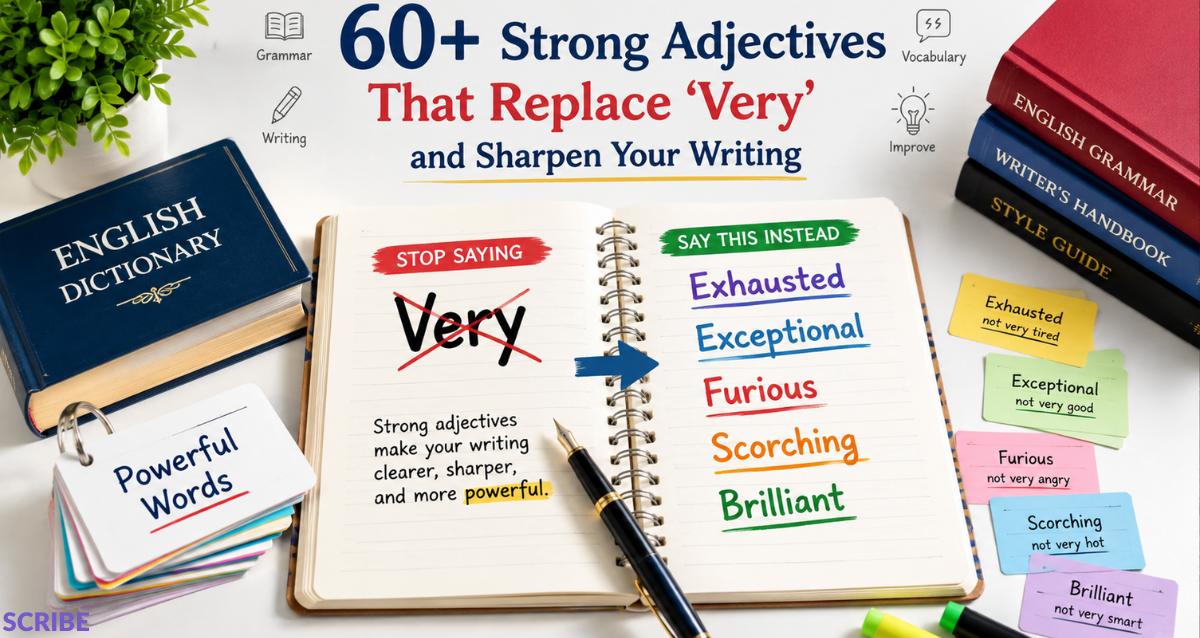
Every writer reaches for “very” without thinking twice about it, but the word rarely says as much as it seems to. Adjectives carry the real weight in a sentence, and picking the right one instead of stacking “very” in front of a weak choice changes how a reader experiences your writing. Whether you’re describing a person, working through a worksheet, or just trying to sound more precise in an email, a stronger set of adjectives does more of the work for you.
This guide breaks that idea down into something you can actually use. You’ll find adjectives sorted by type, grouped into practical lists, shown inside real example sentences, and paired with a handful of positive options worth adding to your everyday vocabulary. By the end, swapping out “very” for something sharper should feel less like a rule you’re following and more like a habit you’ve already built.
Why “Very” Doesn’t Pull Its Weight
“Very” is an intensifier, one of those small adverbs of degree that exist to boost the word next to it. The problem is that it boosts everything the same amount. “Very good,” “very bad,” and “very interesting” all lean on the identical modifier, so the reader has to guess how strong you actually mean it. Strong adjectives remove that guesswork, because the right adjective already carries its own intensity built in.
Relying on “very” instead of sharper adjectives tends to cause a few specific problems in your writing:
- It’s vague. “Very good” could describe a decent meal or a life-changing one. A single sharper adjective narrows that gap.
- It adds bulk. Two words doing the job of one adjective is the definition of wordiness, and cutting it usually tightens the sentence without losing meaning.
- It fades into the background. Readers skim past “very” because they’ve seen it a thousand times. A fresh adjective actually gets noticed.
- It reads as casual. In professional writing, leaning on strong adjectives instead of stacked modifiers signals that you’ve thought about your word choice.
- It’s forgettable. Vivid adjectives create a picture in the reader’s head; “very” mostly just sits there.
None of this means “very” is wrong. It means that when you’re revising, it’s worth asking whether a stronger adjective would say the same thing better than “very” plus a weak one. That habit, more than any list of adjectives you memorize, is what actually builds vocabulary over time. Comparative adjectives and superlative adjectives run into the same trap: “more very good” doesn’t exist as a phrase, which is a small reminder that “very” was never built to stack the way real adjectives can.
Read More: What Is A1, A2, B1, B2, C1, C2 Level in English? (CEFR Explained)
Strong Adjectives by Category
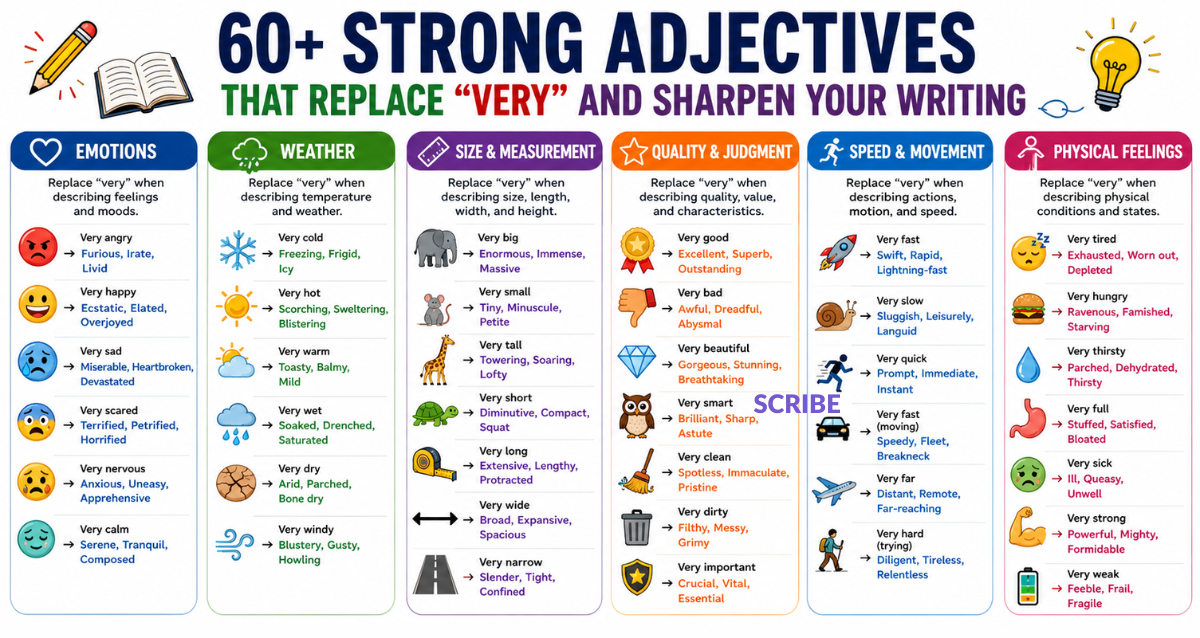
Here’s a working set of powerful adjectives, grouped so you can find the right one quickly. Think of this as your own English adjectives list for revision day, not something to memorize in one sitting. Some of these adjectives will feel familiar right away, while others might be new adjectives you haven’t reached for before, and that’s exactly the point of expanding this kind of list.
Describing How the Body Feels
These physical state adjectives cover the everyday sensations people describe most often, so they’re worth learning first.
- Swap ‘very tired’ for exhausted, worn out, depleted, or fatigued
- Swap ‘very hungry’ for ravenous, famished, or starving
- Swap ‘very thirsty’ for parched or dehydrated
- Swap ‘very full’ for stuffed, satisfied, or bloated
- Swap ‘very sick’ for ill, queasy, or unwell
- Swap ‘very healthy’ for robust, vigorous, or thriving
- Swap ‘very weak’ for feeble, frail, or fragile
- Swap ‘very strong’ for powerful, mighty, or formidable
Describing Weather and Temperature
Temperature vocabulary is one of the easiest places to practice adjective replacement, because most readers already have a strong sense memory for these words.
- Swap ‘very cold’ for freezing, frigid, icy, or bitter
- Swap ‘very hot’ for scorching, sweltering, or blistering
- Swap ‘very warm’ for toasty or balmy
- Swap ‘very wet’ for soaked, drenched, or saturated
- Swap ‘very dry’ for arid, parched, or bone dry
Describing Emotions and Moods
This is where emotional vocabulary really pays off, because the connotation of each word matters as much as its intensity.
- Swap ‘very angry’ for furious, irate, or livid
- Swap ‘very happy’ for ecstatic, elated, or overjoyed
- Swap ‘very sad’ for miserable, heartbroken, or devastated
- Swap ‘very scared’ for terrified, petrified, or horrified
- Swap ‘very excited’ for thrilled, exhilarated, or animated
- Swap ‘very nervous’ for anxious, apprehensive, or uneasy
- Swap ‘very calm’ for serene, tranquil, or composed
- Swap ‘very worried’ for troubled, distressed, or concerned
Describing Size and Measurement
Size descriptors are some of the most overused targets for “very,” largely because “big” and “small” get repeated so often in casual speech. Swapping in more specific adjectives here does more to sharpen an image than almost any other category.
- Swap ‘very big’ for enormous, immense, massive, or colossal
- Swap ‘very small’ for tiny, minuscule, or petite
- Swap ‘very tall’ for towering or soaring
- Swap ‘very short’ for compact or diminutive
- Swap ‘very long’ for extensive or drawn out
- Swap ‘very wide’ for broad or expansive
- Swap ‘very narrow’ for slender or confined
Describing Quality and Judgment
Quality descriptors are the group most writers reach for first, since “very good” and “very bad” show up constantly in everyday sentences. Once these adjectives become second nature, the rest of your writing tends to improve alongside them.
- Swap ‘very good’ for excellent, superb, outstanding, or exceptional
- Swap ‘very bad’ for awful, dreadful, or abysmal
- Swap ‘very beautiful’ for gorgeous, stunning, or breathtaking
- Swap ‘very ugly’ for hideous or unsightly
- Swap ‘very smart’ for brilliant, sharp, or astute
- Swap ‘very clean’ for spotless or immaculate
- Swap ‘very dirty’ for filthy or grimy
Describing Speed and Sound
Speed vocabulary and sound-related adjectives round out the list and are especially useful for anyone doing narrative or descriptive writing, where the right adjectives can make a scene feel faster or louder without adding a single extra sentence.
- Swap ‘very fast’ for rapid, swift, or brisk
- Swap ‘very slow’ for sluggish or unhurried
- Swap ‘very loud’ for deafening or thunderous
- Swap ‘very quiet’ for silent, hushed, or muted
Before and After: What This Looks Like in a Real Sentence

Seeing strong adjectives in context makes the difference easier to feel than any list can. Before and after writing like this is one of the fastest ways to internalize which adjectives actually belong in a sentence.
Weak draft: “I was very tired after the very long shift, and the office was very hot the whole time.”
Revised with stronger adjectives: “I was exhausted after the drawn-out shift, and the office stayed sweltering the whole time.”
Weak draft: “The coffee shop was very clean and the staff were very fast, so the whole visit felt very good.”
Revised with stronger adjectives: “The coffee shop was spotless and the staff were brisk, so the whole visit felt exceptional.”
Notice that the revised sentences aren’t longer or more complicated. They’re actually shorter, because one precise adjective replaces two vaguer words, and reading both versions side by side makes the value of stronger adjectives obvious immediately.
How to Actually Build This Habit
A list of adjectives only helps if you use it. These adjectives won’t stick just because you read them once, so treat the list as a starting point rather than a finished skill. These are practical ways to turn a one-time read into lasting vocabulary building:
- Track your “very” habit for a week. Every time you write or say it, jot down the sentence, then rewrite it with a stronger adjective. This is one of the fastest routes to better word choice.
- Read with a highlighter mindset. When a writer you admire skips “very” in favor of a specific adjective, notice which one they picked and why it fits.
- Pay attention to context clues. Not every synonym fits every situation. “Ravenous” suits genuine hunger, but it would be an odd choice for someone who’s only slightly peckish, so match the word to the actual intensity.
- Revise in a second pass. Write your first draft the way you normally would, then search for “very” and decide, instance by instance, whether a stronger word works better.
- Build your own flashcards. Put “very + adjective” on one side and two or three replacements on the other, then quiz yourself during downtime. Vocabulary flashcards built around adjectives work especially well for ESL vocabulary and general English vocabulary growth, since you’re practicing real adjectives in the exact pairs you’ll actually use.
- Learn the connotation, not just the definition. A thesaurus will hand you ten synonyms for “angry,” but “irate” reads more formal than “furious,” and knowing that difference is what separates a writer who picks the right adjectives from someone just swapping words at random.
These habits matter more for IELTS vocabulary and TOEFL vocabulary prep than most students expect, since examiners specifically reward precise adjectives and varied word choice over repeated generic modifiers.
When “Very” Still Earns Its Place
None of this means banning “very” outright, and it definitely doesn’t mean forcing unusual adjectives into every sentence just to avoid it. There are moments where “very” is the right call and stronger adjectives would actually feel out of place:
- In dialogue. People say “very” constantly in real conversation, so cutting it from spoken lines can make characters sound stiff.
- When you want repetition for effect. “This is very, very serious” uses the repeated word on purpose, and no single adjective replaces that rhythm.
- When no strong single-word option exists. “Very unique” is debated among grammar purists, and phrases like “very soon” don’t have a clean one-word substitute.
- Inside fixed expressions. “Very well,” “very much,” and “very own” are idioms, and rewriting them would just sound unnatural.
The real goal isn’t eliminating “very.” It’s noticeable when you’re reaching for it out of habit instead of choosing your adjectives on purpose.
Practice Exercise
Rewrite each sentence below using stronger adjectives in place of “very.” Treat this as a short set of practice exercises rather than a test; the goal is just to get comfortable reaching for sharper adjectives on your own.
- The lecture was very boring and the room was very cold.
- My neighbor is very smart and always seems very calm.
- I’m very hungry and this bakery looks very clean.
- The exam was very difficult, but the instructor was very helpful.
- It was very hot outside, and by the end of the hike I was very tired.
Sample answers:
- The lecture was tedious and the room was freezing.
- My neighbor is brilliant and always seems composed.
- I’m ravenous and this bakery looks spotless.
- The exam was grueling, but the instructor was supportive.
- It was sweltering outside, and by the end of the hike I was exhausted.
The Takeaway
Strong adjectives don’t require a bigger vocabulary than you already have, just a habit of pausing on “very” long enough to ask what you actually mean. Keep this list of adjectives nearby, revise a few old drafts with it, and reaching for the right adjectives will start to feel automatic instead of forced. Give it a few weeks, and you’ll notice yourself picking sharper adjectives without even stopping to check the list.
Adjectives Types
English groups adjectives into several types based on the job they do inside a sentence. Descriptive adjectives paint a picture, quantitative adjectives tell you how much or how many, demonstrative adjectives point to something specific, and possessive adjectives show ownership. Comparative adjectives and superlative adjectives round out the list, letting you stack one thing against another or single out the extreme case in a group. Knowing these categories matters because each type behaves differently in a sentence, and mixing them up is one of the most common mistakes English learners make early on.
Once you can name the type, choosing the right adjectives gets a lot easier, since you’re no longer just guessing at word choice. A learner working through ESL vocabulary drills, for example, benefits from separating “tall” (descriptive) from “taller” (comparative) rather than treating them as interchangeable. This kind of structure also shows up constantly in IELTS vocabulary and TOEFL vocabulary sections, where examiners specifically test whether a writer understands how each type functions, not just whether they recognize the words themselves.
List of Adjectives
A solid list of adjectives works best when it’s organized rather than random, which is why most useful references group words by category: emotions, size, quality, speed, and so on. Building your own English adjectives list this way turns a wall of vocabulary into something you can actually scan and use under pressure, whether you’re finishing an essay or answering a speaking prompt. Strong adjectives and powerful adjectives tend to cluster naturally once you sort them, since near-synonyms like “furious” and “irate” sit close together but carry slightly different weight.
Keeping your list active, rather than filing it away and forgetting it, is what separates vocabulary building from just reading a page once. Many learners turn their list into vocabulary flashcards, testing themselves on word usage examples until the swap from a generic word to a sharper one becomes automatic. Reviewing the list alongside real sentences, not just isolated words, also gives you the context clues you need to pick the adjective that actually fits the situation you’re describing.
Adjectives to Describe a Person
Describing a person well usually means going past generic words like “nice” or “good” and reaching for adjectives that capture something specific about how they act or come across. Words like compassionate, resourceful, meticulous, or charismatic tell a reader far more than a vague compliment ever could, because each one points to a distinct trait rather than a general impression. This is one of the most practical areas of descriptive language, since it shows up constantly in essays, character sketches, reference letters, and everyday conversation.
Choosing adjectives for a person also depends heavily on connotation, since two words can describe the same trait while landing very differently. “Stubborn” and “determined” both describe someone who doesn’t give up easily, but one reads as a flaw and the other as a strength. Writers working on creative writing tips for character development lean on this distinction constantly, using precise adjectives to shape how a reader feels about a character rather than just what that character does.
Adjectives Worksheets
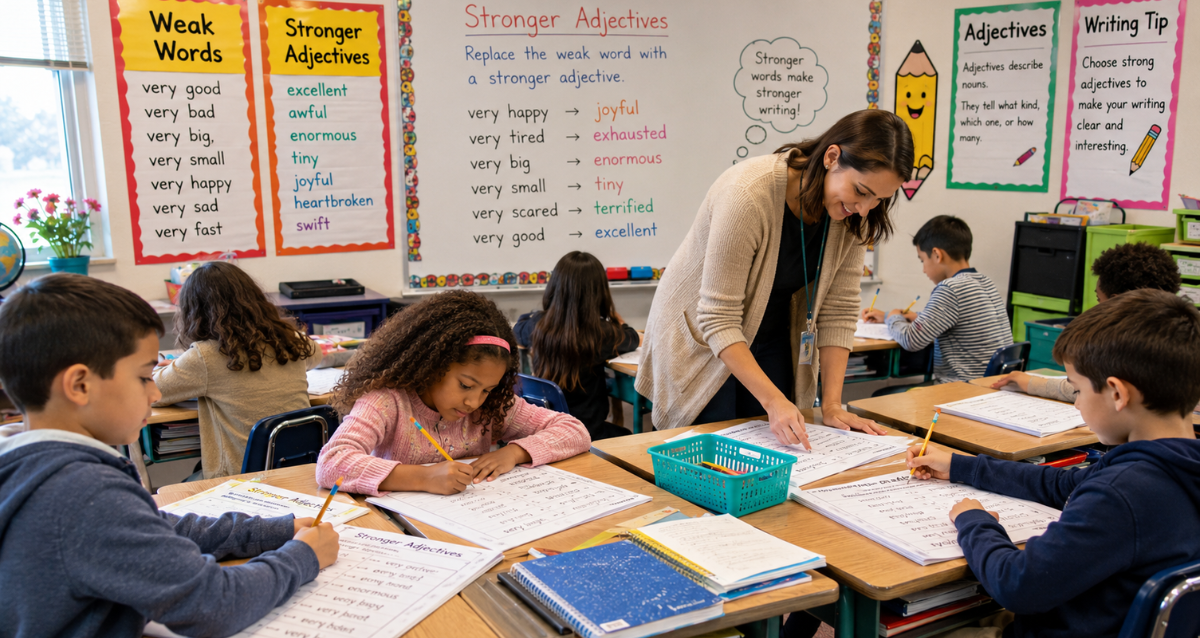
Worksheets remain one of the most effective tools for practicing adjectives, especially for English learners who need repeated, structured exposure rather than a single explanation. A good worksheet usually mixes practice exercises: fill-in-the-blank sentences, categorization tasks, and short writing prompts that force the learner to apply an adjective rather than just recognize it. This active use is what actually builds vocabulary, since passively reading a definition rarely transfers into confident, natural usage.
Teachers and self-learners alike benefit from worksheets that pair adjectives with before and after writing exercises, since seeing a weak sentence next to its improved version makes the value of a stronger word choice immediately obvious. The best worksheets also include answer keys with brief explanations, not just correct answers, so the learner understands why one adjective fits better than another in a given context rather than memorizing the answer without understanding it.
Adjectives Examples
Examples do more work than definitions when it comes to actually learning adjectives, since a single well-chosen sentence shows both meaning and correct placement at once. “The exhausted runner collapsed at the finish line” teaches more about the word “exhausted” than a dictionary entry ever could, because it shows the adjective functioning inside real, natural writing. This is why most vocabulary resources lean so heavily on examples rather than isolated word lists.
Good examples also demonstrate range, showing how the same adjective shifts slightly depending on what it’s paired with. “A scorching afternoon” and “a scorching review” both use the same word, but the connotation changes completely based on context. Seeing adjectives used this way across different situations helps learners avoid the common trap of picking a technically correct word that still sounds unnatural in the sentence they’re actually writing.
Adjectives Positive
Positive adjectives cover the words we reach for when praising, encouraging, or simply describing something favorably, and English offers far more range here than most people use day to day. Beyond generic words like “good” or “nice,” options like outstanding, admirable, delightful, and inspiring let a writer express approval with much more precision. This matters in professional writing especially, where vague praise can come across as insincere while specific, well-chosen adjectives sound genuine and considered.
Building a working set of positive adjectives also helps with everyday communication, from writing a thank-you note to leaving a thoughtful review. Many learners specifically ask why avoid using very in writing, and the answer connects directly here: “very good” is a positive adjective stripped of its personality, while “outstanding” or “commendable” carries real weight on its own. Expanding this part of your vocabulary tends to make both spoken and written communication feel warmer and more sincere.
Adjectives Examples Sentences
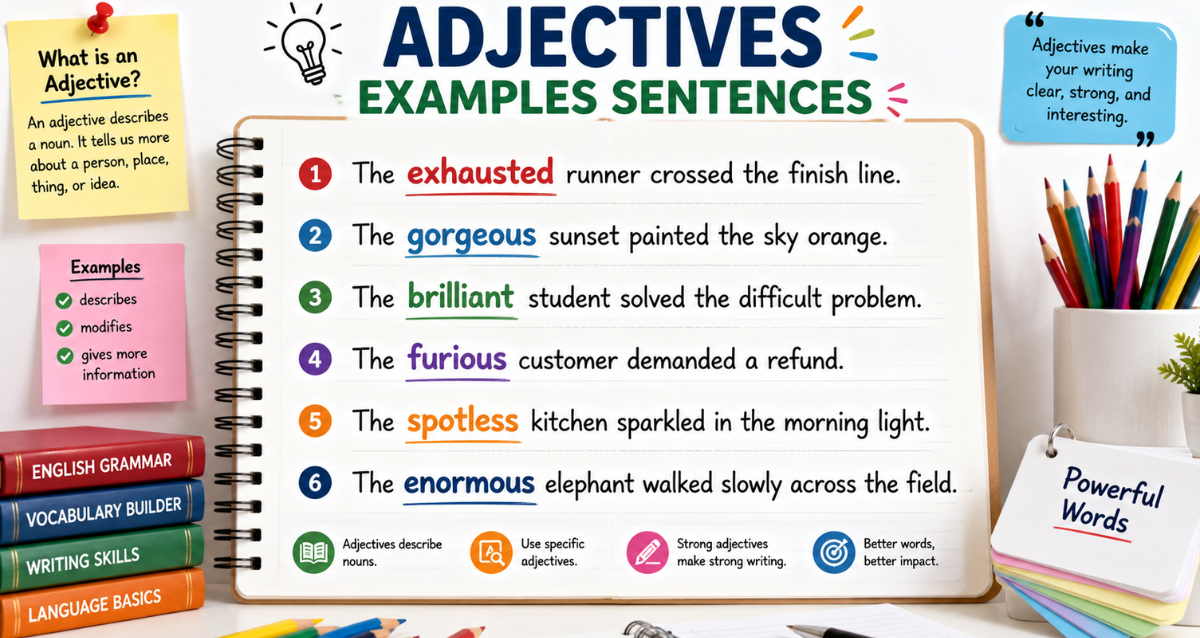
Seeing adjectives inside full sentences, rather than as a standalone list, is often the fastest way to understand how they actually behave in English. “The meticulous editor caught every mistake” and “the editor was meticulous about every detail” both use the same word but in different grammatical positions, which matters once a learner starts building original sentences instead of copying examples. Practicing with full example sentences also reinforces part of speech awareness, helping a learner spot the difference between an adjective, an adverb, and a noun used descriptively.
Example sentences also make it easier to notice how adjectives interact with modifiers and adverbs of degree. Comparing “the food was good” with “the food was surprisingly good” shows how a single added word can shift emphasis without changing the core adjective. This kind of sentence-level practice is exactly what closes the gap between recognizing a word on a page and using it naturally and correctly in conversation or writing.
10 Examples of Adjectives
A short, focused list of ten adjectives is often the easiest starting point for anyone just beginning to expand their vocabulary, since it’s small enough to memorize in a single sitting. A practical set might include brilliant, exhausted, enormous, furious, spotless, sluggish, gorgeous, anxious, ancient, and generous, chosen deliberately to span different categories rather than clustering around a single theme. Covering emotion, size, quality, and physical state in one short list gives a learner a taste of how varied English adjectives really are.
Working through a set this size is also a good entry point for answering practical questions many learners have, like how to stop using very or what words to use instead of very in a specific sentence. The difference between exhausted and very tired becomes a useful teaching example here, since “exhausted” replaces the vaguer phrase with a single precise word. Starting small like this, then gradually expanding the list, tends to work better than trying to memorize fifty words all at once.
Frequently Asked Questions
What are 100 adjectives?
A set of 100 adjectives is simply a large, varied word bank covering categories like emotions, size, quality, and appearance, useful for building richer, more precise writing.
What are 50 adjectives?
Fifty adjectives is a smaller, focused list, often grouped by theme so you can quickly find a stronger word for feelings, sizes, or qualities without hunting through a huge list.
What are 10 examples of an adjective?
Brilliant, exhausted, enormous, furious, spotless, sluggish, gorgeous, anxious, ancient, and generous are ten solid examples, each describing a different quality or state.
What are some powerful adjectives to use in writing?
Words like exceptional, devastating, magnificent, relentless, and captivating add real impact, since each one carries a clear, specific meaning instead of a vague, generic one.
What is the Gen Z word for luxury?
“Boujee” (also spelled bougie) is the term Gen Z commonly uses to describe something upscale or luxurious.
Conclusion
Every writer reaches for “very” without thinking twice about it, but the word rarely says as much as it seems to. Adjectives carry the real weight in a sentence, and picking the right one instead of stacking “very” in front of a weak choice changes how a reader experiences your writing. Whether you’re describing a person, working through a worksheet, or just trying to sound more precise in an email, a stronger set of adjectives does more of the work for you.
This guide breaks that idea down into something you can actually use. You’ll find adjectives sorted by type, grouped into practical lists, shown inside real example sentences, and paired with a handful of positive options worth adding to your everyday vocabulary. By the end, swapping out “very” for something sharper should feel less like a rule you’re following and more like a habit you’ve already built.
