


Learning a new language can feel confusing at first, especially when you keep hearing letters and numbers like A1 or C2. What Is A1, A2, B1, B2, C1, C2 , these are the official levels used to describe how well someone speaks, reads, writes, and understands English. Teachers, universities, and employers all rely on this scale to check your skills. This system comes from the CEFR, a framework built to keep language testing fair and consistent across the world.
Many learners ask the same question when they start studying: What Is A1, A2, B1, B2, C1, C2, and why does it matter so much? The answer is simple, these levels turn something vague, like “I know some English,” into something clear and measurable. A recruiter or a university can look at your level and instantly understand your ability.
Whether you’re prepping for IELTS, applying to a university, or just want to track your progress, this guide covers everything. We’ll walk through each CEFR English Levels stage one by one, in plain language anyone can follow. No confusing jargon, no wasted time , just the facts you actually need. Let’s start with the basics and work our way up to full fluency, step by step.
What Is CEFR?
The Common European Framework of Reference for Languages, known as CEFR, is the standard system used worldwide to measure English proficiency levels. It was created by the Council of Europe to give every school, exam board, and employer a shared way to talk about language skills. Instead of vague labels like “good” or “fluent,” CEFR gives you a clear, testable level. This is why the CEFR framework is trusted by so many major exams and institutions.
- Language schools use it to place students in the right class
- Universities use it to set English entry requirements
- IELTS and TOEFL link their scores directly to CEFR bands
- Employers use it to check a candidate’s real English ability
- Governments use it for visa and immigration language tests
- Online course platforms use it to build structured lesson plans
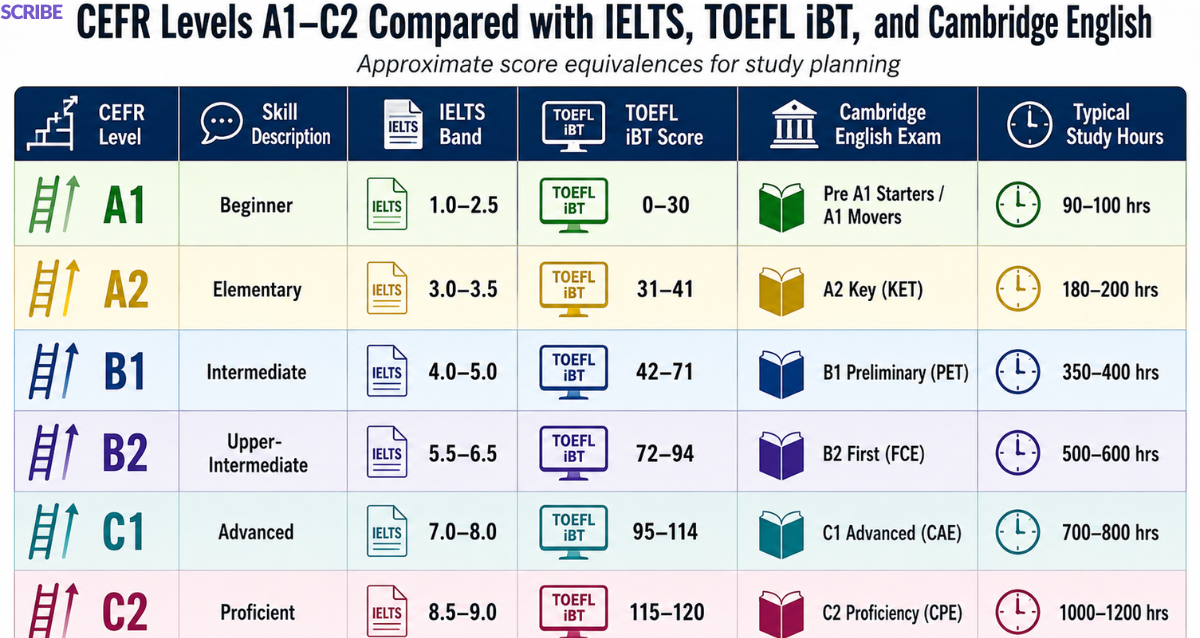
Complete CEFR Level Comparison: IELTS, TOEFL, Cambridge & Study Hours
Based on official Council of Europe, ETS, and Cambridge guidelines.
| CEFR Level | Description | IELTS | TOEFL iBT | TOEFL 2026 | Cambridge Exam | Study Hours* |
| A1 | Beginner | — | 0–12 | 1.0–1.5 | — | 90–100 |
| A2 | Elementary | 3.0–3.5 | 13–31 | 2.0–2.5 | KET | 180–200 |
| B1 | Intermediate | 4.0–5.0 | 32–71 | 3.0–3.5 | PET | 350–400 |
| B2 | Upper-Intermediate | 5.5–6.5 | 72–94 | 4.0–4.5 | FCE (First) | 500–600 |
| C1 | Advanced | 7.0–8.0 | 95–113 | 5.0–5.5 | CAE (Advanced) | 700–800 |
| C2 | Proficient | 8.5–9.0 | 114–120 | 6.0 | CPE (Proficiency) | 1000–1200 |
Read More: Turkish and Arabic: Clearing Up a Common Confusion
CEFR English Levels Overview
| Level | Description |
| A1 | Beginner |
| A2 | Elementary |
| B1 | Intermediate |
| B2 | Upper Intermediate |
| C1 | Advanced |
| C2 | Proficient (Near Native) |
A1 Level (Beginner)
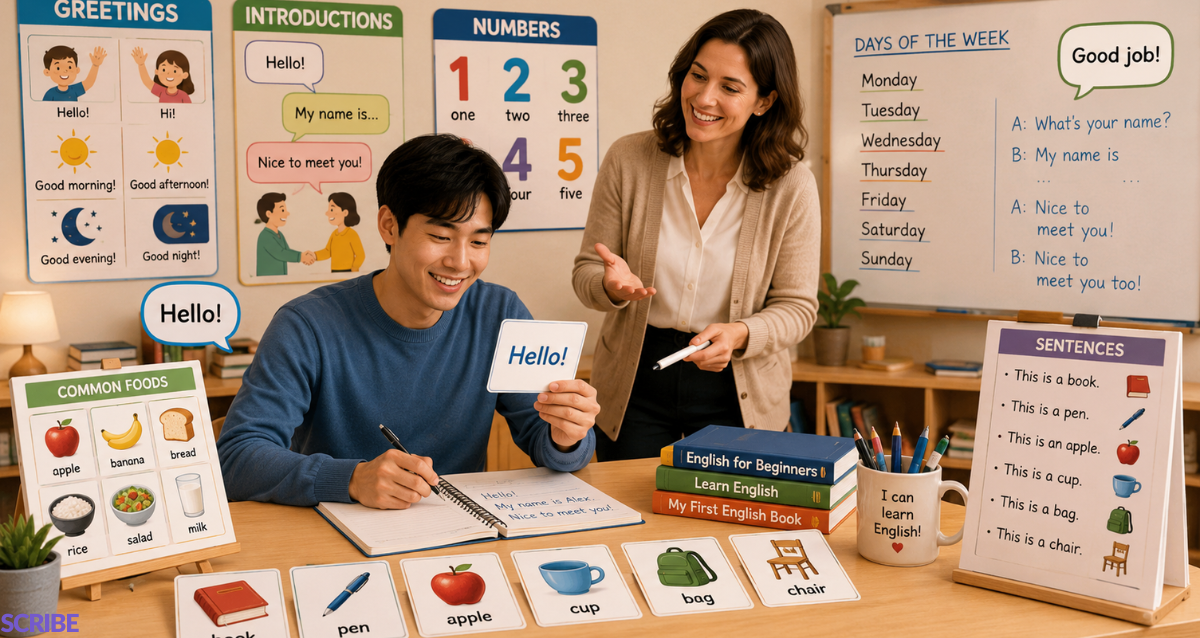
A1 is the true starting point on the CEFR scale, built for someone who is brand new to English. At this stage, you’re learning the basics , greetings, numbers, and simple daily words. Sentences are short and direct, with no complicated grammar involved. Most learners reach solid beginner English skills after about 90 to 100 hours of guided study.
- Say hello and introduce yourself in simple words
- Ask and answer very basic personal questions
- Understand familiar words on signs and menus
- Use short, simple sentences without much grammar
- Recognize numbers, days, and common objects
- Fill out a basic form with your name and details
Example: “My name is Ali. I am from Pakistan. I like tea.” These short lines show exactly how an A1 learner speaks , plain, direct, and easy to follow. This stage builds the foundation for every English learning level that follows, so it’s worth mastering before moving forward.
A2 Level (Elementary)
A2 is often called the elementary English stage, where learners move past single words into short, connected conversations. You can now describe your daily life, your family, and simple routines without much struggle. This level usually takes around 180 to 200 total hours of guided study to reach. It marks real progress on the wider English fluency levels scale.
- Talking about your daily routine and habits
- Describing your family, job, or hometown briefly
- Asking simple questions about prices and directions
- Understanding short, clear announcements or messages
- Writing a short note or simple email to a friend
- Handling basic shopping and travel conversations
Example: “I work in an office. I usually wake up at 7 a.m. I like watching movies.” Notice how these sentences link ideas together, unlike the very basic A1 stage. This is a key sign of steady language proficiency growth as you move toward intermediate English.
B1 Level (Intermediate)
B1 sits right in the middle of the CEFR level chart and is often seen as the point where you become an independent English user. You can now hold real conversations, share opinions, and understand the main point of most everyday talk. Reaching B1 typically takes 350 to 400 hours of guided study in total. This is a major milestone in intermediate English learning.
At this level, you can generally:
- Have basic conversations with native English speakers
- Talk about past experiences and future plans
- Understand the main idea of TV shows or podcasts
- Write short paragraphs about familiar topics
- Handle most situations while traveling abroad
- Express simple opinions and give short reasons
Example: “I started learning English two years ago. I want to travel to Canada next year.” B1 is often the minimum score airlines, colleges, and jobs expect for basic communication. It’s a strong benchmark within the broader language learning framework.
B2 Level (Upper Intermediate)

B2, known as upper intermediate English, is where your confidence really starts to show. You can join detailed discussions, understand most media, and explain complex ideas without too much hesitation. This stage typically requires 500 to 600 hours of guided study to reach comfortably. Many universities set B2 as the minimum bar for admission.
Common abilities at this stage include:
- Joining detailed discussions on familiar and unfamiliar topics
- Understanding most TV shows, articles, and podcasts
- Explaining the advantages and disadvantages of an idea
- Writing clear, detailed text on a range of subjects
- Interacting smoothly with native speakers in most settings
- Expressing opinions with supporting reasons and examples
Example: “Working remotely has both advantages and disadvantages for employees.” B2 English speakers rarely feel lost in conversation, which is why so many IELTS test-takers aim for this level. It’s a strong, practical stage of English competency levels.
C1 Level (Advanced)
C1 marks entry into advanced English, where learners handle academic and professional settings with real ease. You can understand long, complex texts and pick up on subtle meaning and tone. Reaching this stage usually takes about 700 to 800 hours of guided study. At C1, communication problems become rare rather than common.
Typical strengths at the C1 stage include:
- Understanding long, complex academic or technical texts
- Expressing ideas fluently without obviously searching for words
- Using a wide, flexible range of advanced vocabulary
- Taking part confidently in professional meetings and debates
- Writing clear, well-structured essays and reports
- Picking up on implied meaning, tone, and subtle humor
Example: “Although the proposal has clear benefits, its long-term financial impact remains uncertain.” C1 aligns with an IELTS score of roughly 7.0 to 8.0, making it a strong target for postgraduate study. This level reflects true academic English proficiency.
C2 Level (Proficient)
C2 is the highest point on the CEFR scale, representing near-native command of English. At this stage, you understand almost everything you read or hear, even highly specialized material. Learners generally need 1,000 to 1,200 total hours of guided study to reach this level. Very few non-native speakers push all the way to full proficient English.
Skills typical of a C2 speaker include:
- Understanding complex academic and literary texts with ease
- Speaking fluently, naturally, and spontaneously in any setting
- Using subtle nuances in tone, humor, and word choice
- Summarizing information smoothly from multiple sources
- Writing precisely, adjusting style to fit the situation
- Communicating with the ease of an educated native speaker
Example: “The committee’s decision, while controversial, reflects a broader shift in institutional priorities.” C2 English users can work, study, and socialize entirely in English without friction. This is the final stage of the full CEFR English Levels journey.
CEFR Levels Summary
| Level | Skill Level | Description |
| A1 | Beginner | Basic words and phrases |
| A2 | Elementary | Simple conversations |
| B1 | Intermediate | Independent communication |
| B2 | Upper Intermediate | Confident conversations |
| C1 | Advanced | Academic and professional English |
| C2 | Proficient | Near-native fluency |
Why English Levels Are Important
Knowing your exact level on the CEFR scale isn’t just a formality , it shapes real decisions about your education and career. Here’s why understanding CEFR English Levels matters so much:
- It helps you choose learning materials that actually match your ability
- It prepares you properly for exams like IELTS and TOEFL
- It lets universities set clear, fair English entry requirements
- It helps employers judge real workplace communication skills
- It gives you a way to track progress over time
- It helps you set realistic, achievable learning goals
- It supports visa and immigration applications in many countries
- It builds your confidence once you see measurable growth
- It helps teachers place you in the right class or course
- It creates a shared, international standard everyone understands
How to Improve Your English Level
Improving your English proficiency levels takes steady, regular effort across all four core skills: reading, writing, listening, and speaking. Try not to focus on just one skill , real progress on the CEFR scale comes from balanced practice. Reading articles, watching English shows, and speaking with others all build different parts of your ability. Small, consistent habits beat occasional long study sessions every time.
Tools can also speed up your progress in smart, practical ways. A free grammar checker helps you catch mistakes and learn from them instantly, while studying commonly confused words prevents repeated errors. Learning natural English idioms makes your speech sound more fluent and native-like as you climb the CEFR level chart. With daily exposure and honest practice, moving up a level becomes a realistic, achievable goal.
Frequently Asked Questions
What are language levels A1, A2, B1, B2, C1, C2?
They are the six stages of the CEFR scale, ranging from complete beginner (A1) to near-native fluency (C2).
Is B2 fluent?
B2 isn’t full fluency, but it’s confident, independent English good enough for most work and study situations.
Is C1 level fluent?
Yes, C1 is generally considered fluent, allowing smooth academic and professional communication with rare misunderstandings.
What is the meaning of A1, A2, B1, B2, C1, C2?
They represent increasing English proficiency levels, from basic phrases at A1 to expert, near-native skills at C2.
Conclusion
Understanding What Is A1, A2, B1, B2, C1, C2 gives you a clear roadmap for your entire English learning journey. Instead of guessing where you stand, you get a proven, internationally recognized scale backed by the CEFR framework. From your first simple sentences at A1 to confident, near-native fluency at C2, every stage builds on the last. This clarity helps you study smarter, not just harder.
Whatever your current level, steady practice will move you forward on the CEFR English Levels scale. Set clear goals, use the right tools, and track your progress honestly along the way. Over time, those small daily efforts add up to real, lasting fluency. Keep going ,every level you reach opens new doors in study, work, and everyday life.
