


Many people pause mid sentence and wonder if they should type adress or address. This tiny doubt shows up in emails, job applications, shipping forms, and even school essays. The good news is that the confusion around adress or address has one clear and permanent answer, and this guide explains it in full detail.
You will learn the correct spelling, the real meaning of the word, its history, common mistakes, pronunciation, and practical examples. By the end, the adress or address question will never bother you again.
Adress or Address: Quick Answer
The short answer to adress or address is simple. Address is correct. Adress is not a real word in any dictionary. There is no debate, no regional exception, and no informal allowance for the single d version.
Adress
Adress appears often in casual typing, but it carries no linguistic validity. It skips one of the two required d letters and breaks the word’s structure. No dictionary, whether British, American, Canadian, or Australian, lists adress as an accepted term.
Address
Address stands as the only correct spelling. It carries two d letters and two s letters, and this pattern never changes across formal writing, casual writing, or regional dialects. The word also works as both a noun and a verb, which adds to its everyday usefulness.
Meaning of “Address”
Address holds several meanings depending on its role in a sentence. As a noun, it points to a physical location, a formal speech, or a digital identifier such as an email or IP address. As a verb, it means to label something, to speak formally, or to handle a problem.
This flexibility explains why address appears constantly across written and spoken English. People rarely stop and think about adress or address once they understand the word’s range of uses.
Address Meaning
Looking closer at address meaning, dictionaries generally group it into two core categories. The first category covers location, such as a home address or business address. The second category covers action, such as addressing a crowd or addressing a concern.
Understanding address meaning in both forms helps writers avoid confusing a noun sentence with a verb sentence. Once this distinction feels natural, questions around adress or address usually disappear on their own.
Examples
Real sentences make grammar rules easier to absorb. Here are a few natural examples using address correctly.
- Please update your address before the package ships.
- The principal will address the students during assembly.
- Type your email address carefully to avoid delivery errors.
- The senator delivered a moving address at the memorial event.
- We must address this budget issue before next quarter.
Adress or Address Example
Looking at a direct adress or address example helps cement the rule. Imagine two versions of the same sentence. One reads “My adress is 12 Baker Street.” The other reads “My address is 12 Baker Street.” Only the second sentence is grammatically acceptable in any writing context.
This kind of side by side adress or address example is often used in classrooms and writing workshops because it shows the error clearly without extra explanation.
The Origin of Address
The word traces back to the late fourteenth century through Old French adrecier, which meant to straighten or guide. That term came from Latin, combining the prefix ad, meaning toward, with directus, meaning straight or directed.
By the sixteenth century, English speakers used address to describe directing speech at someone. Its meaning as a physical location came later, growing alongside postal systems across Europe during the following centuries.
The doubled d in the modern spelling reflects this Latin French ancestry, where the prefix ad attaches directly onto the root word. This same pattern appears in related English words like addition, adhere, and admit. Knowing this history settles the adress or address debate for good, since the double d was never optional.
Why “Adress” Is Incorrect in English
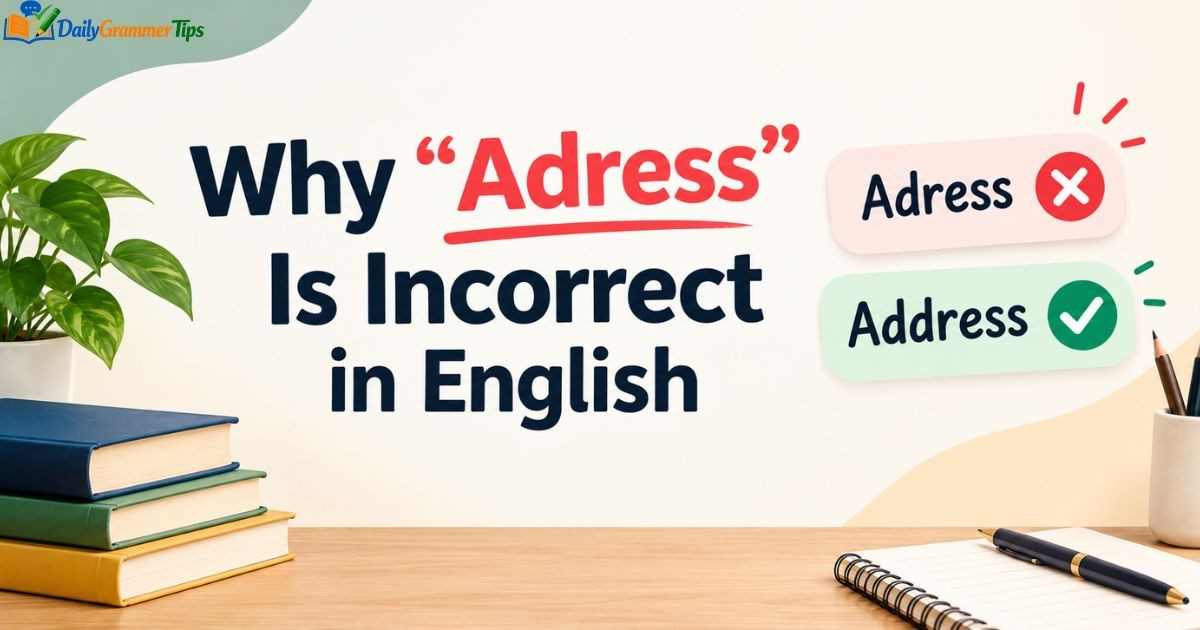
Adress fails for two separate reasons. First, it does not exist in any recognized dictionary. Second, it breaks the etymological logic that built the word in the first place.
The prefix ad, meaning toward, combines with dress, from Old French drecier, meaning to arrange. Together they form ad plus dress, which becomes address. Removing one d damages this structure and disconnects the word from its origin.
English spelling patterns also support the double consonant here. The first syllable carries a short vowel sound, and doubled consonants commonly signal that short sound in English. A single d would hint at a different pronunciation entirely.
No major authority, including Merriam Webster, the Oxford English Dictionary, or the Cambridge Dictionary, recognizes adress as a variant, regional form, or historical spelling. This is exactly why the adress or address question has only one honest answer.
British English vs American English Spelling (Address or Adress)
A frequent question about adress or address involves regional spelling differences. Some assume British English might favor one version while American English favors another. That assumption does not hold here.
Unlike word pairs such as colour and color, address stays identical across every major English speaking region. There is no split, no local preference, and no historical divergence.
Comparison Table
| Region | Correct Spelling | Is Adress Accepted? |
| American English | address | No |
| British English | address | No |
| Australian English | address | No |
| Canadian English | address | No |
| Irish English | address | No |
Does the Spelling Change by Region?
No region changes this spelling. Whether the audience sits in Chicago, Manchester, Melbourne, or Toronto, address remains the expected and only correct form. The adress or address debate simply does not apply once you consider regional spelling.
Learn more…………Himself or Hisself: Which One Is Correct and Why It Matters?
Which Spelling Should You Use?
Address wins in every single context. The real value of this section lies in showing how the adress or address answer plays out across different writing environments.
For Business Writing
Professional documents demand accuracy. A misspelling like adress inside a report, proposal, or client email can quietly damage credibility. Anyone still unsure about adress or address in business writing should default to address and run a spell check before sending anything important.
For Academic Writing
Academic readers judge work partly on precision. A spelling slip such as adress in an essay or research paper can distract from otherwise strong arguments. Sticking with address and enabling automatic spell check tools keeps academic writing clean.
For Online Forms
Registration pages, checkout screens, and contact forms rely on address as a universal field label, so the adress or address choice matters at the moment of typing. Getting it right here prevents failed deliveries or login problems.
For Global Audiences
Content aimed at international readers, including marketing copy and product documentation, should always use address. It remains the accepted spelling across every English speaking market without exception.
Adress or Address for Location
When someone searches adress or address for location, they usually want to confirm how to label a home, office, or delivery point correctly. The rule stays consistent here as well. Address is the only acceptable spelling whether the location sits on a shipping label, a business card, or a map application.
Location based writing, including GPS directions and courier instructions, always uses address. This consistency removes any guesswork for delivery services and postal systems worldwide.
Common Mistakes with Adress or Address
Beyond the basic adress or address confusion, several related errors show up frequently in everyday writing.
Dropping One “D”
This remains the single most common mistake behind the adress or address confusion. Writers type adress instead of address, often because the double d feels repetitive during fast typing. Remembering the word as ad plus dress fixes this instantly.
Dropping One “S”
Some writers keep both d letters but drop an s, producing addres. This error is also wrong. The word ends in ess, matching the pattern found in dress, express, and assess.
Mixing Verb and Noun Forms Incorrectly
Address functions as both a noun and a verb without changing form, which is another reason the adress or address debate stays simple once you know the rule. A rare but real error involves inventing a fake noun form like addression. The correct term stays address in nearly every situation.
| Correct | Incorrect |
| Please address the issue. | Please addression the issue. |
| My home address is listed below. | My home addres is listed below. |
| He addressed the crowd calmly. | He adressed the crowd calmly. |
Capitalization Confusion
Address is a common noun, so it should not carry a capital letter mid sentence unless it starts a sentence or appears inside a proper name like the Gettysburg Address. Writing “I need your Address” mid sentence is unnecessary and incorrect style, even though the adress or address spelling itself is not affected.
Adress or Address Pronunciation
Correct adress or address pronunciation can also guide correct spelling. English speakers pronounce the word as uh DRESS, placing stress on the second syllable. Saying it slowly often reveals both d sounds blending together.
Understanding adress or address pronunciation helps auditory learners connect sound to spelling. Since the pronunciation naturally includes both d letters when spoken carefully, practicing the sound out loud can reduce typing mistakes over time.
Some regional accents soften the first syllable, which may explain why writers sometimes drop a letter when typing quickly. Slowing down while speaking the word can reinforce the correct written form.
Address in Everyday Examples
In Emails
“Please share your address so we can process the shipment.” “I would like to address your concerns from yesterday’s call.” Both lines show how the adress or address rule applies naturally inside everyday email writing.
In News Articles
“The governor is expected to address residents this evening.” “Investigators released the address linked to the ongoing case.”
In Business Communication
“Kindly confirm your billing address inside the client dashboard.” “Leadership will address the staffing shortage during Monday’s meeting.”
On Social Media
“Drop your address in the comments for a chance to win.” “Let’s address the obvious issue with yesterday’s product launch.”
In Formal Writing
“The keynote address was delivered by the conference chairperson.” “This report aims to address the compliance gaps found during the audit.”
To Address Something
The phrase to address something refers to handling a problem, topic, or concern directly, and it follows the same adress or address spelling rule as every other use of the word. This verb usage appears constantly in workplace communication, journalism, and everyday conversation.
When someone plans to address something, they intend to face it rather than avoid it. This meaning has nothing to do with location and everything to do with resolving an issue through action or discussion.
Adress or Address Someone

The correct form when referring to speaking directly to a person is address someone, never adress someone, which settles the adress or address someone question quickly. This usage appears in formal speeches, letters, and professional meetings where tone and respect matter.
For example, a speaker might address someone by their proper title during a ceremony. Getting this spelling right signals attention to detail, especially in formal or ceremonial settings.
Address a Situation
To address a situation means stepping in to manage or resolve a problem before it grows worse. Leaders, teachers, and managers frequently use this phrase when describing proactive action.
This usage of address highlights the verb’s problem solving meaning rather than its location based meaning. Both meanings share the same spelling, which keeps the adress or address rule simple despite covering very different ideas.
Difference Between Address and Address Name
Some online forms and shipping platforms include a field labeled address name alongside the field labeled address. These terms connect closely but do not mean the same thing, and understanding the difference between address and address name prevents confusion during checkout or registration.
The address itself refers to the full physical location, including street, city, and postal code. The address name usually refers to a short label a person assigns to that location, such as Home, Office, or Parents House, making it easier to select the right entry later.
Recognizing this difference between address and address name helps users fill out delivery forms accurately, especially when they save multiple locations inside a single account. Even here, the adress or address spelling rule never changes, only the surrounding label does.
Adress or Address: Google Trends & Usage Data
This section covers search trends for adress or address. It shows which spelling people actually search online.
Search Popularity
Search data consistently shows that address ranks among the most searched English words worldwide. Queries like how to spell address, is it adress or address, and correct spelling of address appear regularly across the United States, United Kingdom, India, and Australia.
This steady search volume confirms that while the correct spelling is well established, confusion still affects a large number of writers, particularly non native speakers and fast typists.
Common Search Mistakes
Search engines frequently log several misspelled variants tied to this word.
- adress, missing one d
- addres, missing one s
- adres, missing both a d and an s
- adresss, containing an extra s
All of these variants are incorrect. Search engines automatically correct most of them and display results for address, reinforcing that the adress or address search only ever leads back to one accepted spelling.
Comparison Table: Adress vs Address
| Feature | Adress | Address |
| Correct spelling | No | Yes |
| Found in dictionaries | No | Yes |
| Accepted in formal writing | No | Yes |
| Used in British English | No | Yes |
| Used in American English | No | Yes |
| Matches word origin | No | Yes |
| Accepted on online forms | Never | Always |
Similar Misspelled English Words
Address shares its double letter pattern with several other frequently misspelled English words.
| Correct Spelling | Common Misspelling | Pattern Issue |
| Accommodate | Acommodate | Missing double c and m |
| Occurrence | Occurence | Missing double r |
| Necessary | Neccessary | Extra c added |
| Aggressive | Agressive | Missing double g |
| Commission | Comission | Missing double m |
| Possession | Posession | Missing double s |
| Address | Adress | Missing double d |
Most of these errors involve Latin prefixes that double a consonant at the point where the prefix meets the root word. Recognizing this pattern helps writers avoid similar mistakes across many other English terms, and it reinforces why the adress or address rule follows a logical structure rather than a random exception.
How to Remember the Correct Spelling of Address

A few simple memory tricks can lock the correct spelling into long term memory.
- Break the word into two parts, ad and dress, and remember that an address tells you where to go.
- Use a short mental phrase such as “add your location, that is your address” to reinforce the double d.
- Connect it to related words like addition, adhere, and admit, which all double their consonant after the ad prefix.
- Say the word slowly as uh DRESS to hear both d sounds clearly.
- Build a habit of running spell check before sending important documents, since most tools flag adress instantly.
Frequently Asked Questions
Is address correct spelling?
Yes, address is the only correct spelling in every form of English. Adress is never accepted in formal or informal writing.
What is the difference between address and address?
This question usually means noun versus verb use. As a noun it names a location or speech, and as a verb it means to speak to someone or handle an issue.
What is the meaning of adres?
Adres is simply a misspelling of address and carries no separate meaning of its own in English.
What are the two different meanings of address?
Address can mean a physical location or digital identifier as a noun, and it can mean to speak to someone or handle a problem as a verb.
What do addresses mean?
Addresses refer to the specific locations, either physical or digital, that identify where a person, business, or device can be found or reached.
Conclusion
The answer to adress or address is final and unchanging. Address is correct, and adress is always a mistake, regardless of region, formality, or context. The word’s Latin French roots make both d letters essential rather than optional.
Writing a business email, filling out a shipping form, or preparing a formal speech, address is the spelling to trust. Keep this guide handy, and the adress or address question will never cause hesitation again.
