

You type a quick message, pause, and wonder whether the plural looks right. Many writers reach that exact moment with bodies vs bodys, and autocorrect does not always rescue them in time. Even careful typists slip on this small word.
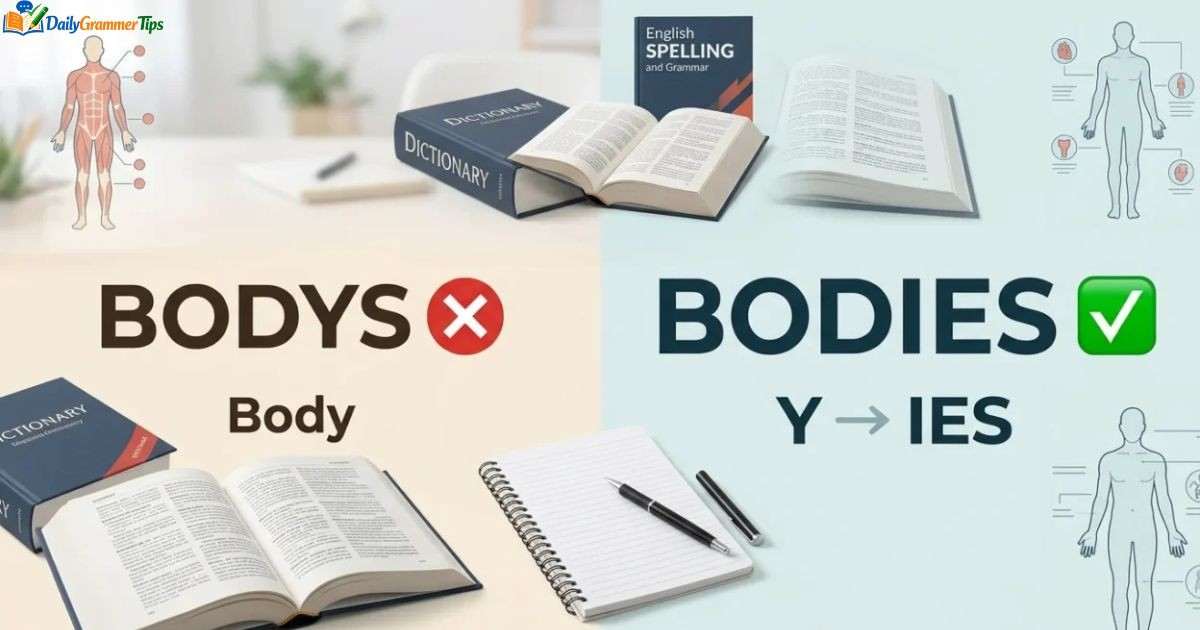
The verdict comes first. The word bodies is the correct plural noun, and bodys is a plain spelling error. This guide explains the rule behind bodies vs bodys, shows real examples, and gives you a simple trick that makes the answer stick.
What Is the Correct Plural of Body?
The correct plural of body is bodies, which ends the bodies vs bodys debate right away. You spell it B, O, D, I, E, S. English has no alternate form, so bodys never counts as an accepted variant in any dictionary or style guide.
This rule covers every meaning of the word. It works for human bodies, car bodies, and bodies of water alike. Learn the pattern behind bodies vs bodys once, and you can apply it to every sentence you write.
Body Plural
Body is a singular noun that ends in a consonant plus y. To build the plural, English changes the y to i and adds es. The result, bodies, is a regular plural, not an irregular one like mice or feet.Singular means one, and plural means more than one. One body stays body, while two or more become bodies. Writers who track that contrast rarely stumble over bodies vs bodys again.
Use this form whenever you count or group bodies. Two bodies, ten bodies, and many bodies all share one spelling. When a writer types bodys, a spellcheck tool usually flags it with a red line. Trust that warning, because it protects you whenever bodies vs bodys comes up.
Why Do People Mix Up Bodies vs Bodys?
Most English plurals simply add an s. Cats, dogs, and books all follow that habit, so your brain reaches for the same shortcut with body. The habit runs so deep that it fires without conscious thought.
The final y changes the outcome, because a consonant sits right before it. Confusion over bodies vs bodys does not signal weak grammar. It signals a strong habit that clashes with a smaller spelling rule.
The Grammar Rule Behind Bodies
The rule behind bodies vs bodys sounds simple. When a noun ends in a consonant plus y, you replace the y with ies to form the plural. That inflection applies to hundreds of common English nouns.Check the word body. The letter before the last y is d, and d is a consonant. So the y turns into ies, which gives you bodies.
Now test the word boy. The letter before y is o, which is a vowel. Nouns with a vowel plus y just add s, so boy becomes boys and never boies.
That one check, consonant or vowel, settles most cases. It answers bodies vs bodys in a single glance, because bodys skips the required change.
Bodies or Body’s Grammar
Grammar gives these two forms different jobs. Bodies works as a plural noun that counts bodies. Body’s works as a possessive noun, and sometimes a contraction, that shows ownership. The apostrophe marks the split.
A possessive shows what a body owns, as in the body’s natural defenses. A plural shows quantity, as in athletes train their bodies. Never insert an apostrophe just to make a plural.
Plural possessives add one more layer. When several bodies own something, you place the apostrophe after the s, as in the bodies’ organs. That rule sits apart from bodies vs bodys, which is purely a spelling question.
Grammar checkers also catch this slip quickly. A tool flags body’s whenever a plural fits the sentence better. Still, human proofreading matters, because software misses context. Learn the logic once, and you will settle bodies vs bodys without any software.
Plural Spelling Table at a Glance
| Singular Word | Letter Before Y | Correct Plural | Wrong Spelling |
| Body | d (consonant) | Bodies | Bodys |
| Family | l (consonant) | Families | Familys |
| Hobby | b (consonant) | Hobbies | Hobbys |
| Lady | d (consonant) | Ladies | Ladys |
| Day | a (vowel) | Days | Daies |
| Monkey | e (vowel) | Monkeys | Monkies |
Read the table from left to right and the logic shows itself. A consonant before y calls for ies. A vowel before y calls for a plain s. This single grid settles bodies vs bodys and dozens of similar plural spellings.
Is Bodys Ever Correct in Any Situation?
No. The spelling bodys stays wrong in formal essays, casual texts, emails, and business reports. British and American English follow the same rule, so no regional spelling excuses it.
You may spot bodys in a brand name, a username, or a product title. Those are branding choices, not grammar. They reveal nothing about how bodies vs bodys works in real writing.
Is Body’s a Word
Yes, body’s is a real form, but it never works as a plural. It is the possessive of body, and it shows that one body owns something. The body’s temperature rises during a fever, for example.
Speakers also shorten body is or body has into body’s, as in the body’s had enough. That contraction shows up in speech and casual writing. It still points to one body only.
Dictionaries list body as the headword, and its plural bodies appears right beside it. You will never see bodys among its variants. That gap explains why bodies vs bodys has a clear winner, while body’s still earns a place in your writing.
Where Does This Spelling Rule Come From?

The spelling behind bodies vs bodys has deep roots. Old English used the word bodig for the trunk or frame of a person. Over the centuries, the meaning widened to cover the whole physical form, and the spelling kept changing with it.
By the time printing spread, writers spelled the plural as bodies. Older printed Bibles already show that form, so the plural has stayed steady for centuries. Spelling reformers never had a reason to touch it.
The rule also survived because it sounds smoother. Say bodys aloud a few times, and it feels clunky next to bodies. That natural flow keeps bodies vs bodys a settled matter in modern English.
Where Do Writers Use Bodies in Everyday English?
The word bodies appears in science, news, law, and daily speech. These examples show how the plural wins the bodies vs bodys contest in real sentences.
- Engineers test new car bodies in wind tunnels.
- Hikers filled their bottles at two separate bodies of water.
- Regulatory bodies review every new drug before sale.
- Trainers know that no two bodies recover at the same speed.
- Astronomers map celestial bodies such as moons and comets.
The word stretches across anatomy, machinery, geography, organizations, and astronomy. Each time, the plural stays bodies. That flexibility explains why the bodies vs bodys check matters in so many kinds of writing.
Bodies or Body’s in a Sentence
Place bodies where the sentence needs more than one body. It usually acts as a subject or an object. For instance, dancers train their bodies every day.
Place body’s right before the noun that one body owns. It works like a possessive adjective. For instance, the body’s rhythm shifts with sleep. If a noun follows and one body owns it, choose body’s.
A quick sentence test also protects you from bodies vs bodys slips. Read the sentence aloud, count the bodies, and check for an owned noun. Those two questions solve nearly every case.
Try one more check for the apostrophe. Replace body’s with body is or body has. If the sentence still makes sense, you have a contraction. If it breaks, you have a possessive. This habit keeps bodies vs bodys errors out of your drafts.
Bodies or Body’s Examples
These pairs show each form in action. Study the reason column, because it explains the choice every time. Each row follows the same logic you met in the grammar section.
| Sentence | Correct Form | Reason |
| The athletes stretched their bodies before the race. | Bodie s | More than one body |
| The body’s response to cold varies from person to person. | Body’s | One body owns the response |
| Several bodies of water feed this valley. | Bodies | More than one body of water |
| The body’s clock guides sleep and hunger. | Body’s | One body owns the clock |
Notice that the apostrophe never appears when the sentence counts bodies. Also notice that bodys appears nowhere in a correct sentence.
Copy these patterns into your own notes. Write one sentence for each form, then read them back a week later. That short drill locks in bodies vs bodys, and it sharpens your ear for every other plural.
Their Body or Bodies
Plural owners take the plural noun. If several dancers each own a body, you write their bodies. For example, the players cooled their bodies after the match.
Singular they changes the picture. When one person uses they as a pronoun, you write their body. For example, the patient asked whether their body could handle the drug.
Some writers use a distributive singular, as in everyone should listen to their body. Many editors still prefer their bodies when the subject is plural. Match the noun to the number of owners, and you will avoid slips in bodies vs bodys too.
Formal writing rewards clarity over cleverness. When a pronoun feels shaky, rewrite the sentence with a clear plural subject. For instance, the runners rested their bodies reads cleaner than a sentence that stacks pronouns. Clear phrasing also gives spelling slips fewer places to hide.
Read more:GPT-4o: Features, Pricing, API, Access and Retirement Status
Common Mistakes People Make With This Word
Beyond the classic bodies vs bodys typo, several related slips appear all the time. Spot them once, and you can catch them for good.
- Using body’s for a plural. The apostrophe form shows ownership by one body, as in the body’s temperature.
- Typing bodys on a phone, where autocorrect sometimes lets the error pass.
- Copying the same habit onto other words, such as ladys for ladies or familys for families.
- Believing that British and American English split on this spelling. Both follow one identical rule.
After you notice these patterns, your eye starts flagging the final y automatically. Careful proofreading turns the bodies vs bodys check into a reflex.
Bodies, Body’s, and Bodys: How Do They Differ?
This section sorts out bodies vs bodys and body’s side by side, since most confusion lives here.
- Bodies: the plural of body, with no apostrophe.
- Body’s: the possessive of body, with an apostrophe before the s. For example, the body’s reaction to stress varies.
- Bodys: not a word in standard English, so it has no grammatical use.
Remember that apostrophes signal ownership, not plurals. That single idea cures many everyday spelling errors, not just bodies vs bodys.
Body’s Meaning
Body’s means belonging to the body. It attaches ownership to one body, so it always sits before the thing owned. For example, the body’s defenses fight infection. Health writing uses this possessive constantly, as in the body’s immune system.
It also works as a contraction in casual writing, standing in for body is or body has. Context tells you which reading fits. In every case, body’s refers to one body only.
Watch the plural possessive as well. The form bodies’ with the apostrophe after the s means belonging to several bodies. Body’s means belonging to just one. Neither spelling makes room for bodys, so bodies vs bodys stays a one sided contest.
Bodies or Body’s Meaning
Bodies means several bodies, while body’s means something that one body owns. The first counts, and the second attaches. That gap in meaning changes a sentence completely.
Compare two short lines. The bodies rested tells you several bodies took a break. The body’s rest tells you one body needs downtime. Once the meaning is clear, bodies vs bodys becomes a simple spelling check instead of a grammar puzzle.
Think of the apostrophe as a tiny ownership tag. Without it, the word counts. With it, the word owns. This mental picture helps students, editors, and busy professionals alike. It also keeps bodies vs bodys from tangling with possessive rules in your head.
Bodies or Bodys: Which One Should You Use?
Always choose bodies for more than one body. In any bodies vs bodys choice, that advice covers text messages, school essays, business reports, and academic papers. No formal or casual setting accepts bodys.
If you hesitate mid sentence, swap body with lady in your head. Ladies sounds right, so bodies fits too, since both words share one spelling pattern. Try the same swap on any confusing noun that ends in y. This swap test settles bodies vs bodys in about two seconds.
Other Words That Follow the Same Pattern
Learning the rule behind bodies vs bodys unlocks dozens of other nouns. Try these quick conversions.
- Bakery becomes bakeries.
- Library becomes libraries.
- Memory becomes memories.
- Enemy becomes enemies.
- Berry becomes berries.
Each noun ends in a consonant plus y, so each one drops the y and adds ies. One rule covers them all. Write each plural inside a sentence to lock the pattern in. That is a strong return for a few minutes of study, and it makes bodies vs bodys feel like one case among many.
Why Getting This Right Matters
Correct spelling builds trust, especially in academic, medical, and professional writing. A resume or report that gets bodies vs bodys wrong can suggest carelessness, even when the ideas are strong.
Readers and search engines both link clean grammar with credibility. Editors, teachers, and hiring managers notice small errors first. Small details, like choosing bodies over bodys, add up to writing that feels polished from the first line to the last. Mastering bodies vs bodys is a quick win for any writer.
Frequently Asked Questions
What is the difference between bodies and body’s?
Bodies works as the plural of body and means more than one body. Body’s works as the possessive form and shows that one body owns something.
Is “bodies” singular or plural?
The word bodies is plural. It names more than one body, and its singular form is body. That fact settles bodies vs bodys.
Is “our bodies” or “our body’s” correct?
The phrase our bodies is correct when you mean several bodies, such as a group of people. Use our body’s only when a noun follows and one body owns it.
What does body’s mean?
The word body’s is the possessive form of body, so it shows ownership by one body. It can also stand in for body is or body has in casual writing.
Is the word “bodies” a noun?
Yes, the word bodies is a plural noun. It names physical forms, groups, and objects, such as human bodies, governing bodies, and bodies of water.
Conclusion
The word bodies is the only correct plural of body. The reason comes down to one spelling rule: a consonant before y becomes ies. Once you grasp bodies vs bodys, the error fades from your writing.
Next time you type the word, you will not need to think twice. That is how a rule becomes a habit. Practice with two or three sentences today, and the habit sticks. Keep this guide handy, and you will settle any bodies vs bodys doubt in seconds.
