

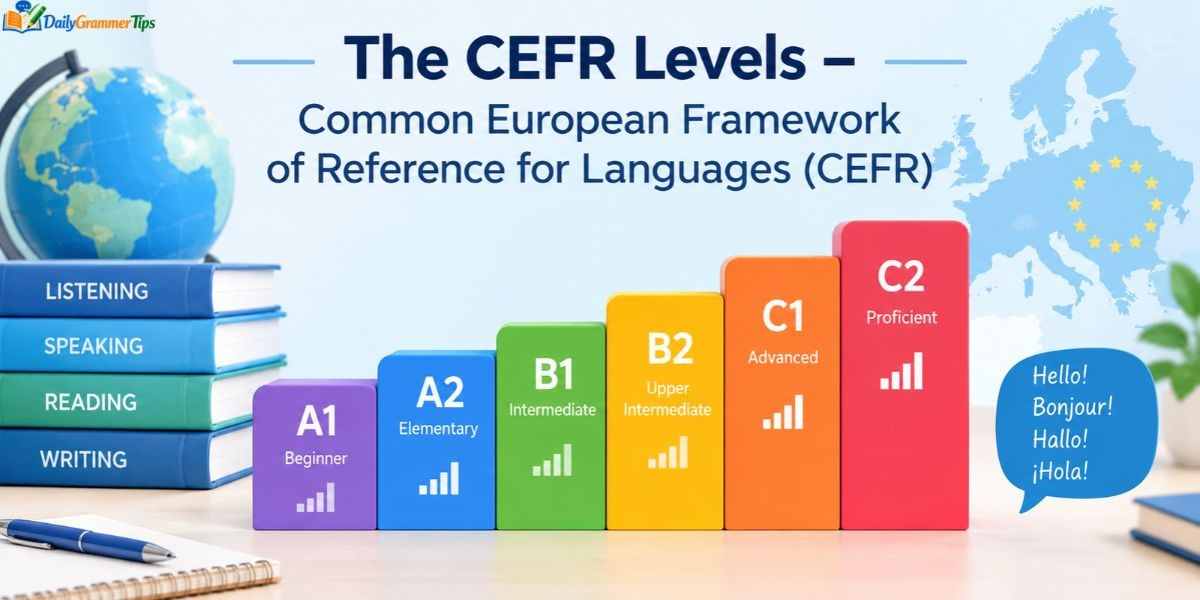
The CEFR levels help people understand their language skills, from beginner to advanced. The Common European Framework of Reference for Languages uses six levels, A1 to C2, to describe what learners can understand, speak, read, and write.
Whether you are learning English, preparing for a language test, studying abroad, or improving your career opportunities, understanding CEFR levels can help you set clear learning goals.
What Is CEFR (Common European Framework of Reference for Languages)?
The Common European Framework of Reference for Languages (CEFR) is an international framework developed by the Council of Europe to describe language proficiency. It helps learners, teachers, schools, and employers understand how well someone can use a language.
CEFR focuses on practical communication. Instead of measuring vocabulary alone, it describes what people can do with a language in real situations.
What Does CEFR Stand For?
CEFR stands for Common European Framework of Reference for Languages. It provides shared descriptions of language ability that can be used across different languages and educational systems.
What Are the Six CEFR Levels?
The six CEFR language levels are A1, A2, B1, B2, C1, and C2. They fall into three main groups: Basic User, Independent User, and Proficient User.
| CEFR level | Category | General ability |
|---|---|---|
| A1 | Basic User | Beginner communication |
| A2 | Basic User | Elementary communication |
| B1 | Independent User | Intermediate communication |
| B2 | Independent User | Upper-intermediate communication |
| C1 | Proficient User | Advanced communication |
| C2 | Proficient User | Highly proficient communication |
CEFR A1 Level – Beginner

A1 is the first CEFR level. At this stage, learners understand familiar words and simple phrases. They can introduce themselves and answer basic questions when others speak slowly and clearly.
For example, an A1 English learner can share their name, ask someone’s name, order a simple drink, and understand basic signs.
What Can You Do at CEFR A1?
- Introduce yourself and share personal information.
- Understand basic greetings and everyday expressions.
- Ask and answer simple questions.
- Read short, familiar words and phrases.
- Write basic sentences and complete simple forms.
How can you improve from A1? Practice common vocabulary, basic grammar, short conversations, and simple listening exercises every day.
CEFR A2 Level – Elementary
A2 is the elementary level of language proficiency. Learners can understand common expressions related to shopping, family, work, daily routines, and familiar surroundings.
An A2 learner can ask for directions, talk about their schedule, make simple purchases, and exchange information about everyday needs.
What Can You Do at CEFR A2?
- Understand frequently used phrases.
- Describe your family, job, and daily activities.
- Handle simple conversations in familiar situations.
- Read short messages and basic notices.
- Write simple notes and personal messages.
To move from A2 to B1, expand your vocabulary, practice longer sentences, and listen to conversations about different everyday topics.
CEFR B1 Level – Intermediate
B1 is the intermediate CEFR level. Learners can understand the main points of clear speech on familiar topics and manage many situations while traveling or interacting with others.
They can describe experiences, explain plans, discuss interests, and give simple reasons for their opinions.
What Can You Do at CEFR B1?
- Understand the main ideas of familiar conversations.
- Describe experiences, events, and future plans.
- Explain opinions with simple reasons.
- Write connected paragraphs about familiar subjects.
- Handle many everyday situations independently.
For example, a B1 learner can explain a past trip, discuss weekend plans, or describe a problem at work. Progressing to B2 requires stronger listening, more detailed writing, and greater confidence in complex conversations.
CEFR B2 Level – Upper Intermediate
B2 is the upper-intermediate level. Learners can communicate with greater fluency and understand the main ideas of complex texts, including discussions about familiar technical subjects.
They can express opinions, explain advantages and disadvantages, and participate in conversations with less effort.
What Can You Do at CEFR B2?
- Understand detailed discussions on familiar topics.
- Communicate with reasonable fluency and spontaneity.
- Explain and support opinions.
- Write clear, detailed essays and reports.
- Participate in many academic and professional conversations.
B2 can be useful for learners preparing for higher education, international communication, or professional opportunities. However, specific universities and employers set their own language requirements.
CEFR C1 Level – Advanced
C1 is the advanced CEFR level. Learners can understand demanding texts, recognize implied meanings, and communicate fluently in academic, social, and professional settings.
They can organize complex ideas, adapt their language to different situations, and write clear, well-structured content about challenging subjects.
What Can You Do at CEFR C1?
- Understand extended speech and complex written material.
- Express ideas fluently with little obvious hesitation.
- Use language flexibly for different purposes.
- Write detailed, well-organized texts.
- Discuss complex subjects with clear reasoning.
A C1 learner may be able to deliver a presentation, explain a detailed argument, or participate confidently in a professional discussion.
CEFR C2 Level – Proficient
C2 is the highest level in the CEFR framework. It describes learners who can understand almost everything they read or hear and express complex ideas with considerable precision.
C2 proficiency includes understanding subtle meanings, recognizing differences in tone, and summarizing information from different sources.
Read also……..TOEFL Writing Section: Syllabus, Questions, Pattern & More
What Can You Do at CEFR C2?
- Understand demanding spoken and written language.
- Summarize information from multiple sources.
- Express complex ideas accurately and naturally.
- Recognize subtle differences in meaning and style.
- Communicate effectively in challenging situations.
Does C2 mean native-speaker ability? Not necessarily. C2 describes a high level of language proficiency, but it does not guarantee the same cultural knowledge, accent, or specialized vocabulary as every native speaker.
CEFR Levels for Speaking, Listening, Reading, and Writing
The CEFR framework describes language ability across different activities and skills. A learner may perform better in reading than speaking, so one overall level may not show every strength or weakness.
| Skill | What CEFR measures |
|---|---|
| Listening | Understanding spoken language |
| Speaking | Expressing ideas and interacting with others |
| Reading | Understanding written information |
| Writing | Communicating through written text |
Can Your CEFR Level Differ by Skill?
Yes. Someone may understand advanced written English but struggle to speak confidently. Another learner may speak comfortably but find academic reading difficult.
Assessing each skill separately helps learners identify weaknesses and choose more effective study methods.
How Can You Find Your CEFR Level?

You can estimate your CEFR language level through self-assessment, an online placement test, or a formal language examination. The best option depends on whether you want to track personal progress or provide official proof of proficiency.
Take an Online CEFR Test
The EF SET is an example of an English assessment associated with CEFR levels. Before taking a test, check which skills it measures, how it reports results, and whether its certificate meets your needs.
A short online quiz may provide a useful estimate, but it may not assess speaking and writing or qualify as an accepted credential.
Use the Official CEFR Self-Assessment Grid
The Council of Europe provides self-assessment descriptors that help learners evaluate their language abilities. These cover listening, reading, spoken interaction, spoken production, and writing.
Compare your actual abilities with the descriptions rather than choosing a level based only on confidence.
CEFR Levels Compared With IELTS, TOEFL, and Cambridge English
CEFR is a language proficiency framework, while IELTS, TOEFL iBT, and Cambridge English qualifications are assessment systems. Their results may be associated with CEFR levels, but their scores are not automatically interchangeable.
CEFR Levels and IELTS Scores
IELTS results are sometimes mapped to CEFR proficiency levels. However, the relationship is approximate, and different institutions may set different score requirements.
Always check the current IELTS guidance and the specific requirements of the organization requesting your results.
CEFR Levels and TOEFL iBT Scores
TOEFL iBT measures English skills for academic contexts. Its scores may be interpreted alongside CEFR levels, but the applicable comparison depends on the test version and official score guidance.
Do not assume that a particular CEFR level automatically meets every university’s TOEFL requirement.
CEFR Levels and Cambridge English Qualifications
Cambridge English qualifications are designed around specific proficiency levels. Examples include A2 Key, B1 Preliminary, B2 First, C1 Advanced, and C2 Proficiency.
The level associated with a qualification describes its intended proficiency range. The result achieved and the receiving institution’s rules still matter.
Why Are CEFR Levels Important in the USA?
Although the CEFR originated in Europe, it can help people in the United States understand language proficiency and compare international learning goals.
It is useful for language learners, teachers, international students, and professionals who need to describe their language abilities clearly.
CEFR Levels for Education and Careers
Students may encounter CEFR descriptions when researching international programs or language courses. Employers may also use proficiency levels to understand a candidate’s communication skills.
However, CEFR is not a universal requirement for US colleges, universities, or employers. Always check the specific requirements of the institution or workplace.
CEFR Levels for Learning Other Languages
CEFR is not limited to English. It can describe proficiency in Spanish, French, German, Italian, and many other languages.
This makes it useful for learners who want a consistent way to set goals and track progress across different languages.
How Long Does It Take to Reach Each CEFR Level?
The time needed to reach a CEFR level depends on your starting point, study habits, practice opportunities, and previous language experience. There is no single timeline that applies to every learner.
Beginners may focus on basic phrases and daily conversations, while advanced learners need more practice with complex texts, precise expression, and subtle meanings. Regular practice across all four skills supports steady progress.
How to Improve Your CEFR Level
The best way to improve your language proficiency is to practice consistently and focus on the skills you need most. Set a clear target level and use CEFR descriptors to measure your progress.
- Practice listening and speaking: Use conversations, podcasts, videos, and language partners.
- Improve reading and writing: Read suitable texts and write messages, summaries, and longer pieces.
- Choose CEFR-aligned materials: Study resources that match your current level.
- Track your progress: Review completed tasks and reassess your abilities regularly.
Avoid focusing only on grammar or vocabulary tests. Real communication requires understanding information, expressing ideas, and responding appropriately.
Common Misunderstandings About CEFR Levels
Several misconceptions can lead learners to misunderstand their language proficiency.
- CEFR is not a single test: It is a framework used to describe language ability.
- C2 does not guarantee native-speaker status: It represents a high level of proficiency.
- One level does not mean equal skills: Speaking, reading, listening, and writing can develop differently.
- Test scores are not always interchangeable: Each provider uses its own assessment system and scoring rules.
- CEFR is not only for European languages: It can be used to describe proficiency across many languages.
Understanding these differences helps learners choose suitable assessments and set realistic goals.
Advantages and Limitations of the CEFR Framework
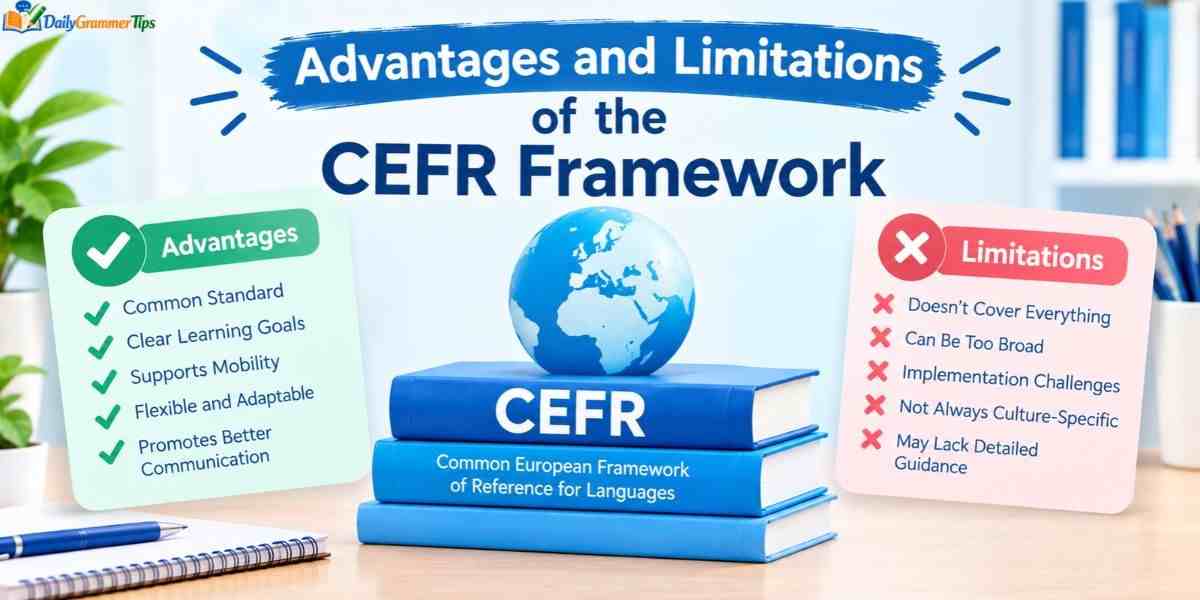
CEFR provides a shared way to describe language ability. It helps learners understand their progress, supports teaching and assessment, and makes some international qualifications easier to compare.
However, the six broad levels cannot capture every difference between learners. Self-assessments may also be inaccurate, and a single level may hide important skill gaps. Formal testing may be necessary when an organization requires verified results.
Frequently Asked Questions
What Does CEFR Stand For?
CEFR stands for Common European Framework of Reference for Languages. It is an international framework that describes language proficiency through six main levels, from A1 to C2.
What Are the Six CEFR Levels?
The six levels are A1, A2, B1, B2, C1, and C2. They progress from beginner communication to highly proficient language use.
Which CEFR Level Is Considered Fluent?
B2 often represents the ability to communicate with reasonable fluency in many situations. C1 and C2 describe more advanced proficiency, but fluency can vary by skill and context.
Is B2 English Considered a Good Level?
Yes. B2 indicates that a learner can understand complex material on familiar subjects, communicate with greater spontaneity, and explain opinions clearly.
Is C1 Better Than B2?
Yes. C1 is a higher CEFR level than B2. It reflects stronger comprehension and more flexible language use in complex academic, social, and professional situations.
Is C2 the Highest CEFR Level?
Yes. C2 is the highest of the six main CEFR levels. It describes highly proficient language use and the ability to understand and express subtle meanings.
How Can I Check My CEFR Level for Free?
You can use a free online English assessment, such as an available EF SET test, or review the Council of Europe’s self-assessment grid. Check what skills each assessment covers before relying on its result.
Is CEFR the Same as IELTS or TOEFL?
No. CEFR is a framework for describing language proficiency. IELTS and TOEFL are tests that measure language ability and report results using their respective scoring systems.
Can I Put My CEFR Level on My Resume?
Yes. You can list your language proficiency on a resume if the level accurately reflects your abilities. Include a recognized test result or qualification when it is relevant to the job.
Is CEFR Used in the United States?
CEFR is used as a reference by some learners, educators, institutions, and organizations in the United States. However, acceptance depends on the specific institution or employer.
Can I Have Different CEFR Levels for Speaking and Writing?
Yes. Language skills do not always develop at the same pace. You may have stronger reading skills than speaking skills, so separate assessments can provide a more complete picture.
How Long Does It Take to Reach C1 English?
The time varies based on your starting level, study hours, practice quality, and language background. Reaching C1 generally requires sustained work on advanced reading, listening, speaking, and writing.
Conclusion
The CEFR levels provide a clear way to understand language proficiency, from A1 beginner to C2 proficient. They help learners identify their abilities, set realistic goals, and track progress in speaking, listening, reading, and writing.
Whether you are learning English in the United States, preparing for a language test, or developing professional skills, knowing your CEFR level can help you choose the right next step.
