


Every organization today runs on data customer records, financial reports, product information, and countless digital interactions. But having data isn’t the same as being able to use it well. That’s where data management comes in.
Data management is the practice of collecting, organizing, storing, protecting, and using data throughout its lifecycle so it remains accurate, accessible, and valuable. Without it, even the most advanced analytics or AI tools have nothing reliable to work with.
This guide breaks down everything you need to know about data management from the basics to tools, careers, and future trends.
What Is Data Management?
At its core, data management is the process of handling data in a structured, secure, and efficient way from the moment it’s created to the moment it’s archived or deleted.
It covers a wide range of activities, including:
- Collecting and storing data
- Organizing and integrating it from multiple sources
- Ensuring its quality and accuracy
- Protecting it from unauthorized access
- Making it available to the right people at the right time
In simple terms, data management turns raw, scattered information into something an organization can actually trust and act on. It’s the foundation that supports reporting, business intelligence, and increasingly, artificial intelligence.
Why Data Management Matters
Poor data management doesn’t just slow teams down it costs money, creates compliance risk, and undermines decision-making. Research suggests that bad data quality can cost organizations up to 30% of their annual revenue through inefficiencies, rework, and missed opportunities.
Here’s why getting data management right matters so much:
- Better decisions: Reliable data leads to more confident, accurate business decisions.
- Operational efficiency: Well-managed data reduces time wasted searching for or fixing information.
- Regulatory compliance: Laws like GDPR and the CCPA require organizations to manage data responsibly.
- AI readiness: Machine learning and AI models are only as good as the data they’re trained on.
As data volumes grow and AI adoption accelerates, data management has shifted from a back-office IT task to a boardroom-level priority.
Data Management vs Data Governance
These two terms are often used interchangeably, but they’re not the same thing.
Data governance sets the rules it defines the policies, standards, and accountability structures for how data should be handled. It answers questions like: Who owns this data? Who can access it? What counts as “quality” data?
Data management is the execution it’s the day-to-day practice of actually collecting, storing, processing, and securing data according to those governance rules.
Think of governance as the rulebook and management as the team that plays by it. Both are essential, and neither works well without the other.
Types of Data Management
Data management isn’t one single activity it’s an umbrella term covering several specialized disciplines, including:
- Data architecture: The blueprint for how data flows and is structured across systems.
- Data integration: Combining data from multiple sources into a unified view.
- Data quality management: Ensuring data is accurate, complete, and consistent.
- Data security: Protecting data from breaches, loss, or unauthorized access.
- Master data management (MDM): Creating a single, trusted version of core business data like customers or products.
- Metadata management: Managing “data about data” so information is easier to find and understand.
Each type addresses a different piece of the puzzle, but together they form a complete data management strategy.
Data Lakes vs Data Warehouses

One of the most common questions in data management is how to actually store all this data. Two popular options are data lakes and data warehouses.
A data lake stores raw, unstructured, and semi-structured data in its original format. It’s flexible and cost-effective, making it popular with data scientists working on complex or exploratory projects.
A data warehouse stores structured, filtered data that’s already been organized for a specific purpose typically business reporting and analytics. It’s more rigid but easier to query quickly.
Many organizations now use a data lakehouse, which combines the flexibility of a lake with the structure and performance of a warehouse giving teams the best of both worlds without maintaining two separate systems.
Key Benefits of Data Management
When done well, data management delivers measurable value across the organization:
- Reduced data silos: Centralized, well-managed data breaks down barriers between departments.
- Improved data quality: Consistent processes catch errors before they cause damage.
- Cost savings: Less duplication and rework means lower operational costs.
- Stronger security and compliance: Clear policies reduce the risk of breaches and fines.
- Scalability: Good data practices let organizations grow without their data becoming unmanageable.
- Faster, smarter decisions: Teams spend less time hunting for data and more time using it.
Learn more………SAP Fieldglass: What It Is, Key Features, and How It Works
Core Elements of a Data Management Strategy
A strong data management strategy typically includes the following building blocks:
- Clear business goals — knowing what you want your data to achieve.
- Data governance policies — defining ownership, access, and standards.
- Data quality processes — regular checks, validation, and cleansing.
- Data security measures — encryption, access control, and backup plans.
- Data cataloging and metadata — making data easy to find and understand.
- The right technology stack — databases, storage systems, and integration tools that fit your needs.
Without these fundamentals in place, even the best software won’t fix a broken data strategy.
Data Management Best Practices
Whether you’re just starting out or refining an existing setup, these best practices consistently deliver results:
- Define clear data ownership for every major data domain.
- Classify data by sensitivity and business value.
- Standardize data definitions across teams to avoid confusion.
- Automate data quality checks instead of relying on manual reviews.
- Set up role-based access control so only the right people see sensitive data.
- Run regular audits to catch compliance gaps and redundancies early.
- Invest in data literacy training so employees understand how to handle data properly.
- Document your data architecture to make onboarding and troubleshooting easier.
Consistency matters more than perfection small, repeatable habits build a reliable data foundation over time.
Common Data Management Challenges
Even well-resourced organizations run into recurring obstacles:
- Growing data volumes: More data from more sources makes it harder to track what exists and where.
- Data silos: Information trapped in disconnected systems limits visibility and collaboration.
- Integration difficulties: Legacy systems and inconsistent formats complicate combining data sources.
- Compliance complexity: Regulations keep evolving, especially for organizations operating across regions.
- Skill gaps: Many teams struggle to find people with both technical and governance expertise.
- Vendor lock-in: Proprietary formats can make it costly or difficult to switch data platforms.
Recognizing these challenges early makes it easier to plan around them rather than react to them.
Data Management and AI

Artificial intelligence has changed what “good” data management looks like. AI and machine learning models need large volumes of accurate, representative, and well-governed data to perform reliably a concept often called “AI-ready data.”
Data management supports AI in several ways:
- Ensuring training data is clean, unbiased, and representative
- Providing lineage and traceability so AI outputs can be audited
- Enabling real-time data access for AI agents and automated systems
- Supporting augmented data management, where AI itself helps automate tasks like data quality checks and metadata tagging
In short, AI doesn’t remove the need for strong data management it raises the stakes for getting it right.
Data Management Architectures (Mesh vs Fabric)
As organizations scale, many are moving beyond traditional centralized systems toward two modern architectural approaches:
Data mesh decentralizes data ownership, treating data as a product managed by the business teams closest to it for example, marketing owns its own campaign data. This improves agility but requires strong shared governance standards.
Data fabric takes a more centralized approach, using metadata and automation to connect data across systems without physically moving it all into one place. It’s especially useful in hybrid or multi-cloud environments.
Neither approach is universally “better” the right choice depends on organizational size, complexity, and how much autonomy individual teams need.
Data Management Tools
Modern data management relies on a mix of specialized tools, including:
- ETL/ELT tools for extracting, transforming, and loading data
- Data catalog tools for making data discoverable and well-documented
- Data quality tools for validation, cleansing, and monitoring
- Data integration platforms for connecting disparate systems
- Data governance tools for enforcing policies and tracking lineage
Choosing the right combination depends on your data volume, technical infrastructure, and specific business needs.
Data Management Software
Beyond individual tools, many organizations invest in full data management software platforms that combine multiple capabilities in one system. Popular categories include:
- Cloud data platforms (e.g., lakehouse-based platforms) that unify storage, processing, and governance
- Enterprise data management suites built for large, complex organizations
- Specialized analytics platforms with built-in data prep and governance features
The right software should reduce manual work, not add another layer of complexity so ease of integration with existing systems is a key factor to evaluate.
Data Management System
A data management system (DMS) refers to the underlying infrastructure — often a database or platform — used to store, retrieve, and manage data. This can range from a traditional relational database management system (RDBMS) to more modern distributed systems built for big data and real-time processing.
Common types of data management systems include:
- Relational database systems (SQL-based)
- NoSQL databases for unstructured or high-volume data
- Cloud-native data platforms with built-in scalability
The right system depends on the type of data you’re handling and how quickly you need to access it.
Data Management Examples
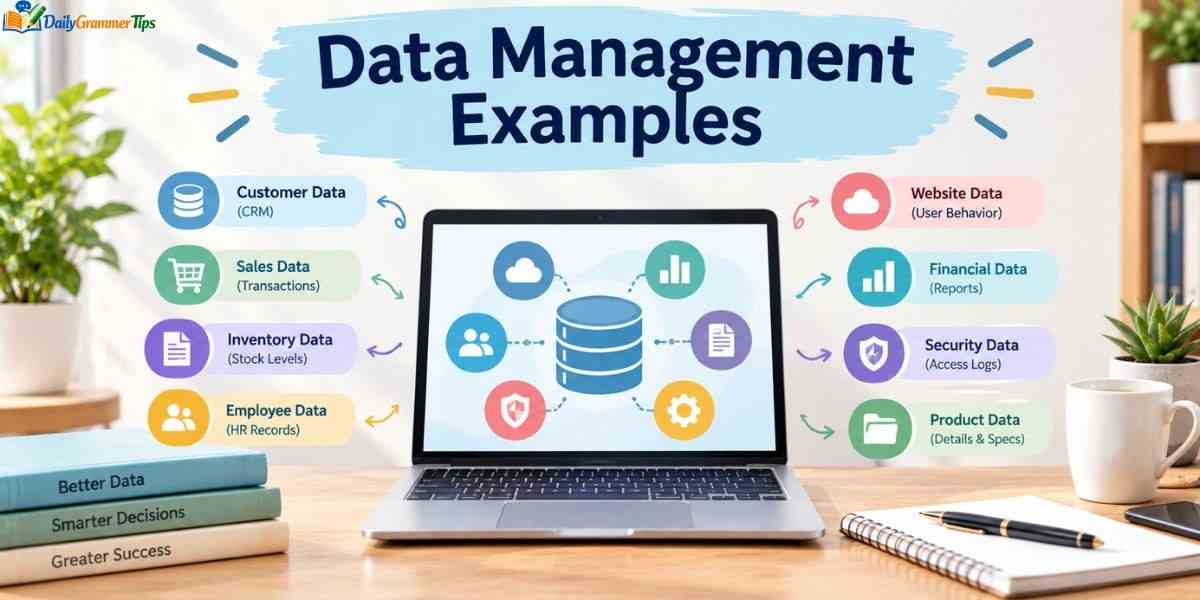
Data management shows up in everyday business activities, even when it isn’t labeled as such. A few common examples:
- A retailer consolidating customer data from online and in-store purchases into one profile
- A bank maintaining accurate, auditable records for regulatory reporting
- A hospital managing patient records securely while meeting privacy regulations
- A marketing team using a data catalog to quickly find and reuse campaign data
- A manufacturer tracking inventory data across multiple warehouses in real time
These examples show that data management isn’t abstract it’s woven into how organizations operate every day.
Data Management Courses & Certifications
For those looking to build a career in this field, several respected courses and certifications can help:
- CDMP (Certified Data Management Professional) — offered by DAMA International, widely recognized as an industry standard
- Cloud platform certifications — offered by major cloud providers, focused on their specific data tools
- University and online courses — covering data governance, database management, and data analytics fundamentals
Certifications like CDMP are particularly valuable for professionals aiming to move into leadership roles such as data governance manager or Chief Data Officer.
Data Management Jobs & Career Paths
Data management supports a wide range of career paths, including:
- Data Analyst — focuses on interpreting and reporting on data
- Data Engineer — builds and maintains data pipelines and infrastructure
- Database Administrator (DBA) — manages databases for performance and security
- Data Governance Manager — oversees policies and compliance
- Data Architect — designs how data flows across an organization
- Chief Data Officer (CDO) — leads data strategy at the executive level
As organizations invest more in AI and analytics, demand for skilled data management professionals continues to grow across nearly every industry.
Data Management Salary Guide
Salaries in data management vary widely based on role, experience, and location, but demand remains strong across the board. Entry-level roles like data analyst typically offer solid starting salaries, while specialized or senior positions such as data architects, governance managers, and Chief Data Officers command significantly higher pay due to the strategic importance of their work.
Factors that influence salary include:
- Years of experience and technical specialization
- Industry (finance and healthcare often pay a premium)
- Location and remote work flexibility
- Certifications like CDMP or cloud-specific credentials
For the most accurate and current figures, it’s worth checking region-specific salary reports, as data management compensation shifts quickly with market demand.
Data Management PDF & Downloadable Resources

Many professionals prefer offline or reference material they can revisit later. If you’re looking to go deeper, useful resource types include:
- DAMA-DMBOK (Data Management Body of Knowledge) — the industry-standard reference guide
- Vendor whitepapers from major data platform providers, often available as free PDF downloads
- University course PDFs covering data management fundamentals
- Industry reports on data quality, governance, and AI readiness
These resources are especially helpful for structured learning or for teams building internal training materials.
Frequently Asked Questions
What is data management in simple terms?
It’s the practice of collecting, organizing, protecting, and using data effectively so it stays accurate and useful throughout its lifecycle.
What are the 5 steps of data management?
Most frameworks describe it as: collecting data, organizing/integrating it, storing it securely, managing its quality and governance, and finally retaining or deleting it based on business needs.
What’s the difference between data management and database management?
Data management is the broader discipline covering governance, quality, and security across an organization. Database management focuses specifically on operating and maintaining databases themselves.
Is data management a good career?
Yes with growing reliance on data and AI, skilled data management professionals are in high demand across almost every industry.
What tools are used in data management?
Common tools include ETL/ELT platforms, data catalogs, data quality software, and integration and governance tools, often combined into larger data management software suites.
Conclusion
Data management is no longer just an IT function, it’s the backbone of how modern organizations operate, make decisions, and prepare for AI-driven growth. From choosing the right storage architecture to enforcing governance and security, every element works together to turn scattered data into a trustworthy business asset.
As data volumes continue to grow and AI adoption accelerates, the importance of clean, well-governed, and accessible data will only increase. Whether you’re just building a data strategy or refining an existing one, focusing on consistent, repeatable practices today will determine how well your organization scales tomorrow.
