


Dought vs Doubt is a comparison that trips up more writers than you’d expect, mixing up a modern everyday word with one that barely survives outside old texts. Doubt refers to uncertainty or a lack of belief in something, while dought is a rarely used archaic term linked to bravery or strength. Understanding the real difference behind Dought vs Doubt clears up a confusion that stems purely from similar spelling, not similar meaning.
Have you ever typed a word, paused, and wondered if you just made a mistake or stumbled onto something real? That’s exactly the moment Dought vs Doubt confusion tends to strike, especially for learners still building their vocabulary. This guide breaks down what each word actually means, why the mix up happens, and how to use the correct one with total confidence.
What does doubt mean?
Doubt is a common word in everyday English, and it describes uncertainty or a lack of confidence in something.
It works as both a noun and a verb:
- Noun: a state of being unsure
- Verb: to question or feel uncertain about something
Examples:
- I have no doubt she will pass the exam.
- He doubts whether the numbers in the report are accurate.
You will also come across related expressions like:
- self doubt
- without a doubt
- cast doubt on something
Doubt is the standard, grammatically correct word you will see in books, conversations, exams, and formal writing everywhere.
Read Also: How to Keep Up With Gaming News TheHakeTech: A Smarter Guide for Gamers
What does dought mean?
Dought is nowhere near as common as doubt, and most modern dictionaries barely list it. It falls into the archaic English category, meaning it belonged to an earlier stage of the language and has mostly disappeared from daily use.
In older or poetic English, dought was occasionally used to describe someone brave, strong, or skilled in combat. Its closer modern relative is the word doughty, which still shows up in literature and history writing to describe courageous or valiant people. If you dig through historical texts, you might spot dought used this way, but you will not find it in casual conversation, emails, or modern articles today.
Example from older usage:
- A dought knight refused to retreat from the battlefield.
Because it has fallen out of everyday language, most people who type dought are not reaching for this archaic word on purpose. They are simply making a spelling mistake while trying to write doubt.
Dought vs doubt: the key differences
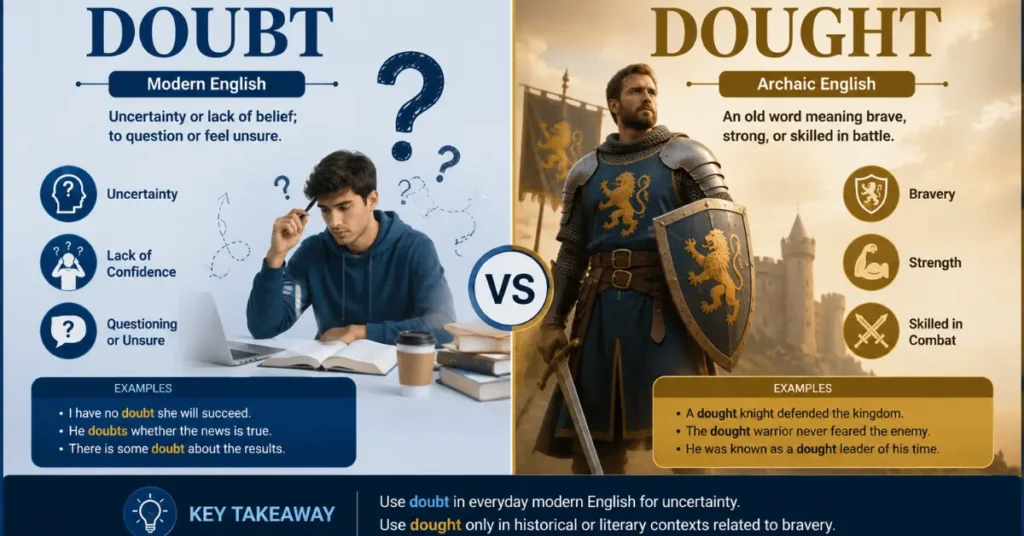
The dought vs doubt mix up happens mainly because the two words look and sound alike, not because their meanings overlap. Once you separate them, the difference becomes obvious.
Here is the simple breakdown:
- Doubt means uncertainty or a lack of belief, and it belongs to modern English.
- Dought is an old term connected to bravery or strength, and it belongs to archaic English.
For everyday writing, whether it is an email, a school essay, or a blog post, doubt is almost always the word you need. Dought only makes sense if you are quoting historical or poetic material on purpose.
So the real takeaway from comparing dought vs doubt is this: one word is alive and active in modern communication, while the other survives mostly in old books and historical references.
Dought vs doubt meaning
The dought vs doubt meaning question usually comes down to one simple fact: doubt is alive in modern English while dought has faded into history books. Doubt describes uncertainty, hesitation, or a lack of belief in something, and you can use it as a noun or a verb depending on the sentence.
Dought, on the other hand, traces back to old English roots connected to the word doughty, meaning brave or capable in battle. Once you separate the two meanings, the confusion clears up fast, since the words share nothing beyond a similar look on the page.
Why people confuse these words
Most writers who type dought never intended to reach for an archaic term. This spelling mix up usually comes from a handful of everyday causes:
- Fast typing that skips letters or rearranges them
- Autocorrect suggesting the wrong word
- Mishearing the word while learning English by ear
- Similar sounding words causing mental mix ups
English learners especially run into trouble here because dough, doubt, and dought all look and sound close to each other despite having nothing in common meaning wise.
Quick reminder:
- Correct spelling for modern writing: doubt
- Not appropriate in modern context: dought
Understanding this distinction clears up most of the confusion people run into with dought vs doubt.
How to use doubt correctly
Seeing doubt used naturally in sentences makes the correct usage stick much faster.
Correct examples:
- There is still some doubt surrounding the final results.
- I doubt he will show up on time.
- She voiced her doubt about the new plan.
A few quick usage tips:
- Reach for doubt whenever you are describing uncertainty
- Combine it naturally with words like have, express, or no
- Skip outdated or archaic alternatives when writing for a modern audience
Following these small habits keeps your writing sounding natural and grammatically sound.
Doubt meaning

At its core, doubt meaning centers on uncertainty. It captures that feeling when you are not fully convinced something is true, accurate, or going to happen the way you expect.
You will hear it in everyday conversation just as often as in formal writing, whether someone says they have doubts about a decision or doubts whether a plan will work. The word carries a slightly cautious tone, signaling hesitation rather than outright disbelief.
Dought vs doubt examples
Seeing dought vs doubt examples side by side makes the difference click faster than any definition alone. Doubt shows up naturally in modern sentences like I doubt the weather will clear up, or she has no doubt about her decision.
Dought rarely appears outside older texts, but when it does, it looks something like a dought soldier held the line until dawn. Comparing the two this way shows just how far apart their real world usage actually sits.
Dought vs doubt synonym
When people search for a dought vs doubt synonym, they are usually looking for words to replace doubt rather than dought, since dought barely has modern synonyms of its own. Common alternatives for doubt include uncertainty, skepticism, hesitation, and suspicion.
For dought, the closest related word is doughty, which means brave, valiant, or courageous. Since dought itself is archaic, writers rarely need a synonym for it in everyday content.
Dought vs doubt pronunciation
Pronunciation plays a big role in why people mix up dought vs doubt in the first place. Doubt is pronounced with a silent b, sounding close to dout, which can trip up learners who expect every letter to be spoken.
Dought, when it does appear in older texts, is generally pronounced closer to dowt or dout as well, which only adds to the confusion between the two. This overlap in sound is one of the biggest reasons the spelling mistake happens so often.
Dought vs doubt reddit
Online communities like Reddit often have threads where users ask whether dought is a real word or simply a typo for doubt. Most responses agree that dought is either extremely rare or effectively obsolete, with doubt being the word people actually mean to type.
These discussions usually circle back to the same conclusion: dought vs doubt is less of a genuine debate and more of a spelling correction moment for most everyday writers.
Doubt in Hindi

For readers exploring doubt in Hindi, the word is most commonly translated as sandeh or shak, both of which capture the sense of uncertainty or suspicion. These translations carry the same emotional weight as the English word, describing a state of not being fully sure about something.
Understanding this Hindi equivalent can help bilingual readers connect the English meaning of doubt to a term they already use naturally in daily conversation.
Dought in a sentence
Since dought is archaic, using dought in a sentence usually only makes sense in historical, poetic, or creative writing. An example might read the dought knight refused to surrender even as his strength faded.
Outside of that kind of stylistic context, dought rarely belongs in a sentence at all, since modern readers will most likely read it as a spelling error rather than an intentional word choice.
Frequently Asked Questions
Is doubt spelling correct?
Yes, “doubt” is the correct modern spelling, complete with its silent b.
What do you mean by dought?
Dought is an archaic word once used to mean brave, strong, or capable in battle, closely tied to “doughty.”
What is the correct spelling of dought?
“Dought” is the accepted archaic spelling, though it is essentially never used in modern writing.
Is it doubt or dout?
It is “doubt,” not “dout.” The silent b is part of the correct modern spelling even though it isn’t pronounced.
What does douting mean?
“Douting” isn’t a standard word; people usually mean “doubting,” the present participle form of doubt, meaning to feel uncertain about something.
Conclusion:
Doubt and dought might look similar on paper, but they belong to completely different worlds. Doubt lives in everyday English, describing the uncertainty or hesitation people feel when they aren’t fully convinced about something, while dought sits quietly in old texts, tied to words like doughty and carrying a meaning of bravery or strength in battle. Most people who type dought aren’t reaching for this forgotten word on purpose. They’re simply making a spelling slip while trying to write doubt, often thanks to fast typing, autocorrect, or the tricky silent b that doubt carries.
Once you understand where each word comes from and how rarely dought shows up outside historical writing, the confusion disappears fast. Doubt remains the word you’ll always reach for in emails, conversations, and everyday writing, while dought stays reserved for poetic or historical contexts where its old world meaning actually fits. Keeping this distinction in mind, along with a few quick memory tricks, makes it easy to write with confidence and avoid this common mix up for good.
