


Emasculate vs. demasculate is a mix-up that trips up even careful writers, since demasculate sounds plausible but no dictionary actually recognizes it. This piece on GrammarPathway.com covers Emasculate vs Demasculate: What’s the Real Difference, showing where emasculate really comes from and why demasculate never became standard English.
Knowing the difference keeps your writing sharp and credible. Once you understand Emasculate vs Demasculate: What’s the Real Difference, choosing the correct word becomes automatic instead of a guessing game.
Emasculate vs Effeminate
People often lump these two words together, but they do different jobs in a sentence. Emasculate is a verb, and it describes an action, something that weakens a person’s authority or, in the literal sense, removes male reproductive function. Effeminate is an adjective, and it describes a man’s manner, voice, or style as more traditionally associated with femininity. One word acts on someone, the other simply describes someone.
Understanding this split matters when you compare Emasculate vs Demasculate too, since demasculate tries to copy the pattern of a real adjective like effeminate but never earned the same dictionary status. A man can behave in an effeminate way without ever being emasculated, and a person can be emasculated by an event without their manner changing at all. Keeping the two ideas separate saves you from an easy mix-up.
ReadaAlso: 60+ Strong Adjectives That Replace ‘Very’ and Sharpen Your Writing
What Emasculate Really Means
Emasculate carries two separate meanings, and both of them show up in everyday writing and speech.
The Literal Meaning
In medical and scientific writing, emasculate refers to:
- Removing male reproductive organs
- Castrating an animal
- Reducing or blocking male hormone production
- Sterilizing the male parts of a plant
You will run into this literal sense in veterinary reports, hormone studies, surgical notes, and breeding programs.
Example: Farmers emasculate certain livestock to manage aggression and control breeding.
The Figurative Meaning
In casual and professional conversation, emasculate usually points to something emotional rather than physical:
- Weakening someone’s authority
- Damaging someone’s confidence
- Taking away a person’s dignity
- Publicly embarrassing someone
- Making a person feel powerless
Example: Getting corrected in front of the whole office emasculated him.
This figurative use connects the word to pride, status, and identity, which explains why it lands so hard when someone hears it directed at them.
Where Does Emasculate Come From?

Emasculate traces back to Latin. The root, emasculare, translates roughly to “to strip of manhood.” Break it into pieces, and you get e, meaning out of, combined with masculus, meaning male. This history is part of why the Emasculate vs Demasculate comparison is not close, since one word has centuries of documented use and the other has none.
English adopted the word in the 1500s. Writers first used it in its literal, biological sense. Over the following centuries, the figurative meaning grew alongside it, as authors reached for the word to describe damaged pride and lost authority. That shift is normal; plenty of English words start out literal and pick up emotional weight over time.
Is Demasculate a Real Word?
No. It never made it into standard dictionaries, and it never will unless usage patterns change dramatically.
People assume demasculate exists because the prefix de often signals removal, the same way it works in devalue, deactivate, and defrost. That logic feels sound on the surface, which is exactly why the mistake spreads so easily. But English vocabulary does not grow from logic alone. A word becomes real once enough credible sources actually use it, and demasculate has never cleared that bar.
Why Demasculate Never Became Standard English
- No dictionary includes an entry for it
- Academic papers do not use it
- Scientific fields rely on emasculate instead
- Style guides never approved it
Outside of casual chats, texts, and unedited social posts, you will not find demasculate anywhere near formal writing. That gap alone settles most arguments about Emasculate vs Demasculate before they even start.
The Scientific Side of Emasculate
Writers often forget that emasculate started as a clinical, scientific term, and it still functions that way in several fields. No version of demasculating or demasculated ever appears in this kind of writing, which is another reason the Emasculate vs Demasculate question tilts so heavily in one direction.
Medicine and Veterinary Science
Doctors and vets use emasculate in its most literal sense, referring to:
- Surgical removal of the testicles
- Suppressing hormone levels
- Sterilization procedures
You will see this usage in livestock management, wildlife population studies, cancer treatment protocols, and hormone therapy documentation.
Fact: Castration can lower testosterone by roughly 95 percent within a matter of weeks, which is why the procedure shows up so often in veterinary and medical literature.
Plant Science
Botanists rely on the same word for a very different purpose. In this field, to emasculate a flower means removing its male parts to prevent self-pollination and control which plants breed with which.
Plant scientists lean on this technique to develop hybrid varieties, boost crop yield, and protect genetic purity in seed production.
Example: Researchers emasculate corn flowers to manage pollination during hybrid breeding trials.
Emasculate in Everyday Conversation
Outside of a lab or a clinic, emasculate almost always carries emotional weight. When someone says a person got emasculated, they typically mean he lost face, his confidence took a hit, or his authority collapsed in front of others.
Example: Constant teasing from his coworkers slowly emasculated him.
It is a blunt word, and it lands with more force than gentler alternatives.
Masculinity, Culture, and Why This Word Sparks Debate
Emasculate does not exist in isolation. It reflects deeper cultural assumptions about what masculinity is supposed to look like, and this is where the Emasculate vs Demasculate distinction really starts to carry emotional weight.
Masculinity and Identity
Across many cultures, people tie masculinity to strength, control, and authority. So describing a man as emasculated implies he lost some form of social standing tied to those traits.
Why Critics Push Back
Some writers argue the word reinforces outdated ideas, because it links a person’s worth directly to masculinity. Critics point out three recurring issues:
- It frames vulnerability as a flaw
- It treats emotional pain as a loss of manhood
- It keeps rigid gender stereotypes alive
Where You’ll Hear It
The word turns up constantly in political speeches, office gossip, film dialogue, and sports commentary.
Example: The scandal effectively emasculated the once dominant executive.
Emasculate in Politics and the Workplace
Media outlets reach for this word often because it dramatizes conflict and power struggles better than a plain synonym would, and the Emasculate vs Demasculate divide shows up here too, since only the correct spelling ever makes it into print.
Political Language
Commentators use emasculate to describe defeated candidates, weakened leaders, or gutted legislation.
Example: The new bill emasculated much of the governor’s authority.
Office Dynamics
In professional settings, people use it when someone gets publicly corrected, loses control of a project, or gets undermined in front of colleagues.
Example: The blunt feedback during the meeting emasculated him in front of the whole team.
Emasculate vs Demasculate: Why Demasculate Keeps Popping Up
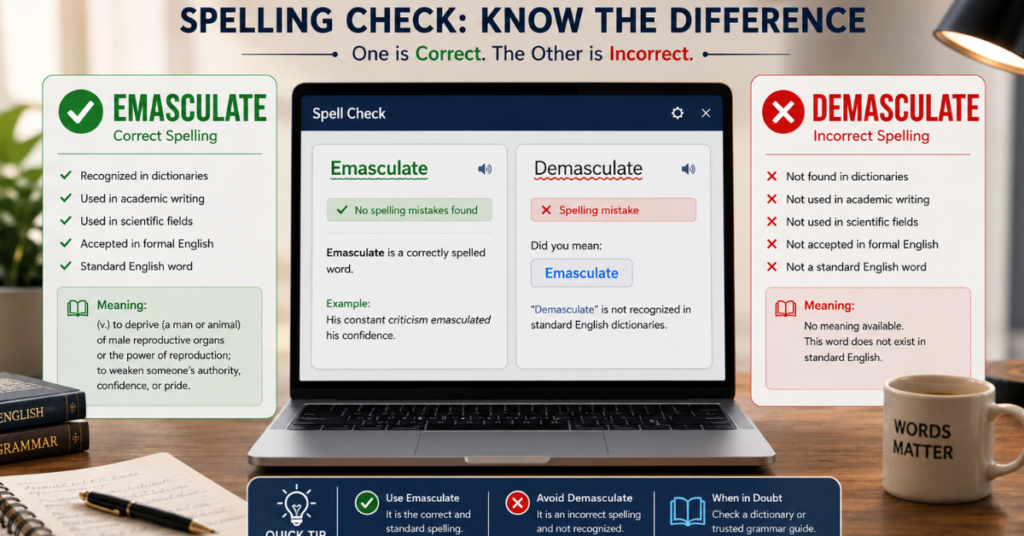
This particular mistake refuses to go away, and there are a few clear reasons why the demasculate spelling keeps resurfacing despite never earning dictionary status.
Flawed but Convincing Logic
The reasoning usually goes like this: masculine relates to masculinity, emasculate removes masculinity, so demasculate must mean roughly the same thing. It sounds tidy. It is still wrong.
Following a Familiar Pattern
English speakers absorb patterns without thinking about them consciously. Words like deactivate, devalue, and defrost train the brain to expect de plus a root to mean removal, so demasculate feels like it should exist even though it does not.
Where the Habit Spreads Fastest
This error shows up most often in casual texting, informal social posts, online forums, and writing by people still learning English as a second language. Once a mistake gains traction in casual spaces, it tends to stick around.
How to Use Emasculate Correctly
This is not a word to toss around lightly. It carries real weight, so use it with intention, and keeping the Emasculate vs Demasculate distinction in mind will save you from an easy, avoidable error.
Good Places to Use It
Emasculate fits naturally in:
- Academic writing
- Political analysis
- Cultural commentary
- Psychology discussions
- Scientific research
Example: Public criticism can emasculate a leader and quietly chip away at their credibility.
Where to Avoid It
Skip the word in:
- Casual jokes
- Sensitive personal conversations
- Workplace conflict resolution
- Therapy sessions
- One-on-one disputes
In these settings, it can come across as harsh, mean-spirited, or even sexist.
Better Words Than Emasculate
Sometimes a gentler term communicates the same idea without the same intensity, and reaching for one of these can matter as much as getting the Emasculate vs Demasculate spelling right in the first place. Consider these alternatives:
- Undermine
- Humiliate
- Weaken
- Diminish
- Disempower
- Belittle
- Discredit
- Strip of authority
Example swap: Instead of “The comment emasculated him,” try “The comment humiliated him.”
Emasculate vs Demasculate: Will Demasculate Ever Become an Accepted Word?
Unlikely. Nothing in current usage trends points toward demasculate gaining real acceptance, and the Emasculate vs Demasculate gap has actually held steady for decades rather than narrowing.
The Reasons It Probably Never Will
- Dictionaries have not added it
- Academic writing does not rely on it
- There is no historical precedent supporting it
- English already has emasculate, which covers the same ground
The language does not need a second word for a job emasculate already handles.
Emasculate vs Demasculate at a Glance
| Feature | Emasculate | Demasculate |
| Recognized word | Yes | No |
| Listed in dictionaries | Yes | No |
| Used in science | Yes | No |
| Used figuratively | Yes | Rarely, and incorrectly |
| Acceptable in formal writing | Yes | No |
| Common spelling mistake | No | Yes |
When you lay Emasculate vs Demasculate out this clearly, the choice stops being a judgment call.
Common Mistakes Writers Make
Mistake One: Writing Demasculate Instead of Emasculate
Fix: Train yourself to default to emasculate every time, since demasculate never appears in edited, professional writing.
Mistake Two: Leaning on the Word Too Often
Fix: Reach for one of the gentler alternatives listed above when the emotional intensity of emasculate feels like too much for the context.
Mistake Three: Mixing Up the Literal and Figurative Senses
Fix: Make sure your surrounding sentence makes it obvious whether you mean the biological process or the emotional one.
A Real World Case of Demasculate in Print
A major news outlet once published a line reading, “The policy demasculated the opposition leader.” The correction came within hours, once editors flagged it as nonstandard English. A single word choice like that can quietly damage a publication’s credibility, which is exactly why understanding Emasculate vs Demasculate matters even for professional writers and editors.
How the Word Evolved Over Time
The meaning of emasculate has expanded steadily, even though the spelling never changed.
- 1500s: Used mainly in literal, medical writing
- 1600s: Figurative use begins appearing in literature
- 1800s: Adopted widely in political and social commentary
- 1900s: Picks up broader psychological meaning
- Today: Central to ongoing conversations about culture and gender
Demasculate Pronunciation
Because demasculate never became a standard dictionary word, it has no official, agreed-upon pronunciation. Most people who say it out loud guess based on how emasculate sounds, landing somewhere close to dee MASS kyoo layt. That guesswork is part of the reason the spelling spread in the first place, since a word that sounds plausible tends to get typed the way it sounds.
Dictionaries only assign standardized pronunciation guides to words they actually recognize, and demasculate has never cleared that hurdle. If you want a pronunciation you can rely on, stick with emasculate, spoken as ih MASS kyoo layt, since that is the version every major dictionary actually documents.
Is Demasculate a Word

No, and this question comes up constantly because the word looks so convincing on the page. Demasculate follows a familiar pattern, the same one you see in devalue or deactivate, so it reads as logical even though no dictionary has ever added it. Real words earn their place through consistent use across publishing, education, and reference works, and demasculate has simply never reached that threshold.
This is really the heart of the Emasculate vs Demasculate debate. Emasculate has centuries of documented use behind it, while demasculate survives only in casual texts, social posts, and spoken guesswork. If you are choosing between the two for anything you plan to publish, emasculate is the only option that holds up.
Emasculate vs Demasculate Meaning
Emasculate carries two meanings, a literal one tied to biology and a figurative one tied to power and confidence. In science, it describes removing male reproductive function in an animal or plant. In everyday speech, it describes stripping someone of authority, dignity, or self-assurance in front of others.
Demasculate, on the other hand, does not carry an official meaning at all, since no dictionary defines it. People who search for a demasculated meaning online usually land on forum guesses or informal blog explanations rather than a verified definition. When you need a word that actually communicates weakening or humiliation with real linguistic backing, emasculate is the one that delivers.
Masculated
Masculated shows up occasionally in casual writing, usually as an attempt to describe something made masculine or given traditionally male traits. Like demasculate, it has not earned a spot in standard dictionaries, and careful writers tend to avoid it in anything formal.
If you need to describe the opposite idea, of a person or thing taking on masculine qualities, safer choices include words like toughened, hardened, or strengthened, depending on context. Masculated might sound intuitive the same way demasculate does, but intuition alone does not make a word standard English.
Demasculinization Meaning
Demasculinization is different from demasculate, and this is where confusion often creeps in. Unlike demasculate, demasculinization actually is a recognized scientific term, used mainly in endocrinology and developmental biology to describe the reduction or loss of male physical characteristics, often tied to hormone levels during development.
So while demasculate never made it into serious writing, demasculinization shows up regularly in medical journals and research papers. The two words look similar on the page, but only one carries real scientific weight, which is worth remembering the next time the Emasculate vs Demasculinate question comes up alongside related medical terminology.
Emasculate Meaning Opposite

The opposite of emasculate depends on which sense of the word you mean. For the figurative sense, tied to confidence and authority, opposite words include empower, embolden, and strengthen. Someone who gets emasculated in a meeting loses standing, while someone who gets empowered gains it.
For the literal, biological sense, the opposite would involve restoring or enhancing male reproductive function rather than removing it, though English does not have one single clean word for that idea. Either way, the opposite of emasculate has nothing to do with spelling debates like demasculate, since that word never described a genuine antonym in the first place.
Opposite of Emasculate Feminine
Some people assume feminine works as the direct opposite of emasculate, but that is not quite accurate. Emasculate, in its figurative sense, is about power and confidence, not gender expression, so its true opposites are words like empower, strengthen, or embolden rather than a gender descriptor.
Feminine describes qualities or presentation, while emasculate describes an action that removes strength or standing. Mixing the two ideas together is part of why so many word pairs in this space get tangled, right alongside the ongoing Emasculate vs Demasculate confusion. Keeping the concepts of gender, action, and standard spelling separate makes all of these related words much easier to use correctly.
Frequently Asked Questions
Is the word demasculate or emasculate?
The correct word is emasculate. Demasculate looks logical, but no dictionary recognizes it, so emasculate is always the safer choice in real writing.
What is the word for losing masculinity?
Emasculation is the word people reach for here, describing the loss of masculine authority, confidence, or, in its literal sense, male reproductive function.
Is there a female version of emasculation?
Not really. English does not have a direct female equivalent, though words like disempower or humiliate cover similar emotional ground regardless of gender.
What does emasculated someone mean?
It means someone got stripped of their authority, confidence, or dignity, often through public criticism, humiliation, or a loss of control in a situation.
How do you use emasculate in a sentence?
Just place it where you would use any verb describing weakened authority or confidence, like “The harsh feedback emasculated him in front of the entire team.”
Conclusion
Emasculate vs. demasculate really comes down to one simple fact: emasculate is a real, dictionary-backed word with centuries of use behind it, while demasculate is a spelling habit that never earned that same status. Once you understand where emasculate comes from and how it functions in both science and everyday speech, the mix-up stops feeling confusing and starts feeling obvious.
Small details like this shape how readers judge your writing, whether it lands in a formal report, a casual email, or a social post. Choosing emasculate over demasculate is a quick, easy fix that pays off every time you write. Keep this guide close, and the next time Emasculate vs Demasculate crosses your mind, you will already know exactly which word belongs on the page.
